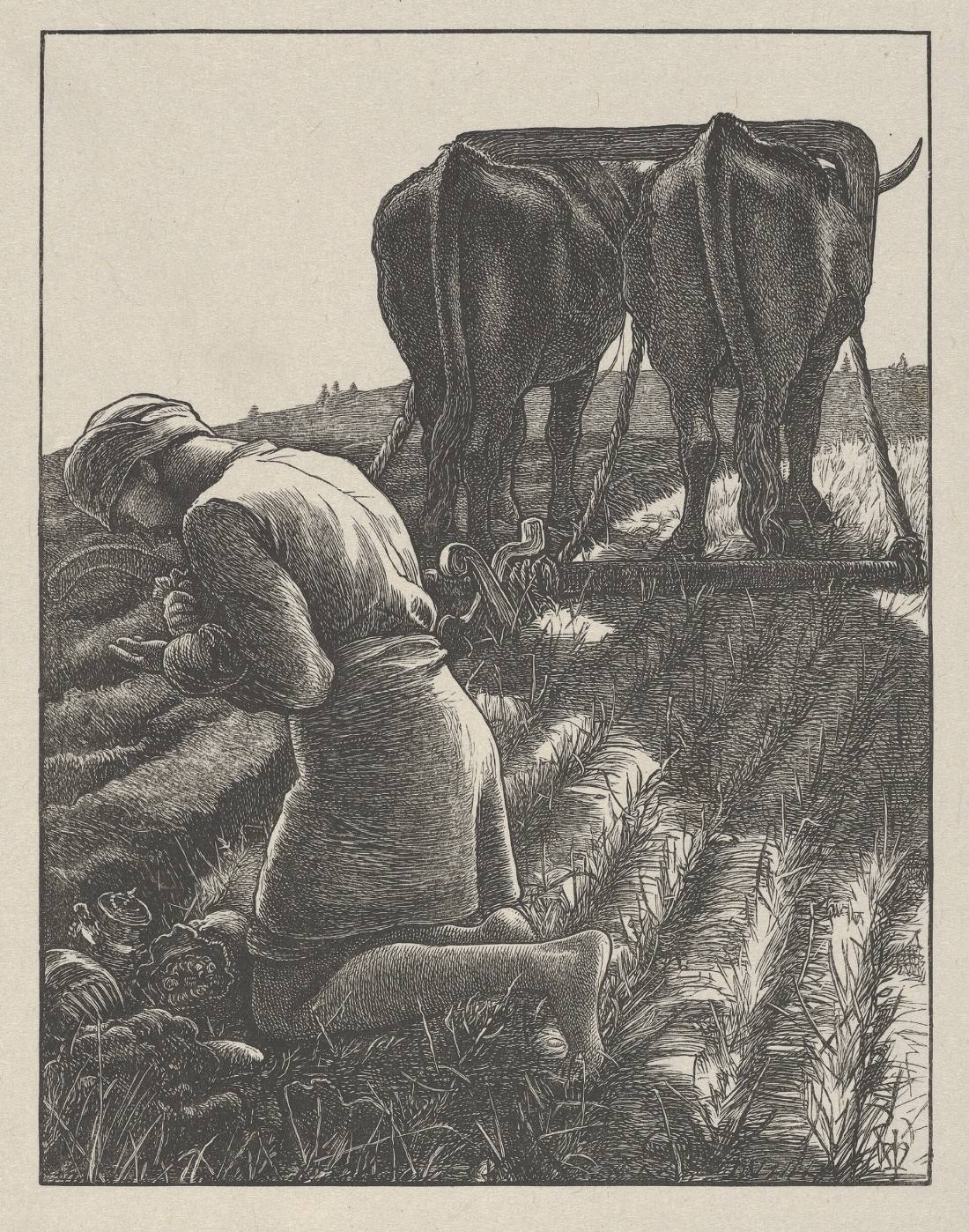
一片田野,遠處是緩緩的山坡。兩頭牛背對著我們站著,身後拖著一張犁,停在那裡。犁旁邊,一個包著頭巾的人跪在一堆翻開的土前,彎著腰,頭幾乎埋進土裡,兩手扒著土。左下角的草裡,有一隻像是帶蓋的罐子,旁邊一堆圓圓的東西,像是錢幣。這塊地,還不是他的。
約翰·埃弗雷特·米萊(John Everett Millais)畫,達爾齊爾兄弟(Dalziel Brothers)刻版,《藏寶》(The Hidden Treasure),1864 年,木刻版畫,出自《我主我救主耶穌基督的比喻》,美國紐約大都會藝術博物館藏。公有領域。 Wikimedia Commons一起讀太 13:44
(36 节)耶穌離開眾人,進了房子,門徒來問稗子的比喻(見稗子一課)。
44天國好像寶貝藏在地裡,人遇見了,就把它藏起來,歡歡喜喜地去變賣一切所有的,買這塊地。
當時現場
誰在場。 講完稗子、芥菜種、麵酵,「耶穌離開眾人,進了房子」(太 13:36)。接下來的藏寶、尋珠、撒網,是在屋裡對門徒講的;講完,他問的也是門徒:「這一切的話你們都明白了嗎」(太 13:51)。
前面兩個比喻,芥菜種和麵酵,講的都是很小的東西。馬亨利說,耶穌到這裡換了一個方向:天國開頭雖然小,卻怕人“因此小看它”,所以這一個和下一個比喻,要顯明天國“本身極有價值”。
Matthew Henry, Commentary on the Whole Bible, Vol. V,太 13:44-52。译自英文原著。
看英文原文
Hitherto he had compared the kingdom of heaven to small things, because its beginning was small; but, lest any should thence take occasion to think meanly of it, in this parable and the next he represents it as of great value in itself
地裡的寶貝。 那時把值錢的東西埋在地裡,並不稀奇。耶穌講的另一個比喻裡,那領一千銀子的僕人,就是「去把你的一千銀子埋藏在地裡」(太 25:25)。
找到了,寶貝歸誰?吉爾說:“照這個比喻看,按猶太人的律法,田裡的寶貝不歸找到的人,而歸田的主人。”所以這人要得著寶貝,先要得著這塊地。
John Gill, Exposition of the Entire Bible,太 13:44。译自英文原著。
看英文原文
It seems by this parable, according to the Jewish laws, that not the finder of a treasure in a field, but the owner of the field, had the propriety in it
講解
看見什麼。 一節經文,五個動作:遇見,藏起來,歡歡喜喜,去變賣一切所有的,買這塊地(44 節)。
請留意次序:喜樂在變賣之前。他不是咬著牙、心疼地去賣;經文說,他是「歡歡喜喜地去變賣一切所有的」。
他是怎麼“遇見”的?經文沒有說他在找。吉爾說,有人是在讀經、聽道、禱告、默想中找到福音的;也有人“偶然”找到,“對自己說是偶然,對神說卻是他的安排”。
John Gill, Exposition of the Entire Bible,太 13:44。译自英文原著。
看英文原文
found, and attained to, by persons accidentally, with respect to themselves, though providentially, with respect to God
如果我在場。 坐在屋裡聽的門徒,有幾位是打魚的,聽到耶穌的呼召,就撇下網和船跟了他。後來彼得對耶穌說:「我們已經撇下所有的跟從你」(太 19:27)。這個比喻,他們聽來不會陌生。
神是怎樣的神。 他把寶貝放在田裡,不是鎖在深宅大院裡。馬亨利說,這寶貝“不是藏在關鎖的園中、封閉的泉源裡,而是在田裡,一片敞開的田裡;誰願意,都可以來,來查考聖經”。
Matthew Henry, Commentary on the Whole Bible, Vol. V,太 13:44-52。译自英文原著。
看英文原文
It is hid, not in a garden enclosed, or a spring shut up, but in a field, an open field; whoever will, let him come, and search the scriptures
可是很多人從這塊田邊走過,什麼也沒看見。馬亨利說,他們“只看田的表面,憑表面判斷”;“最富的礦,常常在看起來最貧瘠的地底下”。箴言說,尋求智慧,要「如搜求隱藏的珍寶」(箴 2:4)。
Matthew Henry, Commentary on the Whole Bible, Vol. V,太 13:44-52。译自英文原著。
看英文原文
they look only upon the surface of the field, and judge by that
the richest mines are often in grounds that appear most barren
和我有什麼關係。 讀到“變賣一切所有的”,有人會問:這是說,救恩要拿我所有的去買嗎?
先知早就說過:「不用銀錢,不用價值」(賽 55:1)。吉爾說,變賣、買地這句話“不照字面講”,說的是人看見了福音的寶貴,就甘心捨下從前看為寶貴的,包括“自己的罪,和自以為義”。克拉克說得更直接:救恩“一定是買來的,而唯一被接受的價錢,是立約的血,就是我們獨一的主、救主耶穌基督的受苦和死”。
John Gill, Exposition of the Entire Bible,太 13:44;Adam Clarke, Commentary on the Bible,太 13:44。译自英文原著。
看英文原文
which is not to be interpreted literally and properly
with their sins, and self-righteousness
it must be bought, and that no price is accepted for it but the blood of the covenant; the sufferings and death of our only Lord and Savior Jesus Christ.
所以,變賣一切不是付的價錢,是看見寶貝以後的樣子。保羅說:「我也將萬事當作有損的,因我以認識我主基督耶穌為至寶」(腓 3:8)。
不同的看見
下面三位都是英國的解經家:馬亨利(1662–1714)、吉爾(1697–1771)、克拉克(約 1760–1832)。各段都譯自英文原著,出處附在後面。
經文自己說的(三家都照這個講): 天國像藏在地裡的寶貝,人遇見了,歡歡喜喜地變賣一切所有的,買下那塊地(44 節)。三家都讀出:天國的寶貴,值得人捨下一切。下面兩處,是讀法不同的地方。
一、寶貝是什麼?田是什麼?
“耶穌基督是那真正的寶貝”;“福音就是藏著這寶貝的田”。
Matthew Henry, Commentary on the Whole Bible, Vol. V,太 13:44-52。译自英文原著。
看英文原文
Jesus Christ is the true Treasure
The gospel is the field in which this treasure is hid
寶貝指的“不是永生”,“也不是基督”,“而是福音”;“這裡的‘田’是指聖經,福音藏在其中”。
John Gill, Exposition of the Entire Bible,太 13:44。译自英文原著。
看英文原文
By which is meant, not eternal life
nor Christ, in whom are hid all the treasures of wisdom and knowledge
but the Gospel
but here "the field" means the Scriptures, in which the Gospel lies hid
寶貝是“福音所預備的救恩”,“是一條富礦,它的礦脈在聖經裡四通八達”;所以要把田翻過來,把救恩的記載仔細地翻查。
Adam Clarke, Commentary on the Bible,太 13:44。译自英文原著。
看英文原文
the salvation provided by the Gospel
it is a rich mine, the veins of which run in all directions in the sacred Scriptures; therefore, the field must be dug up, the records of salvation diligently and carefully turned over, and searched
怎麼看: 這是寓意讀法:給比喻裡的寶貝和田各找一個對應。馬亨利說是基督和福音,吉爾說是福音和聖經,克拉克說是救恩和聖經。三家找的對應不同,指的方向卻相近:寶貝在神的話裡,要去挖。經文自己只說「天國好像寶貝藏在地裡」(44 節);Thayer 的辭典把這一處的“寶貝”就歸在“寶貴的東西”下(見“原文詞眼”)。
二、他把寶貝藏起來,再去買地,這公道嗎?
“藏起來”“不是往壞處講,像那人把一千銀子藏在地裡那樣,而是往好處講”,是說他珍惜它,“把它存在心裡,免得失去”。至於寶貝歸誰,他說按猶太人的律法歸田的主人(見“當時現場”),所以這人要先買地。
John Gill, Exposition of the Entire Bible,太 13:44。译自英文原著。
看英文原文
which is to be understood not in an ill sense, as the man hid his talent in a napkin, and in the earth; but in a good sense, and designs his care of it; his laying it up in his heart, that he might not lose it
他說這寶貝“不是埋在田裡的一罐錢、一箱錢,而是一條金礦或銀礦”,不把田翻過來就採不到,所以才買地。他引魏克菲的話:“為一罐錢買一塊地,說不通;那罐錢他大可以輕輕鬆鬆帶走,這跟用不公道的買賣佔地主的便宜,一樣‘誠實’。”“藏起來”就是“保守秘密,地買下來以前,對誰都沒有說”。
Adam Clarke, Commentary on the Bible,太 13:44。译自英文原著。
看英文原文
means a pot or chest of money hidden in the field, but rather a gold or silver mine, which he who found out could not get at, or work, without turning up the field, and for this purpose he bought it
"There is no sense in the purchase of a field for a pot of money, which he might have carried away with him very readily, and as honestly, too, as by overreaching the owner by an unjust purchase."
he kept secret, told the discovery to no person, till he had bought the field
他不討論買賣的對錯,只讀“藏”這個動作:找到這寶貝的人把它藏起來,“表明一種聖潔的戒慎,怕自己趕不上”(來 4:1)。他還說,買賣還沒有成,這人已經在歡喜了。
Matthew Henry, Commentary on the Whole Bible, Vol. V,太 13:44-52。译自英文原著。
看英文原文
He that has found this treasure, hides it, which denotes a holy jealousy, lest we come short
He rejoices in it, though as yet the bargain be not made
怎麼看: 三家都沒有說這人做錯了:吉爾從律法講,克拉克從礦講,馬亨利從心講。比喻要人看見的,是這寶貝值得人歡歡喜喜地變賣一切;這人買賣的細節,經文沒有停下來評。
原文詞眼
「天國好像寶貝藏在地裡」(44 節)。
“寶貝”原文是 θησαυρός,英文的 thesaurus 就從這個字來。Thayer 的希臘文辭典分兩個意思:一是收藏寶物的地方,像寶庫、倉房,家主「從他庫裡拿出新舊的東西來」(太 13:52),那“庫”就是這個字;二是收藏起來的寶物,像太 6:19-21 的“財寶”。這一處,他歸在“寶貴的東西”下,又舉了兩處同樣的用法:林後 4:7,指福音的光;還有「所積蓄的一切智慧知識,都在他裡面藏著」(西 2:3)。
Thayer's Greek-English Lexicon of the New Testament,G2344。译自英文原著。
看英文原文
the place in which goods and precious things are collected and laid up
the things laid up in a treasury; collected treasures: Matthew 6:19-21
something precious, Matthew 13:44; used thus of the light of the gospel, 2 Corinthians 4:7
就是同一個字,耶穌在山上說過:「因為你的財寶在哪裡,你的心也在那裡」(太 6:21)。這個人的心,從此就在那塊地裡了。
還有一句。「歡歡喜喜」原文是“因著喜樂”。Thayer 把 13:44 的“因著喜樂”和 13:20 的“歡喜”都列在 χαρά(喜樂)這個字下。石頭地上的人也是「當下歡喜領受」(太 13:20),可是「心裡沒有根」(太 13:21);這個人的喜樂,卻叫他變賣了一切。
Thayer's Greek-English Lexicon of the New Testament,G5479。译自英文原著。
看英文原文
ἀπό τῆς χαρᾶς, for joy, Matthew 13:44
μετά χαρᾶς, with joy, Matthew 13:20
請思考
沒有標準答案,不打分。寫下來,只給自己看。
- 你有沒有過“挖到寶”的經歷?找到的時候,第一個反應是什麼?
- 你是怎麼“遇見”福音的?是找了很久,還是好像碰巧撞上的?
- 如果要你說出現在手裡最捨不得放下的一樣東西,會是什麼?
- 再看一次米萊的畫:那人跪在土堆前,地還不是他的。你現在離那塊“地”有多遠?
這週去做
這一週,挑一天,把手機放遠一點,花半小時只讀馬太 13 章,像在田裡挖寶一樣,讀到覺得寶貴的地方就停下來,抄下一句。
週末問自己:這一週,有沒有一樣東西,我為了這“寶貝”歡歡喜喜地放下了?
延伸參考
- Matthew Henry, Commentary on the Whole Bible, Vol. V:太 13:44(英文原著,公有領域,CCEL 可免費讀全文)
- 法蘭士(R. T. France)著,丁道爾新約註釋《馬太福音》,校園書房出版社(ISBN 9789575874988):太 13:44
- 施諾格拉斯《主耶穌的比喻》:藏寶和尋珠一章
本單元其它比喻單元三 · 天國的比喻
- 撒種 太 13:1-23
- 種子自長 可 4:26-29
- 稗子 太 13:24-30、36-43
- 芥菜種 太 13:31-32
- 麵酵 太 13:33
- 藏寶 太 13:44 本課
- 尋珠 太 13:45-46 即將上線
- 撒網 太 13:47-50 即將上線
- 家主 太 13:52 即將上線
- 燈臺 可 4:21-25 即將上線
經文:和合本(1919),用字按本站規則現代化。「不同的看見」裡的註釋都譯自英文原著(公有領域),每段可展開看英文原文。