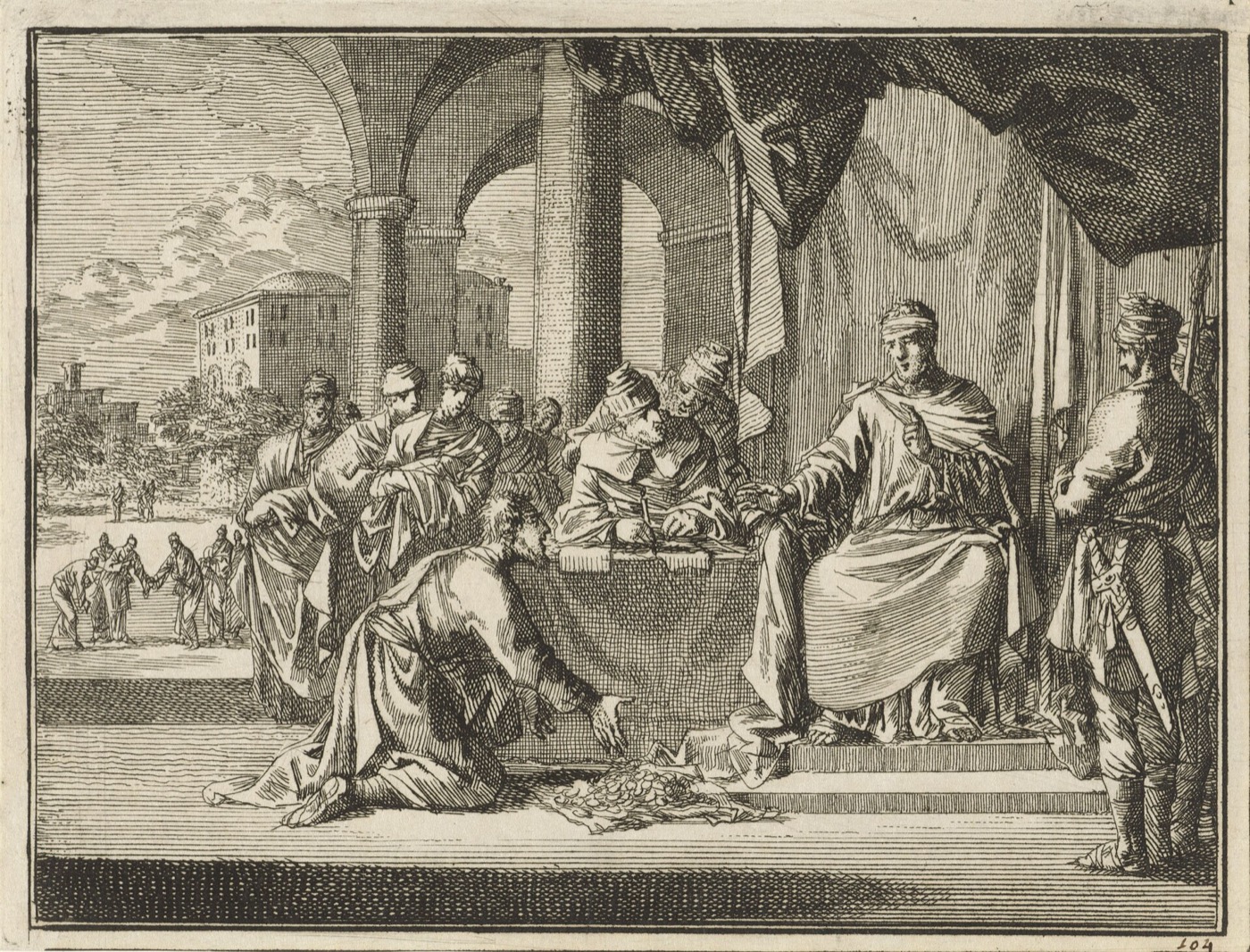
一座有圓柱和拱門的大廳,上面垂著厚厚的帳幔。右邊高起的臺上,一個包著頭巾的人坐著,一隻手向前伸,另一隻手豎起一根指頭。他旁邊的桌子後面,兩個人湊在一起,一個手裡拿著筆。臺下,一個人跪在地上,兩手攤開,面前的一塊布上堆著一堆錢幣。左邊幾個人站著,看著這一幕;最右邊,一個佩刀的人揹著手站在臺邊。拱門外的空地上,遠遠還有幾個小小的人影。你看,跪著的那個人攤開雙手,像是在說什麼?
揚·呂肯(Jan Luyken),《懶惰的僕人的比喻》(Gelijkenis van de luie dienstknecht),1712 年,蝕刻版畫,荷蘭阿姆斯特丹國立博物館藏。公有領域。 Wikimedia Commons一起讀太 25:14-30
(太 24:3–25:13)門徒在橄欖山上問耶穌“什麼時候”,耶穌講了忠心與惡僕、十個童女兩個比喻(見“當時現場”)。
14“天國又好比一個人要往外國去,就叫了僕人來,把他的家業交給他們,
15按著各人的才幹給他們銀子:一個給了五千,一個給了二千,一個給了一千,就往外國去了。
16那領五千的隨即拿去做買賣,另外賺了五千。
17那領二千的也照樣另賺了二千。
18但那領一千的去掘開地,把主人的銀子埋藏了。
19過了許久,那些僕人的主人來了,和他們算帳。
20那領五千銀子的又帶著那另外的五千來,說:‘主啊,你交給我五千銀子,請看,我又賺了五千。’
21主人說:‘好,你這又良善又忠心的僕人!你在不多的事上有忠心,我要把許多事派你管理,可以進來享受你主人的快樂。’
22那領二千的也來說:‘主啊,你交給我二千銀子,請看,我又賺了二千。’
23主人說:‘好,你這又良善又忠心的僕人!你在不多的事上有忠心,我要把許多事派你管理,可以進來享受你主人的快樂。’
24那領一千的也來,說:‘主啊,我知道你是忍心的人,沒有種的地方要收割,沒有散的地方要聚斂,
25我就害怕,去把你的一千銀子埋藏在地裡。請看,你的原銀子在這裡。’
26主人回答說:‘你這又惡又懶的僕人,你既知道我沒有種的地方要收割,沒有散的地方要聚斂,
27就當把我的銀子放給兌換銀錢的人,到我來的時候,可以連本帶利收回。
28奪過他這一千來,給那有一萬的。
29因為凡有的,還要加給他,叫他有餘;沒有的,連他所有的也要奪過來。
30把這無用的僕人丟在外面黑暗裡,在那裡必要哀哭切齒了。’”
當時現場
聽的是誰。 這是耶穌受難前幾天,在橄欖山上。門徒私下來問:「請告訴我們,什麼時候有這些事?你降臨和世界的末了,有什麼預兆呢」(太 24:3)。耶穌回答了很多,又說「所以你們要儆醒,因為不知道你們的主是哪一天來到」(太 24:42),接著講了忠心與惡僕、十個童女,然後是這個比喻。講完以後,「耶穌說完了這一切的話,就對門徒說:你們知道過兩天是逾越節,人子將要被交給人,釘在十字架上」(太 26:1-2)。
和十個童女連著讀。 馬亨利說,十個童女的比喻說的是我們在“等候”,這個比喻說的是我們在“做工、經營”。
Matthew Henry, Commentary on the Whole Bible, Vol. V,太 25:14-30。譯自英文原著。
看英文原文
this implies that we are in a state of work and business, as the former implies that we are in a state of expectancy.
“一千銀子”有多少。 和合本的“五千、二千、一千”,原文是五個、兩個、一個“他連得”。Thayer 說,“他連得”本來指天平的秤盤,後來指一種重量,再後來指重一他連得的銀子;雅典的一他連得合六千個德拉克馬。他又說,新約說的可能是叙利亞的他連得,比這小。
Thayer's Greek-English Lexicon of the New Testament,G5007。譯自英文原著。
看英文原文
the scale of a balance, a balance, a pair of scales
the Attic talent was equal to 60 Attic minae or 6,000 drachmae
But in the N. T. probably the Syrian talent is referred to
德拉克馬是一種希臘銀幣,Thayer 說它和羅馬的得拿利分量差不多;得拿利,和合本譯作“一錢銀子”,葡萄園的工人「一天一錢銀子」(太 20:2)。
Thayer's Greek-English Lexicon of the New Testament,G1406。譯自英文原著。
看英文原文
a silver coin of (nearly) the same weight as the Roman denarius
不論照哪一種算,都不是小數目。不饒恕的惡僕欠主人「一千萬銀子」(太 18:24),原文是一萬他連得。
“才幹”。 15 節「按著各人的才幹」,“才幹”原文是另一個詞,Thayer 解作“本身所有的能力”,正列了這一節。這一課的名字“按才受託”,就是從這裡來的。
Thayer's Greek-English Lexicon of the New Testament,G1411。譯自英文原著。
看英文原文
inherent power, power residing in a thing by virtue of its nature, or which a person or thing exerts and puts forth
ἑκάστῳ κατά τήν ἰδίαν δύναμιν, Matthew 25:15
兌換銀錢的人。 27 節說的兌換銀錢的人,吉爾說,他們得名是因為面前擺著一張桌子,在桌上點錢、付錢。“連本帶利”的“利”,克拉克說原文是“出產”,就是錢生出來的。
John Gill, Exposition of the Entire Bible,太 25:27;Adam Clarke, Commentary on the Bible,太 25:27。譯自英文原著。
看英文原文
who were so called from the table that stood before them, on which they told, and paid their money
Συν τοκω, with its produce - not usury
路加的彌拿。 路加福音也記了一個相似的比喻,是耶穌「將近耶路撒冷」(路 19:11)時講的,錢數、人數都不一樣。那是下一課。
講解
看見什麼。 主人要出遠門,把家業交給三個僕人,“按著各人的才幹”,有多有少。兩個僕人“隨即”(16 節)拿去做買賣,都翻了一倍;第三個把銀子埋在地裡。主人「過了許久」(19 節)才回來。克拉克說,主人去了很久,那兩個僕人卻沒有鬆懈。
Adam Clarke, Commentary on the Bible,太 25:15。譯自英文原著。
看英文原文
The master was long before he returned, but they did not relax.
最值得慢慢讀的,是 21 節和 23 節。領五千的賺了五千,領二千的賺了二千,賺的數目差了一倍多,主人對兩人說的話卻一字不差:「好,你這又良善又忠心的僕人!你在不多的事上有忠心,我要把許多事派你管理」(23 節)。馬亨利說,那領二千的交賬,和領五千的一樣歡喜;因為到交賬的日子,我們得的安慰,“是照我們的忠心,不是照我們的用處;是照我們的真誠,不是照我們的成績”。
Matthew Henry, Commentary on the Whole Bible, Vol. V,太 25:14-30。譯自英文原著。
看英文原文
for our comfort, in the day of account, will be according to our faithfulness, not according to our usefulness; our sincerity, not our success
如果我在場。 如果我是領一千的那一個,我大概會覺得:我領得最少,做不了什麼。馬亨利說,每個僕人至少有一個他連得,“對一個窮僕人來說,作本錢已經不少了”。
Matthew Henry, Commentary on the Whole Bible, Vol. V,太 25:14-30。譯自英文原著。
看英文原文
Every one had some one talent at least, and that is not a despicable stock for a poor servant to begin with.
他還說,有人拿“機會不如別人”作懶惰的藉口;其實只有一個他連得要照管,卻連這一個也荒廢了,懶惰就更重了。
Matthew Henry, Commentary on the Whole Bible, Vol. V,太 25:14-30。譯自英文原著。
看英文原文
it is really an aggravation of their sloth, that when they have but one talent to take care about, they neglect that one.
如果我是領五千的那一個呢?克拉克兩邊都提醒:領得少的,不要嫉妒領得多的,因為領得多的,工也多,要交的賬也多;領得多的,也不要輕看領得少的。
Adam Clarke, Commentary on the Bible,太 25:15。譯自英文原著。
看英文原文
He who has little should not envy him who has received much, for he has the greater labor, and the greater account to give. He who has much should not despise him who has little
神是怎樣的神。 比喻一開頭,銀子就是主人的。克拉克說,那些僕人本來什麼都沒有,也不配得什麼,主人卻出於恩待,把他的家業交給他們。
Adam Clarke, Commentary on the Bible,太 25:15。譯自英文原著。
看英文原文
The servants had nothing - deserved nothing - had no claim on their master, yet he, in his Kindness, delivers unto them his goods
第三個僕人卻說:「我知道你是忍心的人」(24 節)。馬亨利說,問題就出在這裡:把神想好了,會生出愛,愛叫人殷勤、忠心;把神想刻薄了,會生出怕,怕叫人懶惰、不忠心。
Matthew Henry, Commentary on the Whole Bible, Vol. V,太 25:14-30。譯自英文原著。
看英文原文
Good thought of God would beget love, and that love would make us diligent and faithful; but hard thoughts of God beget fear, and that fear makes us slothful and unfaithful.
他又說,神哪裡是刻薄的主人?“沒有種的地方要收割”,正好說反了:神在許多收不到什麼的地方,撒下了許多。他「叫日頭照好人,也照歹人;降雨給義人,也給不義的人」(太 5:45)。
Matthew Henry, Commentary on the Whole Bible, Vol. V,太 25:14-30。譯自英文原著。
看英文原文
he is so far from being a hard master, that the earth is full of his goodness, so far from reaping where he sowed not, that he sows a great deal where he reaps nothing
主人給的賞賜,也大得不成比例:「不多的事」換來“許多事”,還請僕人「進來享受你主人的快樂」(21 節)。馬亨利說,我們從神領受的託付、為神做的工,比起擺在前面的喜樂,“是很少很少的”。
Matthew Henry, Commentary on the Whole Bible, Vol. V,太 25:14-30。譯自英文原著。
看英文原文
What charge we receive from God, what work we do for God in this world, is but little, very little, compared with the joy set before us.
和我有什麼關係。 第三個僕人沒有偷,沒有賭,也沒有亂花。馬亨利說,他沒有挪用、沒有浪費,“他只是把它埋了”。
Matthew Henry, Commentary on the Whole Bible, Vol. V,太 25:14-30。譯自英文原著。
看英文原文
he did not misspend or misemploy it, did not embezzle it or squander it away, but he hid it.
他交賬的時候還覺得理直氣壯:「請看,你的原銀子在這裡」(25 節)。馬亨利說:不作惡還不夠,還要行善。
Matthew Henry, Commentary on the Whole Bible, Vol. V,太 25:14-30。譯自英文原著。
看英文原文
it is not enough not to do hurt, but we must do good
30 節主人叫他「無用的僕人」。單元五讀過另一句話:「你們作完了一切所吩咐的,只當說:我們是無用的僕人」(路 17:10)。兩處原文是同一個詞。忠心的僕人做完了還說自己“無用”;這一個什麼都沒做,卻覺得自己沒有錯。
不同的看見
下面三位都是英國的解經家:馬亨利(1662–1714)、吉爾(1697–1771)、克拉克(約 1760–1832)。各段都譯自英文原著,出處附在後面。
經文自己說的(三家都照這個講): 銀子是主人的,僕人只是受託;主人回來要算賬;忠心的得稱讚,又惡又懶的受責罰,責罰他的不是他賺得少,是他把銀子埋了。下面三處,是讀法不同的地方。
一、主人、僕人、銀子,各指誰?
這一處有一部分是寓意讀法:把比喻裡的人和東西各對應一樣。比喻本身只說:主人把家業交給僕人,回來和他們算賬。
這個人“指的是基督”,往外國去,指的是昇天。“他的僕人”不是指所有的人,“而是指傳道人”;銀子“不是指救恩的恩典”,而是使人能傳福音的“傳道的恩賜”。
John Gill, Exposition of the Entire Bible,太 25:14、15。譯自英文原著。
看英文原文
for by the man here, is meant Christ
into a far country; by which heaven is designed
but ministers of the word are here meant
By these talents, special grace is not meant
but ministerial gifts, such as fit and qualify men to be preachers of the Gospel
主人是基督,僕人是基督徒,“很可能特別指傳道人”。銀子範圍很寬:神在人的心智、身體、產業、關係、影響上給了不同的能力,屬靈的恩賜也照著分配。人人至少有一個他連得,“就是我們自己的靈魂”。
Matthew Henry, Commentary on the Whole Bible, Vol. V,太 25:14-30。譯自英文原著。
看英文原文
The servants are Christians, his own servants, so they are called
It is probable that ministers are specially intended here
When Divine Providence has made a difference in men's ability, as to mind, body, estate, relation, and interest, divine grace dispenses spiritual gifts accordingly
A soul of our own is the one talent we are every one of us entrusted with
他不只講傳道人。他說,神賜的恩典和今生的憐憫,都配合各人善用它的能力;人所有的好處,和善用這好處的能力,都是從神領受的。
Adam Clarke, Commentary on the Bible,太 25:15。譯自英文原著。
看英文原文
God's graces and temporal mercies are suited to the power which a man has of improving them.
The good that any man has he has received from God, as also the ability to improve that good.
怎麼看: 銀子指傳道的恩賜,還是指人所有的一切,三家讀法寬窄不同;三家都同意,那是主人的,不是僕人的。保羅也這樣問:「你有什麼不是領受的呢」(林前 4:7)。
二、26 節主人是不是承認自己“忍心”?
主人“不是承認”自己是這樣的人,而是假定他真像僕人說的那樣,“拿這話反過來駁他”:既然這樣,你就更該殷勤。
John Gill, Exposition of the Entire Bible,太 25:26。譯自英文原著。
看英文原文
not granting that he was such an one
he turns the argument upon him
他說這話“可以有三種讀法”。一是:就算我真是那樣嚴厲的主人,你不是更該小心討我喜歡嗎,不為愛,也為怕;二是:你不敢自己做買賣,至少可以交給兌換銀錢的人;三是:就算我在別處收割沒有種的,在你身上我是種過的,那銀子本是我交給你的。
Matthew Henry, Commentary on the Whole Bible, Vol. V,太 25:14-30。譯自英文原著。
看英文原文
Three ways this may be taken
Suppose I had been so hard a master, shouldest not thou therefore have been the more diligent and careful to please me, if not for love, yet for fear
Suppose I did reap where I sowed not, yet that is nothing to thee, for I had sowed upon thee
“忍心”這個詞,也有“貪心”的意思。這個不忠心的僕人的藉口,“自己駁倒了自己,定了自己的罪”。
Adam Clarke, Commentary on the Bible,太 25:15。譯自英文原著。
看英文原文
Lord, I knew thee that thou art a hard (or avaricious) man
The wicked excuse of this faithless servant confuted itself and condemned him.
怎麼看: 三家都說,主人並沒有認這個罪名;僕人怎樣看主人,主人就照他自己的話問他。前面兩個僕人交賬,一句也沒有提主人嚴厲不嚴厲。
三、29、30 節“奪過來”“丟在外面”,說的是什麼人?
28 節奪過那一千,正表明銀子“不是救恩的恩典”;所以,從這個比喻“推不出”真恩典一旦賜下、種下,還會被奪去或失落。
John Gill, Exposition of the Entire Bible,太 25:23、28。譯自英文原著。
看英文原文
This shows it was not special grace, which is intended by the talent
nor is it to be inferred from hence, that true grace once given, or implanted, may be taken away or lost
他讀 28 節說:從那冷淡、“沒有基督的基督徒”身上,把聖靈的感動奪去。他又說,善用所領恩典的人,不論領得多麼少,都一樣確定進神的國,和領得最多、全都善用的人一樣。
Adam Clarke, Commentary on the Bible,太 25:15。譯自英文原著。
看英文原文
take away the inspirations of the Holy Spirit from that lukewarm, Christless Christian, who only lives to resist them and render them of none effect.
The man who improves the grace he has received, however small, will as surely get to the kingdom of God, as he who has received most from his master, and improved all.
他說,心裡沒有“活的恩典根基”的人,連他所有的普通恩賜也要被奪去,就像愚拙童女的燈,因為沒有油滅了。他又說,到了 30 節,救主不知不覺從比喻“滑到了比喻所指的事上”。
Matthew Henry, Commentary on the Whole Bible, Vol. V,太 25:14-30。譯自英文原著。
看英文原文
From his that hath not a living principle of grace in his soul, shall be taken away the common gifts which he hath, as the lamps of the foolish virgins went out for want of oil
our Saviour slides insensibly out of the parable into the thing intended by it
怎麼看: 三家都把 30 節讀得很重,也都說,忠心的僕人領多領少,得的稱讚一樣。至於被奪去、被丟在外面的,是從來沒有得著真恩典的人,還是得過恩典卻失落了的人,這一問,各教會的理解不盡相同,請向你所在的教會請教。
原文詞眼
「你這又惡又懶的僕人」(26 節)
“懶”,原文是 ὀκνηρός。Thayer 解作“遲緩、懶惰、退縮”。它從一個動詞來,意思是“不情願、遲緩、耽延、猶豫”。
Thayer's Greek-English Lexicon of the New Testament,G3636、G3635。譯自英文原著。
看英文原文
sluggish, slothful, backward: Matthew 25:26
to feel loath, to be slow; to delay, hesitate
所以這個“懶”,不只是躺著不動。第三個僕人其實動過,他「去掘開地」(18 節),挖坑也要力氣。他的懶,是不情願、往後縮:「我就害怕」(25 節)。
那個動詞,路加用在門徒請彼得的話裡:「快到我們那裡去,不要耽延」(徒 9:38)。這個形容詞,保羅用過兩次。一次是勸信徒:「殷勤不可懶惰,要心裡火熱,常常服事主」(羅 12:11)。一次是說自己:「我把這話再寫給你們,於我並不為難」(腓 3:1),“不為難”,就是“不懶於”、不覺得是負擔。
Thayer's Greek-English Lexicon of the New Testament,G3636。譯自英文原著。
看英文原文
οὐκ ὀκνηρόν μοι ἐστι, followed by an infinitive, is not irksome to me, I am not reluctant, Philippians 3:1
主人叫他“又惡又懶”,把兩樣放在一起。馬亨利說:懶惰的僕人,就是惡僕人。
Matthew Henry, Commentary on the Whole Bible, Vol. V,太 25:14-30。譯自英文原著。
看英文原文
Slothful servants are wicked servants
請思考
沒有標準答案,不打分。寫下來,只給自己看。
- 讀到“一個給了五千……一個給了一千”,你覺得自己像領了多少的那一個?為什麼?
- 21 節和 23 節,主人對兩個僕人說的話一字不差。這對你有什麼安慰,或者有什麼挑戰?
- 第三個僕人說「我知道你是忍心的人」(24 節)。你心裡有沒有哪一個時候,也覺得神是嚴厲、難討喜歡的?那種想法,叫你往前走,還是往後縮?
- 你手上有沒有一樣東西,是你“埋”起來了的:一樣本事、一段時間、一個機會?是什麼叫你把它埋起來的?
這週去做
這一週,想一樣你“埋”起來了的東西:一樣手藝、一種語言、一段空閒、一個常想幫卻沒開口幫的人。
選一樣,這週拿出來用一次,用在一個具體的人身上。不必做得大,也不必做得好,只要不再埋著。
延伸參考
- Matthew Henry, Commentary on the Whole Bible, Vol. V:太 25:14-30(英文原著,公有領域,CCEL 可免費讀全文)
- 法蘭士(R. T. France)著,丁道爾新約註釋《馬太福音》,校園書房出版社(ISBN 9789575874988):太 25:14-30
- 施諾格拉斯《主耶穌的比喻》:按才受託一章
本單元其它比喻單元六 · 錢財
- 無知的財主 路 12:16-21
- 不義的管家 路 16:1-13
- 財主與拉撒路 路 16:19-31
- 按才受託 太 25:14-30 本課
- 彌拿 路 19:11-27 即將上線
經文:和合本(1919),用字按本站規則現代化。「不同的看見」裡的註釋都譯自英文原著(公有領域),每段可展開看英文原文。