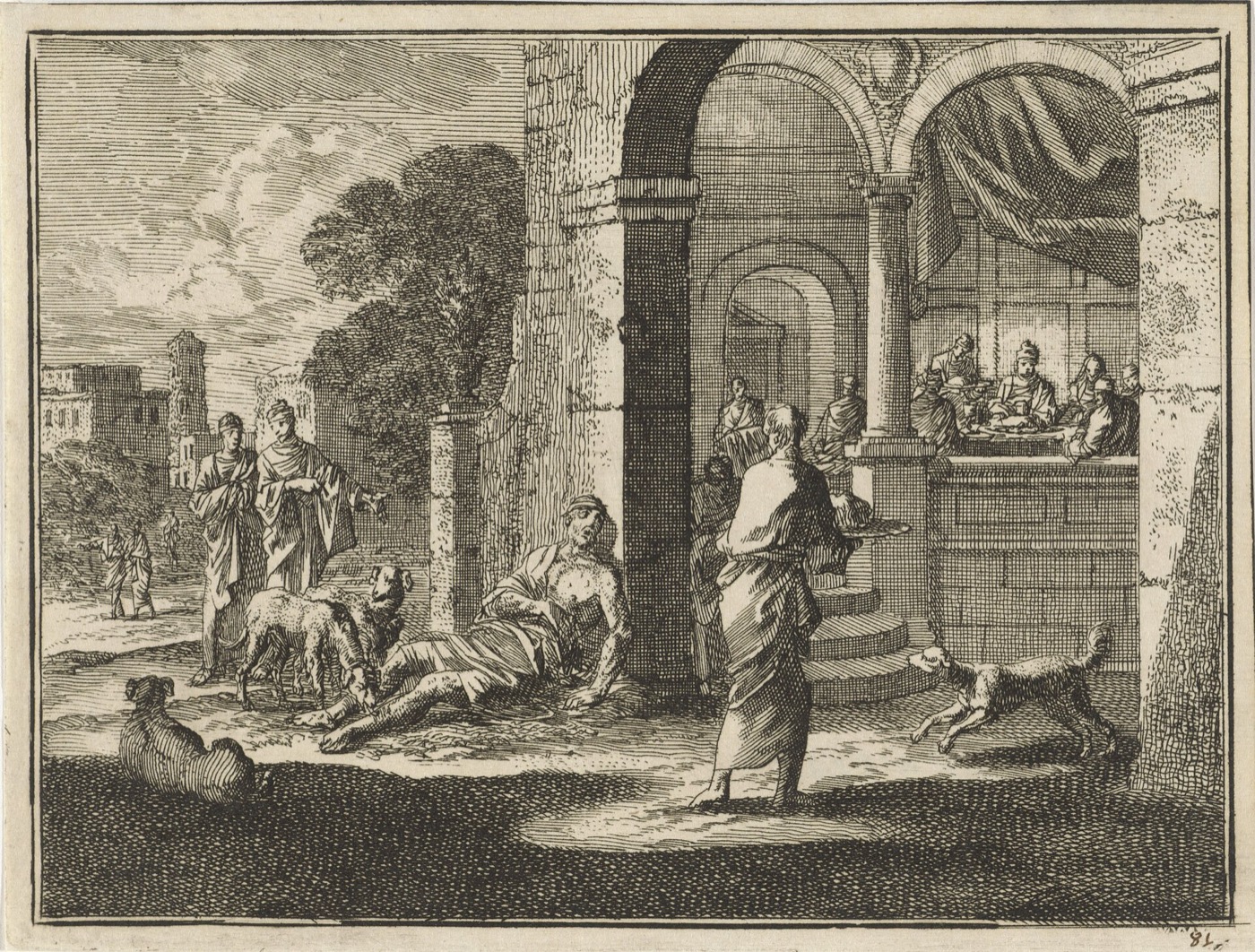
一座有拱門的大房子外面。牆根下,一個瘦弱的人半躺在地上,衣服敞開,閉著眼,幾隻狗圍在他身邊。拱門裡面高起的地方,掛著簾子,一群人圍著桌子吃飯。一個人背對著我們,手裡端著一盤東西,正往臺階那邊走。左邊路上,兩個人站著說話,其中一個伸手指著。你看,桌子和牆根,隔著多遠?
揚·呂肯(Jan Luyken),《財主與貧窮的拉撒路》(De rijke man en de arme Lazarus),1712 年,蝕刻版畫,荷蘭阿姆斯特丹國立博物館藏。公有領域。 Wikimedia Commons一起讀路 16:19-31
(14–18 节)法利賽人聽了耶穌論錢財的話,就嗤笑他;耶穌對他們說話(見“當時現場”)。
19“有一個財主,穿著紫色袍和細麻布衣服,天天奢華宴樂。
20又有一個討飯的,名叫拉撒路,渾身生瘡,被人放在財主門口,
21要得財主桌子上掉下來的零碎充飢,並且狗來舔他的瘡。
22後來那討飯的死了,被天使帶去放在亞伯拉罕的懷裡;財主也死了,並且埋葬了。
23他在陰間受痛苦,舉目遠遠地望見亞伯拉罕,又望見拉撒路在他懷裡,
24就喊著說:‘我祖亞伯拉罕哪,可憐我吧!打發拉撒路來,用指頭尖蘸點水,涼涼我的舌頭;因為我在這火焰裡,極其痛苦。’
25亞伯拉罕說:‘兒啊,你該回想你生前享過福,拉撒路也受過苦;如今他在這裡得安慰,你倒受痛苦。
26不但這樣,並且在你我之間,有深淵限定,以致人要從這邊過到你們那邊,是不能的;要從那邊過到我們這邊,也是不能的。’
27財主說:‘我祖啊,既是這樣,求你打發拉撒路到我父家去,
28因為我還有五個弟兄,他可以對他們作見證,免得他們也來到這痛苦的地方。’
29亞伯拉罕說:‘他們有摩西和先知的話,可以聽從。’
30他說:‘我祖亞伯拉罕哪,不是的;若有一個從死裡復活的,到他們那裡去的,他們必要悔改。’
31亞伯拉罕說:‘若不聽從摩西和先知的話,就是有一個從死裡復活的,他們也是不聽勸。’”
當時現場
聽的是誰。 耶穌剛講完不義的管家,說「你們不能又事奉神,又事奉瑪門」(路 16:13)。接著,「法利賽人是貪愛錢財的,他們聽見這一切話,就嗤笑耶穌」(路 16:14)。馬亨利說,法利賽人拿基督講貪愛世界的道取笑,這個比喻就是要叫這些譏誚的人認真起來。
Matthew Henry, Commentary on the Whole Bible, Vol. V,路 16:19-31。譯自英文原著。
看英文原文
The Pharisees made a jest of Christ's sermon against worldliness; now this parable was intended to make those mockers serious.
律法和先知。 在這個比喻之前,耶穌還說了一句:「律法和先知,到約翰為止」(路 16:16)。比喻的最後,亞伯拉罕兩次提到「摩西和先知的話」(29、31 節)。
紫色袍和細麻布。 馬亨利說,細麻布是貼身穿的,圖舒服;紫色是為了排場,“那是王侯穿的”。
Matthew Henry, Commentary on the Whole Bible, Vol. V,路 16:19-31。譯自英文原著。
看英文原文
He had purple for state, for that was the wear of princes
和前一個比喻的對照。 馬亨利說,浪子的比喻把福音的恩典擺在我們面前,叫人得鼓勵;這個比喻卻把將來的忿怒擺在我們面前,是要喚醒我們。
Matthew Henry, Commentary on the Whole Bible, Vol. V,路 16:19-31。譯自英文原著。
看英文原文
As the parable of the prodigal son set before us the grace of the gospel, which is encouraging to us all, so this sets before us the wrath to come, and is designed for our awakening
講解
看見什麼。 前一半在今生:一道門,門裡天天宴樂,門外一個人渾身生瘡,想得桌上掉下來的零碎。後一半在死後:一切倒過來,拉撒路在亞伯拉罕懷裡得安慰,財主在陰間受痛苦。財主求了兩件事:一滴水給自己,一個人去警告五個弟兄。兩件都沒有得著。比喻停在最後一句:「若不聽從摩西和先知的話,就是有一個從死裡復活的,他們也是不聽勸」(31 節)。
馬亨利有一句話,把前後兩半連在一起:“不給人一點零碎的,也得不著一滴水。”
Matthew Henry, Commentary on the Whole Bible, Vol. V,路 16:19-31。譯自英文原著。
看英文原文
He that denied a crumb is denied a drop.
如果我在場。 我是那五個弟兄中的一個,還活著,手裡也有「摩西和先知的話」(29 節)。馬亨利說,這是他們的特權,也是他們的本分:有,就要聽。
Matthew Henry, Commentary on the Whole Bible, Vol. V,路 16:19-31。譯自英文原著。
看英文原文
Here is their privilege: They have Moses and the prophets; and their duty
財主以為,要是有人從死裡復活去說,弟兄們就會信。馬亨利說,愚昧人總以為,任何叫人知罪的方法,都比神自己定下的好。
Matthew Henry, Commentary on the Whole Bible, Vol. V,路 16:19-31。譯自英文原著。
看英文原文
Foolish men are apt to think any method of conviction better than that which God has chosen and appointed.
神是怎樣的神。 比喻裡有名字的,不是財主,是門口那個討飯的。神記得這個人。克拉克說,拉撒路的名字是“以利以謝”的縮寫,意思是“神的幫助”,給一個又窮又苦、除了從天上來的幫助以外別無幫助的人,正合適。
Adam Clarke, Commentary on the Bible,路 16:20。譯自英文原著。
看英文原文
a name properly given to a man who was both poor and afflicted, and had no help but that which came from heaven.
拉撒路死了,經文沒有提他的埋葬,卻說他「被天使帶去」(22 節)。迎接他的亞伯拉罕,在世時也是大富戶。馬亨利說:“亞伯拉罕又大又富,在天上卻不嫌把貧窮的拉撒路放在懷裡。富足的聖徒和貧窮的聖徒,在天上相會。”
Matthew Henry, Commentary on the Whole Bible, Vol. V,路 16:19-31。譯自英文原著。
看英文原文
Abraham was a great and rich man, yet in heaven he does not disdain to lay poor Lazarus in his bosom. Rich saints and poor meet in heaven.
和我有什麼關係。 拉撒路「被人放在財主門口」(20 節),天天就在那裡。馬亨利說,這個人是“一個真正需要賙濟的人,自己就會說話”,而且就擺在財主自家門口。
Matthew Henry, Commentary on the Whole Bible, Vol. V,路 16:19-31。譯自英文原著。
看英文原文
Here was a real object of charity, and a very moving one, which spoke for itself; it was presented to him at his own gate.
馬亨利又說,沒有錢的人也可以幫:“不能拿錢包幫窮人的,可以出力;借不出一文錢的,可以伸一隻手。”
Matthew Henry, Commentary on the Whole Bible, Vol. V,路 16:19-31。譯自英文原著。
看英文原文
Those that are not able to help the poor with their purses should help them with their pains; those that cannot lend them a penny should lend them a hand
31 節後來真的應驗了。耶穌叫另一個拉撒路從死裡出來(約 11:43-44),結果「祭司長商議連拉撒路也要殺了」(約 12:10)。克拉克說:“信心有神所給的憑據就滿足了;不信的心,憑據永遠不夠。”
Adam Clarke, Commentary on the Bible,路 16:31。譯自英文原著。
看英文原文
Christ caused this to be exemplified, in the most literal manner, by raising Lazarus from the dead. And did this convince the unbelieving Jews? No.
Faith is satisfied with such proofs as God is pleased to afford! Infidelity never has enow.
吉爾也說,這一節表明,人對寫成的話語,無論是讀的還是講的,都當存敬重的心。
John Gill, Exposition of the Entire Bible,路 16:31。譯自英文原著。
看英文原文
This shows the regard that ought to be had to the written word, as read, or preached
不同的看見
下面三位都是英國的解經家:馬亨利(1662–1714)、吉爾(1697–1771)、克拉克(約 1760–1832)。各段都譯自英文原著,出處附在後面。
經文自己說的(三家都照這個講): 財主和拉撒路生前的境遇,死後倒了過來,而且不能再改;活著的人有摩西和先知的話,要聽從。下面三處,是讀法不同的地方。
一、財主的罪在哪裡?
有錢不是罪,穿紫色袍、細麻布衣服,擺豐盛的筵席,只要家道擔得起,也不是罪。“這財主的罪,不在他的衣著飲食,而在他只顧自己。”經文沒有說他打過拉撒路、趕過他,“卻暗示他輕看他”,不關心,也不照顧。
Matthew Henry, Commentary on the Whole Bible, Vol. V,路 16:19-31。譯自英文原著。
看英文原文
It is no sin to be rich, no sin to wear purple and fine linen, nor to keep a plentiful table, if a man's estate will afford it.
The sin of this rich man was not so much his dress or his diet, but his providing only for himself.
We are not told that he abused him, or forbade him his gate, or did him any harm, but it is intimated that he slighted him; he had no concern for him, took no care about him.
經文沒有說他心硬。拉撒路想得零碎,“這願望很可能得著了”,因為經文沒有說財主把他從門口趕走。主耶穌沒有把他描寫成“沒有人性的怪物”,只是一個“懶散的人,在今生尋求、也得了他的福分,對來生一點也不關心”。
Adam Clarke, Commentary on the Bible,路 16:19、21。譯自英文原著。
看英文原文
And it is likely this desire was complied with, for it is not intimated that he spurned away the poor man from the gate
Let us consider all the circumstances, and we shall see that our blessed Lord has not represented this man as a monster of inhumanity, but merely as an indolent man, who sought and had his portion in this life, and was not at all concerned about another.
吉爾: 他把財主讀作一群人,不是某一個人(見第三處)。
怎麼看: 馬亨利看重“只顧自己”,克拉克看重“只顧今生”,兩樣其實連在一起。經文自己沒有寫財主做了什麼壞事,只寫了一道門:拉撒路天天在門外,財主天天在門裡。亞伯拉罕對他說的,是「你該回想你生前享過福」(25 節)。
二、陰間、火焰、深淵,能照字面讀到什麼地步?
拉撒路的靈魂離了身體以後,“並沒有死,也沒有隨身體睡了”。但他又說,財主和亞伯拉罕的對話,是描述常用的寫法;得榮耀的聖徒和受刑的罪人之間,“很可能不會真有這樣的對話”。
Matthew Henry, Commentary on the Whole Bible, Vol. V,路 16:19-31。譯自英文原著。
看英文原文
His soul existed in a state of separation from the body. It did not die, or fall asleep, with the body
Though it is probable that there will not be, nor are, any such dialogues or discourses between glorified saints and damned sinners, yet it is very proper, and what is usually done in descriptions
他照字面講,把火焰裡“實實在在的痛苦”,列為失喪之人所受刑罰的第四樣。
Adam Clarke, Commentary on the Bible,路 16:22。譯自英文原著。
看英文原文
Actual torment in the flames of the bottomless pit forms a fourth circumstance in the punishment of the lost.
26 節的“深淵”,“不是指天然的距離”,而是神不能改變的定旨,把受刑的和蒙福的各自的境況永遠定住了。
John Gill, Exposition of the Entire Bible,路 16:26。譯自英文原著。
看英文原文
But not this natural space, be it what it will, but the immutable decree of God is intended here, which has unalterably fixed the state of the damned, and of the blessed
怎麼看: 三家都同意,人死後的境況是真實的,而且死後不能再改。至於陰間、亞伯拉罕的懷裡、火焰、深淵各是什麼樣子,人死後到復活之前是怎樣的情形,這一問,各教會的理解不盡相同,請向你所在的教會請教。
三、財主、拉撒路、狗,各指誰?
這一處有一部分是寓意讀法:把比喻裡的人各對應一樣。比喻本身只說:一個財主,一個討飯的,死後境況倒了過來。
“財主指的是猶太人全體”,“特別是指法利賽人”;拉撒路“是主耶穌基督自己”;舔他瘡的狗,不是猶太人,“而是外邦人”。
John Gill, Exposition of the Entire Bible,路 16:19、20、21。譯自英文原著。
看英文原文
but by the rich man are meant, the Jews in general
and particularly the Pharisees are designed
but our Lord Jesus Christ himself is here meant
but rather the Gentiles, who were so called by the Jews
他照描述講,只在一處找了對應:“亞伯拉罕在這裡代表基督,因為審判的事都交給了他。”
Matthew Henry, Commentary on the Whole Bible, Vol. V,路 16:19-31。譯自英文原著。
看英文原文
Abraham in this description represents Christ, for to him all judgment is committed
克拉克: 他不找對應,把財主當作一個人來講(見第一處)。
怎麼看: 吉爾的讀法和「法利賽人是貪愛錢財的」(路 16:14)連得上,也和 31 節“有一個從死裡復活的”連得上。不論怎樣對應,比喻自己的落點只有一個:「他們有摩西和先知的話,可以聽從」(29 節)。
原文詞眼
「後來那討飯的死了,被天使帶去放在亞伯拉罕的懷裡」(22 節)
“懷”,原文是 κόλπος,指胸前。克拉克說,這是借猶太人坐席的樣子說的:幾個人側臥在榻上,一個人的頭靠近旁邊那人的胸前,就說他“在那人的懷裡”。門徒約翰在最後的晚餐上就是這樣,「那門徒便就勢靠著耶穌的胸膛」(約 13:25)。
Adam Clarke, Commentary on the Bible,路 16:21。譯自英文原著。
看英文原文
By the phrase, Abraham's bosom, an allusion is made to the custom at Jewish feasts, when three persons reclining on their left elbows on a couch, the person whose head came near the breast of the other, was said to lie in his bosom. So it is said of the beloved disciple, John 13:25.
Thayer 說,“在亞伯拉罕的懷裡”,就是得了緊挨著亞伯拉罕的座位,和他同享樂園裡的福樂。
Thayer's Greek-English Lexicon of the New Testament,G2859。譯自英文原著。
看英文原文
to obtain the seat next to Abraham, i. e. to be partaker of the same blessedness as Abraham in paradise, Luke 16:23
財主天天坐席,拉撒路連桌下的零碎也難得著;如今,拉撒路坐上了最近主人的位子。
同一個詞,約翰也用來說主耶穌:「只有在父懷裡的獨生子將他表明出來」(約 1:18)。Thayer 說,這是“和父有最親密的關係”。
Thayer's Greek-English Lexicon of the New Testament,G2859。譯自英文原著。
看英文原文
lying (turned) unto the bosom of his father (God), i. e. in the closest and most intimate relation to the Father, John 1:18
路加在別處還用過一次,講給人的福氣:「用十足的升斗,連搖帶按,上尖下流的,倒在你們懷裡」(路 6:38)。
體裁說明
這一則是 6 則“有體裁說明”的比喻之一。下面把幾種看法擺出來,不下結論。
路加沒有說這是“比喻”,人物還有名字。 這一段開頭只說「有一個財主」(19 節),沒有“耶穌設一個比喻”。在耶穌所有的比喻裡,只有這一則的人物有名字。所以歷來有人說,這是一件真事。
兩種看法。 吉爾說,貝撒(Beza)收藏的最古抄本,這一段開頭有“他又設一個比喻”,可見這“不是一件真事的記載”。克拉克說,這段記載“或是比喻,或是真事”:若是比喻,就是可能發生的事;若是真事,就是已經發生過的事;不論怎樣看,“都一樣有教訓”。
John Gill, Exposition of the Entire Bible,路 16:19;Adam Clarke, Commentary on the Bible,路 16:19。譯自英文原著。
看英文原文
which shows, that this is not a history of matter of fact
This account of the rich man and Lazarus is either a parable or a real history. If it be a parable, it is what may be: if it be a history, it is that which has been.
The account is equally instructive in whichsoever of these lights it is viewed.
馬亨利走了第三條路。他說這一則不像別的比喻,別的比喻是借世上的事比喻屬靈的事,這裡卻直接描寫;他問:“這是比喻嗎?這裡比的是什麼呢?”所以他寧可叫它“描述”。他又說,不必把它看成某一件具體發生過的事,它說的卻是天天都在發生的真實。
Matthew Henry, Commentary on the Whole Bible, Vol. V,路 16:19-31。譯自英文原著。
看英文原文
This parable is not like Christ's other parables, in which spiritual things are represented by similitudes borrowed from worldly things
Is this a parable? What similitude is there in this?
Yet we need not call it a history of a particular occurrence, but it is matter of fact that is true every day
為什麼拉撒路有名字,財主沒有。 馬亨利轉述提洛森(Tillotson)主教的話:在這樣的描述裡點出某個財主的名字,會招人怨恨。克拉克說,提拉撒路的名字,是因為他品格好、結局榮耀,也因為神的心意是叫義人永遠被記念。
Matthew Henry, Commentary on the Whole Bible, Vol. V,路 16:19-31;Adam Clarke, Commentary on the Bible,路 16:20。譯自英文原著。
看英文原文
as Bishop Tillotson observes, he has no name given him, as the poor man has, because it had been invidious to have named any particular rich man in such a description as this
His name is mentioned, because his character was good, and his end glorious; and because it is the purpose of God that the righteous shall be had in everlasting remembrance.
怎麼看: 叫它比喻、真事還是描述,三家讀出來的教訓是一樣的。讀的時候,跟著 31 節,回到摩西和先知的話。
請思考
沒有標準答案,不打分。寫下來,只給自己看。
- 拉撒路天天在財主門口。我的“門口”有誰?我是不是天天經過,卻沒有看見?
- 財主求的是一滴水、一個從死裡復活的人。我心裡是不是也覺得:要是神給我一個更大的神蹟,我就會更認真?
- 比喻裡有名字的是拉撒路,不是財主。想到神記得那些沒人記得的人,你有什麼感受?
- 「他們有摩西和先知的話,可以聽從」(29 節)。我手裡的聖經,我聽了多少?
這週去做
這一週,留心你的“門口”:每天經過、卻很少停下來的那個人,可能是樓下的清潔工、公司裡沒人搭理的同事、一位很久沒人探望的老人。
選一個人,這週做一件小事:一頓飯、一次探望、一句問候。馬亨利說,借不出一文錢的,可以伸一隻手。
延伸參考
- Matthew Henry, Commentary on the Whole Bible, Vol. V:路 16:19-31(英文原著,公有領域,CCEL 可免費讀全文)
- 莫理斯(Leon Morris)著,丁道爾新約註釋《路加福音》:路 16:19-31
本單元其它比喻單元六 · 錢財
- 無知的財主 路 12:16-21
- 不義的管家 路 16:1-13
- 財主與拉撒路 路 16:19-31 本課
- 按才受託 太 25:14-30 即將上線
- 彌拿 路 19:11-27 即將上線
經文:和合本(1919),用字按本站規則現代化。「不同的看見」裡的註釋都譯自英文原著(公有領域),每段可展開看英文原文。