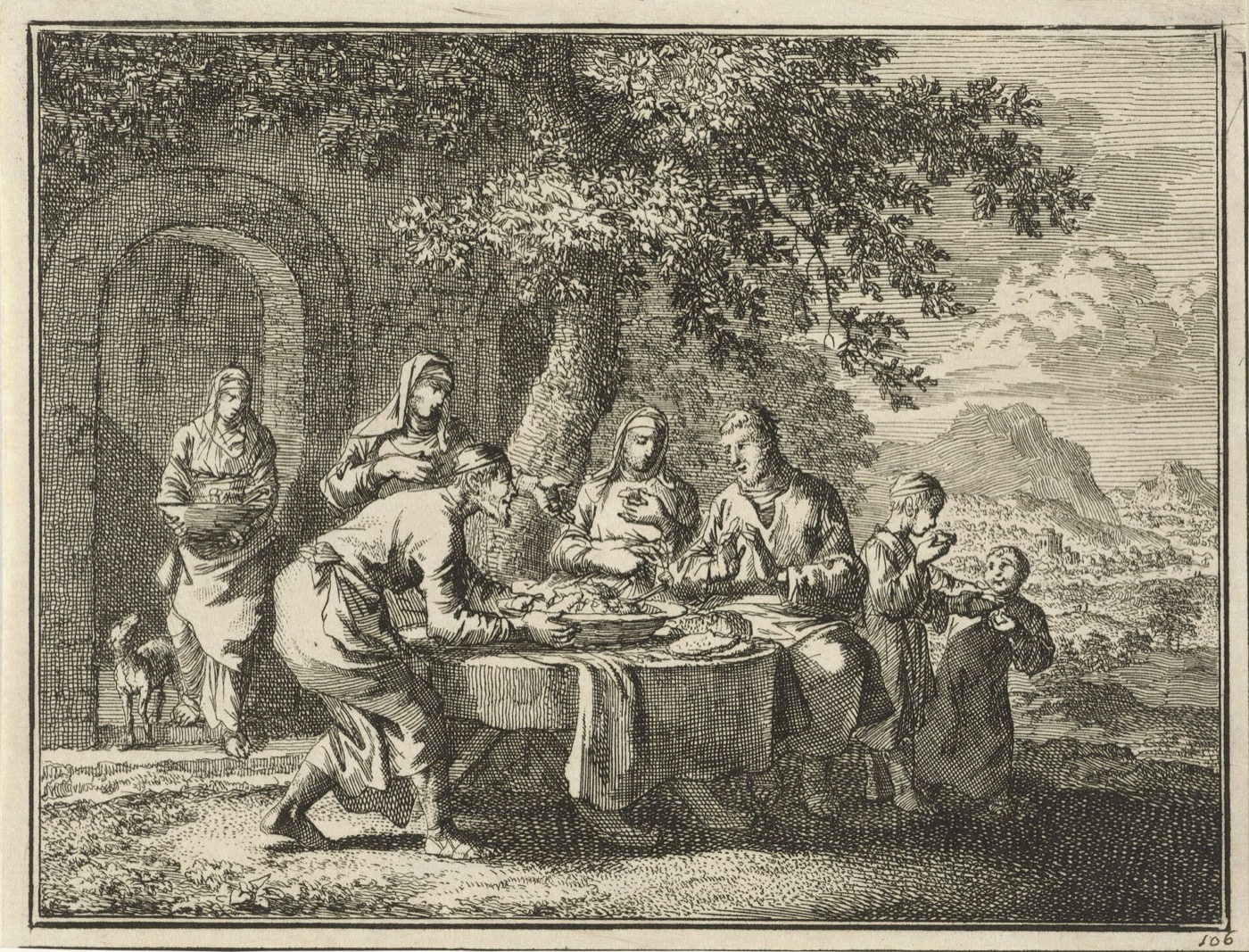
一棵大樹下襬著一張桌子。一個人彎著腰,把一大盤吃的放到桌上;桌邊坐著兩個人,後面站著一個婦人。左邊拱門口,另一個婦人端著一隻籃子,腳邊有一隻狗。右邊兩個孩子,一個正往嘴裡送吃的。你看,是誰把吃的放到桌上的?
揚·呂肯(Jan Luyken),《給飢餓的人吃》(Spijzigen van de hongerigen),1712 年,蝕刻版畫,荷蘭阿姆斯特丹國立博物館藏。公有領域。呂肯在同一本書裡,緊接《最後的審判》刻了一組“憐憫的事”,這是第一張,對 35 節“我餓了,你們給我吃”。 Wikimedia Commons一起讀太 25:31-46
(1–30 节)耶穌講了十個童女等候新郎、三個僕人領銀子作買賣(見“當時現場”)。
31“當人子在他榮耀裡,同著眾天使降臨的時候,要坐在他榮耀的寶座上。
32萬民都要聚集在他面前。他要把他們分別出來,好像牧羊的分別綿羊山羊一般,
33把綿羊安置在右邊,山羊在左邊。
34於是王要向那右邊的說:‘你們這蒙我父賜福的,可來承受那創世以來為你們所預備的國。
35因為我餓了,你們給我吃;渴了,你們給我喝;我作客旅,你們留我住;
36我赤身露體,你們給我穿;我病了,你們看顧我;我在監裡,你們來看我。’
37義人就回答說:‘主啊,我們什麼時候見你餓了給你吃,渴了給你喝?
38什麼時候見你作客旅留你住,或是赤身露體給你穿?
39又什麼時候見你病了,或是在監裡,來看你呢?’
40王要回答說:‘我實在告訴你們,這些事你們既作在我這弟兄中一個最小的身上,就是作在我身上了。’
41王又要向那左邊的說:‘你們這被咒詛的人,離開我,進入那為魔鬼和他的使者所預備的永火裡去!
42因為我餓了,你們不給我吃;渴了,你們不給我喝;
43我作客旅,你們不留我住;我赤身露體,你們不給我穿;我病了,我在監裡,你們不來看顧我。’
44他們也要回答說:‘主啊,我們什麼時候見你餓了,或渴了,或作客旅,或赤身露體,或病了,或在監裡,不伺候你呢?’
45王要回答說:‘我實在告訴你們,這些事你們既不作在我這弟兄中一個最小的身上,就是不作在我身上了。’
46這些人要往永刑裡去;那些義人要往永生裡去。”
當時現場
前面說了什麼。 這一段是耶穌在橄欖山上那一番話的最後一段。前面講了十個童女,又講了三個僕人領銀子。馬亨利說,這三段的用意是一樣的:預備好迎接他;預備好向他交賬;預備好領受他最後的判決,願那判決是永生。前兩段是比喻,這一段是對最後審判“更直白的描述”。
Matthew Henry, Commentary on the Whole Bible, Vol. V,太 25 章導言。譯自英文原著。
看英文原文
That we may then be ready to receive from him our final sentence, and that it may be to eternal life; and this is shown in a more plain description of the process of the last judgment
綿羊和山羊。 克拉克說,看來綿羊和山羊從來不關在同一個圈裡,雖然可能在同一片草場上吃草。馬亨利說,綿羊和山羊白天在同一片草場上吃草,到了晚上,卻要趕進不同的圈裡。
Adam Clarke, Commentary on the Bible,太 25:32;Matthew Henry, Commentary on the Whole Bible, Vol. V,太 25:31-46。譯自英文原著。
看英文原文
It does not appear that sheep and goats were ever penned or housed together, though they might feed in the same pasture
The sheep and goats are here feeding all day in the same pasture, but will be coted at night in different folds.
馬亨利又說,這個比方是從以西結書來的。神在那裡說:「我必在羊與羊中間,公綿羊與公山羊中間,施行判斷」(結 34:17)。
Matthew Henry, Commentary on the Whole Bible, Vol. V,太 25:31-46。譯自英文原著。
看英文原文
This is compared to a shepherd's dividing between the sheep and the goats; it is taken from Ezek. xxxiv. 17
後面發生了什麼。 「耶穌說完了這一切的話,就對門徒說:你們知道過兩天是逾越節,人子將要被交給人,釘在十字架上」(太 26:1-2)。剛說完自己要坐在榮耀寶座上的那一位,兩天以後,就要被釘在十字架上。
講解
看見什麼。 萬民聚集,王把他們分成兩邊。兩邊聽到的理由是同一張單子:餓了、渴了、作客旅、赤身露體、病了、在監裡。兩邊的回答也是同一句話:「我們什麼時候見你」(37、44 節)?分別不在他們知道什麼,而在他們做了什麼。
馬亨利說,經上沒有說王把富人放在右邊、窮人放在左邊,也沒有說把有學問、有地位的放在右邊;而是把敬虔的人放在右邊,惡人放在左邊。
Matthew Henry, Commentary on the Whole Bible, Vol. V,太 25:31-46。譯自英文原著。
看英文原文
It is not said that he shall put the rich on his right hand, and the poor on his left
but the godly on his right hand, and the wicked on his left
左邊的人被定罪,不是因為他們搶了誰的飯、把誰關進監裡,而是因為他們沒有做。馬亨利說,王沒有說“我病了,你們沒有醫好我;我在監裡,你們沒有放我出來”,那可能是他們做不到的;王說的是“你們不來看顧我”,這是他們本可以做的。他說:“沒有做的事,毀了千千萬萬的人。”
Matthew Henry, Commentary on the Whole Bible, Vol. V,太 25:31-46。譯自英文原著。
看英文原文
He doth not say, "I was sick, and you did not cure me; in prison, and you did not release me" (perhaps that was more than they could do); but, "You visited me not, which you might have done."
Omissions are the ruin of thousands.
46 節兩句話是對著說的:「這些人要往永刑裡去;那些義人要往永生裡去」。吉爾說,同一個字用在兩句裡,沒有理由在一句裡當作有限的時候、在另一句裡當作永遠。克拉克、馬亨利也都這樣講。
John Gill, Exposition of the Entire Bible,太 25:46。譯自英文原著。
看英文原文
for no reason can be given why the word which is the same in both clauses, should be taken in the one for a limited time, and in the other for an eternal duration
如果我在場。 我是右邊的人,聽見王說「我餓了,你們給我吃」,第一個反應卻是:“什麼時候?”我不記得見過他。馬亨利說,有恩典的人往往把自己的善行看得很低;他又說,基督在我們中間,比我們以為的更近。
Matthew Henry, Commentary on the Whole Bible, Vol. V,太 25:31-46。譯自英文原著。
看英文原文
Gracious souls are apt to think meanly of their own good deeds
Christ is more among us than we think he is
左邊的人也問了同一句:「主啊,我們什麼時候見你餓了……不伺候你呢」(44 節)?克拉克說,人若確知耶穌就在這地方某處,又餓又渴、赤身被關,必定跑去幫他;可是基督說,那飢餓、口渴、赤身的人,就代表他。
Adam Clarke, Commentary on the Bible,太 25:43。譯自英文原著。
看英文原文
If men were sure that Jesus Christ was actually somewhere in the land, in great personal distress, hungry, thirsty, naked, and confined, they would doubtless run unto and relieve him.
神是怎樣的神。 34 節和 41 節都說“預備”。給右邊的人預備的,是「創世以來為你們所預備的國」;左邊的人去的永火,卻是「為魔鬼和他的使者所預備的」(41 節)。馬亨利說,那火起初不是為惡人預備的,而是為魔鬼和他的使者預備的。克拉克說,那地方“從來不是為人的靈魂設計的”。
Matthew Henry, Commentary on the Whole Bible, Vol. V,太 25:31-46;Adam Clarke, Commentary on the Bible,太 25:41。譯自英文原著。
看英文原文
The fire is said to be prepared, not primarily for the wicked, as the kingdom is prepared for the righteous; but it was originally intended for the devil and his angels.
it never was designed for human souls
那麼,右邊的人是靠這些善行進天國的嗎?三家都說不是。馬亨利說,這裡提到他們的順服,“不是作他們的名分,而是作憑據”;吉爾說,這些事不是天國為他們預備的原因,而是神的恩典在他們裡面的見證和憑據;克拉克說,基督在這裡沒有說他們用這些善行買了永生。
Matthew Henry, Commentary on the Whole Bible, Vol. V,太 25:31-46;John Gill, Exposition of the Entire Bible,太 25:35;Adam Clarke, Commentary on the Bible,太 25 章末。譯自英文原著。
看英文原文
mention will be made of their obedience, not as their title, but as their evidence of an interest in Christ, and his purchase
but as descriptive of their characters, and as testimonies and evidences of the grace of God in them
Let it be farther remarked, that Christ does not say here that they have purchased the eternal life by these good deeds.
保羅也是這樣說的:「你們得救是本乎恩,也因著信,這並不是出於自己,乃是 神所賜的」(弗 2:8),接著又說:「我們原是他的工作,在基督耶穌裡造成的,為要叫我們行善」(弗 2:10)。
和我有什麼關係。 那麼,自己窮得什麼也給不出的人怎麼辦?馬亨利說,右邊會有許多人,從來沒有能力給飢餓的人吃、給赤身的人穿,自己反倒是靠別人的施捨吃飯穿衣的。基督不會把他們關在外面,他認他們,連最小的,都是他的弟兄。
Matthew Henry, Commentary on the Whole Bible, Vol. V,太 25:31-46。譯自英文原著。
看英文原文
not but that many will be found on the right hand who never were in a capacity to feed the hungry, or clothe the naked, but were themselves fed and clothed by the charity of others
單子上的六件事,都不是大事:一頓飯,一杯水,留人住一晚,一件衣服,去醫院坐一坐,去監裡看一看。克拉克說,人對窮人心硬,一般是因為缺了信心;只用肉眼看的人,看不出一個缺衣少食的人身上有基督。
Adam Clarke, Commentary on the Bible,太 25:44。譯自英文原著。
看英文原文
It is want of faith which in general produces hard-heartedness to the poor.
單元八從無花果樹發芽講起:「那日子,那時辰,沒有人知道」(太 24:36);到這裡,耶穌告訴我們那一天會問什麼。不問我們算準了沒有,問的是:餓了的人,你給他吃了沒有?
不同的看見
下面三位都是英國的解經家:馬亨利(1662–1714)、吉爾(1697–1771)、克拉克(約 1760–1832)。各段都譯自英文原著,出處附在後面。
經文自己說的(三家都照這個講): 人子要在榮耀裡來,坐在寶座上審判;他要把人分在左右;他把人怎樣待“我這弟兄中一個最小的”,當作怎樣待他自己;右邊的往永生裡去,左邊的往永刑裡去。下面三處,是讀法不同的地方。
一、32 節「萬民」:被聚集來審判的是誰?
大日的審判,是普遍的審判;所有的人,各世代、各地方的人,都要被召到基督的審判臺前。
Matthew Henry, Commentary on the Whole Bible, Vol. V,太 25:31-46。譯自英文原著。
看英文原文
Note, The judgment of the great day will be a general judgment.
他也承認,各國每一個人都要受審判;但他說,這裡描寫的,是各國中所有自稱信基督的人,就像前面十個童女、按才受託說的,都是在教會裡的人。
John Gill, Exposition of the Entire Bible,太 25:32。譯自英文原著。
看英文原文
That is, all that have professed the Christian religion in all the nations of the world
though it is also true of every individual of mankind of every nation, tribe and family
字面是“萬國”,就是外邦世界;猶太人自然也包括在內,只是前一章已經特別講過他們了。
Adam Clarke, Commentary on the Bible,太 25:32。譯自英文原著。
看英文原文
Literally, all the nations - all the Gentile world; the Jews are necessarily included
怎麼看: 三家都同意,所有的人都要站在基督面前。分別在於這一段描寫的重點:馬亨利講所有人,吉爾講自稱信主的人,克拉克從“外邦”這個字講起。經文自己說的是「萬民都要聚集在他面前」(32 節)。
二、40 節「我這弟兄中一個最小的」是誰?
“我餓了”,就是我的門徒、跟從我的人餓了。他又說,貧窮的聖徒、貧窮的傳道人在哪裡,基督就在那裡,接受我們向他們所行的善。
Matthew Henry, Commentary on the Whole Bible, Vol. V,太 25:31-46。譯自英文原著。
看英文原文
I was hungry, that is, my disciples and followers were so
Wherever poor saints and poor ministers are, there Christ is ready to receive our kindnesses in them
不可窄到只指使徒,也不可寬到包括全人類,只是指聖徒、神的兒女、信徒一家的人。但他又說,仁愛的事要向眾人行,只是更要向這些人行。
John Gill, Exposition of the Entire Bible,太 25:40。譯自英文原著。
看英文原文
not in so limited a sense, as to regard only the apostles, and the least of them, for these were not the only brethren of Christ; nor in so large a sense, as to include all in human nature; but the saints only, the children of God, and household of faith
for though acts of charity and humanity are to be done to all men, yet especially to these
40 節他說,基督最卑微的跟從者,基督都認作弟兄;到 43 節,他說得更寬:基督告訴我們,一個飢餓、口渴、赤身的人,就是他的代表。
Adam Clarke, Commentary on the Bible,太 25:40、25:43。譯自英文原著。
看英文原文
The meanest follower of Christ is acknowledged by him as his brother!
Now Christ assures us that a man who is hungry, thirsty, naked, etc., is his representative
怎麼看: 馬亨利、吉爾都說是跟從基督的人,吉爾說得最明;克拉克在 43 節把範圍說寬了。可是三家都不叫人只幫信徒、不幫別人。保羅的話可以放在一起讀:「所以有了機會,就當向眾人行善;向信徒一家的人更當這樣」(加 6:10)。
三、34 節「創世以來為你們所預備的國」:是為誰預備的?
這一處碰到預定與揀選,各教會的理解不同。
這國是特意為他們預備的,“不只是為你們這樣的人,而是為你們,點名為你們,一個一個地為你們”,就是那些被揀選、藉著成聖得救的人。
Matthew Henry, Commentary on the Whole Bible, Vol. V,太 25:31-46。譯自英文原著。
看英文原文
It is prepared on purpose for them; not only for such as you, but for you, you by name, you personally and particularly, who were chosen to salvation through sanctification.
他們稱為“蒙我父賜福的”,是因為他們屬於父,不只是因為父造了他們,更是因為父揀選他們得恩典、得榮耀。
John Gill, Exposition of the Entire Bible,太 25:34。譯自英文原著。
看英文原文
partly because they were his Father's, not only by creation, but by his choice of them to grace and glory
“為你們所預備的”,就是說榮耀的國是為你們這樣的人設計的;神定意除了有分於他聖潔的人以外,不讓人進他的天。
Adam Clarke, Commentary on the Bible,太 25:34。譯自英文原著。
看英文原文
That is, the kingdom of glory is designed for such as you
It was God's purpose and determination to admit none into his heaven but those who were made partakers of his holiness
怎麼看: 馬亨利那句話,正好把兩種讀法都說出來了:“為你們這樣的人”,還是“為你們,點名為你們”。三家都同意,這國是神早就預備好的,進去的人是“承受”,不是掙來的。至於神在創世以先是預定了一類人,還是揀選了一個一個的人,這一問,各教會的理解不盡相同,請向你所在的教會請教。
原文詞眼
「這些事你們既作在我這弟兄中一個最小的身上,就是作在我身上了」(40 節)
“最小的”,原文是 ἐλάχιστος。Thayer 解作“最小的”,又按“小在哪裡”分開列:大小、數量、輕重、權柄、地位,還有一項是“在人眼中”。太 25:40、45 他列在“在人眼中最小的人”這一項下面。
Thayer's Greek-English Lexicon of the New Testament,G1646。譯自英文原著。
看英文原文
smallest, least
in the estimation of men: of persons, Matthew 25:40, 45
就是說,這些人“最小”,是別人眼裡的最小:沒人注意,沒人記得。王卻說,他們是“我這弟兄”。
同一個詞,我們在別處也讀過:不義的管家一課,「人在最小的事上忠心,在大事上也忠心」(路 16:10);保羅說自己:「我原是使徒中最小的」(林前 15:9);先知說到伯利恆:「你在猶大諸城中,並不是最小的」(太 2:6)。那座在人眼中小小的城,出了一位君王;這位君王,認那些在人眼中最小的人作弟兄。
Thayer's Greek-English Lexicon of the New Testament,G1646。譯自英文原著。
看英文原文
in rank and excellence: of persons, Matthew 5:19; 1 Corinthians 15:9; of a town, Matthew 2:6
體裁說明
這一則是 6 則“有體裁說明”的比喻之一。下面把幾種看法擺出來,不下結論。
這是不是比喻? 這一段裡,真正打比方的只有一句:「好像牧羊的分別綿羊山羊一般」(32 節)。下面就不再說羊了,說的是“王”、“右邊的”、“義人”、“萬民”。所以立項書把它列為“末世審判的場景,不完全符合比喻的體裁”。
前面兩個比喻所表明的,這裡是“不用比喻”,清清楚楚地說出來。
John Gill, Exposition of the Entire Bible,太 25:31。譯自英文原著。
看英文原文
What is before signified in the two preceding parables, is here clearly and distinctly represented without a parable
他在導言裡說,這一段是對最後審判“更直白的描述”(見“當時現場”);可是講到 37-39 節義人問“什麼時候”,他又說這些話“是比喻式的”,是要把大道理印在人心裡。
Matthew Henry, Commentary on the Whole Bible, Vol. V,太 25:31-46。譯自英文原著。
看英文原文
The expressions are parabolical, designed to introduce and impress these great truths
怎麼看: 一種看法是:這一段是直說審判,只借了一個牧羊的比方;另一種看法是:整段的說法帶著比喻的色彩,細節不必一一照字面。兩種看法都同意,這一段說的是真實要來的審判。比喻庫把它和其他比喻放在一起,是因為它和前面十個童女、按才受託連成一氣,一同回答門徒那一問「什麼時候」(太 24:3)。
請思考
沒有標準答案,不打分。寫下來,只給自己看。
- 右邊、左邊的人都問:「我們什麼時候見你」?這一週,你可能在哪裡“見過他”而沒有認出來?
- 單子上的六件事,你最常做的是哪一件?最少做的是哪一件?為什麼?
- 左邊的人被定罪,是因為“沒有做”。你有沒有一件早就知道該做、卻一直沒做的善事?
- 你自己有沒有作過“最小的”那一個:餓了、病了、在異鄉、被人忘記?那時候,誰來看過你?
這週去做
單子上有六件事:給飢餓的人吃,給口渴的人喝,留客旅住,給赤身的人穿,看顧病人,探望坐監的人。
這一週,從裡面選一件,為一個在別人眼裡“最小”的人做:請一頓飯、送一件衣服、去醫院或養老院坐一坐、給一個在異鄉的人打個電話。做的時候,不必告訴別人。做完那天晚上,讀一遍 40 節。
這是比喻課的最後一課。你也可以回頭翻翻這四十課寫下的“這週去做”,看看哪一件還沒有做完。
延伸參考
- Matthew Henry, Commentary on the Whole Bible, Vol. V:太 25:31-46(英文原著,公有領域,CCEL 可免費讀全文)
- 法蘭士(R. T. France)著,丁道爾新約註釋《馬太福音》,校園書房出版社(ISBN 9789575874988):太 25:31-46
本單元其它比喻單元八 · 末世
- 無花果樹發芽 太 24:32-35
- 忠心與惡僕 太 24:45-51
- 十個童女 太 25:1-13
- 綿羊山羊 太 25:31-46 本課
經文:和合本(1919),用字按本站規則現代化。「不同的看見」裡的註釋都譯自英文原著(公有領域),每段可展開看英文原文。