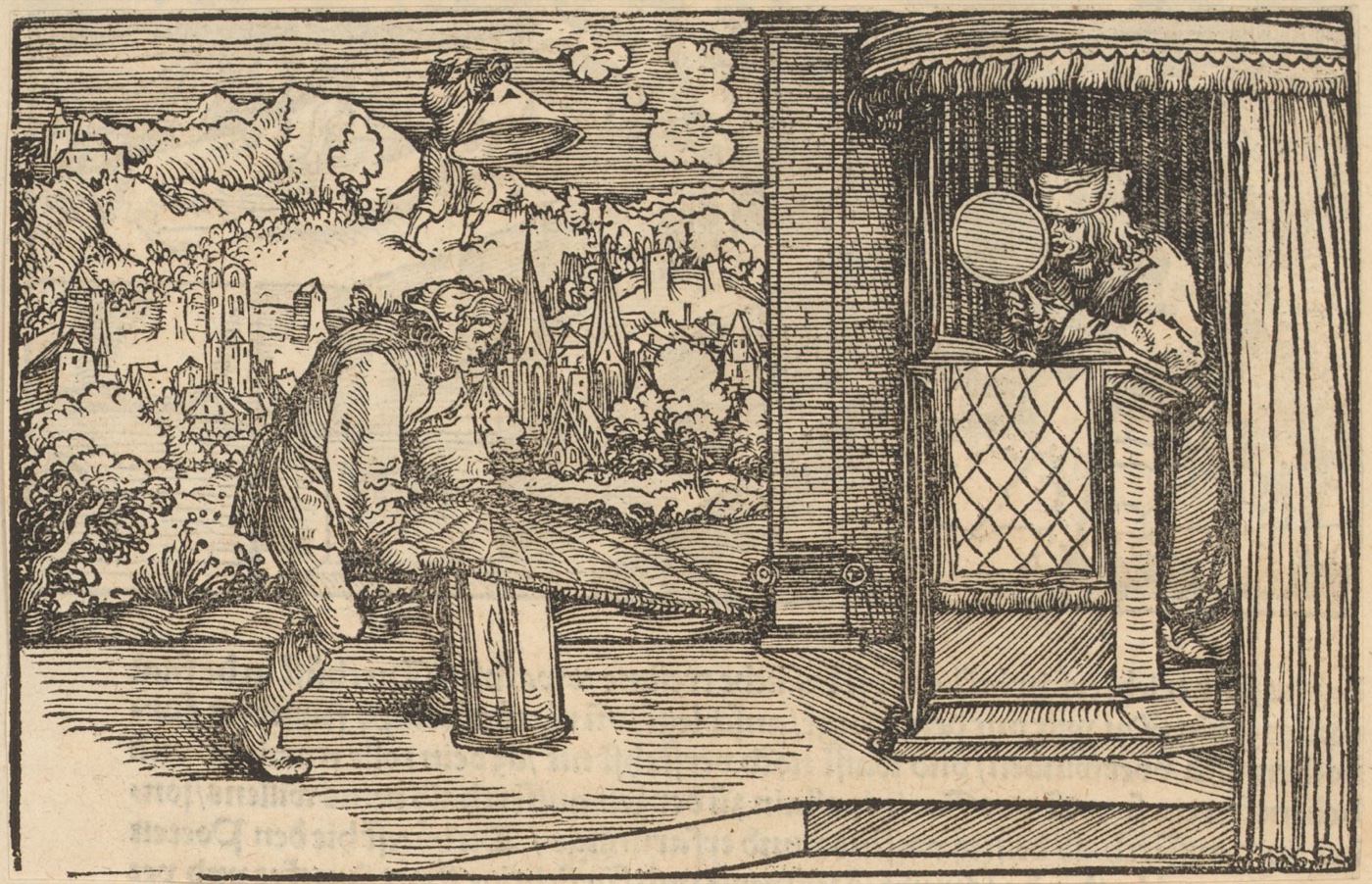
左边,一个人弯着腰,两手抓着一个编织的大罩子,正往一盏灯笼上盖;灯笼里看得见火苗。他身后有一座城,城里有教堂的尖塔;天上云边,又有一个人扛着一个大盖子,像是要去盖那座城。右边屋里,一个人站在高台后面,把一样圆圆的东西举到眼前。这幅画本来是为太 5:15 刻的。这三个人,各在做什么?
汉斯·魏迪茨(Hans Weiditz,二世)设计,佚名刻工,《三个人想把光和一座城藏起来》(Drie mannen proberen licht en een stad te verbergen),1514–1532 年间,木刻书籍插图,荷兰阿姆斯特丹国立博物馆藏。公有领域。 Wikimedia Commons一起读可 4:21-25
(1–20 节)耶稣在海边讲了撒种的比喻,又在没有人的时候,给门徒讲解(见撒种一课)。
21耶稣又对他们说:“人拿灯来,岂是要放在斗底下、床底下,不放在灯台上吗?
22因为掩藏的事,没有不显出来的;隐瞒的事,没有不露出来的。
23有耳可听的,就应当听。”
24又说:“你们所听的要留心。你们用什么量器量给人,也必用什么量器量给你们,并且要多给你们。
25因为有的,还要给他;没有的,连他所有的也要夺去。”
当时现场
还是撒种那一天。 耶稣在海边坐在船上讲了撒种的比喻;「无人的时候,跟随耶稣的人和十二个门徒,问他这比喻的意思」(可 4:10)。他讲解完了,接着说了这几句。吉尔说,这些话“还是接着对门徒说的”。
John Gill, Exposition of the Entire Bible,可 4:24。译自英文原著。
看英文原文
still continuing his discourse with his disciples
灯、斗、床。 “灯”,Thayer 的辞典说是“放在架子上”的灯,“蜡烛”二字后面他打了一个问号;英文钦定本译作 candle(蜡烛),所以三位注释家都说“蜡烛”。“灯台”就是放灯的架子。“斗”是量粮食的器具,Thayer 说约合英制一配克(不到十升)。“床”不是睡觉的床,Thayer 说是“吃饭时斜靠的榻”:吃饭的时候,人斜靠在榻上,灯若放在榻底下,一屋子都是暗的。
Thayer's Greek-English Lexicon of the New Testament,G3088、G3087、G3426、G2825。译自英文原著。
看英文原文
a lamp, candle (?), that is placed on a stand or candlestick
a (candlestick) lampstand
a dry measure holding 16 sextarii
about a peck, A. V. bushel
a couch to recline on at meals, Mark 4:21
吉尔照当时人家的情形描写:晚上大家在屋里说话、读书、做活,有人拿灯进来,难道用斗盖上?进了卧房,难道放在床底下?不是该放在灯台上,屋里的人都得着用处吗?
John Gill, Exposition of the Entire Bible,可 4:21。译自英文原著。
看英文原文
when a candle is brought into a room, in the night, where company are together, to converse, or read, or work; is it proper that it should be covered with a bushel, or any other hollow vessel?
is it not most fitting and convenient, that it should be set in a candlestick, and then it will be of use to all in the room?
三卷福音书对照
马可、路加都把这几句话放在撒种的比喻后面;马太没有放在一起,同样的话出现在别的地方:
| 马可 | 路加 | 马太 | |
|---|---|---|---|
| 灯 | 「人拿灯来,岂是要放在斗底下、床底下,不放在灯台上吗」(可 4:21) | 「没有人点灯用器皿盖上,或放在床底下,乃是放在灯台上,叫进来的人看见亮光」(路 8:16) | 「人点灯,不放在斗底下,是放在灯台上,就照亮一家的人」(太 5:15)· 登山宝训 |
| 隐藏的事 | 「因为掩藏的事,没有不显出来的」(可 4:22) | 「隐瞒的事,没有不露出来被人知道的」(路 8:17) | 「掩盖的事,没有不露出来的」(太 10:26)· 差遣十二门徒 |
| 怎样听 | 「你们所听的要留心」(可 4:24) | 「所以你们应当小心怎样听」(路 8:18) | 「有耳可听的,就应当听」(太 13:9) |
| 量器 | 「你们用什么量器量给人,也必用什么量器量给你们」(可 4:24) | (这里没有;在路 6:38 讲“给人”) | 「你们用什么量器量给人,也必用什么量器量给你们」(太 7:2)· 讲论断人 |
| 有的、没有的 | 「没有的,连他所有的也要夺去」(可 4:25) | 「凡没有的,连他自以为有的,也要夺去」(路 8:18) | 「凡没有的,连他所有的,也要夺去」(太 13:12) |
同一句“量器”,马太用在“不要论断人”,路加 6:38 用在“你们要给人”,马可用在“听道”上。同一句“有的、没有的”,路加多了三个字:“自以为”。这几句话为什么在不同的地方出现,请看“体裁说明”。
讲解
看见什么。 五节经文,像一串短短的格言:灯要放在灯台上(21 节);藏着的要显出来(22 节);有耳的要听(23 节);听什么要留心,量给人的会量回来(24 节);有的还要给,没有的连所有的也要夺去(25 节)。
请留意它们放的位置:就在撒种的比喻后面。撒种讲的是道落在什么样的土里;这几句接着讲,听了道以后怎样:灯点了,要放出来;听了,要留心;有了,还要加。
如果我在场。 门徒刚刚私下听了讲解,「神国的奥秘只叫你们知道」(可 4:11)。他们可能以为,这是只给自己的秘密。耶稣却说:灯不是拿来盖的。马亨利说:“虽然基督私下给门徒讲解比喻,用意却是叫他们在众人面前更有用处;他们受教,是为了教人。”
Matthew Henry, Commentary on the Whole Bible, Vol. V,可 4:21-34。译自英文原著。
看英文原文
Though Christ expounded the parables to his disciples privately, yet it was with design to make them the more publicly useful; they were taught, that they might teach
神是怎样的神。 他点灯,是要照亮人。克拉克替耶稣把话说明:“我讲道的用意是光照人;我的比喻不是要把真理藏起来,乃是要叫它更显明。”他也是一位愿意多给的神:「并且要多给你们」(24 节)。
Adam Clarke, Commentary on the Bible,可 4:21。译自英文原著。
看英文原文
The design of my preaching is to enlighten men; my parables not being designed to hide the truth, but to make it more manifest.
和我有什么关系。 马亨利说,人最出色的,比起公义的日头,也“不过是蜡烛,是微小的光”;一盏蜡烛“只照得不远、照得不久,容易吹灭,又一直在烧短”;可就是这样小的光,也有人把它放在床底下:“他们有家产,却不用来行善;有手脚、有聪明、也许还有学问,却没有一个人因他们得益处……好像罐子里的小蜡烛,只照着自己。”
Matthew Henry, Commentary on the Whole Bible, Vol. V,可 4:21-34。译自英文原著。
看英文原文
the most eminent are but candles, poor lights, compared with the Sun of righteousness
A candle gives light but a little way, and but a little while, and is easily blown out, and continually burning down and wasting.
they have estates, and do no good with them; have their limbs and senses, wit and learning perhaps, but nobody is the better for them
like a taper in an urn, they burn to themselves
他又说:“我们不是为自己生的。”还有一句话,读来很直白:“不用,就失去。”
Matthew Henry, Commentary on the Whole Bible, Vol. V,可 4:21-34。译自英文原著。
看英文原文
we are not born for ourselves
If we do not use, we lose, what we have
24 节是一句提醒:先管好自己听什么、怎样听,光才有得照出去。路加把它说成:「所以你们应当小心怎样听」(路 8:18)。
不同的看见
下面三位都是英国的解经家:马亨利(1662–1714)、吉尔(1697–1771)、克拉克(约 1760–1832)。各段都译自英文原著,出处附在后面。
经文自己说的(三家都照这个讲): 灯是要放在灯台上的;藏着的要显出来;听道的人要留心(21–24 节)。三家都读出:神给的光不是叫人藏起来的。下面三处,是读法不同的地方。
一、那盏灯,指什么?
是人身上的恩赐和恩典:“恩赐和恩典叫一个人成为一盏灯”;“基督徒既领受了恩赐,就要照样彼此服事”。
Matthew Henry, Commentary on the Whole Bible, Vol. V,可 4:21-34。译自英文原著。
看英文原文
Gifts and graces make a man as a candle
All Christians, as they have received the gift, must minister the same.
是福音:“福音可以比作种子,也可以比作一盏灯,灯的用处是给人光亮”;耶稣不愿意福音“永远、完全、对所有人都”用比喻盖着,特别要让门徒得着,因为他们是世上的光(他请读者参看太 5:14)。
John Gill, Exposition of the Entire Bible,可 4:21。译自英文原著。
看英文原文
for as the Gospel might be compared to seed, so likewise to a candle, the design and use of which is to give light to men
it was not his will that it should be always, and altogether, and from all men, covered with parables, and dark sayings, without any explanation of them
是耶稣自己的讲道:“我讲道的用意是光照人”(见“讲解”)。22 节,他说“很可能”是指:救恩的事以前隐藏着,或者只借着“预表和献祭”模糊地指出来,如今要借着福音显明出来。
Adam Clarke, Commentary on the Bible,可 4:22。译自英文原著。
看英文原文
Probably our Lord means, that all that had hitherto been secret, relative to the salvation of a lost world, or only obscurely pointed out by types and sacrifices, shall now be uncovered and made plain by the everlasting Gospel.
怎么看: 吉尔、克拉克落在“道”上:灯是福音、是耶稣的讲道;马亨利落在“人”上:灯是领受了恩赐的人。两样其实连在一起:道点亮了人,人又把道照出去。马太在登山宝训里用的是后一种:「你们的光也当这样照在人前」(太 5:16)。
二、“你们用什么量器量给人”,是什么意思?
他引哈蒙德博士的解释:“我们怎样待神,神也怎样待我们”;“你们若作他忠心的仆人,他也作你们信实的主人”。
Matthew Henry, Commentary on the Whole Bible, Vol. V,可 4:21-34。译自英文原著。
看英文原文
As we deal with God, God will deal with us, so Dr. Hammond explains these words
If ye be faithful servants to him, he will be a faithful Master to you
这是“犹太人常用的俗语,用在各样场合,各有用意”;在这里,是说门徒若用心听、努力明白、忠心分给别人,就会得着“更大的量、更多属灵的知识”。
John Gill, Exposition of the Entire Bible,可 4:24。译自英文原著。
看英文原文
a common proverb among the Jews, used on various occasions, and to different purposes
if the disciples carefully hearkened to what they heard from Christ, and studiously laboured to understand it, and faithfully dispensed it to others, in return, a larger measure, and greater degree of spiritual knowledge, would be bestowed upon them
怎么看: 马亨利读得宽:讲人和神之间;吉尔读得窄:讲听道、明白、分给人。马可把这句话放在“你们所听的要留心”后面,吉尔的读法贴着上下文。同一句话,马太用在论断人(太 7:2),路加用在给人(路 6:38):耶稣在不同的地方用它,意思跟着上下文走。
三、“连他所有的也要夺去”:真恩典会不会失去?
这句话一般的意思,总论一课“不同的看见”第三处已经讲过。这里只讲新的一层。
加给的,是用心听、善用所领受的人;夺去的,是“似乎有的、自以为有的”(他请读者参看路 8:18)。他说:“真恩典永不会被夺去,也不会失落”;被夺去的,是“对福音只有空想的知识”“假冒的恩典”,和没有神恩典的恩赐。
John Gill, Exposition of the Entire Bible,可 4:25。译自英文原著。
看英文原文
or seemed to have, or thought he had, Luke 8:18
for true grace is never taken away, nor lost
He that has only a speculative notion of the Gospel, and is without any experience and practice of it, in course of time his candle is put out
“不用,就失去”;“埋藏一千银子是辜负所托,等于丧失;恩赐和恩典不用,就生锈”。
Matthew Henry, Commentary on the Whole Bible, Vol. V,可 4:21-34。译自英文原著。
看英文原文
Burying a talent is the betraying of a trust, and amounts to a forfeiture; and gifts and graces rust for want of wearing.
他在可 4:25 请读者参看太 13:12 的注释;在那里他说,人若不善用恩典最初的工作,不管多小,“就有危险,不但失去可能的收成,连本钱也要失去”。
Adam Clarke, Commentary on the Bible,可 4:25;太 13:12。译自英文原著。
看英文原文
He that hath - See on Matthew 13:12 (note).
he who does not improve the first operations of grace, howsoever small, is in danger of losing not only all the possible product, but even the principal
怎么看: 三家都说:领受了不用的人,会失去。分歧在:失去的是什么。吉尔说失去的只是“似乎有的”,真恩典不会失去;克拉克说连“本钱”都有失去的危险。真得救的人会不会失去恩典,这一问,各教会的理解不尽相同,请向你所在的教会请教。
原文词眼
「你们所听的要留心」(24 节)。
“留心”原文是 βλέπω,本义是“看”。马可这句,照字面是“你们要看清楚,你们听的是什么”。路加记同一处,写的是「所以你们应当小心怎样听」(路 8:18),用的也是这个字,后面接的却是“怎样”。
Thayer 的辞典在同一条下面把这两处分开列:后面接“怎样”的,有路 8:18;后面接“什么”的,意思是“仔细掂量、察验”,例句就是可 4:24。
Thayer's Greek-English Lexicon of the New Testament,G991。译自英文原著。
看英文原文
followed by πῶς with indicative (Winers Grammar, 300 (282); Buttmann, 255 (219)), Luke 8:18
to weigh carefully, examine, followed by the interrogative τί with indicative Mark 4:24
马可提醒听“什么”,路加提醒“怎样”听:一个管进来的是什么,一个管自己的耳朵和心。两样都是撒种那块地的事:路加在前面刚说过,好土是「人听了道,持守在诚实善良的心里」(路 8:15)。
体裁说明
这一则是 6 则“有体裁说明”的比喻之一。下面把几种看法摆出来,不下结论。
马可没有叫它“比喻”,可是…… 21 节只说「耶稣又对他们说」,没有用“比喻”两个字;这五节也没有撒种、浪子那样的故事:没有人物,没有经过,没有结局。可是同一章的末了,马可说:「耶稣用许多这样的比喻,照他们所能听的,对他们讲道」(可 4:33)。
“比喻”这个字本来就宽。 Thayer 的希腊文辞典给 παραβολή 列了几个意思,第三个是:“一句简短而有教训的话,含着比方或比较,带着劝诫的力量;就是格言、箴言”。他在这一条下面列的是路 5:36、6:39、太 15:15,没有列本段;把灯台这几句归到这一类,是按意思归的。
Thayer's Greek-English Lexicon of the New Testament,G3850。译自英文原著。
看英文原文
"a pithy and instructive saying, involving some likeness or comparison and having preceptive or admonitory force; an aphorism, a maxim"
同样的话,在别的地方也出现。 看“三卷福音书对照”:马太把灯放在登山宝训里(太 5:15),把“掩盖的事”放在差遣十二门徒时(太 10:26),把“量器”放在不要论断人(太 7:2);路加在 11:33、12:2、6:38 又各说了一次。吉尔说,这些“比喻式、俗语式的话”,耶稣“在别的、不同的时候讲过,有的讲过两次”,但在这里也可能一起讲了。马亨利称它们是“比喻和比方的说法”。
John Gill, Exposition of the Entire Bible,可 4:21;Matthew Henry, Commentary on the Whole Bible, Vol. V,可 4:21-34。译自英文原著。
看英文原文
though the following parabolical and proverbial expressions were delivered by Christ at other, and different times, and some of them twice, as related by other evangelists; yet they might be all of them expressed or repeated at this time
The lessons which our Saviour designs to teach us here by parables and figurative expressions are these
怎么看: 说它是比喻,有可 4:33 的话为凭,Thayer 也说“比喻”可以是一句格言;说它不太像撒种、浪子那样的比喻,有它的写法为凭:是几句短话,不是一个故事。本栏目收它,是因为马可把它放在撒种的比喻和种子自长的比喻中间,讲的正是“听了道以后怎样”。读的时候,不必先定它是哪一类;一句一句地听进去。
请思考
没有标准答案,不打分。写下来,只给自己看。
- 你领受的“光”是什么?一段经文、一次经历、一样恩赐,或者一份能帮助人的本事?
- 有什么东西像“斗”或“床”,把这光盖住了?忙、怕、懒,还是觉得“我这点光不算什么”?
- 这一周,你听进去最多的是什么?新闻、短视频、别人的议论,还是神的话?
- 再看一次那幅木刻:一个人正弯着腰去盖灯。如果画里的人是你,你会怎么做?
这周去做
每天睡前,用一分钟问自己两个问题:今天我听了什么?今天我有没有把一点光照给一个人?
周末,挑一样你一直“放在床底下”的恩赐或本事,用它为一个人做一件小事。
延伸参考
- Matthew Henry, Commentary on the Whole Bible, Vol. V:可 4:21-25(英文原著,公有领域,CCEL 可免费读全文)
- 法兰士(R. T. France)著,丁道尔新约注释《马太福音》,校园书房出版社(ISBN 9789575874988):太 5:14-16
- 施诺格拉斯《主耶稣的比喻》:灯台一章
本单元其它比喻单元三 · 天国的比喻
经文:和合本(1919),用字按本站规则现代化。“不同的看见”里的注释都译自英文原著(公有领域),每段可展开看英文原文。