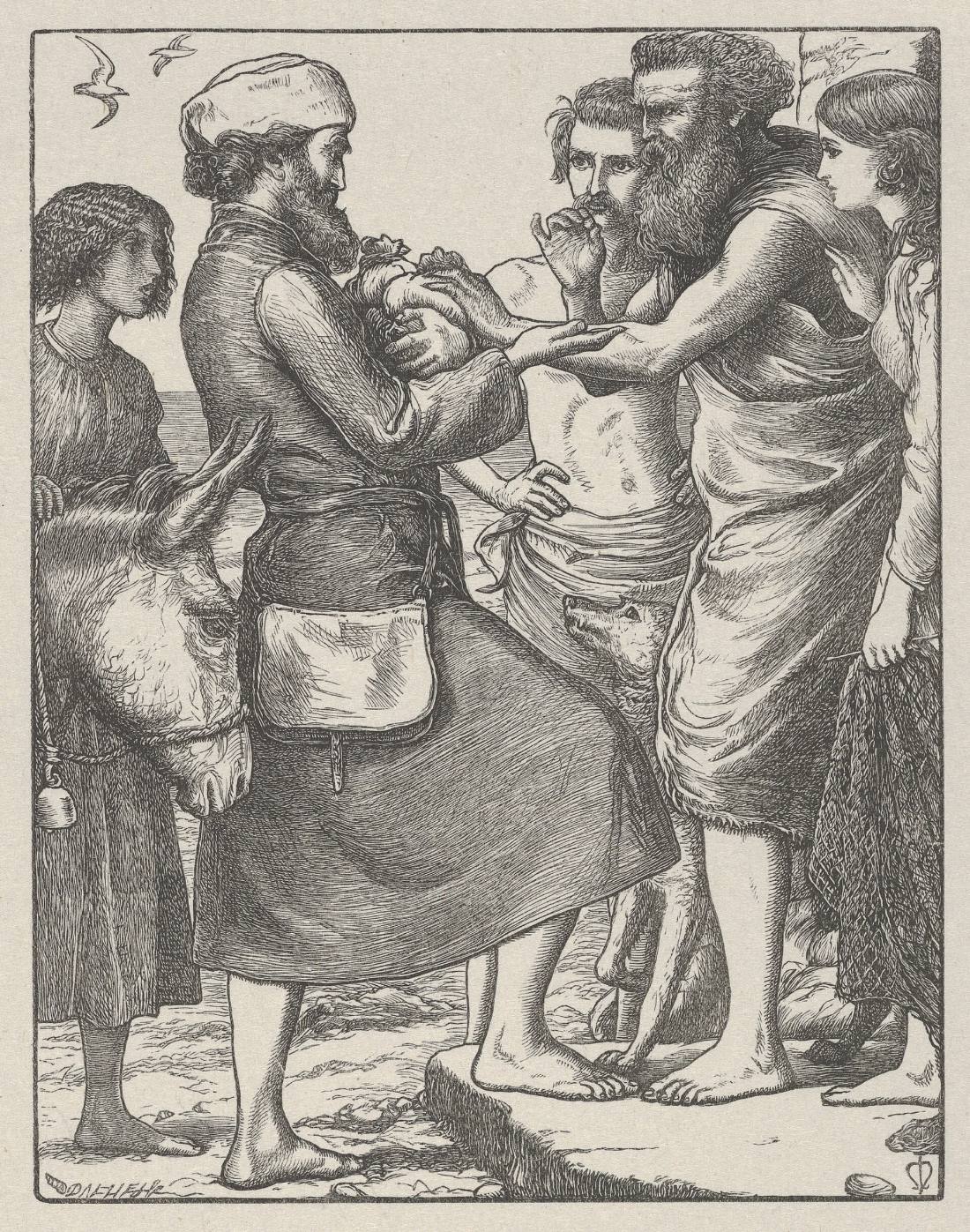
海边,天上飞着两只鸟。一个戴帽子、留胡子的人,腰间挎着一只皮袋,两手握着两个扎口的小袋子,像是钱袋。他身边一头驴,一个孩子扶着驴。对面几个光着脚的人,一个大胡子伸出手掌,旁边的年轻人捂着嘴看;右边一个女孩手里拎着渔网,地上散着贝壳。那只伸出来的手掌里,是珠子,还是他要付的钱?
约翰·埃弗雷特·米莱(John Everett Millais)画,达尔齐尔兄弟(Dalziel Brothers)刻版,《重价的珠子》(The Pearl of Great Price),1864 年,木刻版画,出自《我主我救主耶稣基督的比喻》,美国纽约大都会艺术博物馆藏。公有领域。 Wikimedia Commons一起读太 13:45-46
(44 节)耶稣讲了藏宝的比喻(见藏宝一课)。
45天国又好像买卖人,寻找好珠子,
46遇见一颗重价的珠子,就去变卖他一切所有的,买了这颗珠子。
当时现场
谁在场。 还是那间屋子,还是门徒(太 13:36)。耶稣讲完藏宝,紧接着讲这一个。马亨利说,这个比喻“和前面藏宝的用意相同”,又说:“梦这样重复,是因为事情确定。”这是借用约瑟对法老说的话:「至于法老两回作梦,是因神命定这事」(创 41:32)。
Matthew Henry, Commentary on the Whole Bible, Vol. V,太 13:44-52。译自英文原著。
看英文原文
That of the pearl of price (v. 45, 46), which is to the same purport with the former, of the treasure. The dream is thus doubled, for the thing is certain.
买卖人。 和合本的“买卖人”,原文是 ἔμπορος。Thayer 说,这个字本指出门远行的人,后来指“特别为做买卖”远行的人,就是商人,与开小铺的零售商相对。这是一个走南闯北、见过许多珠子的行家。
Thayer's Greek-English Lexicon of the New Testament,G1713。译自英文原著。
看英文原文
one on a journey, whether by sea or by land, especially for traffic; hence,
a merchant (opposed to κάπηλος a retailer, petty tradesman)
珍珠。 那时的珍珠是极贵的东西,常和黄金并提:保罗劝妇女「不以编发、黄金、珍珠,和贵价的衣裳为妆饰」(提前 2:9)。旧约讲智慧的宝贵,也拿珍珠来比:「智慧的价值胜过珍珠」(伯 28:18)。启示录里,新耶路撒冷「十二个门是十二颗珍珠」(启 21:21)。
讲解
看见什么。 两节经文,四个动作:寻找,遇见,去变卖他一切所有的,买(45–46 节)。
放在藏宝旁边读,有几处不一样:
- 藏宝的是「人遇见了,就把它藏起来」(太 13:44),经文没说他在找;这个买卖人本来就在「寻找好珠子」(45 节)。
- 宝贝藏在地里;珠子在买卖人走过的路上。
- 藏宝的人「欢欢喜喜」(太 13:44);这里没有提。
也有一处一模一样:两个人都“去变卖”一切所有的,都“买”了下来(太 13:44;46 节)。
还有一个小地方:他找的是“好珠子”,好些颗;遇见的是「一颗重价的珠子」(46 节)。
如果我在场。 门徒里有几位是打鱼的,耶稣呼召的时候,他们「立刻舍了网,跟从了他」(太 4:20)。可是后来也有一位少年人,耶稣叫他变卖所有的来跟从,他「就忧忧愁愁地走了,因为他的产业很多」(太 19:22)。门徒们听这个比喻,也许会想起那个转身走开的背影。
神是怎样的神。 他让寻找的人寻见。耶稣说:「寻找,就寻见」(太 7:7);先知说:「你们寻求我,若专心寻求我,就必寻见」(耶 29:13)。
马亨利说,世上的人都在忙着寻找好珠子,“有人要发财,有人要尊荣,有人要学问;可是大多数人上了当,拿假珠子当真”。他说:“耶稣基督是一颗重价的珠子,一件无价的珍宝,得着他的人就富足了,真正富足,在神面前富足。”
Matthew Henry, Commentary on the Whole Bible, Vol. V,太 13:44-52。译自英文原著。
看英文原文
All the children of men are busy, seeking goodly pearls: one would be rich, another would be honourable, another would be learned; but the most are imposed upon, and take up with counterfeits for pearls.
Jesus Christ is a Pearl of great price, a Jewel of inestimable value, which will make those who have it rich, truly rich, rich toward God
和我有什么关系。 买卖人一生的本事,就是分辨真假、估量价钱。他看准了,就把一切都押上。马亨利有一句很短的话:“金子,人可能买贵了;这颗重价的珠子,不会。”
Matthew Henry, Commentary on the Whole Bible, Vol. V,太 13:44-52。译自英文原著。
看英文原文
A man may buy gold too dear, but not this pearl of price.
克拉克说,商人为了今生的利益走遍海洋陆地,这就定了许多自称基督徒的人懒惰的罪:他们口里承认这救恩是最确实、最美好的宝贝,却宁可先去追求世上的财物。
Adam Clarke, Commentary on the Bible,太 13:45。译自英文原著。
看英文原文
Those merchants who compass sea and land for temporal gain, condemn the slothfulness of the majority of those called Christians, who, though they confess that this salvation is the most certain and the most excellent of all treasures, yet seek worldly possessions in preference to it!
耶稣自己问过:「人若赚得全世界,赔上自己的生命,有什么益处呢」(太 16:26)。
不同的看见
下面三位都是英国的解经家:马亨利(1662–1714)、吉尔(1697–1771)、克拉克(约 1760–1832)。各段都译自英文原著,出处附在后面。
经文自己说的(三家都照这个讲): 天国像一个寻找好珠子的买卖人,遇见一颗重价的珠子,就变卖一切所有的,买了它(45–46 节)。三家都读出:天国极其宝贵,值得人舍下一切。下面两处,是读法不同的地方。
一、买卖人是谁?珠子是谁?
珠子是基督(见“讲解”);买卖人是“真基督徒,一个属灵的商人”,他寻找、也找到了这颗重价的珠子,“不只是出个价,而是买了下来”。
Matthew Henry, Commentary on the Whole Bible, Vol. V,太 13:44-52。译自英文原著。
看英文原文
A true Christian is a spiritual merchant, that seeks and finds this pearl of price
did not only bid for it, but purchased it
他一人摆出三种读法。第一种:“这比喻可以理解为基督寻找、找到、买赎他的选民。”可是他自己提出异议:把基督比作买卖人“似乎不太合适”;而且选民“本身没有内在的美好,配不上称为珍珠,全在乎他的恩典”。第二种是“更普遍的解释”:一个知罪的人寻找得救的真道,找到了基督,为他舍下一切;这样的人起初会去找许多“乍看很好”的东西,像“礼貌、道德、律法上的义”。第三种是他自己的看法:“我倒认为,照着和其他比喻的连贯一致”,这是指寻求各样知识的人,“找到了福音,看它比一切都宝贵”。
John Gill, Exposition of the Entire Bible,太 13:45。译自英文原著。
看英文原文
This parable may be understood of Christ's seeking, finding, and purchasing his elect
it does not seem so agreeable, that Christ should be compared to a merchant man
nor have they any intrinsic excellency in them, to denominate them pearls, but by his grace
The more common interpretation of it is, that it designs a sensible sinner, seeking after the true way of salvation, and finding Christ, and parting with all for him
which at first sight seem "goodly", in order to obtain salvation by; as civility, morality, a legal righteousness
Though I rather think, that in connection and agreement with the other parables, this is to be understood of such, who are seeking after knowledge in every branch of it
and who find the Gospel, and prefer it to everything else
他不给买卖人找对应,只说珠子的意思:“从罪和罪的后果中得着永远的救恩,是人至高的善”,要“过于万事去寻求”。
Adam Clarke, Commentary on the Bible,太 13:45。译自英文原著。
看英文原文
eternal salvation from sin and its consequences is the supreme good of man, should be sought after above all things
怎么看: 这是寓意读法:给比喻里的买卖人和珠子各找一个对应。光是吉尔一个人,就摆出三种,又对其中一种提出保留,可见这里的读法本来就多。三家相同的是:这颗珠子极其宝贵,值得变卖一切。经文自己只说「天国又好像买卖人」(45 节)。
二、藏宝和寻珠,是一个意思说两遍吗?
马亨利: 是。两个比喻“用意相同”,“梦这样重复,是因为事情确定”(见“当时现场”)。
也是。“这个比喻的意思和另一个相同;两个都讲,是要把这个大真理更有力地印在人心上。”
Adam Clarke, Commentary on the Bible,太 13:45。译自英文原著。
看英文原文
The meaning of this parable is the same with the other; and both were spoken to impress more forcibly this great truth on the souls of the people
他没有直接比较这两个比喻。不过在藏宝那里,他说福音被人找到,有的是在专心寻找的时候,有的是“偶然”找到的。
John Gill, Exposition of the Entire Bible,太 13:44。译自英文原著。
看英文原文
either with or without the use of means, purposely attended to, in order to find it
怎么看: 三家都说两个比喻的用意相同。经文自己也留下一点不同:一个是「人遇见了,就把它藏起来」(太 13:44),没说在找;一个是「寻找好珠子」(45 节)。有人没在找,却撞上了;有人找了一辈子,终于找到了。怎样遇见不一样,遇见以后做的事一样。
原文词眼
「遇见一颗重价的珠子」(46 节)。
“珠子”原文是 μαργαρίτης,就是珍珠。耶稣在山上说过一句俗语:「不要把圣物给狗,也不要把你们的珍珠丢在猪前」(太 7:6),也是这个字。Thayer 解释那句俗语,说珍珠指的是“福音最神圣、最宝贵的教训”,并对照箴言「比珍珠宝贵」(箴 3:15)。
Thayer's Greek-English Lexicon of the New Testament,G3135。译自英文原著。
看英文原文
to thrust the most sacred and precious teachings of the gospel upon the most wicked and abandoned men
Matthew 7:6 (cf. Proverbs 3:15; Job 28:18f)
“重价”原文是 πολύτιμος,由“多”和“价值”两个字合成,Thayer 解作“极有价值的、价钱很高的”。新约里另有两处用到它:伯大尼的马利亚「拿着一斤极贵的真哪哒香膏,抹耶稣的脚」(约 12:3),那“极贵的”就是这个字;彼得说,信心被试验以后,「就比那被火试验仍然能坏的金子更显宝贵」(彼前 1:7),那“更显宝贵”也是这个字。
Thayer's Greek-English Lexicon of the New Testament,G4186。译自英文原著。
看英文原文
very valuable, of great price: Matthew 13:46
John 12:3; comparitive πολυτιμότερον, 1 Peter 1:7
一个买卖人为珠子变卖一切;一个女人把极贵的香膏全倒在耶稣脚上。重价的东西,换的是更重价的那一位。
请思考
没有标准答案,不打分。写下来,只给自己看。
- 你做过最“值得”的一次花费是什么?当时有没有人觉得你傻?
- 在遇见基督以前,你最想要的“好珠子”是什么?现在还想要吗?
- 你是“遇见”信仰的,还是“寻找”信仰的?还是两样都有?
- 再看一次米莱的画:那人手里攥着钱袋,对面伸出一只手。如果你站在他的位置上,手里攥着的是什么?
这周去做
这一周,每天睡前花两分钟,想一想今天花在哪里最多:时间、钱、心思。不用评判,只记下来。
周末把一周的记录摊开看:我真正当作“重价的珠子”的,是什么?
延伸参考
- Matthew Henry, Commentary on the Whole Bible, Vol. V:太 13:45-46(英文原著,公有领域,CCEL 可免费读全文)
- 法兰士(R. T. France)著,丁道尔新约注释《马太福音》,校园书房出版社(ISBN 9789575874988):太 13:45-46
- 施诺格拉斯《主耶稣的比喻》:藏宝和寻珠一章
本单元其它比喻单元三 · 天国的比喻
- 撒种 太 13:1-23
- 种子自长 可 4:26-29
- 稗子 太 13:24-30、36-43
- 芥菜种 太 13:31-32
- 面酵 太 13:33
- 藏宝 太 13:44
- 寻珠 太 13:45-46 本课
- 撒网 太 13:47-50
- 家主 太 13:52 即将上线
- 灯台 可 4:21-25 即将上线
经文:和合本(1919),用字按本站规则现代化。“不同的看见”里的注释都译自英文原著(公有领域),每段可展开看英文原文。