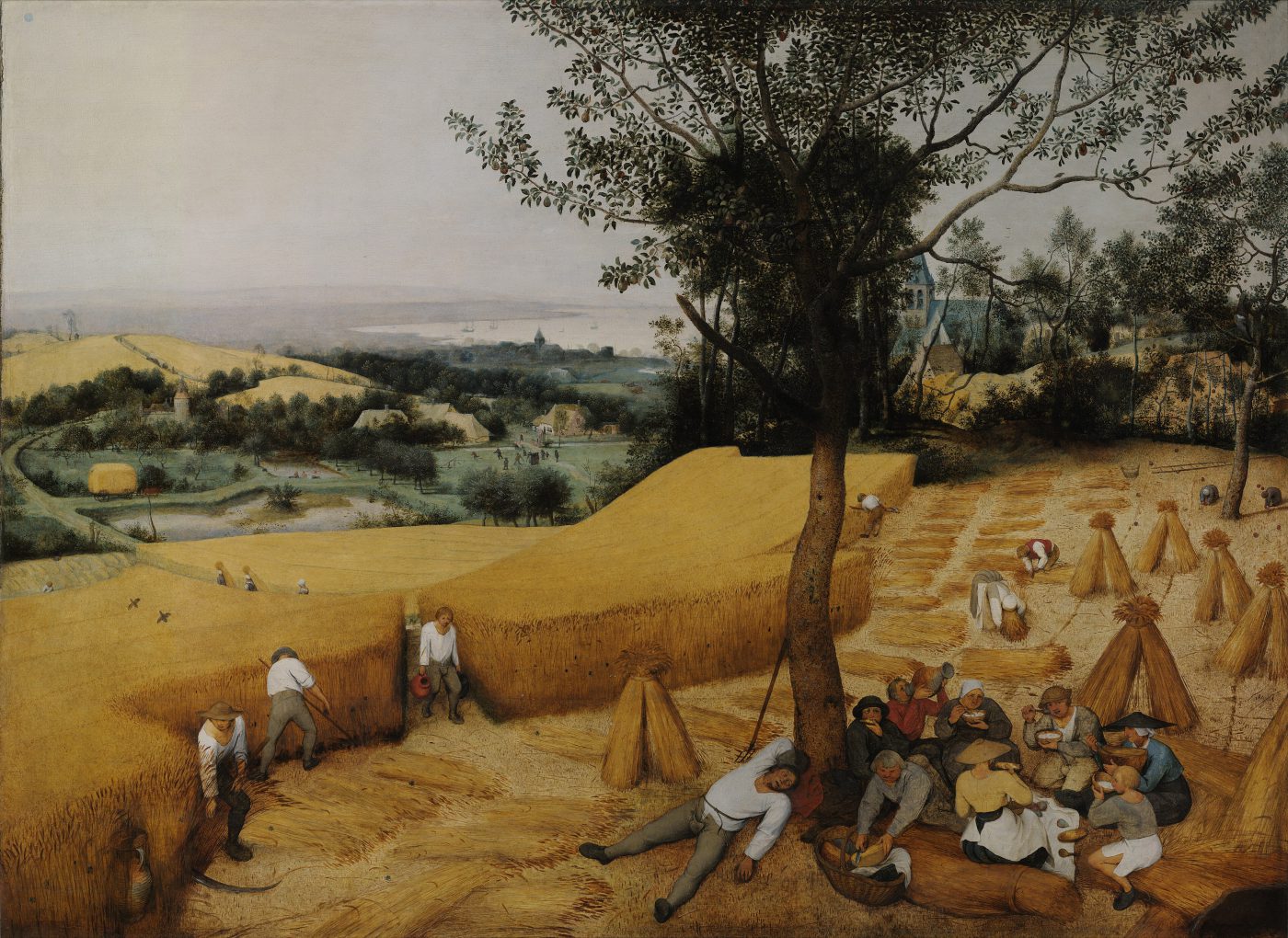
一大片熟透的麦田,金黄一直铺到远处。左边有人弯着腰挥镰割麦,有人提着罐子从麦子中间的小路走出来;右边,割下的麦子捆成一束一束立在地里,还有人弯着腰在捆。一棵树下,一群人坐着吃饭,有的端着碗,有的仰头喝水;旁边一个人仰面躺着,睡着了。远处是村庄、教堂和一片海湾。这些麦子,从撒下去到今天,经过了多少个黑夜和白日?
老彼得·勃鲁盖尔(Pieter Bruegel the Elder)《收割者》(The Harvesters),1565 年,木板油画,美国纽约大都会艺术博物馆藏。公有领域。画的是收割的场面,不是画这个比喻,用来对照 29 节。 Wikimedia Commons一起读可 4:26-29
(1–25 节)耶稣在海边坐在船上,用比喻教训众人:先讲了撒种的比喻,又讲了灯放在灯台上(见撒种一课)。
26又说:“神的国,如同人把种撒在地上,
27黑夜睡觉,白日起来,这种就发芽渐长,那人却不晓得如何这样。
28地生五谷是出于自然的:先发苗,后长穗,再后穗上结成饱满的子粒;
29谷既熟了,就用镰刀去割,因为收成的时候到了。”
当时现场
谁在场。 还是撒种比喻的那一天。耶稣在海边,人太多,他「只得上船坐下」(可 4:1),对岸上的众人讲。这一天他讲了好几个比喻,马可说:「耶稣用许多这样的比喻,照他们所能听的,对他们讲道」(可 4:33)。四卷福音书里,只有马可记了这一个。克拉克说:“这个比喻只有马可提到。”
Adam Clarke, Commentary on the Bible,可 4:26。译自英文原著。
看英文原文
This parable is mentioned only by Mark
种地的人在等什么。 种撒下去以后,农夫能做的不多:等雨,等发芽,等成熟。雅各书说:「看哪,农夫忍耐等候地里宝贵的出产,直到得了秋雨春雨」(雅 5:7)。比喻里的人也是这样,「黑夜睡觉,白日起来」(27 节)。克拉克说,这就是“夜里睡,白天起”,没有别的深意。
Adam Clarke, Commentary on the Bible,可 4:27。译自英文原著。
看英文原文
That is, he should sleep by night, and rise by day; for so the words are obviously to be understood.
和撒种的比喻,放在一起看:
| 撒种(可 4:3-20) | 种子自长(可 4:26-29) | |
|---|---|---|
| 开头 | 「有一个撒种的出去撒种」(可 4:3) | 「如同人把种撒在地上」(26 节) |
| 讲的重点 | 种落在四种土里,结果不一样 | 种撒下去以后,怎样一步步长起来 |
| 撒种的人 | 撒完以后,比喻里不再提他 | 「黑夜睡觉,白日起来」(27 节) |
| 种是什么 | 「撒种之人所撒的,就是道」(可 4:14) | 耶稣没有解释 |
| 结局 | 「有三十倍的、有六十倍的、有一百倍的」(可 4:20) | 「谷既熟了,就用镰刀去割」(29 节) |
前一个比喻告诉门徒,四种土里有三种不结果;这一个接着说:落在地里的种,会自己长。
讲解
看见什么。 四节经文,人只做了头尾两件事:撒种(26 节),收割(29 节)。中间最长的一段,是种自己在长:发芽,长高,先苗,后穗,再结出饱满的子粒(27–28 节)。
撒种的人不知道它是怎样长的:「那人却不晓得如何这样」(27 节)。克拉克说:“植物怎样生长,是自然界的奥秘,世上最有智慧的哲学家也不能完全解释。”
Adam Clarke, Commentary on the Bible,可 4:27。译自英文原著。
看英文原文
How a plant grows is a mystery in nature, which the wisest philosopher in the universe cannot fully explain.
如果我在场。 门徒刚听完撒种的比喻:路旁的被鸟吃了,石头地的晒干了,荆棘里的挤住了。四份种,三份没有结果。听到这里,撒种的人难免灰心。
耶稣接着讲了这一个:种撒下去,你去睡觉,它在长;你起来做别的事,它也在长。你看不见它怎样长,它照样在长。
神是怎样的神。 「地生五谷是出于自然的」(28 节)。“自然”不是说没有神。吉尔说,地是在“太阳、露水和天上来的雨”之下结出果子的。
John Gill, Exposition of the Entire Bible,可 4:28。译自英文原著。
看英文原文
Without any further help, or cultivation from the husbandman; though under the influence of the sun, dews, and showers of rain from heaven
马亨利说,种这样长起来,是照着自然平常的规律,也是靠着“造自然的神同在、同工的能力”。他又说:“神做他的工,不知不觉,没有声响,却是挡不住的,也不会落空。”
Matthew Henry, Commentary on the Whole Bible, Vol. V,可 4:26-29。译自英文原著。
看英文原文
according to the ordinary course of nature, and by the concurring power of the God of nature
God carries on his work insensibly and without noise, but insuperably and without fail.
保罗也说过同样的话:「我栽种了,亚波罗浇灌了,惟有神叫他生长」(林前 3:6)。
和我有什么关系。 我们常常想知道自己“长了多少”,也想看见别人长进。这个比喻说:长,是有次序的,「先发苗,后长穗,再后穗上结成饱满的子粒」(28 节),急不来;长,也常常是看不见的。马亨利说,先知不能永远活着,“他们传的道,在他们进了坟墓以后还在做工”。
Matthew Henry, Commentary on the Whole Bible, Vol. V,可 4:26-29。译自英文原著。
看英文原文
The prophets do not live for ever; but the word which they preached, is doing its work, when they are in their graves
对传福音、带小组、教孩子的人,这是安慰:撒了种,可以安心去睡觉。对自己,这是提醒:不要天天把种挖出来看它长了没有。
不同的看见
下面三位都是英国的解经家:马亨利(1662–1714)、吉尔(1697–1771)、克拉克(约 1760–1832)。各段都译自英文原著,出处附在后面。
经文自己说的(三家都照这个讲): 神的国像人把种撒在地上(26 节);种自己发芽渐长,撒种的人不晓得怎样长的(27 节);长有次序:苗、穗、饱满的子粒(28 节);熟了就收割(29 节)。耶稣没有解释这个比喻,下面两处,是历代读法不同的地方。
一、撒种、睡觉的那个人是谁?
那个人“不是指基督,因为基督不睡觉;而且他知道种是怎样发芽生长的”,而是指基督差出去的传福音的人;种是“神的道,就是基督的福音”。
John Gill, Exposition of the Entire Bible,可 4:26。译自英文原著。
看英文原文
by "the man", is not meant Christ, for he sleeps not; and besides, he knows how the seed springs and grows; but any Gospel minister, who is sent forth by Christ, bearing precious seed
but the word of God, or Gospel of Christ
他引了另一位解经家的读法,说到时候是“基督这位农夫在收割的时候收进好种”。他自己说:“我看不出有必要去问基督怎样能说是黑夜睡觉、白日起来;基督像这个农夫,只在撒种和收割这两件事上。”
Adam Clarke, Commentary on the Bible,可 4:26。译自英文原著。
看英文原文
and then Christ the husbandman, at the time of the harvest, gathers in this good seed into the kingdom of heaven
I see no necessity of inquiring how Christ may be said to sleep and rise night and day; Christ being like to this husbandman only in sowing and reaping the seed.
他从传道人讲:撒种以后,农夫对种的发芽“一点也没有做什么”;照样,恩典的道被人用信心领受以后,在心里做恩典的工作,“传道的人对此一点也帮不上”。
Matthew Henry, Commentary on the Whole Bible, Vol. V,可 4:26-29。译自英文原著。
看英文原文
The husbandman, when he hath sown the seed, doth nothing toward the springing of it up
Thus the word of grace, when it is received in faith, is in the heart a work of grace, and the preachers contribute nothing to it.
怎么看: 这是寓意读法:给比喻里的人找一个对应。吉尔说是传道人,克拉克说撒种、收割的是基督,马亨利从传道人讲。经文自己没有说这个人是谁,只说「神的国,如同人把种撒在地上」(26 节)。三家倒有一点相同:种怎样长,不在撒种的人。
二、“饱满的子粒”和“收成”指什么?
他把苗、穗、子粒读成灵魂在恩典里长进的三步;到了“饱满的子粒”,“灵魂洁净,脱离一切不义……被神一切所充满的,充满了”。说到 29 节,他说有人以为,灵魂一完全成圣,就被接进神的国里去,“可是比喻确实没有这样说”;神救人到底,是要他们“在今生完全地爱他”。
Adam Clarke, Commentary on the Bible,可 4:28-29。译自英文原著。
看英文原文
The soul is purified from all unrighteousness; and, having escaped the corruption that is in the world, it is made a partaker of the Divine nature, and is filled with all the fullness of God.
It has been supposed that our Lord intimates here that, as soon as a soul is made completely holy, it is taken into the kingdom of God. But certainly the parable does not say so.
God saves men to the uttermost, that they may here perfectly love him
他也把这三步读成恩典的渐长:起初信心很小,后来“越来越坚固”。庄稼熟了,是“恩典长到成熟”;收成是“在死的时候,或在世界的末了”。
John Gill, Exposition of the Entire Bible,可 4:28-29。译自英文原著。
看英文原文
faith grows stronger and stronger
signifying that when grace is brought to maturity, and faith is performed with power, and the good work begun is perfected
at death or at the end of the world, which the harvest represents
收成是说,那些正确领受福音的人“走完了他们的路程,收成就到了,他们要像麦子一样被收进神的仓里”。
Matthew Henry, Commentary on the Whole Bible, Vol. V,可 4:26-29。译自英文原著。
看英文原文
When those that receive the gospel aright, have finished their course, the harvest comes, when they shall be gathered as wheat into God's barn
他把 29 节的“收成”列在比喻的用法下,指“末后审判的时候,义人被收进神的国”。
Thayer's Greek-English Lexicon of the New Testament,G2326。译自英文原著。
看英文原文
equivalent to the time of reaping, i. e. figuratively, the time of final judgment, when the righteous are gathered into the kingdom of God
怎么看: 收成指一个人的一生走完,还是指世界的末了,三家和 Thayer 说法不一,经文只说「因为收成的时候到了」(29 节)。更大的不同在“饱满的子粒”:信徒在今生能长到什么地步,克拉克说今生就能“完全地爱神”;吉尔讲恩典渐渐长到成熟,收成在死的时候或世界的末了,没有像克拉克那样讲今生的完全。这一问,各教会的理解不尽相同,请向你所在的教会请教。
原文词眼
「地生五谷是出于自然的」(28 节)。
“出于自然的”原文只有一个字 αὐτόματος。Thayer 的希腊文辞典解释:“凭自己的动力,或者说,没有别人推动、插手而行”,常用来说“地自己长出植物,植物和果实不经耕种自己长出来”;他列的经文就是马可 4:28。
Thayer's Greek-English Lexicon of the New Testament,G844。译自英文原著。
看英文原文
moved by one's own impulse, or acting without the instigation or intervention of another
often of the earth producing plants of itself, and of the plants themselves and fruits growing without culture
Mark 4:28
Thayer 在这一条下列的新约经文,除了这一处,只有另一处:彼得被天使领出监牢的时候,「那门自己开了」(徒 12:10)。
Thayer's Greek-English Lexicon of the New Testament,G844。译自英文原著。
看英文原文
of gates opening of their own accord: Acts 12:10
克拉克说,这是“凭它自己的力量,没有人的影响,也没有人的劳力”。
Adam Clarke, Commentary on the Bible,可 4:28。译自英文原著。
看英文原文
By its own energy, without either the influence or industry of man.
“自己”长,是说不靠人;不是说人自己会长出恩典来。吉尔特别提醒:这句话“不是说人听了道,就能凭自己在心里结出恩典的果子”。
John Gill, Exposition of the Entire Bible,可 4:28。译自英文原著。
看英文原文
this is said, not to denote that man of himself, upon hearing the word, can bring forth the fruit of grace in himself
门自己开了,是神开的;地自己长了,也是神叫它长的。
请思考
没有标准答案,不打分。写下来,只给自己看。
- 你有没有种过东西,或者养过什么?等它长的时候,你是什么心情?
- 回想你信主以后:哪些改变是你“看见了才发现已经长出来”的?
- 你有没有为某一个人祷告、向他传福音很久,却看不见变化?读了这个比喻,你想对自己说什么?
- 「先发苗,后长穗,再后穗上结成饱满的子粒」(28 节)。你觉得自己现在在哪一步?
这周去做
想一个你为他撒过种的人:家人、朋友、小组里的弟兄姐妹。这一周每天为他祷告一次,只求神叫种生长,不催促,也不去“挖出来看”。
周末问自己:这一周,我是更焦急,还是更安心了?
延伸参考
- Matthew Henry, Commentary on the Whole Bible, Vol. V:可 4:26-29(英文原著,公有领域,CCEL 可免费读全文)
- 丁道尔新约注释《马可福音》:可 4:26-29
- 施诺格拉斯《主耶稣的比喻》:种子自长一章
本单元其它比喻单元三 · 天国的比喻
- 撒种 太 13:1-23
- 种子自长 可 4:26-29 本课
- 稗子 太 13:24-30、36-43 即将上线
- 芥菜种 太 13:31-32 即将上线
- 面酵 太 13:33 即将上线
- 藏宝 太 13:44 即将上线
- 寻珠 太 13:45-46 即将上线
- 撒网 太 13:47-50 即将上线
- 家主 太 13:52 即将上线
- 灯台 可 4:21-25 即将上线
经文:和合本(1919),用字按本站规则现代化。“不同的看见”里的注释都译自英文原著(公有领域),每段可展开看英文原文。