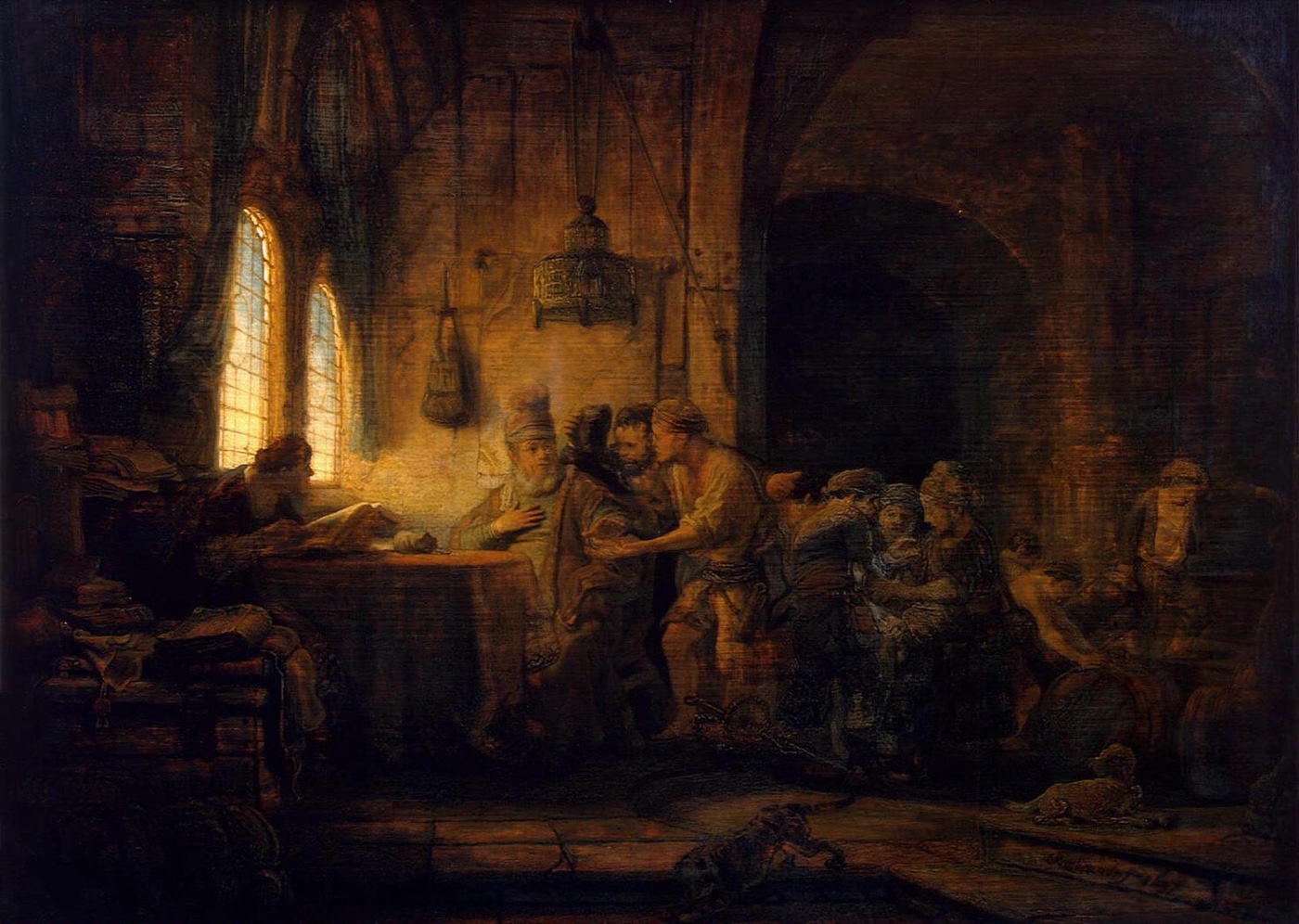
一間昏暗的大屋子,光從左邊兩扇高窗照進來。窗下桌邊,一個年輕人對著一本攤開的大書。桌旁坐著一位戴高帽、留白鬍子的老人,一隻手按在胸口。他面前一個工人彎著身子,伸出一隻攤開的手,另一隻手往後指。他身後還有人湊過來聽。右邊暗處,幾個人擠在一起,再往裡有人彎腰在木桶邊。你看,那個伸手的工人,臉朝著誰?他要說的是什麼?
倫勃朗(Rembrandt van Rijn),《葡萄園工人的比喻》(The Parable of the Labourers in the Vineyard),1637 年,木板油畫,俄羅斯聖彼得堡冬宮博物館藏。公有領域。 Wikimedia Commons一起讀太 20:1-16
1“因為天國好像家主,清早去僱人進他的葡萄園作工,
2和工人講定一天一錢銀子,就打發他們進葡萄園去。
3約在巳初出去,看見市上還有閒站的人,
4就對他們說:‘你們也進葡萄園去,所當給的,我必給你們。’他們也進去了。
5約在午正和申初又出去,也是這樣行。
6約在酉初出去,看見還有人站在那裡,就問他們說:‘你們為什麼整天在這裡閒站呢?’
7他們說:‘因為沒有人僱我們。’他說:‘你們也進葡萄園去。’
8到了晚上,園主對管事的說:‘叫工人都來,給他們工錢,從後來的起,到先來的為止。’
9約在酉初僱的人來了,各人得了一錢銀子。
10及至那先僱的來了,他們以為必要多得;誰知也是各得一錢。
11他們得了,就埋怨家主說:
12‘我們整天勞苦受熱,那後來的只做了一小時,你竟叫他們和我們一樣嗎?’
13家主回答其中的一人說:‘朋友,我不虧負你,你與我講定的不是一錢銀子嗎?
14拿你的走吧!我給那後來的和給你一樣,這是我願意的。
15我的東西難道不可隨我的意思用嗎?因為我作好人,你就紅了眼嗎?’
16這樣,那在後的將要在前,在前的將要在後了。”
當時現場
先聽彼得的問題。 前一章,一個有錢的少年人憂憂愁愁地走了。彼得就對耶穌說:「看哪,我們已經撇下所有的跟從你,將來我們要得什麼呢?」(太 19:27)耶穌應許了他們,最後說:「然而有許多在前的將要在後,在後的將要在前」(太 19:30)。這個比喻開頭的“因為”,就接在這句話後面;比喻講完,16 節又把這句話倒過來說了一遍。馬亨利說,這比喻就是“和這句話連著的”。
Matthew Henry, Commentary on the Whole Bible, Vol. V,太 20:1-16。譯自英文原著。
看英文原文
that many that are first shall be last, and the last, first; with which this parable is connected
幾個時辰。 當時從早上六點左右算起,到傍晚六點收工,一天十二個鐘頭。和合本用的是中國的舊時辰:“巳初”約是上午九點,“午正”是正午,“申初”約是下午三點,“酉初”約是下午五點。克拉克說,酉初僱的人,離一天做工的結束“只剩一個鐘頭”。
Adam Clarke, Commentary on the Bible,太 20:6。譯自英文原著。
看英文原文
Five o'clock in the evening, when there was only one hour before the end of the Jewish day, which, in matters of labor, closed at six.
市上閒站的人。 克拉克說,市場是做工的人“通常站著等人僱的地方”;他自己也常在大城的市場上,看見做工的人站著等活幹。
Adam Clarke, Commentary on the Bible,太 20:3。譯自英文原著。
看英文原文
Where laborers usually stood till they were hired.
I have often seen laborers standing in the market places of large towns in these countries, waiting to be employed.
一錢銀子。 克拉克說,這“看來是當時一天工的通常工價”。馬亨利說,這是“一天的工錢,夠一天的用度”。
Adam Clarke, Commentary on the Bible,太 20:2;Matthew Henry, Commentary on the Whole Bible, Vol. V,太 20:1-16。譯自英文原著。
看英文原文
This appears to have been the ordinary price of a day's labor at that time.
a day's wages for a day's work, and the wages sufficient for a day's maintenance.
當晚發工錢。 摩西的律法說到窮苦的僱工:「要當日給他工價,不可等到日落,因為他窮苦,把心放在工價上」(申 24:15)。
講解
看見什麼。 家主出去了五次:清早、巳初、午正、申初、酉初。最後一批人說:「因為沒有人僱我們」(7 節)。克拉克說:“這就是他們整天閒站的緣故。”
Adam Clarke, Commentary on the Bible,太 20:7。譯自英文原著。
看英文原文
This was the reason why they were all the day idle.
發工錢的次序是倒過來的:「從後來的起,到先來的為止」(8 節)。先來的人站在後面,眼看著只做了一小時的人拿到一錢銀子,心裡就有了指望:「他們以為必要多得」(10 節)。
他們不是沒有拿到講定的工錢。馬亨利說,他們挑剔家主,“與其說是因為自己得的不夠,不如說是因為別人和他們一樣了”。所以他們說:「你竟叫他們和我們一樣嗎?」(12 節)
Matthew Henry, Commentary on the Whole Bible, Vol. V,太 20:1-16。譯自英文原著。
看英文原文
found fault, not because they had not enough, so much as because others were made equal with them.
如果我在場。 我是清早就進園的那一個。太陽底下幹了一整天,排在最後,看著傍晚才來的人先領了錢。我會說什麼?馬亨利說:“我們很容易覺得,自己從神得的恩寵太少,別人得的太多;自己為神做的太多,別人做的太少。”又說:“我們都很容易把別人該得的看低,把自己該得的看高。”
Matthew Henry, Commentary on the Whole Bible, Vol. V,太 20:1-16。譯自英文原著。
看英文原文
There is a great proneness in us to think that we have too little, and other too much, of the tokens of God's favour; and that we do too much, and others too little, in the work of God.
Very apt we all are to undervalue the deserts of others, and to overvalue our own.
神是怎樣的神。 家主回答了三句。第一句講公道:「朋友,我不虧負你,你與我講定的不是一錢銀子嗎?」(13 節)第二句講主權:「我的東西難道不可隨我的意思用嗎?」(15 節)馬亨利說:“前面他說明自己的公道,這裡說明自己的主權。”第三句講他的好:「因為我作好人,你就紅了眼嗎?」(15 節)
Matthew Henry, Commentary on the Whole Bible, Vol. V,太 20:1-16。譯自英文原著。
看英文原文
As before he asserted his justice, so here his sovereignty
馬亨利說:“神若把他沒有給我們的恩典給了別人,那是向他們的恩慈,對我們卻沒有不公。”又說,給只做了不到一天十分之一的人整天的工錢,是要顯明神“憑恩典和主權”分賜賞賜,“不是還債”。
Matthew Henry, Commentary on the Whole Bible, Vol. V,太 20:1-16。譯自英文原著。
看英文原文
If God gives that grace to others, which he denies to us, it is kindness to them, but no injustice to us
The giving of a whole day's wages to those that had not done the tenth part of a day's work, is designed to show that God distributes his rewards by grace and sovereignty, and not of debt.
家主開口先叫“朋友”。馬亨利說,和人講理,“話要軟,理要硬”。
Matthew Henry, Commentary on the Whole Bible, Vol. V,太 20:1-16。譯自英文原著。
看英文原文
He calls him friend, for in reasoning with others we should use soft words and hard arguments
和我有什麼關係。 這個比喻和浪子回頭可以放在一起讀。馬亨利說,兩個比喻“有些相近”:那裡的大兒子,和這裡先來的工人,都看不得別人得著和自己一樣的。
Matthew Henry, Commentary on the Whole Bible, Vol. V,太 20:1-16。譯自英文原著。
看英文原文
Something of affinity there is between this parable and that of the prodigal son
馬亨利說,“紅了眼”這種嫉妒,“對自己是愁苦,對神是惱怒,對鄰舍是惡意”;嫉妒的人“不像神,因為神是好的,行好事,也喜歡行好事”。
Matthew Henry, Commentary on the Whole Bible, Vol. V,太 20:1-16。譯自英文原著。
看英文原文
It is grief to ourselves, anger to God, and ill-will to our neighbour
Envy is unlikeness to God, who is good, and doeth good, and delighteth in doing good
彼得問「將來我們要得什麼呢」(太 19:27),耶穌沒有說他得的會少。他講了這個比喻,讓問的人看一看:別人得著恩典的時候,我是跟著歡喜,還是紅了眼?
不同的看見
下面三位都是英國的解經家:馬亨利(1662–1714)、吉爾(1697–1771)、克拉克(約 1760–1832)。各段都譯自英文原著,出處附在後面。
經文自己說的(三家都照這個講): 家主一次次出去僱人;最後來的和最先來的,各得一錢銀子;先來的埋怨,家主說他沒有虧負誰,他有權照自己的意思給,他作的是好事。下面兩處,是讀法不同的地方。
一、人人都得一錢銀子,是不是說將來的賞賜沒有分別?
“天上雖有榮耀的等次,對每個人卻都是完全的福樂。”他打比方說:“在天上,每個器皿都滿了,滿到邊上,雖然器皿大小不一。”
Matthew Henry, Commentary on the Whole Bible, Vol. V,太 20:1-16。譯自英文原著。
看英文原文
Though there be degrees of glory in heaven, yet it will be to all a complete happiness.
In heaven, every vessel will be full, brimful, though every vessel is not alike large and capacious.
從這裡“推不出榮耀有等次”,因為榮耀“不按人的行為比例,是出於神的恩典”。他說,現在人得的恩典有多有少,“到了天上,在所有人身上都一樣,完全、全備”。
John Gill, Exposition of the Entire Bible,太 20:9。譯自英文原著。
看英文原文
it follows not, that there will be degrees in glory; since that is not proportioned to the works of men, but springs from the grace of God
Now, indeed, they have not the same measures of grace; some have more, others less; but in heaven, it will be alike, complete and perfect in all
“永生既是神白白的恩賜,他有權按他喜歡的分量、時候、條件賜下。”
Adam Clarke, Commentary on the Bible,太 20:15。譯自英文原著。
看英文原文
As eternal life is the free gift of God, he has a right to give it in whatever proportions, at whatever times, and on whatever conditions he pleases.
怎麼看: 三家都說,永生是神的恩典,不是工價。比喻中人人得一錢,新約別處又說「將來各人要照自己的工夫,得自己的賞賜」(林前 3:8)。將來的賞賜有沒有等次,這一問,各教會的理解不盡相同,請向你所在的教會請教。
二、清早、巳初、午正、申初、酉初,指的是什麼?
這是寓意讀法:把比喻裡的每個時辰各對應一件事。比喻本身只說家主一次次出去僱人,沒有解釋這幾個時辰。
他認為這比喻主要講的是福音先傳給猶太人,後來,“好像在酉初”,使徒們把外邦人也召來,和猶太人得著同樣的工作和權利。又說,這幾個時辰“也可以,而且通常是”用在人一生中歸向基督的不同年紀。
Matthew Henry, Commentary on the Whole Bible, Vol. V,太 20:1-16。譯自英文原著。
看英文原文
at length, as it were about the eleventh hour, they called the Gentiles to the same work and privilege with the Jews
But this may be, and commonly is, applied to the several ages of life, in which souls are converted to Christ.
“大多數註釋家對這比喻各有各的讀法。”他照凱內爾(Quesnel)的讀法:“人生不過一天”,童年是清早,後面依次是少年、壯年、晚年,最後是病弱臨終的時候。他又說,“另有人”把清早讀作福音的開端,第一次呼召是施洗約翰的傳道。
Adam Clarke, Commentary on the Bible,太 20:15。譯自英文原著。
看英文原文
Most commentators have different methods of interpreting this parable.
Life is but a day, whereof childhood, or the first use of reason, is the day-break or first hour
Others consider the morning the first dawn of the Gospel; and the first call to be the preaching of John Baptist.
三種讀法並列:可以指世界的幾個時期,“律法以前、律法之下、彌賽亞的時代、末後的日子”;或者指福音幾次的差遣;或者指“人一生的幾個階段”,在童年、少年、壯年、老年蒙召。
John Gill, Exposition of the Entire Bible,太 20:6。譯自英文原著。
看英文原文
may have regard either to the several periods of time, and ages of the world, as before the law, under the law, the times of the Messiah, and the last days; or the various dispensations of the Gospel
or to the several stages of human life, and may regard Christ's call of persons in childhood, youth, manhood, and old age
三家的讀法各有道理,但都是比喻之外加上去的。經文自己只說:家主一次又一次出去,到了酉初還出去。讀成人生的年紀的,馬亨利特別提醒一句:“誰也不可憑著這個,把悔改拖到年老。”酉初的人進來晚,是因為「沒有人僱我們」(7 節),不是因為他們一直推辭。
Matthew Henry, Commentary on the Whole Bible, Vol. V,太 20:1-16。譯自英文原著。
看英文原文
Yet let none, upon this presumption, put off their repentance till they are old.
原文詞眼
「因為我作好人,你就紅了眼嗎?」(15 節)
“紅了眼”,原文直譯是“你的眼睛是惡的”。Thayer 說:“你的眼睛是惡的,就是說,你嫉妒。”他接著引舊約的同一個說法:“你的眼向你弟兄是惡的,就是說,你嫉妒(捨不得給)你的弟兄。”
Thayer's Greek-English Lexicon of the New Testament,G3788。譯自英文原著。
看英文原文
ὀφθαλμός σου πονηρός ἐστιν, i. e. thou art envious, Matthew 20:15
thine eye is evil toward thy brother, i. e. thou enviest (grudgest) thy brother, Deuteronomy 15:9
和合本在申命記譯作:「你便惡眼看你窮乏的弟兄,什麼都不給他」(申 15:9)。“惡眼”的人,看見弟兄缺乏,捨不得給;看見弟兄得著,又看不下去。
家主問的是一對相反的話:我的“好”,對你的眼睛的“惡”。克拉克說:“在猶太人中,‘惡眼’指惡毒、貪心或嫉妒的人。”
Adam Clarke, Commentary on the Bible,太 20:15。譯自英文原著。
看英文原文
An evil eye among the Jews meant a malicious, covetous, or envious person.
登山寶訓裡也有一句「你的眼睛若昏花,全身就黑暗」(太 6:23),原文也是“惡的眼睛”。Thayer 說那一處指的是“有病的、出了毛病的眼睛”,和這裡不是一個意思,兩處不要混在一起讀。
Thayer's Greek-English Lexicon of the New Testament,G3788。譯自英文原著。
看英文原文
on the other hand, ὀφθαλμός πονηρός in Matthew 6:23 is a diseased, disordered eye
請思考
沒有標準答案,不打分。寫下來,只給自己看。
- 讀這個比喻,你第一個反應是替誰說話:先來的工人,還是後來的工人?為什麼?
- 有沒有一次,別人得著了好處,你心裡說“這不公平”?那時候你在比的是什麼?
- 家主說“我不虧負你”。你得著的,有哪些是你“講定”的,有哪些是你沒有想到的?
- 在你身邊,有沒有一個人,像酉初還站在市上,“沒有人僱”?
這週去做
這一週,留意一次“紅了眼”的時刻:別人被稱讚、升職、蒙了恩典,你心裡不舒服。
那一刻,為那個人向神說一句感謝;能當面說的,就當面向他道一聲喜。「與喜樂的人要同樂」(羅 12:15)。
週末問自己:這一週,我的眼睛是在數自己得了多少,還是在看神的好?
延伸參考
- Matthew Henry, Commentary on the Whole Bible, Vol. V:太 20:1-16(英文原著,公有領域,CCEL 可免費讀全文)
- 法蘭士(R. T. France)著,丁道爾新約註釋《馬太福音》,校園書房出版社(ISBN 9789575874988):太 20:1-16
- 施諾格拉斯《主耶穌的比喻》:葡萄園工人一章
本單元其它比喻單元五 · 門徒訓練
- 兩種蓋房的人 太 7:24-27
- 好撒瑪利亞人 路 10:25-37
- 葡萄園工人 太 20:1-16 本課
- 蓋樓與打仗 路 14:28-33 即將上線
- 無用的僕人 路 17:7-10 即將上線
- 警醒的僕人 路 12:35-40 即將上線
經文:和合本(1919),用字按本站規則現代化。「不同的看見」裡的註釋都譯自英文原著(公有領域),每段可展開看英文原文。