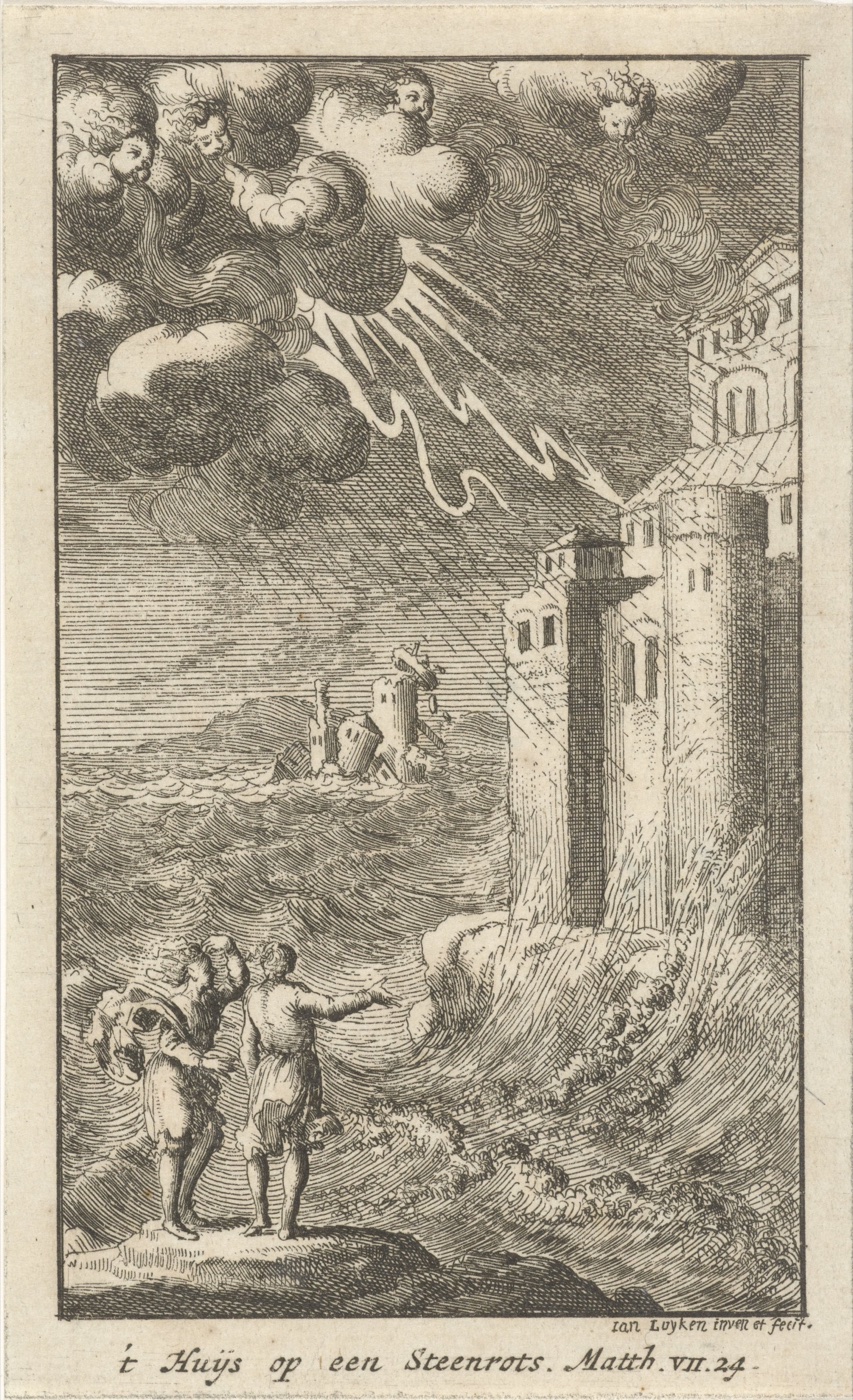
一場大風雨。天上的雲裡有幾張臉在鼓著腮吹氣,一道閃電劈下來,雨斜斜地落著。右邊一座高樓連著一座圓塔,立在岩石上,浪頭打在下面。遠處的水裡,另一座房子已經塌了,牆斷成幾截,碎塊落進浪裡。左下角的岩石上站著兩個人,背對著我們:一個伸出手臂指著前面,另一個一隻手按著頭,衣服被風吹起來。你看,同一場風雨,這兩座房子有什麼不同?
揚·呂肯(Jan Luyken),《磐石上的房子》('t Huijs op een Steenrots),1681 年,蝕刻版畫,荷蘭阿姆斯特丹國立博物館藏。公有領域。 Wikimedia Commons一起讀太 7:24-27
24“所以,凡聽見我這話就去行的,好比一個聰明人,把房子蓋在磐石上;
25雨淋,水沖,風吹,撞著那房子,房子總不倒塌,因為根基立在磐石上。
26凡聽見我這話不去行的,好比一個無知的人,把房子蓋在沙土上;
27雨淋,水沖,風吹,撞著那房子,房子就倒塌了,並且倒塌得很大。”
當時現場
登山寶訓的最後一段。 從馬太福音第 5 章起,耶穌坐在山上教訓門徒和眾人。這個比喻是整篇講論的收尾。馬亨利說,這是要把釘子“釘牢,釘在穩當的地方”。
Matthew Henry, Commentary on the Whole Bible, Vol. V,太 7:21-29。譯自英文原著。
看英文原文
this is designed to clench the nail, that it might fix in a sure place
“所以”。 24 節開頭的“所以”,接的是前面一段:「凡稱呼我主啊,主啊的人,不能都進天國;惟獨遵行我天父旨意的人,才能進去」(太 7:21)。
那裡的雨。 克拉克說,在猶太地一帶,雨有時傾盆而下,衝出一條條急流,把石山上的土沖走;那裡有些房子只用曬乾的土磚蓋成,“在這樣的雨和大水面前,真是化掉了”。
Adam Clarke, Commentary on the Bible,太 7:25。譯自英文原著。
看英文原文
In Judea, and in all countries in the neighborhood of the tropics, the rain sometimes falls in great torrents, producing rivers, which sweep away the soil from the rocky hills; and the houses, which are built of brick only dried in the sun, of which there are whole villages in the east, literally melt away before those rains, and the land-floods occasioned by them.
講完以後。 「耶穌講完了這些話,眾人都希奇他的教訓;因為他教訓他們,正像有權柄的人,不像他們的文士」(太 7:28-29)。
三卷福音書對照
這個比喻馬太、路加都記了,都放在一篇講論的最後:
| 馬太 | 路加 | |
|---|---|---|
| 前一句 | 「凡稱呼我主啊,主啊的人,不能都進天國」(太 7:21) | 「你們為什麼稱呼我主啊,主啊,卻不遵我的話行呢」(路 6:46) |
| 聰明的那一個 | 「把房子蓋在磐石上」(太 7:24) | 「深深地挖地,把根基安在磐石上」(路 6:48) |
| 另一個 | 「把房子蓋在沙土上」(太 7:26) | 「在土地上蓋房子,沒有根基」(路 6:49) |
| 風雨 | 「雨淋,水沖,風吹,撞著那房子」(太 7:25) | 「到發大水的時候,水沖那房子」(路 6:48) |
| 結局 | 「房子就倒塌了,並且倒塌得很大」(太 7:27) | 「隨即倒塌了,並且那房子壞得很大」(路 6:49) |
路加多了“深深地挖地”。馬亨利在路加這裡說,這些人是“在信仰上肯下功夫的人”,他們“挖得深”,把盼望建在基督這萬古磐石上。
Matthew Henry, Commentary on the Whole Bible, Vol. V,路 6:37-49。譯自英文原著。
看英文原文
These are they that take pains in religion, as they do,—that dig deep, that found their hope upon Christ, who is the Rock of ages
講解
看見什麼。 兩個人都蓋了房子,都聽了耶穌的話。馬亨利說,聽道的人在這裡被分成兩種:“有的聽了,就去行所聽的;有的聽了,卻不去行。”
Matthew Henry, Commentary on the Whole Bible, Vol. V,太 7:21-29。譯自英文原著。
看英文原文
some that hear, and do what they hear; others that hear and do not.
再看 25 節和 27 節:「雨淋,水沖,風吹,撞著那房子」,一字不差。風雨沒有挑房子,兩座都遇上了。不同的只在根基。
馬亨利說,蓋在磐石上“要費心、費力”;蓋在沙土上,“不用費多少力氣”。
Matthew Henry, Commentary on the Whole Bible, Vol. V,太 7:21-29。譯自英文原著。
看英文原文
Building upon a rock requires care and pains
which is done without much pains, but it is their folly.
如果我在場。 我坐在山坡上,從頭聽完了這篇道,和眾人一起「希奇他的教訓」(太 7:28)。馬亨利提醒:“人可能很欣賞好的講道,卻仍舊無知、不信;可能驚奇,卻沒有成聖。”
Matthew Henry, Commentary on the Whole Bible, Vol. V,太 7:21-29。譯自英文原著。
看英文原文
It is possible for people to admire good preaching, and yet to remain in ignorance and unbelief; to be astonished, and yet not sanctified.
馬亨利還列了一串:只是聽了、明白了、記住了、談論、複述、為它辯論,“都不夠”,要“聽了,就去行”。
Matthew Henry, Commentary on the Whole Bible, Vol. V,太 7:21-29。譯自英文原著。
看英文原文
It is not enough to hear Christ's sayings, and understand them, hear them, and remember them, hear them, and talk of them, repeat them, dispute for them; but we must hear, and do them.
神是怎樣的神。 磐石不是蓋房的人自己造的。馬亨利說:“有一塊磐石已經為我們預備好了,可以在上面蓋這房子;那磐石就是基督。”又說:“他像磐石一樣堅固、不動搖;我們可以把一切都託付在他身上,我們的盼望不至於羞愧。”
Matthew Henry, Commentary on the Whole Bible, Vol. V,太 7:21-29。譯自英文原著。
看英文原文
That there is a rock provided for us to build this house upon, and that rock is Christ.
He is strong and immovable as a rock; we may venture our all upon him, and shall not be made ashamed of our hope.
和我有什麼關係。 我聽過的道不少。馬亨利說:“我們的聽,若不叫我們順服,就要加重我們的不順服。”
Matthew Henry, Commentary on the Whole Bible, Vol. V,太 7:21-29。譯自英文原著。
看英文原文
if our hearing be not the means of our obedience, it will be the aggravation of our disobedience.
風雨來以前,兩座房子看起來差不多。要看根基,不必等到風雨來;現在就可以問:耶穌的話,我聽了以後,做了哪一句?
不同的看見
下面三位都是英國的解經家:馬亨利(1662–1714)、吉爾(1697–1771)、克拉克(約 1760–1832)。各段都譯自英文原著,出處附在後面。
經文自己說的(三家都照這個講): 兩個人都聽見了耶穌的話;一個去行,一個不去行;風雨一樣撞著兩座房子,一座站住了,一座倒了。三家也都說,磐石是基督。下面兩處,是讀法不同的地方。
一、“聽了去行”,和“蓋在磐石上”,是什麼關係?
蓋在沙土上的,是那些“想靠自己的行為與神和好”、“靠自己的義而不靠基督的義稱義”的人。行道的人行這些事,是出於愛基督,“不是為了靠這些得永生”,永生他只指望從基督那裡得著。
John Gill, Exposition of the Entire Bible,太 7:24、26。譯自英文原著。
看英文原文
who pretend to make their peace with God by their own works
seek for justification by their own, and not the righteousness of Christ
all the duties of religion he performs from love to Christ, without any view to obtain eternal life hereby, which he only expects from Christ
“請注意,房子站得住的,不是聽了或信了基督這些話的人,是去行的人。”可是遵行這些誡命,是不是“買來榮耀”?他說:“不是,這只是通往那榮耀的路;那榮耀已經由羔羊的血買來了。”
Adam Clarke, Commentary on the Bible,太 7:26。譯自英文原著。
看英文原文
Let it be observed, that it is not the man who hears or believes these sayings of Christ, whose building shall stand, when the earth and its works are burnt up; but the man who Does them.
No, it is the Way only to that glory which has already been purchased by the blood of the Lamb.
“基督是到父那裡唯一的路,信而順服是到基督那裡唯一的路。”
Matthew Henry, Commentary on the Whole Bible, Vol. V,太 7:21-29。譯自英文原著。
看英文原文
Christ is our only Way to the Father, and the obedience of faith is our only way to Christ
怎麼看: 三家都說磐石是基督,也都說只聽不行的房子要倒。新約別處說:「只是你們要行道,不要單單聽道,自己欺哄自己」(雅 1:22);又說:「那已經立好的根基,就是耶穌基督,此外沒有人能立別的根基」(林前 3:11)。信靠基督和遵行他的話,兩樣怎樣連在一起,這一問,各教會的理解不盡相同,請向你所在的教會請教。
二、雨、水、風,指的是什麼?
可以指“撒但的試探、世界的逼迫、人自己心裡的敗壞,和人的錯謬與假道理”。
John Gill, Exposition of the Entire Bible,太 7:25。譯自英文原著。
看英文原文
may design the temptations of Satan, the persecutions of the world, the corruptions of a man's own heart, and the errors and false doctrines of men
“有人認為”主在這裡暗指三種試煉:神的安排中臨到的苦難,像傾盆大雨;從人的情慾來的,像奔騰的急流;從撒但來的,像旋風。他說,建在萬古磐石上的人,“不但站得住,還從中得益處”。
Adam Clarke, Commentary on the Bible,太 7:25。譯自英文原著。
看英文原文
There are three general kinds of trials to which the followers of God are exposed; and to which, some think, our Lord alludes here
He alone, whose soul is built on the Rock of ages, stands all these shocks; and not only stands in, but profits by them.
試驗“有時在今世”:為道遭了患難、逼迫的時候,就看出誰只是聽道、誰又聽又行。“無論如何,死亡和審判來的時候,風雨就來了;不管我們現在多麼風平浪靜,它一定會來。”
Matthew Henry, Commentary on the Whole Bible, Vol. V,太 7:21-29。譯自英文原著。
看英文原文
the trial is sometimes in this world; when tribulation and persecution arise because of the word, then it will be seen, who only heard the word, and who heard and practiced it
However, when death and judgment come, then the storm comes, and it will undoubtedly come, how calm soever things may be with us now.
怎麼看: 比喻沒有說風雨是什麼。三家的讀法可以合著看:今生的難處是風雨,最後的審判也是。不管是哪一種,比喻只說:風雨會來,兩座房子都會遇上。
原文詞眼
「好比一個無知的人,把房子蓋在沙土上」(26 節)
“無知的”,原文是 μωρός。這個詞在十個童女的比喻裡也出現過,和合本譯作“愚拙的”(太 25:2)。Thayer 把這幾處列在同一個意思下:“不謹慎,沒有先見,沒有智慧”。
Thayer's Greek-English Lexicon of the New Testament,G3474。譯自英文原著。
看英文原文
imprudent, without forethought or wisdom, Matthew 7:26; Matthew 23:17, 19 (see above); Matthew 25:2f, 8
和它相對的,是 24 節的“聰明人”,原文 φρόνιμος,也就是十個童女裡“聰明的”那個詞。Thayer 在這裡註明:“與 μωρός 相對,太 7:24。”
Thayer's Greek-English Lexicon of the New Testament,G5429。譯自英文原著。
看英文原文
prudent, i. e. mindful of one's interests: Matthew 10:16; Matthew 24:45; Luke 12:42; opposed to μωρός, Matthew 7:24
兩個比喻放在一起看:無知的人和愚拙的童女,都不是壞在當下,是壞在沒有往後看。蓋房的時候不想風雨,拿燈的時候不想油。
路加還有一個詞。「深深地挖地」(路 6:48)裡的“挖深”,原文是 βαθύνω。Thayer 說,路加這裡不是簡單地說“挖得深”,這個詞“表示工作的持續”:他挖了,又往深裡挖。
Thayer's Greek-English Lexicon of the New Testament,G900。譯自英文原著。
看英文原文
where ἔσκαψε καί ἐβάθυνε is not used for βαθέως ἔσκαψε, but ἐβάθυνε expresses the continuation of the work (he dug and deepened i. e. went deep)
請思考
沒有標準答案,不打分。寫下來,只給自己看。
- 耶穌的話裡,有哪一句你聽過很多遍,卻一直沒有去行?
- 馬亨利說,人可能很欣賞講道,卻沒有改變。你聽完一篇好的講道,通常會做什麼?
- 你經歷過什麼樣的“風雨”?那時候,你看出自己的根基在哪裡?
- 路加說那人“挖了,又往深裡挖”。你覺得自己現在挖到哪裡了?
這週去做
從登山寶訓裡挑一句,這一週去行出來。比如:
- 「先去同弟兄和好,然後來獻禮物」(太 5:24)
- 「為那逼迫你們的禱告」(太 5:44)
- 「你施捨的時候,不要叫左手知道右手所作的」(太 6:3)
週末問自己:這一句,我是隻聽見了,還是也去行了?
延伸參考
- Matthew Henry, Commentary on the Whole Bible, Vol. V:太 7:21-29(英文原著,公有領域,CCEL 可免費讀全文)
- 法蘭士(R. T. France)著,丁道爾新約註釋《馬太福音》,校園書房出版社(ISBN 9789575874988):太 7:24-27
- 施諾格拉斯《主耶穌的比喻》:兩種蓋房的人一章
本單元其它比喻單元五 · 門徒訓練
- 兩種蓋房的人 太 7:24-27 本課
- 好撒瑪利亞人 路 10:25-37
- 葡萄園工人 太 20:1-16
- 蓋樓與打仗 路 14:28-33 即將上線
- 無用的僕人 路 17:7-10 即將上線
- 警醒的僕人 路 12:35-40 即將上線
經文:和合本(1919),用字按本站規則現代化。「不同的看見」裡的註釋都譯自英文原著(公有領域),每段可展開看英文原文。