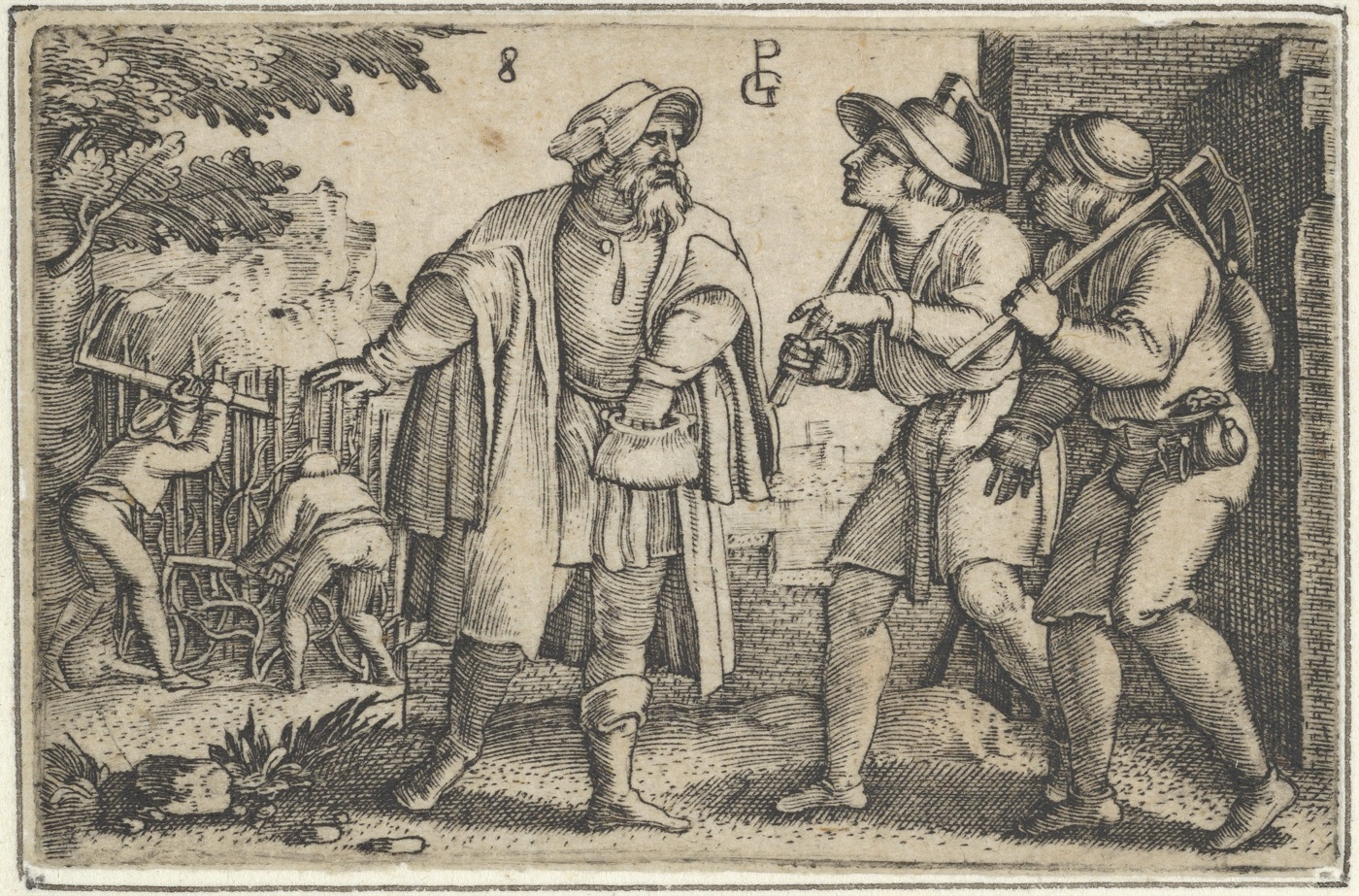
一個留著鬍子、披著長外衣的人站在中間,一隻手伸向左邊。左邊一排木樁上爬著藤,兩個人正彎著腰幹活,一個高高舉著工具。右邊走來兩個年輕人,肩上都扛著鎬。前面那個抬頭看著他,後面那個低著頭,背上掛著一個口袋。這兩個年輕人,哪一個會說“我去”?哪一個會真的去?
格奧爾格·彭茨(Georg Pencz),《父親與兩個兒子在葡萄園的比喻》(The Parable of the Father and His Two Sons in the Vineyard),“基督的故事”組畫之一,1534–35 年,銅版畫,美國紐約大都會藝術博物館藏。公有領域。 Wikimedia Commons一起讀太 21:23-32
23耶穌進了殿,正教訓人的時候,祭司長和民間的長老來問他說:“你仗著什麼權柄作這些事?給你這權柄的是誰呢?”
24耶穌回答說:“我也要問你們一句話,你們若告訴我,我就告訴你們我仗著什麼權柄作這些事。
25約翰的洗禮是從哪裡來的?是從天上來的?是從人間來的呢?”他們彼此商議說:“我們若說‘從天上來’,他必對我們說:‘這樣,你們為什麼不信他呢?’
26若說‘從人間來’,我們又怕百姓,因為他們都以約翰為先知。”
27於是回答耶穌說:“我們不知道。”耶穌說:“我也不告訴你們我仗著什麼權柄作這些事。”
28又說:“一個人有兩個兒子。他來對大兒子說:‘我兒,你今天到葡萄園裡去作工。’
29他回答說:‘我不去。’以後自己懊悔,就去了。
30又來對小兒子也是這樣說。他回答說:‘父啊,我去。’他卻不去。
31你們想,這兩個兒子是哪一個遵行父命呢?”他們說:“大兒子。”耶穌說:“我實在告訴你們,稅吏和娼妓倒比你們先進神的國。
32因為約翰遵著義路到你們這裡來,你們卻不信他;稅吏和娼妓倒信他。你們看見了,後來還是不懊悔去信他。”
當時現場
在聖殿裡,被人追問。 這是耶穌被釘十字架前幾天。祭司長和長老來問他憑什麼“作這些事”。克拉克說,“這些事”指的是:眾人把他當作應許的彌賽亞來歡呼,他把做買賣的趕出聖殿,又在殿裡公開教訓百姓。
Adam Clarke, Commentary on the Bible,太 21:23。譯自英文原著。
看英文原文
The things which the chief priests allude to, were his receiving the acclamations of the people as the promised Messiah, his casting the traders out of the temple, and his teaching the people publicly in it.
耶穌反問約翰的洗禮從哪裡來。他們回答「我們不知道」(27 節)。克拉克說,照實話說,這一句本該是“我們不肯說”。馬亨利說得更直:“他們說‘我們不知道’的時候,是說了謊,因為他們知道約翰的洗禮是從神來的。”
Adam Clarke, Commentary on the Bible,太 21:27;Matthew Henry, Commentary on the Whole Bible, Vol. V,太 21:23-27。譯自英文原著。
看英文原文
We cannot tell, said they; which, in the words of truth, should have been, We will not tell
when they said, We cannot tell, they told a lie, for they knew that John's baptism was of God.
比喻就是接著這一問講的。
稅吏和娼妓。 稅吏替羅馬收稅,娼妓靠賣身過活,在當時都是人人看不起的人。可是約翰傳道的時候,他們來了:「又有稅吏來要受洗,問他說:夫子,我們當作什麼呢?」(路 3:12)路加也記著:「眾百姓和稅吏,既受過約翰的洗,聽見這話,就以神為義;但法利賽人和律法師,沒有受過約翰的洗,竟為自己廢棄了神的旨意。」(路 7:29-30)吉爾提醒,31 節說的稅吏和娼妓,“是指從前是這樣的人”。
John Gill, Exposition of the Entire Bible,太 21:31。譯自英文原著。
看英文原文
that the publicans and the harlots; that is, such who had been so,
“今天”。 父親說的是「你今天到葡萄園裡去作工」(28 節)。吉爾說,去作工的時候是“今天,就是馬上,趁著還是白天”。馬亨利也說:“我們若真想為神、為自己的靈魂做點什麼,為什麼不是現在?為什麼不是今天?”
John Gill, Exposition of the Entire Bible,太 21:28;Matthew Henry, Commentary on the Whole Bible, Vol. V,太 21:28-32。譯自英文原著。
看英文原文
The time of working in it is "today"; directly, immediately, and whilst it is day
if ever we mean to do any thing for God and our souls, why not now? Why not to-day?
講解
看見什麼。 同一個父親,同一句話,兩個兒子。一個嘴上說“我不去”,後來去了(29 節);一個嘴上說「父啊,我去」,卻沒有去(30 節)。馬亨利說,比喻裡有兩種人:“有些人做得比答應的好,就是第一個兒子;有些人答應得比做的好,就是第二個兒子。”
Matthew Henry, Commentary on the Whole Bible, Vol. V,太 21:28-32。譯自英文原著。
看英文原文
some that prove better than they promise, represented by the first of those sons; others that promise better than they prove represented by the second.
兩個兒子都不是理想的兒子。馬亨利說:“兩個都有不是:一個粗魯,一個虛假。”耶穌問的不是哪一個說話好聽,是「哪一個遵行父命」(31 節)。
Matthew Henry, Commentary on the Whole Bible, Vol. V,太 21:28-32。譯自英文原著。
看英文原文
They both had their faults, one was rude and the other was false
請留意:耶穌先讓聽的人自己回答,他們說“大兒子”(31 節);然後耶穌才說出這比喻指的是誰。馬亨利說,這一類責備人的比喻,是“讓犯錯的人自己來評理,用他們自己的口定他們的罪”,好像當年拿單用一個比喻叫大衛知罪,最後說:「你就是那人」(撒下 12:7)。
Matthew Henry, Commentary on the Whole Bible, Vol. V,太 21:28-32。譯自英文原著。
看英文原文
Reproving parables are appeals to the offenders themselves, and judge them out of their own mouths.
Thus Nathan convinced David by a parable
如果我在場。 我大概也會很快答出“大兒子”。吉爾說,這個答案是常識就能給的,所以他們“一口就說出來,沒有停下來想”,卻“好像沒有發覺,這話接下來要用到他們自己身上”。
John Gill, Exposition of the Entire Bible,太 21:31。譯自英文原著。
看英文原文
an answer which natural reason, and common sense, directed them to; and therefore they give it out at once, directly, without staying upon it, and demurring about it; though they seemed not to be aware of the application of it to themselves, which follows
評別人容易,看見自己難。小兒子那一句「父啊,我去」(30 節),克拉克說:“這是十足的恭敬、客氣、口頭上的順服;可是他沒有去。他答應得好,卻沒有做。”
Adam Clarke, Commentary on the Bible,太 21:30。譯自英文原著。
看英文原文
This is all respect, complaisance, and professed, obedience; but he went not: he promised well, but did not perform.
神是怎樣的神。 父親對兩個兒子,開口都是吩咐,也都是父親的口氣:“我兒”(28 節)。馬亨利說:“這是父親的吩咐,裡面有權柄,也有疼愛。”
Matthew Henry, Commentary on the Whole Bible, Vol. V,太 21:28-32。譯自英文原著。
看英文原文
It is the command of a Father, which carries with it both authority and affection
大兒子當面頂撞過父親,後來去了,就算「遵行父命」(31 節)。馬亨利說:“你看神是多麼慈愛的父親。我們拒絕他,本來理當惹他動怒,他卻不記這個仇。”
Matthew Henry, Commentary on the Whole Bible, Vol. V,太 21:28-32。譯自英文原著。
看英文原文
See what a kind Father God is; he resents not the affront of our refusals, as justly he might.
稅吏和娼妓「先進神的國」(31 節),說的是“走在前頭”。門還開著嗎?馬亨利替祭司長們問了一句:“稅吏和娼妓都得了恩典和榮耀,我們難道不去爭一份嗎?”只是這些人“自以為是領頭的,不屑跟在後面,就算是進天國,特別是跟在稅吏後面”。
Matthew Henry, Commentary on the Whole Bible, Vol. V,太 21:28-32。譯自英文原著。
看英文原文
Shall publicans and harlots go away with grace and glory; and shall not we put in for a share?
These proud priests, that set up for leaders, scorned to follow, though it were into the kingdom of heaven, especially to follow publicans
和我有什麼關係。 小兒子不是壞在說了“我去”,是壞在沒有去。馬亨利說:“說和做是兩回事;說了不做的人很多。”耶穌說過文士和法利賽人「能說不能行」(太 23:3),也說過:「凡稱呼我主啊,主啊的人,不能都進天國;惟獨遵行我天父旨意的人,才能進去。」(太 7:21)馬亨利又說了一句,和無花果樹那一課連得上:“花苞和花,不是果子。”
Matthew Henry, Commentary on the Whole Bible, Vol. V,太 21:28-32。譯自英文原著。
看英文原文
Saying and doing are two things; and many there are that say, and do not; it is particularly charged upon the Pharisees, ch. xxiii. 3.
Buds and blossoms are not fruit.
對那些一開始就說過“我不去”的人,這比喻是個好消息。馬亨利說:“遲做總比不做好。”又說:“他懊悔了,就去了;這就是與悔改相稱的果子。”
Matthew Henry, Commentary on the Whole Bible, Vol. V,太 21:28-32。譯自英文原著。
看英文原文
Better late than never.
When he repented he went; that was the fruit meet for repentance.
說過“我去”,還沒有去的,今天也還可以去。
不同的看見
下面三位都是英國的解經家:馬亨利(1662–1714)、吉爾(1697–1771)、克拉克(約 1760–1832)。各段都譯自英文原著,出處附在後面。
經文自己說的(三家都照這個講): 耶穌自己把比喻用在兩種人身上:信了約翰的稅吏和娼妓,和不信約翰的“你們”(31–32 節),就是來問權柄的祭司長和長老(23 節)。下面三處,是讀法不同的地方。
一、兩個兒子,除了當時的人,還指誰?
“這個比喻首要的意思”,是講稅吏和娼妓接受了約翰;“但它還有更遠的所指”:外邦人從前也不順從,“像大兒子”,福音傳給他們的時候,他們就順從了真道。
Matthew Henry, Commentary on the Whole Bible, Vol. V,太 21:28-32。譯自英文原著。
看英文原文
The primary scope of the parable is, to show how the publicans and harlots, who never talked of the Messiah and his kingdom, yet entertained the doctrine, and submitted to the discipline, of John the Baptist
But it has a further reach; the Gentiles were sometimes disobedient, had been long so, children of disobedience, like the elder son (Tit. iii. 3, 4); yet, when the gospel was preached to them, they became obedient to the faith
他正面不同意:兩個兒子“不是指猶太人和外邦人”,“是猶太人中間的兩種人:文士和法利賽人,稅吏和罪人;主自己對這比喻的應用,把這一點說得最清楚”。
John Gill, Exposition of the Entire Bible,太 21:28。譯自英文原著。
看英文原文
by whom are meant not Jews and Gentiles
but by them are meant two sorts of people, among the Jews, the Scribes and Pharisees, and publicans and sinners; as the application of the parable, by our Lord himself, most clearly shows
他把範圍放寬:大兒子是“各樣的稅吏和罪人”,聽了約翰和基督的傳道,離開罪惡,接受了福音;小兒子是“文士、法利賽人和自以為義的人”,裝作熱心律法,卻不肯接受福音的救恩。他又說:“世上像這樣的人何其多,口稱認識神,行事卻與他相背!”
Adam Clarke, Commentary on the Bible,太 21:28、30。譯自英文原著。
看英文原文
our Lord points out, on the one hand, the tax-gatherers and sinners of all descriptions, who, convicted by the preaching of John and that of Christ, turned away from their iniquities and embraced the Gospel; and, on the other hand, the scribes, Pharisees, and self-righteous people, who, pretending a zeal for the law, would not receive the salvation of the Gospel.
What a multitude of such are in the world, professing to know God, but denying him in their works!
怎麼看: 耶穌自己的應用,只說到稅吏和娼妓,和眼前問話的人。比喻還能用到誰身上,三家各有延伸。這個比喻是當面對著問話的人講的;我們讀的時候,先要問的,也是自己像哪一個兒子,不是別人像哪一個。
二、“約翰遵著義路到你們這裡來”:誰在義路上?
是約翰:他“受了神的差遣,不是騙子;他教的道是真的,也忠心地傳了;他的生活無可指摘”。
John Gill, Exposition of the Entire Bible,太 21:32。譯自英文原著。
看英文原文
He had a commission from God; he was no impostor; the doctrine he taught was true, and which he faithfully delivered; his life and conversation were unblamable
也是約翰:“約翰是遵著義路來的,這是明擺著的。他傳道,教人悔改,行公義的事。”這正可以回答 25 節的問題:看他的果子,就知道他的洗禮從哪裡來。
Matthew Henry, Commentary on the Whole Bible, Vol. V,太 21:28-32。譯自英文原著。
看英文原文
Now it was evident that John came in the way of righteousness. In his ministry, he taught people to repent, and to work the works of righteousness.
他讀成另一種意思:約翰來到“你們這些在義路上的人”這裡,“這似乎才是這一句真正的意思和結構”。“你們”有神的啟示,有神設立的公義的典章。他說,把義路說成是約翰走的,“依我看,等於什麼也沒說”,因為一個自稱從神來的人,本來就該行在義路上。
Adam Clarke, Commentary on the Bible,太 21:32。譯自英文原著。
看英文原文
Or, John came unto you, who are in the way of righteousness. This seems rather to be the true meaning and construction of this passage.
had the revelation of God, and the ordinances of justice established among them
To say that it was John who came in the way of righteousness, and that to him the words refer, is, in my opinion, saying nothing
怎麼看: 吉爾、馬亨利讀成約翰的路是義的;克拉克讀成“你們”本有義路。兩種讀法都講得通,落點卻一樣:約翰來了,路是清楚的,「你們卻不信他」(32 節)。
三、大兒子“懊悔”,是從哪裡來的?
不是出於他自己:“人天生看不見自己的罪,也不覺得需要悔改”;他們悔改,“是出於神,是靠著神大能、有效的恩典”。他讀大兒子那句“我不去”(29 節),問:“人的自由意志在哪裡?這就是它真實的樣子;人天生沒有向善的意志。”
John Gill, Exposition of the Entire Bible,太 21:29。譯自英文原著。
看英文原文
not of themselves, men do not naturally see their sin, or need of repentance
but it was of God, and owing to his powerful and efficacious grace, that they repented
where is man's free will? this is the true picture of it; man has no will naturally to that which is good
他說“有些神所揀選的人,被容讓放縱了很久”;又說“我們的神等候施恩,不管我們從前多麼愚妄,只要我們悔改、改正,他必悅納;我們所在的約,給這樣的悔改留了餘地,這是當稱頌神的”。
Matthew Henry, Commentary on the Whole Bible, Vol. V,太 21:28-32。譯自英文原著。
看英文原文
Some that God hath chosen, are suffered for a great while to run to a great excess of riot
our God waits to be gracious, and, not withstanding our former follies, if we repent and mend, will favourably accept of us; blessed be God, we are under a covenant that leaves room for such a repentance.
他讀“我不去”,說這是“每一個罪人對神的邀請一般的回答”;又說:“只有不堅持拒絕的人,才是安全的。”
Adam Clarke, Commentary on the Bible,太 21:29。譯自英文原著。
看英文原文
This is the general reply of every sinner to the invitations of God
They only are safe who persist not in the denial.
怎麼看: 三家都看見大兒子迴轉了,也都看見神在等。迴轉是神的恩典在先,還是人的選擇也有一份,這一問,各教會的理解不盡相同,請向你所在的教會請教。
原文詞眼
「以後自己懊悔,就去了」(29 節);「你們看見了,後來還是不懊悔去信他」(32 節)。
兩個“懊悔”,原文是同一個詞 μεταμέλομαι。Thayer 說,它的本義是“事後掛心”。他列的經文裡,除了這兩節,還有猶大:「賣耶穌的猶大,看見耶穌已經定了罪,就後悔」(太 27:3),和合本譯作“後悔”,原文是同一個詞。
Thayer's Greek-English Lexicon of the New Testament,G3338。譯自英文原著。
看英文原文
properly, it is a care to one afterward
Matthew 21:29, 32; Matthew 27:3; 2 Corinthians 7:8; Hebrews 7:21
新約裡常見的“悔改”是另一個詞 μετανοέω,像「天國近了,你們應當悔改」(太 4:17)。兩個詞有什麼不同?Thayer 說,常聽到的那些區分,比如一個只是情緒、一個是心志的改變,“在用法上很難站得住”;不過 μετανοέω 是“更完整、更高貴的詞”,常用命令式,μεταμέλομαι 從來不用命令式。
Thayer's Greek-English Lexicon of the New Testament,G3340、G3338。譯自英文原著。
看英文原文
heartily to amend with abhorrence of one's past sins: Matthew 3:2; Matthew 4:17; Mark 1:15
seem hardly to be sustained by usage
But that μετανοέω is the fuller and nobler term, expressive of moral action and issues
it is often employed in the imperative (μεταμέλομαι never)
所以單看這個詞,看不出是怎樣的懊悔。大兒子懊悔了,就去了葡萄園;猶大後悔了,結局全然不同。馬亨利從英文的 repentance 聯想到希臘文:“悔改是 metanoia,事後的明白;也是 metameleia,事後的掛心。”要緊的是掛心之後,人往哪裡走。
Matthew Henry, Commentary on the Whole Bible, Vol. V,太 21:28-32。譯自英文原著。
看英文原文
Repentance is metanoia—an after-wit: and metameleia—an after-care.
31 節的“先進”,原文是 προάγω。Thayer 把這一節解作:“在進神的國這件事上,走在某人前頭。”
Thayer's Greek-English Lexicon of the New Testament,G4254。譯自英文原著。
看英文原文
to take precedence of one in entering into the kingdom of God, Matthew 21:31
請思考
沒有標準答案,不打分。寫下來,只給自己看。
- 你最近對神、對人說過哪一句“我去”,到現在還沒有去?
- 你身上有沒有一處,起初說過“我不去”,後來改變了?是什麼讓你改變的?
- 聽的人很快答出“大兒子”,卻沒發覺說的是自己。你讀這個比喻時,第一個想到的是別人,還是自己?
- 稅吏和娼妓“走在前頭”。有沒有你看不起的人,其實在信靠神這件事上走在你前頭?
這週去做
想一件你答應了神、或答應了人,卻一直拖著沒做的事。這一週就去做,哪怕只做第一步。
如果有一件事,你一直說“我不去”,這週安靜下來問自己:現在還是“不去”嗎?
週末問自己:這一週,我說的和我做的,差了多少?
延伸參考
- Matthew Henry, Commentary on the Whole Bible, Vol. V:太 21:23-32(英文原著,公有領域,CCEL 可免費讀全文)
- 法蘭士(R. T. France)著,丁道爾新約註釋《馬太福音》,校園書房出版社(ISBN 9789575874988):太 21:28-32
- 施諾格拉斯《主耶穌的比喻》:兩個兒子一章
本單元其它比喻單元四 · 邀請與拒絕
- 不結果的無花果樹 路 13:1-9
- 兩個兒子 太 21:23-32 本課
- 兇惡園戶 太 21:33-46
- 娶親筵席 太 22:1-14 即將上線
- 大筵席 路 14:15-24 即將上線
經文:和合本(1919),用字按本站規則現代化。「不同的看見」裡的註釋都譯自英文原著(公有領域),每段可展開看英文原文。