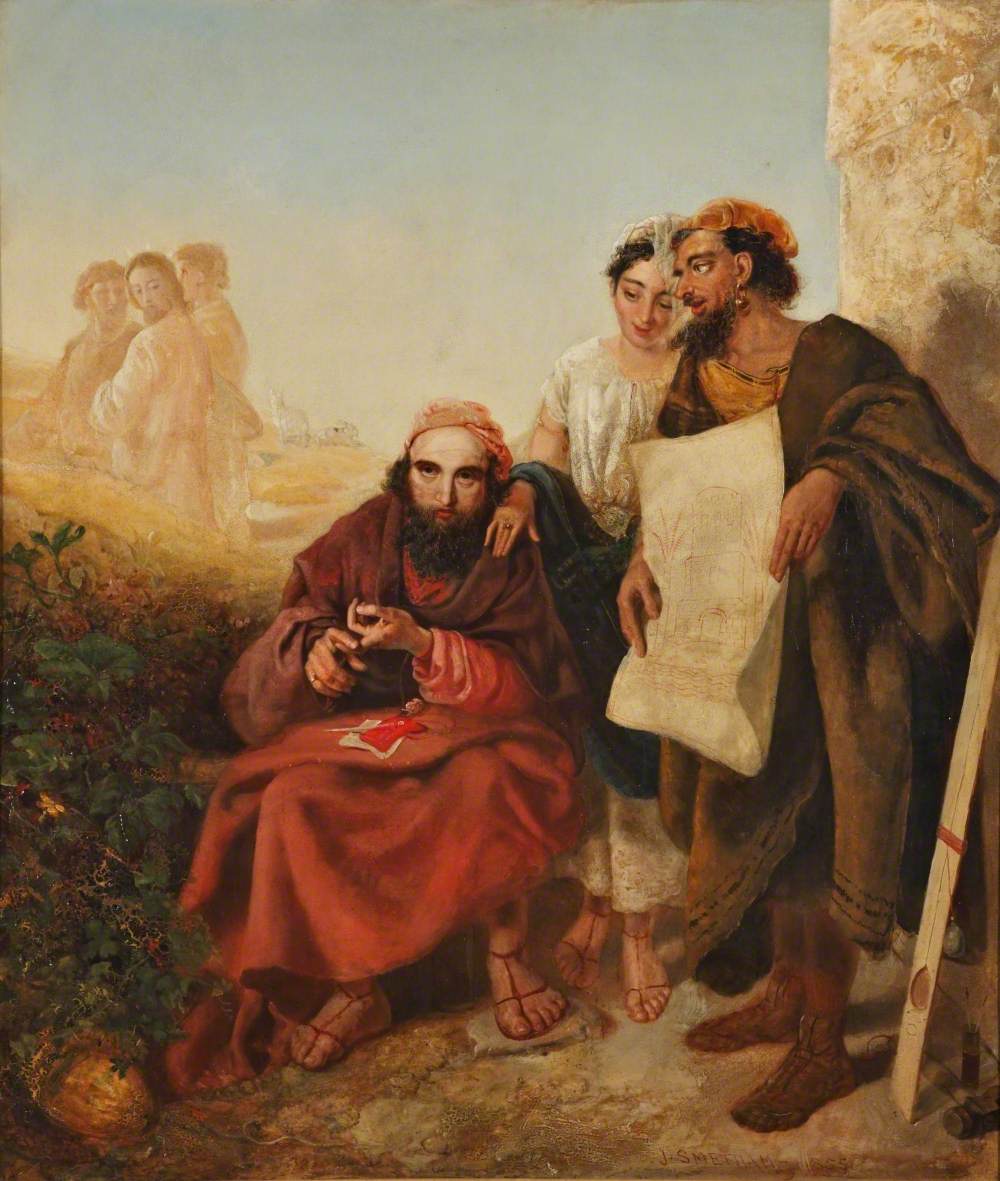
一個披著紅袍的人坐在石頭邊,低著頭,用一隻手掰著另一隻手的手指,膝上放著一張紅色的紙。一個年輕女子站在他身後,一隻手搭在他肩上。旁邊一個纏頭巾的人,捧著一大張紙,上面畫著一座有拱門的房子,他用手指點著圖。右邊靠著一根木杆。左上方遠處,三個人影淡淡地走過,中間那一位回過頭來。你看,坐著的人在算什麼?
詹姆斯·斯梅瑟姆(James Smetham),《算計花費》(Counting the Cost),1855 年,油畫,英國利物浦沃克美術館藏。公有領域。 Wikimedia Commons一起讀路 14:28-33
(25–27 节)有極多的人和耶穌同行,他轉過來對他們說話(見“當時現場”)。
28“你們哪一個要蓋一座樓,不先坐下算計花費,能蓋成不能呢?
29恐怕安了地基,不能成功,看見的人都笑話他,
30說:‘這個人開了工,卻不能完工。’
31或是一個王出去和別的王打仗,豈不先坐下酌量,能用一萬兵去敵那領二萬兵來攻打他的嗎?
32若是不能,就趁敵人還遠的時候,派使者去求和息的條款。
33這樣,你們無論什麼人,若不撇下一切所有的,就不能作我的門徒。”
當時現場
一大群人跟著走。 「有極多的人和耶穌同行,他轉過來對他們說」(路 14:25)。前面,他在一個法利賽人首領家裡吃飯,講了大筵席的比喻(14:1-24)。馬亨利說,對法利賽人,他講的是謙卑和愛;這裡,他轉過來對著跟在後面的群眾,要他們在承認作門徒以前,先明白作門徒的條件。
Matthew Henry, Commentary on the Whole Bible, Vol. V,路 14:25-35。譯自英文原著。
看英文原文
To Pharisees he preached humility and charity. He is in these verses directing his discourse to the multitudes that crowded after him, and seemed zealous in following him; and his exhortation to them is to understand the terms of discipleship, before they undertook the profession of it, and to consider what they did.
他們指望什麼。 吉爾說,那時許多人跟著,“或許都在指望他到了耶路撒冷,就建立地上的國度”。
John Gill, Exposition of the Entire Bible,路 14:25。譯自英文原著。
看英文原文
and all perhaps were in expectation of his setting up a temporal kingdom when he came there
他先說了兩句重話。 「人到我這裡來,若不愛我勝過愛自己的父母、妻子、兒女、弟兄、姐妹和自己的性命,就不能作我的門徒。凡不背著自己十字架跟從我的,也不能作我的門徒」(路 14:26-27)。馬太福音也記了相近的話(太 10:37-38)。
26 節和合本譯作“愛我勝過”,原文是“恨”。克拉克說,這是希伯來的說法:雅各「愛拉結勝似愛利亞」(創 29:30),下一節就說「利亞失寵」(創 29:31),原文也是“恨”,意思是愛得少。馬亨利說,這“不是對他們本人有一點恨”。
Adam Clarke, Commentary on the Bible,路 14:26;Matthew Henry, Commentary on the Whole Bible, Vol. V,路 14:25-35。譯自英文原著。
看英文原文
where Leah's being hated is explained by Rachel's being loved more than Leah
Not that their persons must be in any degree hated, but our comfort and satisfaction in them must be lost and swallowed up in our love to Christ
什麼樣的樓。 克拉克說,這“樓”大概就是一座住房,照東方的樣式,房頂上砌了垛牆,可以乘涼,也可以躲避、防守。
Adam Clarke, Commentary on the Bible,路 14:28。譯自英文原著。
看英文原文
Probably this means no more than a dwelling house, on the top of which, according to the Asiatic manner, battlements were built, both to take the fresh air on, and to serve for refuge from and defense against an enemy.
後面接著講鹽。 兩個比方講完,耶穌說:「鹽本是好的,鹽若失了味,可用什麼叫它再鹹呢?」(路 14:34)
講解
看見什麼。 兩個問句,都是“你們哪一個……”,問的是聽的人自己會怎麼做。兩個人都做同一件事:“先坐下”。蓋樓的「先坐下算計花費」(28 節),打仗的王「先坐下酌量」(31 節)。
馬亨利說,兩個比方各有重點:“前一個說,我們要估量信仰的花費;後一個說,我們要估量信仰的危險。”
Matthew Henry, Commentary on the Whole Bible, Vol. V,路 14:25-35。譯自英文原著。
看英文原文
the former showing that we must consider the expenses of our religion, the latter that we must consider the perils of it.
沒算好的結局,是被人笑話:「這個人開了工,卻不能完工」(30 節)。
如果我在場。 我在那一大群人裡。馬亨利說,大家以為他會說:“凡到我這裡來作我門徒的,必得著豐富的錢財和尊榮。”“他卻告訴他們正相反的話。”
Matthew Henry, Commentary on the Whole Bible, Vol. V,路 14:25-35。譯自英文原著。
看英文原文
They expected that he should say, "If any man come to me, and be my disciple, he shall have wealth and honour in abundance; let me alone to make him a great man." But he tells them quite the contrary.
馬亨利還說,撒但“只給人看好的,把壞的藏起來”;基督卻經得起人仔細查看。
Matthew Henry, Commentary on the Whole Bible, Vol. V,路 14:25-35。譯自英文原著。
看英文原文
Satan shows the best, but hides the worst, because his best will not counter-vail his worst; but Christ's will abundantly.
神是怎樣的神。 耶穌沒有先讓人跟上來,再慢慢說難處。他在路上轉過身來,當著一大群人把代價說在前頭。馬亨利說:“他既然這樣公道,把跟從他要遇見的難處明明告訴我們,我們也要對自己公道,認真掂量。”
Matthew Henry, Commentary on the Whole Bible, Vol. V,路 14:25-35。譯自英文原著。
看英文原文
Since he has been so just to us as to tell us plainly what difficulties we shall meet with in following him, let us be so just to ourselves as to weigh the matter seriously before we take upon us a profession of religion.
可是“算計花費”,不是叫人算出自己夠不夠。馬亨利說:“真的,我們誰也沒有足夠的力量自己蓋成這座樓;但基督說過:我的恩典夠你用的。”「我的恩典夠你用的」(林後 12:9)。保羅也說:「我深信那在你們心裡動了善工的,必成全這工」(腓 1:6)。
Matthew Henry, Commentary on the Whole Bible, Vol. V,路 14:25-35。譯自英文原著。
看英文原文
It is true, we have none of us in ourselves sufficient to finish this tower, but Christ hath said, My grace is sufficient for thee
和我有什麼關係。 馬亨利列了這座樓可能要付的價:治死自己的罪,連最愛的私慾也在內;一生捨己、警醒;也許還有名聲、產業、自由,甚至性命。接著他問:“就算要付上這一切,比起基督為我們買來這些所付的代價,又算什麼呢?”
Matthew Henry, Commentary on the Whole Bible, Vol. V,路 14:25-35。譯自英文原著。
看英文原文
And if it should cost us all this, what is it in comparison with what it cost Christ to purchase the advantages of religion for us, which come to us without money and without price?
吉爾提醒,“先坐下”不是叫人一直坐著:這“不是說該承認信仰的人要拖延”,而是要想清楚、小心、謹慎地去做。
John Gill, Exposition of the Entire Bible,路 14:28。譯自英文原著。
看英文原文
which does not imply, that persons should delay making a profession, on whom it is incumbent; but that this should be done with thoughtfulness, care, and prudence
不同的看見
下面三位都是英國的解經家:馬亨利(1662–1714)、吉爾(1697–1771)、克拉克(約 1760–1832)。各段都譯自英文原著,出處附在後面。
經文自己說的(三家都照這個講): 蓋樓的、打仗的,都要先坐下算一算;算的是自己能不能做到底。耶穌把這兩個比方落在 33 節:撇下一切所有的,才能作他的門徒。下面兩處,是讀法不同的地方。
一、那個“領二萬兵來攻打”的王,是誰?
這一處有一部分是寓意讀法:把比喻裡的人物各對應一位。比喻本身只說:兵力不夠,就趁早求和。
他的主要讀法是:作門徒的要估量跟從基督的危險,看自己能不能抵擋“地獄和世界的勢力,帶著兩萬兵來攻”。他又說,這比喻“另有一種用法”:一直犯罪的人是在和神打仗,最驕傲的罪人也不是神的對手,所以要趁早和神和好,同「你同告你的對頭還在路上,就趕緊與他和息」(太 5:25)是一個意思。
Matthew Henry, Commentary on the Whole Bible, Vol. V,路 14:25-35。譯自英文原著。
看英文原文
whether we are able to encounter the forces of hell and earth, which come against us twenty thousand strong.
This parable is another way applicable
Those that persist in sin make war against God
一方的王是承認基督的人,“另一方的王是魔鬼”。所以他說,派人去求和,就是“放棄和罪、撒但、世界爭戰,和它們講和”,那是“羞恥、可恥的”。
John Gill, Exposition of the Entire Bible,路 14:31-32。譯自英文原著。
看英文原文
The king on the other side, is the devil
so to give out, and leave off fighting with sin, Satan, and the world, and make peace with them, is shameful and scandalous
31、32 兩節沒有另加解釋。他在 28 節說,這個比喻顯明,沒有想過要遇見什麼難處、自己有什麼力量,就去作門徒,是荒唐的。
Adam Clarke, Commentary on the Bible,路 14:28。譯自英文原著。
看英文原文
This parable represents the absurdity of those who undertook to be disciples of Christ, without considering what difficulties they were to meet with, and what strength they had to enable them to go through with the undertaking.
怎麼看: 馬亨利的第二種讀法說“要求和”,吉爾說“求和是羞恥”,方向正好相反,可見寓意讀法容易各走各的。耶穌自己的落點在 33 節:「這樣,你們無論什麼人,若不撇下一切所有的,就不能作我的門徒」。兩個比方要人學的,都是“先坐下”。
二、“撇下一切所有的”,是什麼意思?
“就是說,除非你們預備好撇下一切,並且同意這樣做。”
Matthew Henry, Commentary on the Whole Bible, Vol. V,路 14:25-35。譯自英文原著。
看英文原文
that is, except you count upon forsaking all and consent to it
是“蒙召的時候”撇下:親屬、朋友、產業,一切所有的。他說,這是對 26 節的解釋。
John Gill, Exposition of the Entire Bible,路 14:33。譯自英文原著。
看英文原文
when called to it, relations, friends, possessions, estates, and what not, which is an explanation of Luke 14:26
“這句看來特別是對那時和將來要傳他福音的人說的”,他們要走遍各地,向失喪的世界傳揚救恩。
Adam Clarke, Commentary on the Bible,路 14:33。譯自英文原著。
看英文原文
This seems to be addressed particularly to those who were then, and who were to be, preachers of his Gospel; and who were to travel over all countries, publishing salvation to a lost world.
怎麼看: 三家都沒有說,每個門徒都要把家產全部賣掉;可是對“撇下”落在誰身上、什麼時候、到什麼地步,讀法不同。耶穌說的是「你們無論什麼人」(33 節)。這句話怎樣落實在每個門徒身上,這一問,各教會的理解不盡相同,請向你所在的教會請教。
原文詞眼
「若不撇下一切所有的,就不能作我的門徒」(33 節)
“撇下”,原文是 ἀποτάσσομαι。Thayer 說,這個詞的本義是“離開某人,就是告辭、辭別”;轉過來用,是“棄絕、撇下”。轉義一項下,他只列了這一節。
Thayer's Greek-English Lexicon of the New Testament,G657。譯自英文原著。
看英文原文
properly, to separate oneself, withdraw oneself from anyone, i. e. to take leave of, bid farewell to
tropically, to renounce, forsake: τίνι, Luke 14:33
本義一項下,Thayer 列了路加福音另一處:有人對耶穌說:「主,我要跟從你,但容我先去辭別我家裡的人」(路 9:61)。那裡的“辭別”,就是這個詞。保羅離開哥林多時,「就辭別了弟兄」(徒 18:18),也是這個詞。
那個人想先“辭別”家裡的人,再來跟從;耶穌在這裡說,跟從他,是向一切所有的“辭別”。
體裁說明
這一則是 6 則“有體裁說明”的比喻之一。下面把幾種看法擺出來,不下結論。
路加沒有叫它們“比喻”。 這兩段前面沒有“耶穌設一個比喻”這樣的話,只是兩個問句:“你們哪一個……”“或是一個王……豈不……”。樓蓋成了沒有、仗打了沒有,都沒有說。它們更像兩個比方,不像浪子那樣有頭有尾的故事。
可是註釋家都把它們當比喻讀。 吉爾在 31 節說,耶穌用“另一個比方,或說比喻”說明同一件事。馬亨利稱它們為“兩個比方”,講到打仗時又說“這個比喻”。
John Gill, Exposition of the Entire Bible,路 14:31;Matthew Henry, Commentary on the Whole Bible, Vol. V,路 14:25-35。譯自英文原著。
看英文原文
Our Lord illustrates the same thing, the business of a profession, by another similitude, or parable
Our Saviour here illustrates the necessity of it by two similitudes
為什麼兩個合成一課。 兩個比方連著說,一個講花費,一個講危險,像藏寶和尋珠那樣成對。它們又夾在三句“就不能作我的門徒”中間(26、27、33 節):前面兩句說代價,後面一句收結。拆開講,就聽不出這個次序。
怎麼看: 叫它“比喻”還是“比方”,不影響怎麼讀。讀的時候,跟著耶穌的問句,自己先坐下來算一算。
請思考
沒有標準答案,不打分。寫下來,只給自己看。
- 你開始跟從耶穌的時候,想過要付什麼代價嗎?那時候想的,和後來遇到的,一樣嗎?
- 你身邊有沒有一座“開了工卻沒有完工”的樓:一件為神開始、後來放下的事?
- 馬亨利說,基督把難處明明告訴我們。你覺得,為什麼耶穌要在一大群人跟著的時候,說這樣的重話?
- “撇下一切所有的”。今天,有哪一樣你抓得比耶穌還緊?
這週去做
這一週找一個安靜的時候,真的“坐下來”,拿一張紙,寫兩欄:
- 左邊:跟從耶穌,這一年我付上了什麼,或者可能要付上什麼;
- 右邊:這一年,他給了我什麼。
寫完,為右邊那一欄感謝神;左邊那一欄,求他「我的恩典夠你用的」(林後 12:9)這句話在你身上應驗。
延伸參考
- Matthew Henry, Commentary on the Whole Bible, Vol. V:路 14:25-35(英文原著,公有領域,CCEL 可免費讀全文)
- 莫理斯(Leon Morris)著,丁道爾新約註釋《路加福音》:路 14:25-35
- 施諾格拉斯《主耶穌的比喻》:蓋樓與打仗一章
本單元其它比喻單元五 · 門徒訓練
- 兩種蓋房的人 太 7:24-27
- 好撒瑪利亞人 路 10:25-37
- 葡萄園工人 太 20:1-16
- 蓋樓與打仗 路 14:28-33 本課
- 無用的僕人 路 17:7-10 即將上線
- 警醒的僕人 路 12:35-40 即將上線
經文:和合本(1919),用字按本站規則現代化。「不同的看見」裡的註釋都譯自英文原著(公有領域),每段可展開看英文原文。