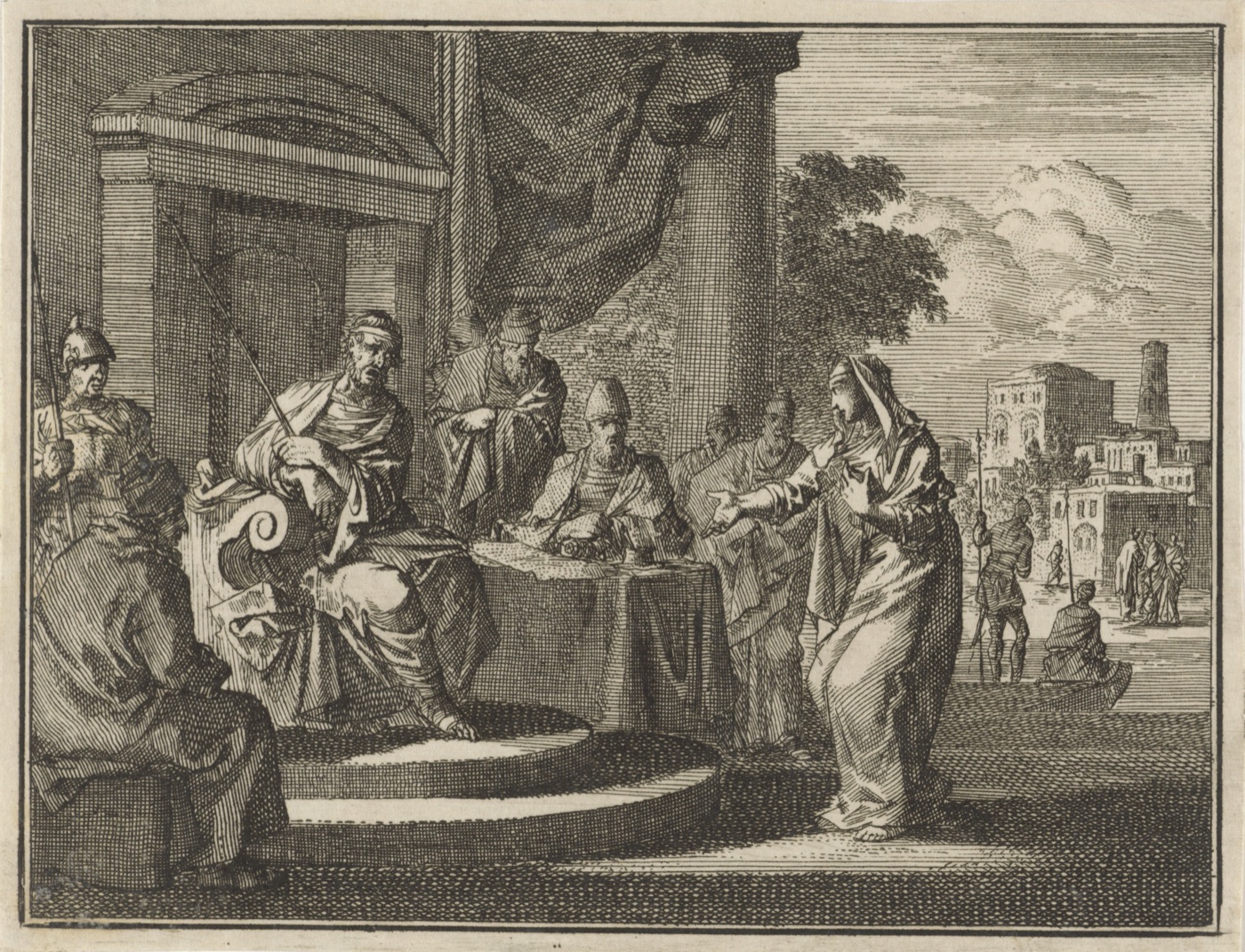
一座有柱子和帷幔的廳堂。一個人坐在高起來的圓臺上,頭上扎著帶子,手裡握著一根長杖。他身邊一張桌子,桌上攤著紙和書卷,幾個人圍在桌旁,左邊站著一個戴頭盔、拿長矛的兵。臺前站著一個蒙著頭巾、赤著腳的婦人,一隻手抬到臉邊,另一隻手張開,伸向坐著的那個人。遠處是一座城,街上有人在走。你看,這屋子裡的人,有誰在聽她說話?
揚·呂肯(Jan Luyken),《被一個控訴的婦人糾纏的法官的比喻》(Gelijkenis van de rechter die wordt lastiggevallen door een klagende vrouw),1712 年,蝕刻版畫,荷蘭阿姆斯特丹國立博物館藏。公有領域。 Wikimedia Commons一起讀路 18:1-8
(17:20–37)法利賽人問神的國幾時來到;耶穌對門徒講人子降臨的日子:「日子將到,你們巴不得看見人子的一個日子,卻不得看見」(路 17:22)。
1耶穌設一個比喻,是要人常常禱告,不可灰心,
2說:“某城裡有一個官,不懼怕神,也不尊重世人。
3那城裡有個寡婦,常到他那裡,說:‘我有一個對頭,求你給我伸冤。’
4他多日不准,後來心裡說:‘我雖不懼怕神,也不尊重世人,
5只因這寡婦煩擾我,我就給她伸冤吧,免得她常來纏磨我。’”
6主說:“你們聽這不義之官所說的話。
7神的選民晝夜呼籲他,他縱然為他們忍了多時,豈不終久給他們伸冤嗎?
8我告訴你們,要快快地給他們伸冤了。然而人子來的時候,遇得見世上有信德嗎?”
當時現場
為什麼講這個比喻。 路加先把用意寫在前頭:「是要人常常禱告,不可灰心」(1 節)。馬亨利說,這個比喻的鑰匙就掛在門口。
Matthew Henry, Commentary on the Whole Bible, Vol. V,路 18:1-8。譯自英文原著。
看英文原文
This parable has its key hanging at the door; the drift and design of it are prefixed.
前面一章,耶穌剛對門徒講完人子降臨的日子:「日子將到,你們巴不得看見人子的一個日子,卻不得看見」(路 17:22)。克拉克說,患難和荒涼就要臨到那地,門徒需要許多忍耐、不斷的剛強,所以要恆切禱告;又說,神叫人覺得需要什麼,人就要一直求,直到得著完全的應允。
Adam Clarke, Commentary on the Bible,路 18:1。譯自英文原著。
看英文原文
that as afflictions and desolations were coming on the land, and they should have need of much patience and continual fortitude, and the constant influence and protection of the Almighty, therefore they should be instant in prayer
that men should never cease praying for that the necessity of which God has given them to feel, till they receive a full answer to their prayers
“常常禱告”是什麼意思。 吉爾說,這不是說人要一直在密室裡、一直在聚會中禱告,把生活裡該盡的本分都丟下;意思是要堅持禱告,不要因為沒有立刻得著回應,就停下來、灰心。
John Gill, Exposition of the Entire Bible,路 18:1。譯自英文原著。
看英文原文
This is not to be understood, that a man should be always actually engaged in the work of prayer
but his meaning is, that a man should persevere in prayer, and not leave off, or be dejected, because he has not an immediate answer
一個什麼樣的官。 「不懼怕神,也不尊重世人」(2 節)。馬亨利說,他既不管自己的良心,也不管自己的名聲。克拉克說,因為他不懼怕神,就不理會公義的呼聲;因為他不尊重人,寡婦來訴苦,他也不動心。
Matthew Henry, Commentary on the Whole Bible, Vol. V,路 18:1-8;Adam Clarke, Commentary on the Bible,路 18:2。譯自英文原著。
看英文原文
he had no manner of concern either for his conscience or for his reputation
Because this person feared not God, he paid no attention to the calls of justice; and because he respected not man, he was unmoved at the complaint of the widow.
一個寡婦。 律法吩咐「不可苦待寡婦和孤兒」(出 22:22),詩篇說神「作寡婦的伸冤者」(詩 68:5)。馬亨利說,窮寡婦常有許多對頭,趁她軟弱無助,侵奪她的權利,把她僅有的一點騙去。她沒有賄賂可送,也沒有一個叫這官害怕的大人物替她說話。
Matthew Henry, Commentary on the Whole Bible, Vol. V,路 18:1-8。譯自英文原著。
看英文原文
Poor widows have often many adversaries, who barbarously take advantage of their weak and helpless state to invade their rights, and defraud them of what little they have
for she had no bribe to give him, no great man whom he stood in any awe of to speak for her
馬亨利又說,她在他門口求,在街上跟著他求,在公堂上求,口裡總是那一句:「求你給我伸冤」(3 節)。
Matthew Henry, Commentary on the Whole Bible, Vol. V,路 18:1-8。譯自英文原著。
看英文原文
she begged it at his door, followed him in the streets, solicited him in open court
“煩擾”。 5 節「只因這寡婦煩擾我」,上一課門裡那人說「不要攪擾我」(路 11:7):Thayer 把這兩節列在同一條,是同一個說法,叫人受累。
講解
看見什麼。 這個官自己說得明明白白:「我雖不懼怕神,也不尊重世人」(4 節)。他終於給寡婦伸冤,不是因為公道,也不是因為可憐她,是怕她「常來纏磨我」(5 節)。吉爾說,這個官的為人、他心裡的盤算、他的動機,講這個比喻的應用時都要放在一邊,只用來加強“從小推到大”的論證。
John Gill, Exposition of the Entire Bible,路 18:5。譯自英文原著。
看英文原文
The character of this judge, his reasoning with himself upon it, his principles from which he acted, and the ends he had in view, are wholly to be left out in the accommodation of this parable; and no farther to be considered than as the argument from the lesser to the greater may be strengthened by them
如果我在場。 我是一個門徒,剛聽耶穌說「你們巴不得看見人子的一個日子,卻不得看見」(路 17:22)。等不到的日子裡,我還會禱告嗎?克拉克說,耶穌是要我們這樣推想:連這樣一個名聲敗壞的官,對一個他根本看不起的窮寡婦,都會被她不住的懇求打動;神無限良善、滿有憐憫,用最溫柔的愛愛他所造的人,豈不更樂意把他完全的救恩,賜給一切殷勤尋求的人?
Adam Clarke, Commentary on the Bible,路 18:6。譯自英文原著。
看英文原文
If a person of such an infamous character as this judge was could yield to the pressing and continual solicitations of a poor widow, for whom he felt nothing but contempt, how much more ready must God be, who is infinitely good and merciful, and who loves his creatures in the tenderest manner, to give his utmost salvation to all them who diligently seek it!
神是怎樣的神。 這個比喻不是說神像那個官,是說神和那個官正好相反。馬亨利一口氣列了九處不同,這裡取四處,列成下表:
| 寡婦和那個官 | 我們和神 | |
|---|---|---|
| 是什麼關係 | 她是個外人,和那官毫無關係 | 神的選民,是他認識、愛、喜悅的 |
| 他讓不讓人靠近 | 那官叫她站遠一點 | 天父叫我們放膽到他面前,呼叫“阿爸,父” |
| 什麼時候能去 | 只在某些時候見得著 | 晝夜隨時可以呼求 |
| 一直求的結果 | 惹那官生氣 | 神喜悅正直人的禱告 |
馬亨利的原話是:寡婦是個外人,和那官毫無關係,神禱告的百姓卻是他自己的選民,是他認識、愛、喜悅的;她去見的官叫她站遠一點,我們去見的卻是父,他叫我們放膽到他面前,教我們呼叫“阿爸,父”;她只在某些時候見得著那官,我們卻可以晝夜隨時向神呼求;她一直求,會惹那官生氣,我們一直求,神卻喜悅,正直人的禱告是他所喜悅的。
Matthew Henry, Commentary on the Whole Bible, Vol. V,路 18:1-8。譯自英文原著。
看英文原文
This widow was a stranger, nothing related to the judge; but God's praying people are his own elect, whom he knows, and loves, and delights in
She came to a judge that bade her keep her distance; we come to a Father that bids us come boldly to him, and teaches us to cry, Abba, Father.
She could have access to the judge only at some certain times; but we may cry to God day and night, at all hours
Her importunity was provoking to the judge, and she might fear lest it should set him more against her; but our importunity is pleasing to God; the prayer of the upright is his delight
上一課,門裡的人起來,不是「因他是朋友」(路 11:8);這一課,官給寡婦伸冤,也不是因為他敬畏神。兩個比喻,一個沒有交情可靠,一個沒有公義可靠,靠的都是不住地求。何況我們求的,是天父,是公義的神。
和我有什麼關係。 馬亨利說,我們為屬靈的仇敵禱告,也要這樣具體,像保羅那樣:「為這事,我三次求過主,叫這刺離開我」(林後 12:8)。“主啊,治死我這個敗壞;主啊,叫我能抵擋這個試探。”我們也要記掛受逼迫、受欺壓的教會,求神為他們伸冤。
Matthew Henry, Commentary on the Whole Bible, Vol. V,路 18:1-8。譯自英文原著。
看英文原文
We ought to be particular in praying against our spiritual enemies, as St. Paul was
Lord, mortify this corruption. Lord, arm me against this temptation. We ought to concern ourselves for the persecuted and oppressed churches, and to pray that God would do them justice, and set them in safety.
比喻最後,耶穌不是問“神會不會伸冤”,他已經說了「要快快地給他們伸冤了」(8 節);他問的是我們:「人子來的時候,遇得見世上有信德嗎」(8 節)。馬亨利說,耶穌尋找的頭一件事,不是問“有沒有清白”,而是問“有沒有信心”。
Matthew Henry, Commentary on the Whole Bible, Vol. V,路 18:1-8。譯自英文原著。
看英文原文
It supposes that faith is the great thing that Jesus Christ looks for. He looks down upon the children of men, and does not ask, Is there innocency? but, Is there faith?
接到下一課。 緊接著,耶穌「向那些仗著自己是義人、藐視別人的,設一個比喻」(路 18:9),就是法利賽人與稅吏。馬亨利說,這兩個比喻,一個教我們禱告要火熱,一個教我們禱告要謙卑。
Matthew Henry, Commentary on the Whole Bible, Vol. V,路 18 章提要。譯自英文原著。
看英文原文
The parable of the importunate widow, designed to teach us fervency in prayer
The parable of the Pharisee and publican, designed to teach us humility
不同的看見
下面三位都是英國的解經家:馬亨利(1662–1714)、吉爾(1697–1771)、克拉克(約 1760–1832)。各段都譯自英文原著,出處附在後面。
經文自己說的(三家都照這個講): 要常常禱告,不可灰心;神必給他的選民伸冤;神和那個不義的官不一樣。下面兩處,是讀法不同的地方。
一、7 節「他縱然為他們忍了多時」:“忍”的是誰?
兩面都有:神對他百姓的仇敵忍耐,沒有立刻向他們施行報應;神也操練他百姓的忍耐,沒有立刻為他們申訴。
Matthew Henry, Commentary on the Whole Bible, Vol. V,路 18:1-8。譯自英文原著。
看英文原文
he exercises patience towards the adversaries of his people, and does not take vengeance on them; and he exercises the patience of his people, and does not plead for them
或是指對選民的仇敵忍耐;“更可能”是指對選民本身忍耐,這句話可以譯作“並且對他們恆久忍耐”:他遲延他的來到,要等到他的選民從世人中間都被招聚進來(彼後 3:9)。
John Gill, Exposition of the Entire Bible,路 18:7。譯自英文原著。
看英文原文
or rather with the elect, for the words may be rendered, "and is longsuffering towards them": delays his coming, and the execution of vengeance, as on the Jewish nation, so upon the whole world of the ungodly, till his elect are gathered in from among them; see 2 Peter 3:9.
他照幾部古抄本,把這一句讀成“他憐憫他們”,說這樣一來,神就完全不像那個不義的官:選民晝夜呼求,又有一位憐憫他們的神,所以必得救恩。
Adam Clarke, Commentary on the Bible,路 18:7。譯自英文原著。
看英文原文
Rather, and He is compassionate towards Them, and consequently not at all like to the unrighteous judge.
they are sure of salvation, because they ask it from that God who is towards them a Father of eternal love and compassion
怎麼看: 三家讀法不同,落點卻一樣:神遲延,不是因為他不在意。彼得也說:「主所應許的尚未成就,有人以為他是耽延,其實不是耽延,乃是寬容你們」(彼後 3:9)。
二、8 節「人子來的時候,遇得見世上有信德嗎」:說的是哪一次來?
這一處牽涉末世,讀法不同。
人子在各個時代的護理中來,為受屈的百姓申訴;到了那大日,他要最後一次來。他說這一問暗示,那時找得著的信心,比人所盼望的少,特別是相信他會來的信心。
Matthew Henry, Commentary on the Whole Bible, Vol. V,路 18:1-8。譯自英文原著。
看英文原文
he will come in his providence to plead the cause of his injured people in every age, and at the great day he will come finally to determine the controversies of Zion
In particular, he will find few that have faith concerning his coming.
人子來,或是來毀滅耶路撒冷,或是來審判世界。到了末日,信的道理少了,信的恩典更少,在禱告裡運用信心的更少。
John Gill, Exposition of the Entire Bible,路 18:8。譯自英文原著。
看英文原文
either to destroy Jerusalem, or to judge the world
there will then be little of the doctrine of faith, and less of the grace of faith, and still less of the exercise of faith, particularly in prayer
“信德”不如讀成“忠信”:他問的是,在這地上找得著忠信嗎?
Adam Clarke, Commentary on the Bible,路 18:8。譯自英文原著。
看英文原文
Or rather, Shall he find fidelity in this land?
怎麼看: 三家都把這一問讀成對聽的人的提醒:等候的時候,要守住信心,繼續禱告。人子怎樣來、什麼時候來,這一問,各教會的理解不盡相同,請向你所在的教會請教。
原文詞眼
「我有一個對頭,求你給我伸冤」(3 節)
這個比喻短短八節,“伸冤”出現了四次(3、5、7、8 節)。原文是 ἐκδικέω。Thayer 解作“為人伸張他的權利,為他主持公道”,欽定本譯作 avenge;3 節這一處,是“保護一個人,不受另一個人侵害”。
Thayer's Greek-English Lexicon of the New Testament,G1556。譯自英文原著。
看英文原文
to vindicate one's right, do one justice (A. V. avenge)
to protect, defend, one person from another, Luke 18:3
所以寡婦求的,是公道,不是報復。克拉克說,這句話更好譯作“為我主持公道,對付我的對頭”;她若是來報仇的,主大概不會讓她在聖經裡有一席之地。馬亨利說,她不是想報復對頭,是要他把侵吞她的東西還回來,不能再欺壓她。
Adam Clarke, Commentary on the Bible,路 18:3;Matthew Henry, Commentary on the Whole Bible, Vol. V,路 18:1-8。譯自英文原著。
看英文原文
had better be translated, Do me justice against, or vindicate me from, my adversary
If the woman had come to get revenge, as our common translation intimates, I think our blessed Lord would never have permitted her to have the honor of a place in the sacred records.
not that she desired to be revenged on him for any thing he had done against her, but that he might be obliged to restore what effects he had of hers in his hands, and might be disabled any more to oppress her
吉爾說,神的百姓求神伸冤,不是為了滿足報復的心;並且總要順服神的旨意,把時候和方法交給他。
John Gill, Exposition of the Entire Bible,路 18:3。譯自英文原著。
看英文原文
they should ask it, not to gratify a revengeful spirit in them
this should be always with submission to the will of God, leaving it to his own time and way
「免得她常來纏磨我」(5 節)。“纏磨”原文是 ὑπωπιάζω。Thayer 說,它本義是“打得青一塊紫一塊”,保羅說「我是攻克己身」(林前 9:27)用的就是這個詞;在這裡是比喻的說法,叫人煩得受不了,“把人磨垮”。
Thayer's Greek-English Lexicon of the New Testament,G5299。譯自英文原著。
看英文原文
properly, to beat black and blue, to smite so as to cause bruises and livid spots
to give one intolerable annoyance (`beat one out', 'wear one out'), by entreaties
請思考
沒有標準答案,不打分。寫下來,只給自己看。
- 「常常禱告,不可灰心」(1 節)。你有沒有一件事,求著求著就灰心了?是在什麼時候停下來的?
- 寡婦沒有錢、沒有靠山,只有一句話。你禱告的時候,有沒有覺得自己“什麼都沒有”?
- 讀講解裡那張對照表,哪一行最打動你?
- 「人子來的時候,遇得見世上有信德嗎」(8 節)。如果這一問是問你的,你會怎樣回答?
這週去做
那個寡婦只有一句話:「求你給我伸冤」(3 節)。
這一週,選一件你曾經為它禱告、後來不再禱告的事,把它寫成一句話。每天把這一句帶到神面前,連續七天。也為一個正在受欺壓、受冤屈的人或教會,每天求一句。到週末,寫下來:這七天,你心裡有什麼變化?
延伸參考
- Matthew Henry, Commentary on the Whole Bible, Vol. V:路 18:1-8(英文原著,公有領域,CCEL 可免費讀全文)
- 莫理斯(Leon Morris)著,丁道爾新約註釋《路加福音》,校園書房出版社(ISBN 9789575874971):路 18:1-8
本單元其它比喻單元七 · 神與禱告
- 半夜的朋友 路 11:5-13
- 寡婦與不義的法官 路 18:1-8 本課
- 法利賽人與稅吏 路 18:9-14
經文:和合本(1919),用字按本站規則現代化。「不同的看見」裡的註釋都譯自英文原著(公有領域),每段可展開看英文原文。