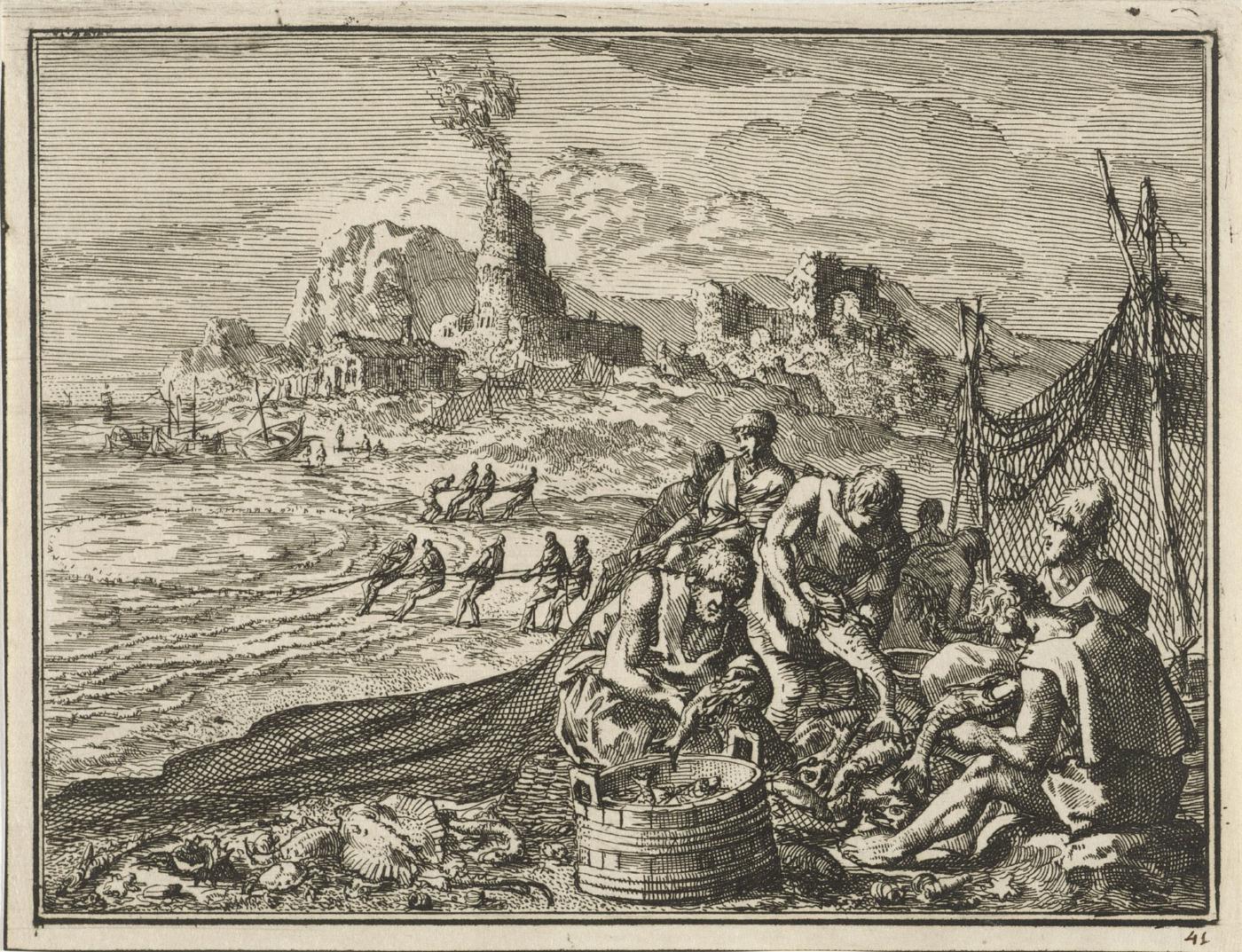
海滩上,两队人弓着身子,拽着长绳往岸上拉网;远处是船、城墙和山。前面,一张大网已经摊在沙上,一群渔夫围坐着,一个人把手伸进木桶里放鱼。左下角的沙滩上,散着螃蟹、贝壳,还有一条像是鳐鱼、一条像是鳗鱼的东西,没有放进桶里。他们是怎样分辨的?
扬·吕肯(Jan Luyken),《渔夫在海滩上从网里拣出好的和坏的》(Vissers op het strand zoeken het goede en het kwade uit hun netten),1712 年,蚀刻版画,荷兰阿姆斯特丹国立博物馆藏。公有领域。 Wikimedia Commons一起读太 13:47-50
(45–46 节)耶稣讲了寻珠的比喻(见寻珠一课)。
47天国又好像网撒在海里,聚拢各样水族。
48网既满了,人就拉上岸来坐下,拣好的收在器具里,将不好的丢弃了。
49世界的末了,也要这样。天使要出来从义人中,把恶人分别出来,
50丢在火炉里,在那里必要哀哭切齿了。
当时现场
谁在场。 还是那间屋子里的门徒(太 13:36)。他们里面有几位本来就是打鱼的:彼得和安得烈「在海里撒网,他们本是打鱼的」(太 4:18);耶稣呼召他们的时候说:「来跟从我,我要叫你们得人如得鱼一样」(太 4:19)。这一个比喻,他们一听就懂。
一张拖网。 克拉克说,这里的“网”是拖网,“撒在水里捕鱼,特别的用处是把鱼从水底拖上来”。拖着走的时候,路上的东西它都兜住,“好的坏的、大的小的”;拉到岸上,有用的留下,没用的不是毁掉,就是扔回水里。
Adam Clarke, Commentary on the Bible,太 13:47。译自英文原著。
看英文原文
Which is cast into the water to catch fish, and the particular use of which is to drag them up from the bottom.
As this is dragged along it keeps gathering all in its way, both good and bad, small and great; and, when it is brought to the shore, those which are proper for use are preserved, and those which are not are either destroyed or thrown back into the water.
什么是“不好的”。 按摩西的律法,「凡在水里、海里、河里,有翅有鳞的,都可以吃」(利 11:9);无翅无鳞的,以色列人不可吃(利 11:10)。一网拉上来,螃蟹、鳗鱼这一类,本来就进不了器具。
讲解
看见什么。 前两节是比喻:网撒在海里,什么都兜住;网满了,拉上岸,坐下来,好的收进器具,不好的丢掉(47–48 节)。后两节,耶稣自己解释:「世界的末了,也要这样」(49 节)。
请留意一件事:在网里的时候,好的坏的混在一起;分开,是在岸上。
这和稗子的比喻是一对。稗子讲的是「容这两样一齐长,等着收割」(太 13:30);撒网讲的是,网里混着,到岸上才分。两个比喻的结尾也一样:「丢在火炉里,在那里必要哀哭切齿了」(50 节),和太 13:42 一字不差。
如果我在场。 打鱼的门徒最清楚:网在水里的时候,谁也看不见里面有什么。马亨利说:“网还在海里的时候,网里有什么是不知道的,渔夫自己也分辨不出来;可是他们把网和网里的一切小心地拉到岸上,为的是里面好的。”
Matthew Henry, Commentary on the Whole Bible, Vol. V,太 13:44-52。译自英文原著。
看英文原文
While the net is in the sea, it is not known what is in it, the fishermen themselves cannot distinguish; but they carefully draw it, and all that is in it, to the shore, for the sake of the good that is in it.
神是怎样的神。 他不着急分,到时候他一定分,而且分得准。马亨利说:天使出来,要做“众教会的使者从来做不到的事”;不必问天使凭什么分辨,因为他们的差遣和吩咐来自那位“认识万人、特别认识谁是他的人、谁不是”的主,“两边都不会出错”。保罗也说:「主认识谁是他的人」(提后 2:19)。
Matthew Henry, Commentary on the Whole Bible, Vol. V,太 13:44-52。译自英文原著。
看英文原文
The angels of heaven shall come forth to do that which the angels of the churches could never do
him that knows all men, and particularly knows them that are his, and them that are not, and we may be sure there shall be no mistake or blunder either way
和我有什么关系。 在网里,不等于在器具里。马亨利说:“我们不可指望网里全是好鱼;器具里会是这样,网里却是混着的。”克拉克也说,到那日,“必定会有许多人,只有基督的名,没有基督的性情”。
Matthew Henry, Commentary on the Whole Bible, Vol. V,太 13:44-52;Adam Clarke, Commentary on the Bible,太 13:47。译自英文原著。
看英文原文
We must not look for the net full of all good fish; the vessels will be so, but in the net they are mixed.
many shall doubtless be found who shall bear the name without the nature of Christ
这句话不是叫我们去量别人,是叫我们问自己。50 节的话很重,马亨利说:“基督自己常讲地狱的刑罚……我们常被提醒这叫人警醒、叫人活过来的真理,是好的。”
Matthew Henry, Commentary on the Whole Bible, Vol. V,太 13:44-52。译自英文原著。
看英文原文
Christ himself preached often of hell-torments
it is good for us to be often reminded of this awakening, quickening truth.
不同的看见
下面三位都是英国的解经家:马亨利(1662–1714)、吉尔(1697–1771)、克拉克(约 1760–1832)。各段都译自英文原著,出处附在后面。
经文自己说的(三家都照这个讲): 网把各样的都聚拢来,到世界的末了,天使要从义人中把恶人分别出来(47–49 节)。三家都读出:现在混杂,将来分开;分开的是神,不是人。下面两处,是读法不同的地方。
一、海、网、各样的水族,各指什么?
“世界是一片大海”;“传福音就是把网撒在这海里”;网“聚拢各样的”,正如“在有形的教会里,除了鱼,还有许多废物、垃圾”。
Matthew Henry, Commentary on the Whole Bible, Vol. V,太 13:44-52。译自英文原著。
看英文原文
The world is a vast sea
The preaching of the gospel is the casting of a net into this sea
In the visible church there is a deal of trash and rubbish, dirt and weeds and vermin, as well as fish.
网是“福音和福音的职事”;海是世界,因为圣徒在其中遭遇“苦难和逼迫的风暴”。聚进有形教会的人,“有好有坏,有些里面有真实的恩典,有些只是假冒为善的”。他还说,拉上岸“坐下”,是传道人做完了工,进入主的快乐。
John Gill, Exposition of the Entire Bible,太 13:47-48。译自英文原著。
看英文原文
By which also is meant, the Gospel, and the ministry of it
by "the sea" is meant the world, so called, for the storms and tempests of afflictions, and persecutions the saints meet with
and of men good and bad; some who have the truth of grace in them, and others that are only hypocrites
the ministers of the word having done their work, enter into the joy of their Lord, and rest from their labours
网是“传天国的福音,不断把人拉进来,承认基督教,进入基督有形教会的团契”;海是“罪、错谬、无知、邪恶的深渊,人就活在其中”。
Adam Clarke, Commentary on the Bible,太 13:47。译自英文原著。
看英文原文
By the net may be understood the preaching of the Gospel of the kingdom, which keeps drawing men into the profession of Christianity, and into the fellowship of the visible Church of Christ
By the sea may be represented that abyss of sin, error, ignorance, and wickedness in which men live
这是寓意读法:给比喻里的海、网、水族各找一个对应。三家在网上是一致的:网是传福音,网里是好坏混杂的有形教会;在海上有出入:马亨利、吉尔说是世界,克拉克说是罪的深渊。耶稣自己只解释了比喻的后半段(49–50 节);马亨利说,前半段“明白浅显”,因为眼前的有形教会就是这样。
Matthew Henry, Commentary on the Whole Bible, Vol. V,太 13:44-52。译自英文原著。
看英文原文
Here is the explanation of the latter part of the parable, the former is obvious and plain enough
二、讲的是世界的末了,还是也讲当时?
讲的是末了:“世界的末了也要这样;那时,不到那时,就没有分别、显明的日子。”
Matthew Henry, Commentary on the Whole Bible, Vol. V,太 13:44-52。译自英文原著。
看英文原文
So shall it be at the end of the world; then, and not till then, will the dividing, discovering day be.
也照末了读:网拉上岸,是“世界的末了来到”的时候,那时传福音的工作就结束了;分开以后,“一边往永生里去,一边往永刑里去,彼此分开,直到永远”。
John Gill, Exposition of the Entire Bible,太 13:48-49。译自英文原著。
看英文原文
which will be done, when the end of the world comes; then will an end be put to the Gospel ministry
the one will go into life eternal, and the other into everlasting punishment; and their separation from one another will be for ever.
他也说拉上岸是“万事的终结”;同时又说:“这个比喻的首要意思,很可能也是指犹太国”,就是罗马兵来的时候,“只有真跟从基督的人得以逃脱”,并请读者参看太 24:30 以下。
Adam Clarke, Commentary on the Bible,太 13:47。译自英文原著。
看英文原文
By drawing to shore, may be represented the consummation of all things
It is probable that this parable also refers, in its primary meaning, to the Jewish state
the genuine followers of Christ only should escape
怎么看: 三家都照“世界的末了”读,这是经文自己说的(49 节)。克拉克多看了一层:这话在当时可能已经有一次应验。比喻和预言哪些话指当时、哪些指将来,这一问,各教会的理解不尽相同,请向你所在的教会请教。
原文词眼
「天国又好像网撒在海里」(47 节)。
和合本译作“网撒在海里”,原文的“网”是 σαγήνη,是一种拖网。Thayer 的希腊文辞典说,这是“大渔网、拖网,用来捕成群游的鱼”,新约只在这里用到。
Thayer's Greek-English Lexicon of the New Testament,G4522。译自英文原著。
看英文原文
a large fishing-net, a drag-net (Vulg.sagena (cf. English seine)), used in catching fish that swim in shoals
彼得、安得烈「在海里撒网」(太 4:18),用的是另一个字 ἀμφίβληστρον,Thayer 说是“捕鱼的网(撒网)”,一个人站在水边就能抛出去。拖网不一样,又大又长,要好几个人在船上、岸上一起拉,拉过去,一大片都兜在里面。
Thayer's Greek-English Lexicon of the New Testament,G293。译自英文原著。
看英文原文
specifically, a net for fishing (casting-net): Mark 1:16 R G L; Matthew 4:18
天国的网,不是挑着撒的,是一大片兜过去的。
49 节的“分别”,原文是 ἀφορίζω。Thayer 说,本义是“用界线划出来,同别的分开”。最后审判时「好像牧羊的分别绵羊山羊一般」(太 25:32),用的也是这个字。
Thayer's Greek-English Lexicon of the New Testament,G873。译自英文原著。
看英文原文
"to mark off from (ἀπό) others by boundaries, to limit, to separate"
划这条界线的,是天使,是那位差他们的主;不是渔夫,也不是网里的鱼。
请思考
没有标准答案,不打分。写下来,只给自己看。
- 你见过人拉网或钓鱼吗?一网(一钩)上来,有多少是能要的?
- 在教会里,你有没有心里给别人分过“好鱼”“坏鱼”?那时你凭的是什么?
- “在网里,不等于在器具里”。这句话放在你自己身上,你想到什么?
- 再看一次吕肯的画:渔夫把好的放进桶里,坏的留在沙滩上。如果今天就是拉上岸的日子,你心里有把握吗?这把握是从哪里来的?
这周去做
这一周,每当心里冒出“那个人不像真基督徒”的念头,就停下来,换成为那个人祷告一句。
周末问自己:这一周,我是更多在“分鱼”,还是更多在求神鉴察我自己?
延伸参考
- Matthew Henry, Commentary on the Whole Bible, Vol. V:太 13:47-50(英文原著,公有领域,CCEL 可免费读全文)
- 法兰士(R. T. France)著,丁道尔新约注释《马太福音》,校园书房出版社(ISBN 9789575874988):太 13:47-50
- 施诺格拉斯《主耶稣的比喻》:撒网一章
本单元其它比喻单元三 · 天国的比喻
- 撒种 太 13:1-23
- 种子自长 可 4:26-29
- 稗子 太 13:24-30、36-43
- 芥菜种 太 13:31-32
- 面酵 太 13:33
- 藏宝 太 13:44
- 寻珠 太 13:45-46
- 撒网 太 13:47-50 本课
- 家主 太 13:52 即将上线
- 灯台 可 4:21-25 即将上线
经文:和合本(1919),用字按本站规则现代化。“不同的看见”里的注释都译自英文原著(公有领域),每段可展开看英文原文。