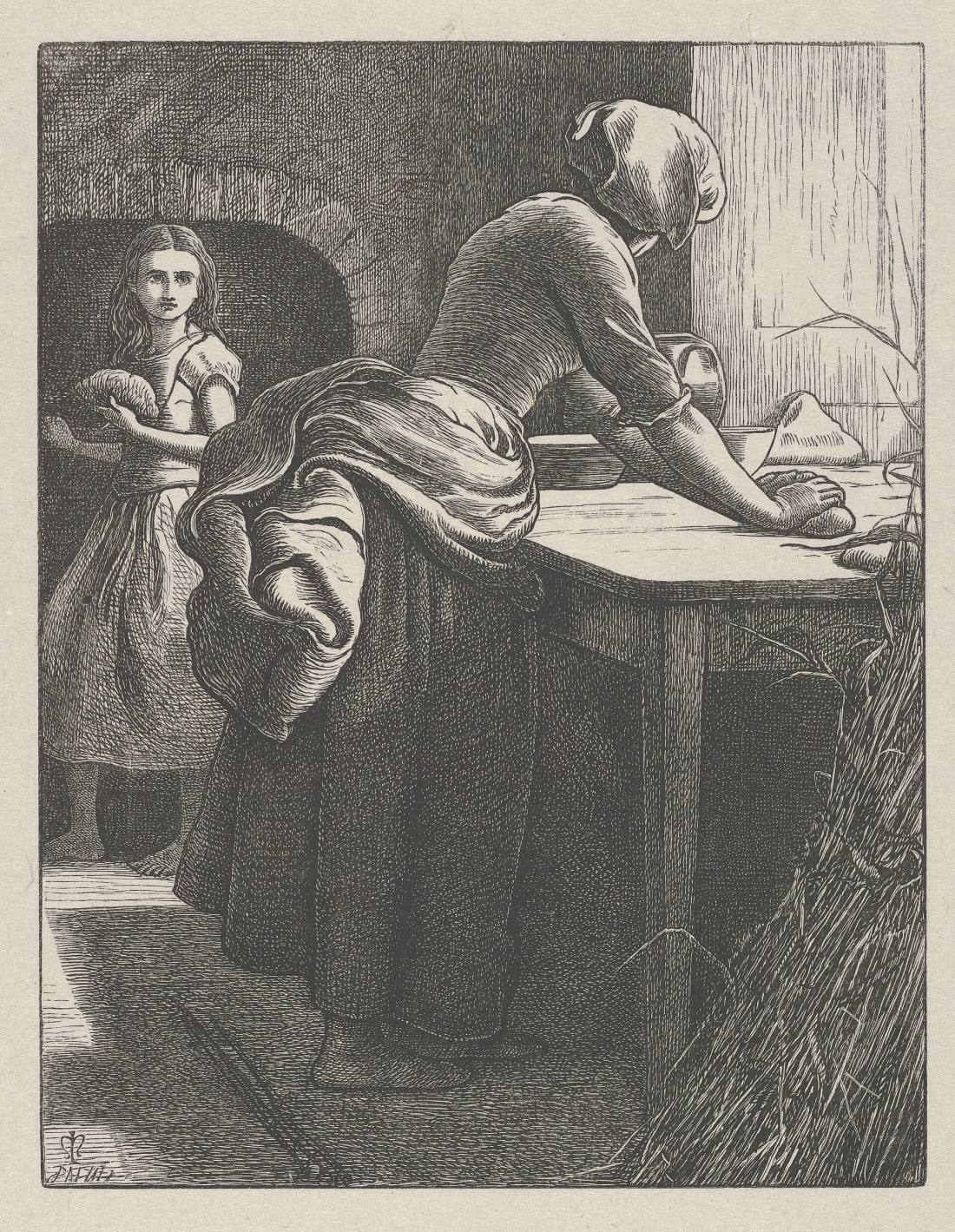
一间屋子,窗口透进光来。一个包着头巾的妇人俯在桌前,两手按着面团在揉;桌上有一只盆、一把罐子,窗边还堆着一堆面粉。她身后,一个光着脚的女孩站在拱形的炉口前,手里捧着圆圆的一团,像是刚发好的面团。右下角堆着柴草。揉进面团里的那一点酵,现在在哪里?
约翰·埃弗雷特·米莱(John Everett Millais)画,达尔齐尔兄弟(Dalziel Brothers)刻版,《面酵的比喻》(The Parable of the Leaven),1864 年,木刻版画,出自《我主我救主耶稣基督的比喻》,美国纽约大都会艺术博物馆藏。公有领域。 Wikimedia Commons一起读太 13:33
(31–32 节)耶稣讲了芥菜种的比喻(见芥菜种一课)。
33他又对他们讲个比喻说:“天国好像面酵,有妇人拿来,藏在三斗面里,直等全团都发起来。”
当时现场
谁在场。 还是撒种、稗子、芥菜种的那一天,耶稣在船上对岸上的众人讲(太 13:2)。芥菜种是一个人在田里做的事,面酵是一个妇人在家里做的事;一个在外,一个在内。马亨利说,这两个比喻的用意“差不多一样”:福音要渐渐地兴旺,“却是安安静静、不知不觉的”。
Matthew Henry, Commentary on the Whole Bible, Vol. V,太 13:24-43。译自英文原著。
看英文原文
The scope of this is much the same with that of the foregoing parable, to show that the gospel should prevail and be successful by degrees, but silently and insensibly
三斗面有多少。 和合本的“斗”,原文是“细亚”,一种量干粮的量器。Thayer 的希腊文辞典说,三细亚的面粉“是平常烤一次饼的分量”,并引了创世记:亚伯拉罕接待三位客人时,对撒拉说「你速速拿三细亚细面调和作饼」(创 18:6)。吉尔说,一细亚约一加仑半,三细亚就是一伊法。这是一家人一大批的饼,不是一小块面团。
John Gill, Exposition of the Entire Bible,太 13:33。译自英文原著。
看英文原文
in both examples A. V. 'three measures of meal' i. e. the common quantity for 'a baking'
The measure here designed, is the Hebrew seah, which held a gallon and an half, and three of these made an ephah
马太和路加,放在一起看:
| 马太 | 路加 | |
|---|---|---|
| 场合 | 海边,船上(太 13:2) | 「安息日,耶稣在会堂里教训人」(路 13:10),紧接着芥菜种 |
| 开头 | 「天国好像面酵」(太 13:33) | 「我拿什么来比神的国呢」(路 13:20) |
| 比喻 | 「有妇人拿来,藏在三斗面里,直等全团都发起来」(太 13:33) | 「有妇人拿来藏在三斗面里,直等全团都发起来」(路 13:21) |
两卷书的比喻本身,几乎一字不差。
讲解
看见什么。 一句话,三件事:妇人“拿来”,“藏在”面粉里,然后就是等,「直等全团都发起来」(33 节)。
面酵放进去以后就看不见了。可是它在面团里一点一点地做工,直到整个面团都变了。马亨利说,它“做工不声不响、不知不觉,却是有力的、挡不住的”。
Matthew Henry, Commentary on the Whole Bible, Vol. V,太 13:24-43。译自英文原著。
看英文原文
It works silently and insensibly (Mark iv. 26), yet strongly and irresistibly
如果我在场。 岸上听的人里,许多妇人天天做这件事:把一点酵揉进面团里,盖起来,过些时候,整盆面团都发了。耶稣用她们最熟悉的一件家务,讲天国。
有一点他们会觉得意外:在犹太人的规矩里,酵常常是要除掉的。逾越节「头一日要把酵从你们各家中除去」(出 12:15);耶稣自己也说过「防备法利赛人和撒都该人的酵」(太 16:6)。在这里,他却说天国像面酵。
神是怎样的神。 他的工作常常是藏着的。马亨利说,福音进到人心里,改变的“不是本质,面团还是那个面团,改变的是性质”;它叫我们的口味不一样了。
Matthew Henry, Commentary on the Whole Bible, Vol. V,太 13:24-43。译自英文原著。
看英文原文
It works a change, not in the substance; the dough is the same, but in the quality
克拉克也说:“面酵的特性是把掺进去的面粉变成它自己的性质;照样,基督的恩典的特性,是把整个灵魂变成它的样子。”
Adam Clarke, Commentary on the Bible,太 13:33。译自英文原著。
看英文原文
As the property of leaven is to change, or assimulate to its own nature, the meal or dough with which it is mixed, so the property of the grace of Christ is to change the whole soul into its own likeness
和我有什么关系。 信主以后,人还是原来那个人,长相、性情、工作都在;可是里面有一样东西掺进来了,慢慢地,说话、花钱、待人,一样一样地变了。保罗说:「只要心意更新而变化」(罗 12:2)。
马亨利还说了一句很实在的话:“面团发好了,就要进炉子;这样的改变,常常伴着试炼和苦难;圣徒却是这样被预备好,成为主人桌上的饼。”
Matthew Henry, Commentary on the Whole Bible, Vol. V,太 13:24-43。译自英文原著。
看英文原文
When the dough is leavened, then to the oven with it; trials and afflictions commonly attend this change; but thus saints are fitted to be bread for our Master's table.
不同的看见
下面三位都是英国的解经家:马亨利(1662–1714)、吉尔(1697–1771)、克拉克(约 1760–1832)。各段都译自英文原著,出处附在后面。
经文自己说的(三家都照这个讲): 天国像面酵,妇人把它藏在三斗面里,直到全团都发起来(33 节)。三家都读出两层:福音在世上渐渐扩展,恩典在人心里渐渐改变。下面两处,是读法不同的地方。
一、面酵在这里是好是坏?
“‘面酵’这个词在别处都是用在坏的意思上,或指恶毒邪恶,或指假教训,像法利赛人和撒都该人的教训;但在这里,似乎是用在好的意思上,拿福音来比它。”他又提到“近来有一种巧妙的解释”,说这比喻“讲的不是真理的扩散,而是错谬的扩散”。两种读法都摆出来以后,他说:“读者可以自己选。”
John Gill, Exposition of the Entire Bible,太 13:33。译自英文原著。
看英文原文
The word "leaven" is every where else used in a bad sense; and either designs immorality, as malice and wickedness, or false doctrine, such as that of the Pharisees and Sadducees: but here it seems to be taken in a good sense, and the Gospel to be compared unto it
There is a late ingenious interpretation (c) of this parable, which, since the word "leaven" is elsewhere always used in a bad sense, deserves consideration; according to which, this parable expresses not the spread of truth, but of error
The reader may choose which interpretation he likes best
照好的读:“福音的传讲像面酵,在领受的人心里像面酵一样做工。”
Matthew Henry, Commentary on the Whole Bible, Vol. V,太 13:24-43。译自英文原著。
看英文原文
the preaching of the gospel is like leaven, and works like leaven in the hearts of those who receive it.
也照好的读,并说芥菜种和面酵“这两个比喻都是预言”,要显明基督的福音怎样从很小的开头,渗透到世上万国。
Adam Clarke, Commentary on the Bible,太 13:33。译自英文原著。
看英文原文
Both these parables are prophetic, and were intended to show, principally, how, from very small beginnings, the Gospel of Christ should pervade all the nations of the world
怎么看: 三家都照好的读,Thayer 的辞典也把这个比喻列在“好的意思”下(见“原文词眼”)。经文开头说的是「天国好像面酵」(33 节):比的是天国,取的是面酵“一点就能渗透全团”的特性。吉尔提到的另一种读法,他自己也没有取。
二、妇人、三斗面指的是什么?
“妇人拿来面酵,这是她的工作。传道人被差去用福音使各地、使人心发起来。妇人是比较软弱的器皿,我们有这宝贝放在这样的器皿里。”人心像面粉,“柔软、能揉”;三斗面“是很多的面粉,因为一点面酵能使全团发起来”。
Matthew Henry, Commentary on the Whole Bible, Vol. V,太 13:24-43。译自英文原著。
看英文原文
A woman took this leaven; it was her work. Ministers are employed in leavening places, in leavening souls, with the gospel. The woman is the weaker vessel, and we have this treasure in such vessels.
The heart is, as the meal, soft and pliable
It is three measures of meal, a great quantity, for a little leaven leaveneth the whole lump.
“三斗面是指神的选民”;“三”这个数,可能指选民的人数不多,“也有人认为,指的是当时所知的世界三大部分”。妇人“或是指教会……或是指传福音的人……更是指耶稣基督,就是神的智慧”。
John Gill, Exposition of the Entire Bible,太 13:33。译自英文原著。
看英文原文
By the "three measures of meal", are meant the elect of God
These measures, as here used parabolically, may design the small number of God's elect; and, as some have thought, may have respect to the three then known parts of the world
is meant, either the church, sometimes compared to a woman in Scripture, Revelation 12:1 or the ministers of the Gospel, wisdom's maidens; or rather, Jesus Christ, the wisdom of God
他没有给妇人、三斗面找对应,只说恩典要一直在灵魂里做工,“直到全团都发起来——直到整个人带着属天的形像,像从前带着属土的形像一样”。
Adam Clarke, Commentary on the Bible,太 13:33。译自英文原著。
看英文原文
till all is leavened - till the whole bear the image of the heavenly, as it before bore the image of the earthly
怎么看: 这是寓意读法:给比喻里的妇人、三斗面各找一个对应。马亨利说是传道人和人心,吉尔说是基督和选民,克拉克不找对应。经文自己没有说妇人和面粉指什么;Thayer 说,三斗面就是“平常烤一次饼的分量”(见“当时现场”)。
原文词眼
「天国好像面酵」(33 节)。
“面酵”原文是 ζύμη。Thayer 的希腊文辞典有一段,正好回答“面酵是好是坏”:
Thayer's Greek-English Lexicon of the New Testament,G2219。译自英文原著。
看英文原文
It is applied to that which, though small in quantity, yet by its influence thoroughly pervades a thing: either in a good sense, as in the parable Matthew 13:33; Luke 13:21 (see ζυμόω); or in a bad sense, of a pernicious influence, as in the proverb μικρά ζύμη ὅλον τό φύραμα ζυμοῖ, a little leaven leaveneth the whole lump
意思是:这个字用来比“量虽少,却以它的影响渗透整个东西”的;有用在好的意思上的,就是这个比喻;也有用在坏的意思上的,像那句俗语「一点面酵能使全团都发起来」(加 5:9),保罗用它来提醒,一点罪、一点错谬,也会败坏全体。
面酵本身没有好坏,要看掺进去的是什么。同一个“渗透”,可以是败坏,也可以是更新。
妇人把面酵“藏”在面粉里,原文是 ἐγκρύπτω。Thayer 说,本义是“藏在某样东西里”,在这里按上下文就是“把一样东西掺进另一样里”。
Thayer's Greek-English Lexicon of the New Testament,G1470。译自英文原著。
看英文原文
to conceal in something
contextually, to mingle one thing with another: Matthew 13:33
藏,不是丢掉,是掺进去,叫它在里面做工。诗篇说:「我将你的话藏在心里」(诗 119:11)。
请思考
没有标准答案,不打分。写下来,只给自己看。
- 你家里有人做过馒头、自己发面吗?从放酵到面团发起来,要等多久?
- 信主以后,你身上有哪一处改变,是慢慢“发”出来的,连你自己都是后来才发现?
- 你的生活里,有哪一部分是面酵还没有“渗”到的?工作、金钱、家人,还是别的?
- 再看一次米莱的画:妇人在揉面,女孩捧着一个面团站在炉口前。面团发好以后要进炉子。你现在是在“揉”,在“发”,还是在“进炉子”?
这周去做
这一周,每天早上读一小段经文(可以就读马太 13 章),挑一句“藏在心里”,白天想起来就默念一次。
周末问自己:这一周,那几句话有没有在我说话、做事的时候“发”出来?
延伸参考
- Matthew Henry, Commentary on the Whole Bible, Vol. V:太 13:33(英文原著,公有领域,CCEL 可免费读全文)
- 法兰士(R. T. France)著,丁道尔新约注释《马太福音》,校园书房出版社(ISBN 9789575874988):太 13:33
- 施诺格拉斯《主耶稣的比喻》:芥菜种和面酵一章
本单元其它比喻单元三 · 天国的比喻
- 撒种 太 13:1-23
- 种子自长 可 4:26-29
- 稗子 太 13:24-30、36-43
- 芥菜种 太 13:31-32
- 面酵 太 13:33 本课
- 藏宝 太 13:44 即将上线
- 寻珠 太 13:45-46 即将上线
- 撒网 太 13:47-50 即将上线
- 家主 太 13:52 即将上线
- 灯台 可 4:21-25 即将上线
经文:和合本(1919),用字按本站规则现代化。“不同的看见”里的注释都译自英文原著(公有领域),每段可展开看英文原文。