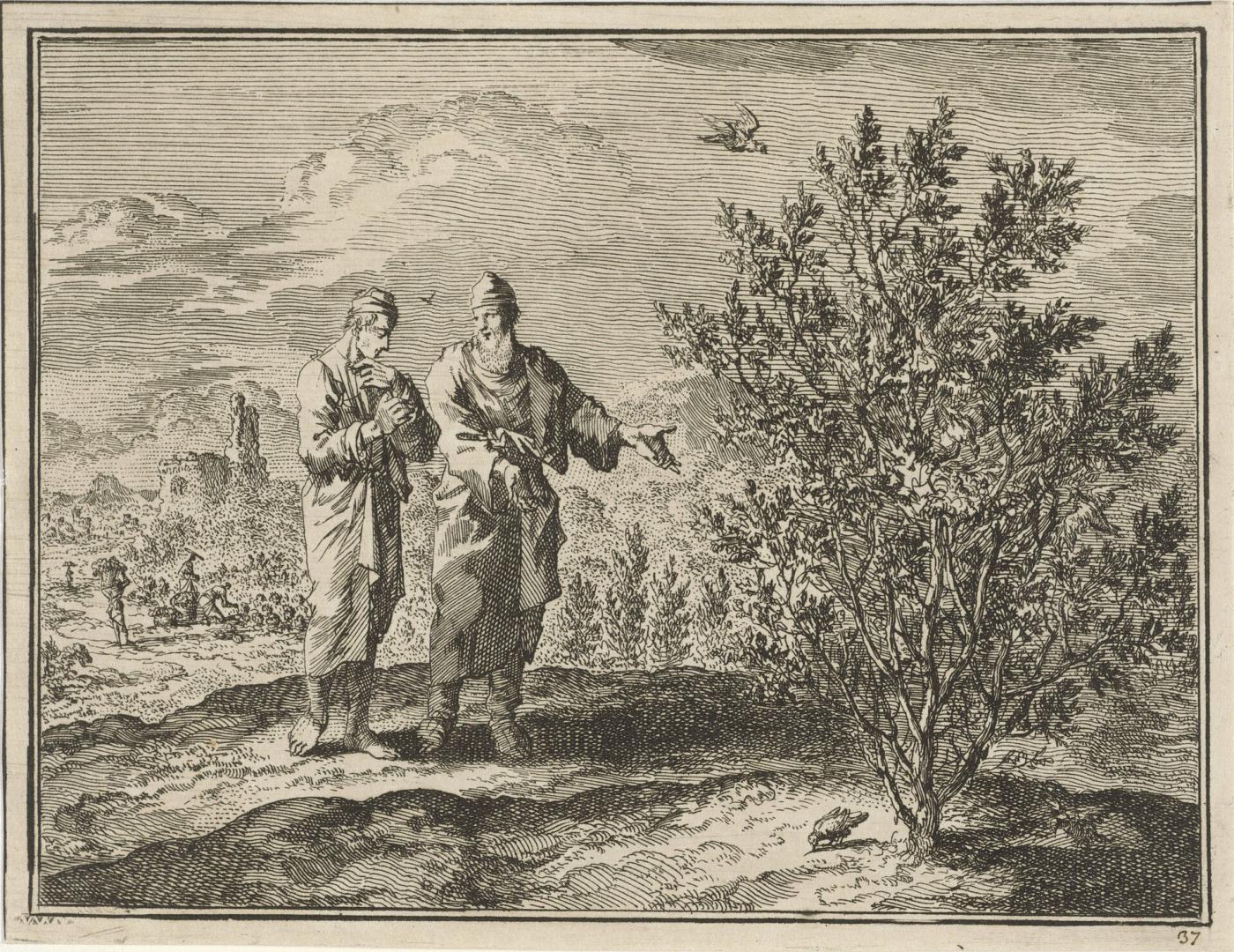
两个人站在一丛长得很高的灌木旁。留胡子的那个伸手指着它,另一个托着下巴在看。枝子上落着鸟,天上还有一只正飞过来,树根旁的地上有一只在啄食。远处有人在田里干活,有人背着筐走路,后面是一座塌了一半的塔。这丛树,当初是从多大的一粒种子长出来的?
扬·吕肯(Jan Luyken)《两个人观看芥菜种长成的灌木》(Twee mannen beschouwen een struik, opgegroeid uit mosterdzaad),蚀刻版画,1712 年,出自他的《新旧约的经文故事与比喻》,荷兰阿姆斯特丹国立博物馆藏。公有领域。 Wikimedia Commons一起读太 13:31-32
(24–30 节)耶稣讲了稗子的比喻(见稗子一课)。
31他又设个比喻对他们说:“天国好像一粒芥菜种,有人拿去种在田里。
32这原是百种里最小的,等到长起来,却比各样的菜都大,且成了树,天上的飞鸟来宿在它的枝上。”
当时现场
谁在场。 还是撒种、稗子的那一天,耶稣坐在船上,对岸上的众人讲(太 13:2)。马太把芥菜种、面酵两个短比喻接在稗子后面。
芥菜能长多大。 芥菜在我们看来是菜,在当时的巴勒斯坦,却能长得很高。Thayer 的希腊文辞典说,这种植物“在东方从很小的种子长到‘一棵树’那么高——十尺以上”。克拉克说,土好、天热的地方,同一种植物能长得比冷地方大得多;他自己就在一个岛上见过一片卷心菜,每一棵高七到九尺。
Adam Clarke, Commentary on the Bible,太 13:32。译自英文原著。
看英文原文
the name of a plant which in oriental countries grows from a very small seed and attains to the height of 'a tree' — ten feet and more
I have myself seen a field of common cabbages, in one of the Norman isles, each of which was from seven to nine feet in height
旧约里的大树。 听的人熟悉旧约,大树、飞鸟宿在枝上的图画,他们在先知书里读到过。以西结说,神要栽一棵香柏树,「各类飞鸟都必宿在其下,就是宿在枝子的荫下」(结 17:23)。但以理书里尼布甲尼撒梦见的大树,也是「天空的飞鸟,宿在枝上」(但 4:12)。
三卷福音书对照
三卷福音书都记了这个比喻:
| 马太 | 马可 | 路加 | |
|---|---|---|---|
| 在什么场合 | 海边,船上(太 13:2) | 海边,船上(可 4:1) | 「安息日,耶稣在会堂里教训人」(路 13:10),医好一个驼背的女人以后 |
| 开头怎么问 | 直接说「天国好像一粒芥菜种」(太 13:31) | 「神的国,我们可用什么比较呢」(可 4:30) | 「神的国,好像什么」(路 13:18) |
| 种在哪里 | 「有人拿去种在田里」(太 13:31) | 「种在地里的时候」(可 4:31) | 「有人拿去种在园子里」(路 13:19) |
| 说它小 | 「这原是百种里最小的」(太 13:32) | 「虽比地上的百种都小」(可 4:31) | 没有说 |
| 长成什么 | 「比各样的菜都大,且成了树」(太 13:32) | 「比各样的菜都大,又长出大枝来」(可 4:32) | 「长大成树」(路 13:19) |
| 飞鸟 | 「宿在它的枝上」(太 13:32) | 「可以宿在它的荫下」(可 4:32) | 「宿在它的枝上」(路 13:19) |
马可开头是耶稣自问:神的国要拿什么来比?他找到的,是一粒小得几乎看不见的种子。
讲解
看见什么。 两节经文,一前一后两幅图:前一幅是「百种里最小的」(32 节),后一幅是「成了树,天上的飞鸟来宿在它的枝上」(32 节)。中间只隔一句「等到长起来」。
马亨利说,这个比喻的用意是:“福音的开头会很小,它的结局却要大大地兴旺。”
Matthew Henry, Commentary on the Whole Bible, Vol. V,太 13:24-43。译自英文原著。
看英文原文
The scope of this parable is to show, that the beginnings of the gospel would be small, but that its latter end would greatly increase.
如果我在场。 听耶稣讲这个比喻的,是一小群渔夫、税吏,加上岸上看热闹的人。耶稣说他带来的是“天国”,可是眼前看不出有什么国:没有王宫,没有军队,跟着他的人一只手就数得过来。马亨利说,基督和使徒们,“跟世上的大人物比起来,就像一粒芥菜种,是世上软弱的”。
Matthew Henry, Commentary on the Whole Bible, Vol. V,太 13:24-43。译自英文原著。
看英文原文
Christ and the apostles, compared with the grandees of the world, appeared like a grain of mustard-seed, the weak things of the world.
后来的事,使徒行传记下来了:耶稣升天以后,聚会的门徒「约有一百二十名」(徒 1:15);五旬节那一天,「门徒约添了三千人」(徒 2:41)。
神是怎样的神。 他不怕小。保罗说:「神却拣选了世上愚拙的,叫有智慧的羞愧;又拣选了世上软弱的,叫那强壮的羞愧」(林前 1:27)。马亨利说:“一粒芥菜种很小,可它毕竟是种子,里面有要长的本性。”
Matthew Henry, Commentary on the Whole Bible, Vol. V,太 13:24-43。译自英文原著。
看英文原文
A grain of mustard-seed is small, but however it is seed, and has in it a disposition to grow.
和我有什么关系。 克拉克说,引人到荣耀里的恩典,常常是从“一个小小的好心愿”开始的。
Adam Clarke, Commentary on the Bible,太 13:31。译自英文原著。
看英文原文
That grace which leads the soul to the fullness of glory may begin, and often does, in a single good desire
不要小看自己心里那一点点的信,也不要小看一个只有几个人的小组、一间只有几家人的小教会。
树长大了,是给飞鸟歇息的。马亨利说:“长大了的基督徒,要渴望对别人有用处,像长成了的芥菜对飞鸟一样。”
Matthew Henry, Commentary on the Whole Bible, Vol. V,太 13:24-43。译自英文原著。
看英文原文
Grown Christians must covet to be useful to others, as the mustard-seed when grown is to the birds
不同的看见
下面三位都是英国的解经家:马亨利(1662–1714)、吉尔(1697–1771)、克拉克(约 1760–1832)。各段都译自英文原著,出处附在后面。
经文自己说的(三家都照这个讲): 天国像一粒芥菜种,起初「这原是百种里最小的」,长起来「却比各样的菜都大,且成了树」(32 节)。三家都读出两层:福音在世上的扩展,和恩典在人心里的长进。下面两处,是读法不同的地方。
一、“百种里最小的”怎么读?
芥菜种“是一切种子里最小的之一”。
Matthew Henry, Commentary on the Whole Bible, Vol. V,太 13:24-43。译自英文原著。
看英文原文
like a grain of mustard-seed, which is one of the least of all seeds
“不是说没有比它更小的种子,意思是:它是一切种子里最小的之一;或者是犹太地人们常见的种子里最小的;或者是能长到这么大的植物里,种子最小的。”
John Gill, Exposition of the Entire Bible,太 13:32。译自英文原著。
看英文原文
Not but there are seeds lesser than this; but the meaning is, that this is one of the least of all seeds; or was the least of seeds, which were commonly known in Judea; or the very least which grew to the size this sometimes did
“就是说:在一切能长出木质茎干和枝子的植物的种子里,它是最小的。”
Adam Clarke, Commentary on the Bible,太 13:32。译自英文原著。
看英文原文
That is, of all those seeds which produce plants, whose stems and branches, according to the saying of the botanists, are apt δενδριζειν, arborescere, to grow into a ligneous or woody substance.
怎么看: 三家都认真对待这句话,给了三种读法:“最小的之一”“当地常见的里最小的”“能长成树的里最小的”。比喻要人看见的,是“小”和“大”的对比:马可的写法是「虽比地上的百种都小」(可 4:31),「但种上以后,就长起来,比各样的菜都大」(可 4:32)。
二、这棵树要长到多大?飞鸟指的是谁?
他说福音在使徒时代、宗教改革时都大有进展,“到末了还要大得多”:“教会要遍满全地,世上的国要成为教会,地上万国都要流归它;犹太人全体要归主,外邦人的数目要添满。”说到飞鸟,“有人认为是指天使”,他自己取“圣徒,就是神的百姓”。
John Gill, Exposition of the Entire Bible,太 13:32。译自英文原著。
看英文原文
and, in ages since, has made a considerable progress, particularly at the Reformation; and will make a much greater one, towards the end of time
for the church will fill the earth, and the kingdoms of the world will become the church, and all nations of the earth will flock unto it; the people of the Jews in general will be converted, and the fulness of the Gentiles will be brought in
by "the birds of the air", some think angels are meant
Though rather, the saints and people of God are intended
他说教会“像从埃及挪出来的葡萄树,已经扎了根,遍满了地”;“教会像一棵大树,空中的飞鸟宿在其中:神的百姓投奔它,得着食物和安息、荫庇和遮盖”。
Matthew Henry, Commentary on the Whole Bible, Vol. V,太 13:24-43。译自英文原著。
看英文原文
The church, like the vine brought out of Egypt, has taken root, and filled the earth
The church is like a great tree, in which the fowls of the air do lodge; God's people have recourse to it for food and rest, shade and shelter.
这个比喻“表明福音在世上的进展,也表明恩典在灵魂里的长进”。他没有讲飞鸟指谁。
Adam Clarke, Commentary on the Bible,太 13:31。译自英文原著。
看英文原文
This parable is a representation of the progress of the Gospel in the world; and of the growth of grace in the soul.
怎么看: 三家都相信这棵树会长大,也都说飞鸟得着它的好处。不同在:吉尔盼望到末了教会要遍满全地、万国归向;马亨利看见的是教会已经扎根、遍满了地;克拉克只讲福音的进展和恩典的长进。经文自己只说「且成了树,天上的飞鸟来宿在它的枝上」(32 节)。末日以前,教会在世上会是怎样的光景,这一问,各教会的理解不尽相同,请向你所在的教会请教。
原文词眼
「天国好像一粒芥菜种」(31 节)。
“芥菜”原文是 σίναπι。Thayer 的希腊文辞典说,这种植物“从很小的种子长到‘一棵树’那么高”,所以新约拿它比两样东西:一样是“很小的一点”,像「你们若有信心像一粒芥菜种」(太 17:20);一样是“长得出奇大的”,就是这个比喻。
Thayer's Greek-English Lexicon of the New Testament,G4615。译自英文原著。
看英文原文
hence, a very small quantity of a thing is likened to a κόκκος σινάπεως (A. V. a grain of mustard seed), Matthew 17:20; Luke 17:6; and also a thing which grows to a remarkable size, Matthew 13:31; Mark 4:31; Luke 13:19.
同一粒种子,耶稣拿来讲信心,说它小;拿来讲天国,说它会长大。小,不妨碍它是真的;真的,就会长。
飞鸟「来宿在它的枝上」的“宿”,原文是 κατασκηνόω。Thayer 说,它的本义是“支搭帐棚,定居、住下”。
Thayer's Greek-English Lexicon of the New Testament,G2681。译自英文原著。
看英文原文
properly, to pitch one's tent, to fix one's abode, to dwell
鸟不是飞过来歇一下脚就走,是在枝子上安了家。
请思考
没有标准答案,不打分。写下来,只给自己看。
- 你信主的开头,是怎样一件“小事”?一句话、一个人、一本书,还是别的?
- 在你身边,有没有一件为主做的事,小得叫你想放弃?读了这个比喻,你会怎么看它?
- 你现在像一粒种子、一棵小苗,还是一棵可以给别人歇息的树?
- 再看一次吕肯的版画:留胡子的人指着树,另一个托着下巴在想。如果你是那个在想的人,你心里在想什么?
这周去做
找一件你觉得“太小、不值得做”的事,这周去做:给一位很久没联络的弟兄姐妹发一句问候,为教会里一件小事祷告,或者在小组里第一次开口分享。
周末问自己:这件小事做下去以后,有没有长出一点什么?
延伸参考
- Matthew Henry, Commentary on the Whole Bible, Vol. V:太 13:31-32(英文原著,公有领域,CCEL 可免费读全文)
- 法兰士(R. T. France)著,丁道尔新约注释《马太福音》,校园书房出版社(ISBN 9789575874988):太 13:31-32
- 施诺格拉斯《主耶稣的比喻》:芥菜种一章
本单元其它比喻单元三 · 天国的比喻
- 撒种 太 13:1-23
- 种子自长 可 4:26-29
- 稗子 太 13:24-30、36-43
- 芥菜种 太 13:31-32 本课
- 面酵 太 13:33
- 藏宝 太 13:44 即将上线
- 寻珠 太 13:45-46 即将上线
- 撒网 太 13:47-50 即将上线
- 家主 太 13:52 即将上线
- 灯台 可 4:21-25 即将上线
经文:和合本(1919),用字按本站规则现代化。“不同的看见”里的注释都译自英文原著(公有领域),每段可展开看英文原文。