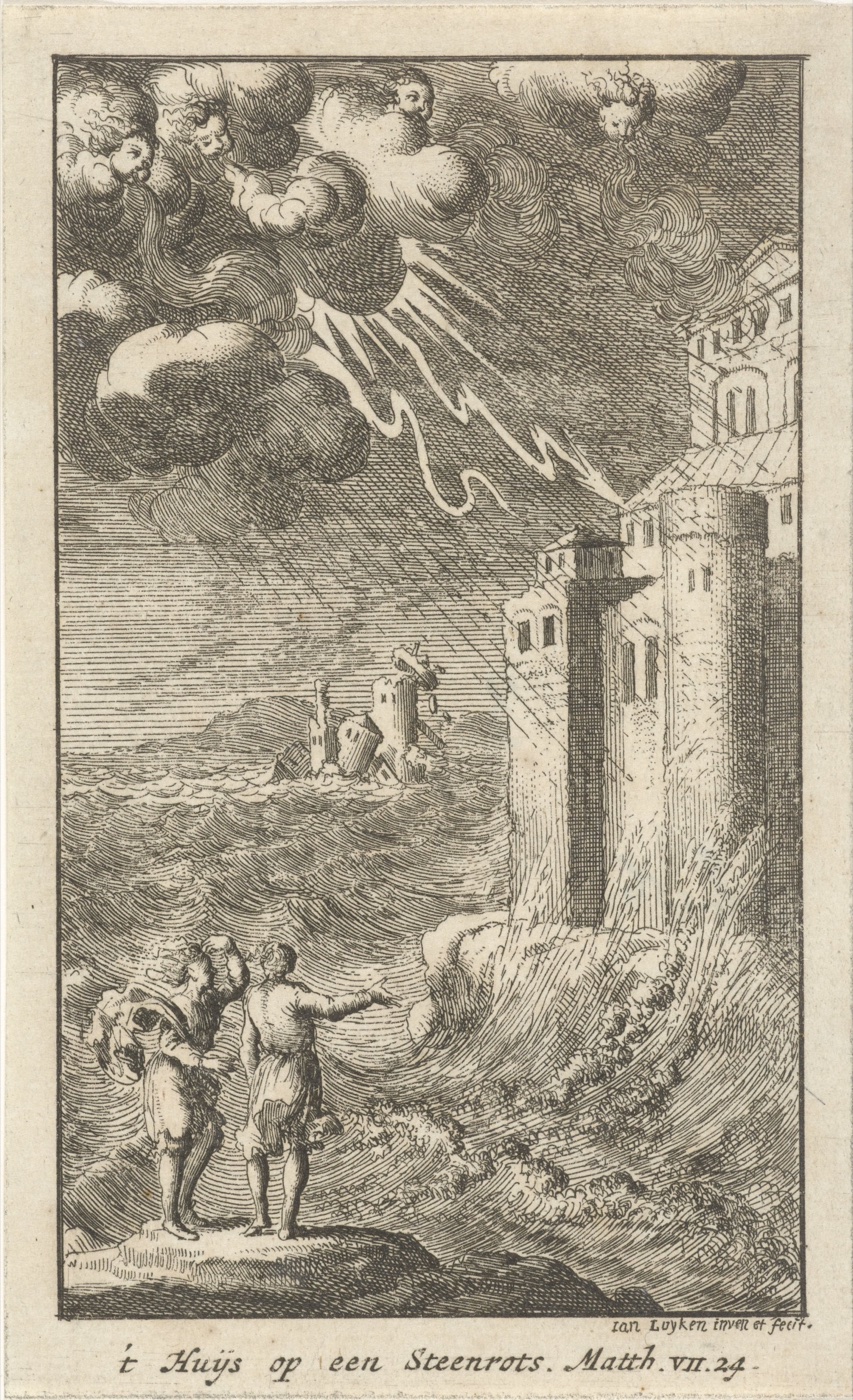
一场大风雨。天上的云里有几张脸在鼓着腮吹气,一道闪电劈下来,雨斜斜地落着。右边一座高楼连着一座圆塔,立在岩石上,浪头打在下面。远处的水里,另一座房子已经塌了,墙断成几截,碎块落进浪里。左下角的岩石上站着两个人,背对着我们:一个伸出手臂指着前面,另一个一只手按着头,衣服被风吹起来。你看,同一场风雨,这两座房子有什么不同?
扬·吕肯(Jan Luyken),《磐石上的房子》('t Huijs op een Steenrots),1681 年,蚀刻版画,荷兰阿姆斯特丹国立博物馆藏。公有领域。 Wikimedia Commons一起读太 7:24-27
24“所以,凡听见我这话就去行的,好比一个聪明人,把房子盖在磐石上;
25雨淋,水冲,风吹,撞着那房子,房子总不倒塌,因为根基立在磐石上。
26凡听见我这话不去行的,好比一个无知的人,把房子盖在沙土上;
27雨淋,水冲,风吹,撞着那房子,房子就倒塌了,并且倒塌得很大。”
当时现场
登山宝训的最后一段。 从马太福音第 5 章起,耶稣坐在山上教训门徒和众人。这个比喻是整篇讲论的收尾。马亨利说,这是要把钉子“钉牢,钉在稳当的地方”。
Matthew Henry, Commentary on the Whole Bible, Vol. V,太 7:21-29。译自英文原著。
看英文原文
this is designed to clench the nail, that it might fix in a sure place
“所以”。 24 节开头的“所以”,接的是前面一段:「凡称呼我主啊,主啊的人,不能都进天国;惟独遵行我天父旨意的人,才能进去」(太 7:21)。
那里的雨。 克拉克说,在犹太地一带,雨有时倾盆而下,冲出一条条急流,把石山上的土冲走;那里有些房子只用晒干的土砖盖成,“在这样的雨和大水面前,真是化掉了”。
Adam Clarke, Commentary on the Bible,太 7:25。译自英文原著。
看英文原文
In Judea, and in all countries in the neighborhood of the tropics, the rain sometimes falls in great torrents, producing rivers, which sweep away the soil from the rocky hills; and the houses, which are built of brick only dried in the sun, of which there are whole villages in the east, literally melt away before those rains, and the land-floods occasioned by them.
讲完以后。 「耶稣讲完了这些话,众人都希奇他的教训;因为他教训他们,正像有权柄的人,不像他们的文士」(太 7:28-29)。
三卷福音书对照
这个比喻马太、路加都记了,都放在一篇讲论的最后:
| 马太 | 路加 | |
|---|---|---|
| 前一句 | 「凡称呼我主啊,主啊的人,不能都进天国」(太 7:21) | 「你们为什么称呼我主啊,主啊,却不遵我的话行呢」(路 6:46) |
| 聪明的那一个 | 「把房子盖在磐石上」(太 7:24) | 「深深地挖地,把根基安在磐石上」(路 6:48) |
| 另一个 | 「把房子盖在沙土上」(太 7:26) | 「在土地上盖房子,没有根基」(路 6:49) |
| 风雨 | 「雨淋,水冲,风吹,撞着那房子」(太 7:25) | 「到发大水的时候,水冲那房子」(路 6:48) |
| 结局 | 「房子就倒塌了,并且倒塌得很大」(太 7:27) | 「随即倒塌了,并且那房子坏得很大」(路 6:49) |
路加多了“深深地挖地”。马亨利在路加这里说,这些人是“在信仰上肯下功夫的人”,他们“挖得深”,把盼望建在基督这万古磐石上。
Matthew Henry, Commentary on the Whole Bible, Vol. V,路 6:37-49。译自英文原著。
看英文原文
These are they that take pains in religion, as they do,—that dig deep, that found their hope upon Christ, who is the Rock of ages
讲解
看见什么。 两个人都盖了房子,都听了耶稣的话。马亨利说,听道的人在这里被分成两种:“有的听了,就去行所听的;有的听了,却不去行。”
Matthew Henry, Commentary on the Whole Bible, Vol. V,太 7:21-29。译自英文原著。
看英文原文
some that hear, and do what they hear; others that hear and do not.
再看 25 节和 27 节:「雨淋,水冲,风吹,撞着那房子」,一字不差。风雨没有挑房子,两座都遇上了。不同的只在根基。
马亨利说,盖在磐石上“要费心、费力”;盖在沙土上,“不用费多少力气”。
Matthew Henry, Commentary on the Whole Bible, Vol. V,太 7:21-29。译自英文原著。
看英文原文
Building upon a rock requires care and pains
which is done without much pains, but it is their folly.
如果我在场。 我坐在山坡上,从头听完了这篇道,和众人一起「希奇他的教训」(太 7:28)。马亨利提醒:“人可能很欣赏好的讲道,却仍旧无知、不信;可能惊奇,却没有成圣。”
Matthew Henry, Commentary on the Whole Bible, Vol. V,太 7:21-29。译自英文原著。
看英文原文
It is possible for people to admire good preaching, and yet to remain in ignorance and unbelief; to be astonished, and yet not sanctified.
马亨利还列了一串:只是听了、明白了、记住了、谈论、复述、为它辩论,“都不够”,要“听了,就去行”。
Matthew Henry, Commentary on the Whole Bible, Vol. V,太 7:21-29。译自英文原著。
看英文原文
It is not enough to hear Christ's sayings, and understand them, hear them, and remember them, hear them, and talk of them, repeat them, dispute for them; but we must hear, and do them.
神是怎样的神。 磐石不是盖房的人自己造的。马亨利说:“有一块磐石已经为我们预备好了,可以在上面盖这房子;那磐石就是基督。”又说:“他像磐石一样坚固、不动摇;我们可以把一切都托付在他身上,我们的盼望不至于羞愧。”
Matthew Henry, Commentary on the Whole Bible, Vol. V,太 7:21-29。译自英文原著。
看英文原文
That there is a rock provided for us to build this house upon, and that rock is Christ.
He is strong and immovable as a rock; we may venture our all upon him, and shall not be made ashamed of our hope.
和我有什么关系。 我听过的道不少。马亨利说:“我们的听,若不叫我们顺服,就要加重我们的不顺服。”
Matthew Henry, Commentary on the Whole Bible, Vol. V,太 7:21-29。译自英文原著。
看英文原文
if our hearing be not the means of our obedience, it will be the aggravation of our disobedience.
风雨来以前,两座房子看起来差不多。要看根基,不必等到风雨来;现在就可以问:耶稣的话,我听了以后,做了哪一句?
不同的看见
下面三位都是英国的解经家:马亨利(1662–1714)、吉尔(1697–1771)、克拉克(约 1760–1832)。各段都译自英文原著,出处附在后面。
经文自己说的(三家都照这个讲): 两个人都听见了耶稣的话;一个去行,一个不去行;风雨一样撞着两座房子,一座站住了,一座倒了。三家也都说,磐石是基督。下面两处,是读法不同的地方。
一、“听了去行”,和“盖在磐石上”,是什么关系?
盖在沙土上的,是那些“想靠自己的行为与神和好”、“靠自己的义而不靠基督的义称义”的人。行道的人行这些事,是出于爱基督,“不是为了靠这些得永生”,永生他只指望从基督那里得着。
John Gill, Exposition of the Entire Bible,太 7:24、26。译自英文原著。
看英文原文
who pretend to make their peace with God by their own works
seek for justification by their own, and not the righteousness of Christ
all the duties of religion he performs from love to Christ, without any view to obtain eternal life hereby, which he only expects from Christ
“请注意,房子站得住的,不是听了或信了基督这些话的人,是去行的人。”可是遵行这些诫命,是不是“买来荣耀”?他说:“不是,这只是通往那荣耀的路;那荣耀已经由羔羊的血买来了。”
Adam Clarke, Commentary on the Bible,太 7:26。译自英文原著。
看英文原文
Let it be observed, that it is not the man who hears or believes these sayings of Christ, whose building shall stand, when the earth and its works are burnt up; but the man who Does them.
No, it is the Way only to that glory which has already been purchased by the blood of the Lamb.
“基督是到父那里唯一的路,信而顺服是到基督那里唯一的路。”
Matthew Henry, Commentary on the Whole Bible, Vol. V,太 7:21-29。译自英文原著。
看英文原文
Christ is our only Way to the Father, and the obedience of faith is our only way to Christ
怎么看: 三家都说磐石是基督,也都说只听不行的房子要倒。新约别处说:「只是你们要行道,不要单单听道,自己欺哄自己」(雅 1:22);又说:「那已经立好的根基,就是耶稣基督,此外没有人能立别的根基」(林前 3:11)。信靠基督和遵行他的话,两样怎样连在一起,这一问,各教会的理解不尽相同,请向你所在的教会请教。
二、雨、水、风,指的是什么?
可以指“撒但的试探、世界的逼迫、人自己心里的败坏,和人的错谬与假道理”。
John Gill, Exposition of the Entire Bible,太 7:25。译自英文原著。
看英文原文
may design the temptations of Satan, the persecutions of the world, the corruptions of a man's own heart, and the errors and false doctrines of men
“有人认为”主在这里暗指三种试炼:神的安排中临到的苦难,像倾盆大雨;从人的情欲来的,像奔腾的急流;从撒但来的,像旋风。他说,建在万古磐石上的人,“不但站得住,还从中得益处”。
Adam Clarke, Commentary on the Bible,太 7:25。译自英文原著。
看英文原文
There are three general kinds of trials to which the followers of God are exposed; and to which, some think, our Lord alludes here
He alone, whose soul is built on the Rock of ages, stands all these shocks; and not only stands in, but profits by them.
试验“有时在今世”:为道遭了患难、逼迫的时候,就看出谁只是听道、谁又听又行。“无论如何,死亡和审判来的时候,风雨就来了;不管我们现在多么风平浪静,它一定会来。”
Matthew Henry, Commentary on the Whole Bible, Vol. V,太 7:21-29。译自英文原著。
看英文原文
the trial is sometimes in this world; when tribulation and persecution arise because of the word, then it will be seen, who only heard the word, and who heard and practiced it
However, when death and judgment come, then the storm comes, and it will undoubtedly come, how calm soever things may be with us now.
怎么看: 比喻没有说风雨是什么。三家的读法可以合着看:今生的难处是风雨,最后的审判也是。不管是哪一种,比喻只说:风雨会来,两座房子都会遇上。
原文词眼
「好比一个无知的人,把房子盖在沙土上」(26 节)
“无知的”,原文是 μωρός。这个词在十个童女的比喻里也出现过,和合本译作“愚拙的”(太 25:2)。Thayer 把这几处列在同一个意思下:“不谨慎,没有先见,没有智慧”。
Thayer's Greek-English Lexicon of the New Testament,G3474。译自英文原著。
看英文原文
imprudent, without forethought or wisdom, Matthew 7:26; Matthew 23:17, 19 (see above); Matthew 25:2f, 8
和它相对的,是 24 节的“聪明人”,原文 φρόνιμος,也就是十个童女里“聪明的”那个词。Thayer 在这里注明:“与 μωρός 相对,太 7:24。”
Thayer's Greek-English Lexicon of the New Testament,G5429。译自英文原著。
看英文原文
prudent, i. e. mindful of one's interests: Matthew 10:16; Matthew 24:45; Luke 12:42; opposed to μωρός, Matthew 7:24
两个比喻放在一起看:无知的人和愚拙的童女,都不是坏在当下,是坏在没有往后看。盖房的时候不想风雨,拿灯的时候不想油。
路加还有一个词。「深深地挖地」(路 6:48)里的“挖深”,原文是 βαθύνω。Thayer 说,路加这里不是简单地说“挖得深”,这个词“表示工作的持续”:他挖了,又往深里挖。
Thayer's Greek-English Lexicon of the New Testament,G900。译自英文原著。
看英文原文
where ἔσκαψε καί ἐβάθυνε is not used for βαθέως ἔσκαψε, but ἐβάθυνε expresses the continuation of the work (he dug and deepened i. e. went deep)
请思考
没有标准答案,不打分。写下来,只给自己看。
- 耶稣的话里,有哪一句你听过很多遍,却一直没有去行?
- 马亨利说,人可能很欣赏讲道,却没有改变。你听完一篇好的讲道,通常会做什么?
- 你经历过什么样的“风雨”?那时候,你看出自己的根基在哪里?
- 路加说那人“挖了,又往深里挖”。你觉得自己现在挖到哪里了?
这周去做
从登山宝训里挑一句,这一周去行出来。比如:
- 「先去同弟兄和好,然后来献礼物」(太 5:24)
- 「为那逼迫你们的祷告」(太 5:44)
- 「你施舍的时候,不要叫左手知道右手所作的」(太 6:3)
周末问自己:这一句,我是只听见了,还是也去行了?
延伸参考
- Matthew Henry, Commentary on the Whole Bible, Vol. V:太 7:21-29(英文原著,公有领域,CCEL 可免费读全文)
- 法兰士(R. T. France)著,丁道尔新约注释《马太福音》,校园书房出版社(ISBN 9789575874988):太 7:24-27
- 施诺格拉斯《主耶稣的比喻》:两种盖房的人一章
本单元其它比喻单元五 · 门徒训练
- 两种盖房的人 太 7:24-27 本课
- 好撒玛利亚人 路 10:25-37
- 葡萄园工人 太 20:1-16
- 盖楼与打仗 路 14:28-33 即将上线
- 无用的仆人 路 17:7-10 即将上线
- 警醒的仆人 路 12:35-40 即将上线
经文:和合本(1919),用字按本站规则现代化。“不同的看见”里的注释都译自英文原著(公有领域),每段可展开看英文原文。