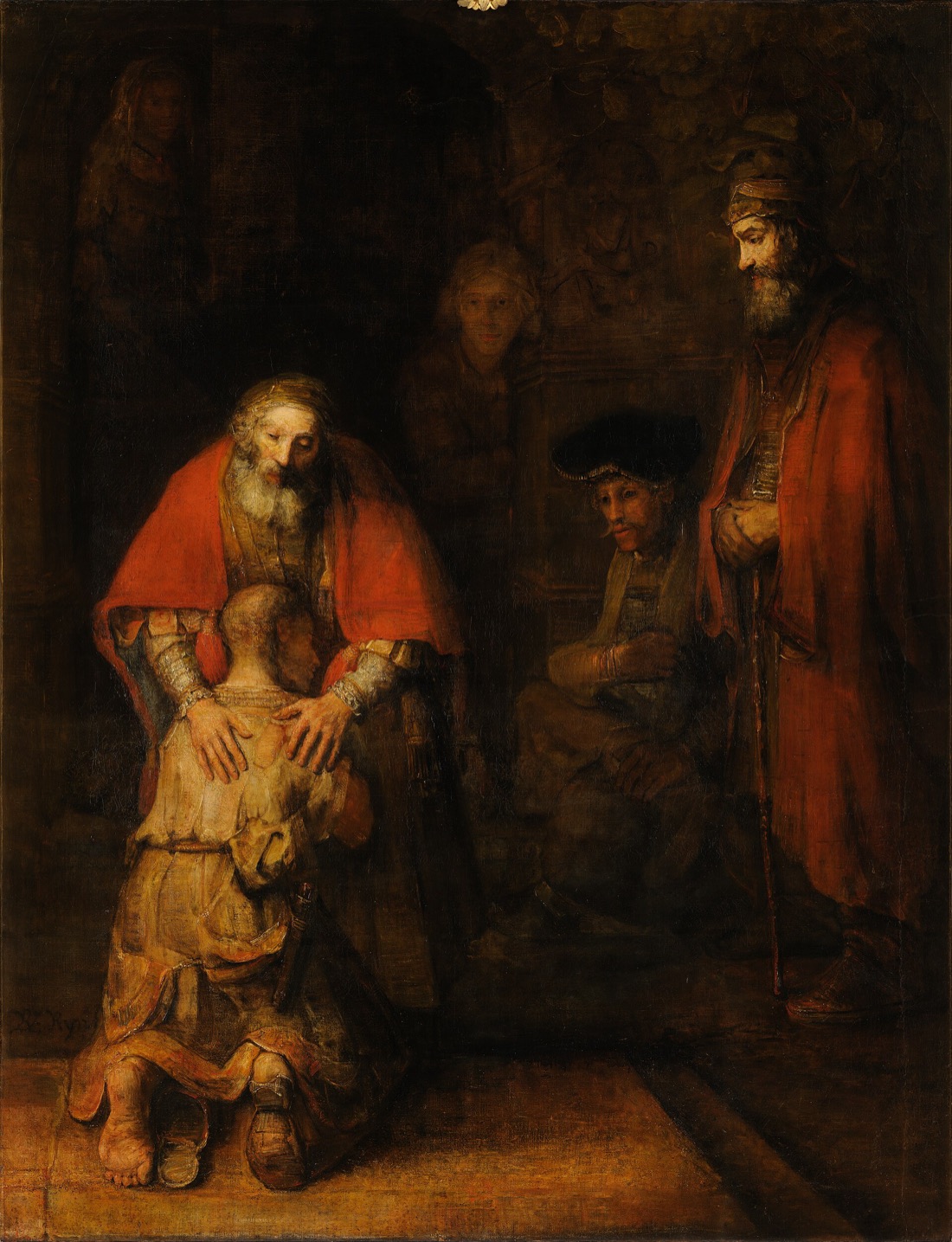
The father bows his head, both hands resting on the back of his kneeling son. The son’s hair is cut very short; one shoe has fallen off behind his foot, showing the sole. On the right stands a man in a red robe, leaning on a staff, watching. In this painting, whom do you see first?
Rembrandt van Rijn, The Return of the Prodigal Son, c. 1668, oil painting, Hermitage Museum, Saint Petersburg, Russia. Public domain. Wikimedia CommonsRead TogetherLuke 15:1-3, 11-32
1Now all the tax collectors and sinners were coming close to him to hear him.
2The Pharisees and the scribes murmured, saying, “This man welcomes sinners, and eats with them.”
3He told them this parable:
(vv. 4–10) A man loses one sheep, a woman loses one coin; when they find them, both call their friends and neighbors to rejoice with them. Each of these two parables has its own lesson in this series.
11He said, “A certain man had two sons.
12The younger of them said to his father, ‘Father, give me my share of your property.’ So he divided his livelihood between them.
13Not many days after, the younger son gathered all of this together and traveled into a far country. There he wasted his property with riotous living.
14When he had spent all of it, there arose a severe famine in that country, and he began to be in need.
15He went and joined himself to one of the citizens of that country, and he sent him into his fields to feed pigs.
16He wanted to fill his belly with the pods that the pigs ate, but no one gave him any.
17But when he came to himself, he said, ‘How many hired servants of my father’s have bread enough to spare, and I’m dying with hunger!
18I will get up and go to my father, and will tell him, “Father, I have sinned against heaven and in your sight.
19I am no more worthy to be called your son. Make me as one of your hired servants.”’
20“He arose and came to his father. But while he was still far off, his father saw him and was moved with compassion, and ran, fell on his neck, and kissed him.
21The son said to him, ‘Father, I have sinned against heaven and in your sight. I am no longer worthy to be called your son.’
22“But the father said to his servants, ‘Bring out the best robe and put it on him. Put a ring on his hand and sandals on his feet.
23Bring the fattened calf, kill it, and let’s eat and celebrate;
24for this, my son, was dead and is alive again. He was lost and is found.’ Then they began to celebrate.
25“Now his elder son was in the field. As he came near to the house, he heard music and dancing.
26He called one of the servants to him and asked what was going on.
27He said to him, ‘Your brother has come, and your father has killed the fattened calf, because he has received him back safe and healthy.’
28But he was angry and would not go in. Therefore his father came out and begged him.
29But he answered his father, ‘Behold, these many years I have served you, and I never disobeyed a commandment of yours, but you never gave me a goat, that I might celebrate with my friends.
30But when this your son came, who has devoured your living with prostitutes, you killed the fattened calf for him.’
31“He said to him, ‘Son, you are always with me, and all that is mine is yours.
32But it was appropriate to celebrate and be glad, for this, your brother, was dead, and is alive again. He was lost, and is found.’”
The Setting
Who was there. At the start of this chapter, two groups are around Jesus: “all the tax collectors and sinners were coming close to him to hear him” (v. 1); and “The Pharisees and the scribes murmured” (v. 2). What they murmured was this: “This man welcomes sinners, and eats with them” (v. 2).
Why he told it. Next, “He told them this parable” (v. 3). The three parables in this chapter are told in answer to that murmuring.
Three in a row. The first two parables are short; the third is the longest. Side by side:
| The lost sheep | The lost coin | The two sons | |
|---|---|---|---|
| What is lost | a hundred sheep, one lost (v. 4) | ten coins, one lost (v. 8) | two sons; the younger “traveled into a far country” (v. 13) |
| How it comes back | “go after the one that was lost, until he found it” (v. 4) | “light a lamp, sweep the house, and seek diligently until she found it” (v. 8) | the son “came to himself” (v. 17) and turned back on his own; the father saw him while he was “still far off” (v. 20) |
| The ending | “Rejoice with me” (v. 6) | “Rejoice with me” (v. 9) | the father says “it was appropriate to celebrate and be glad” (v. 32); the elder son “would not go in” (v. 28) |
The first two parables both end with rejoicing together. The third has one more person in it: someone who will not rejoice with them.
Explanation
What do we see? This parable has two sons, and both are far from their father. The younger son “traveled into a far country” (v. 13); the elder son is right at the door of the house, yet “he was angry and would not go in” (v. 28).
Twice the father goes out to meet a son. Once when the younger son was “still far off”: he saw him, and “ran, fell on his neck, and kissed him” (v. 20). Once when the elder son stood outside: “his father came out and begged him” (v. 28).
Both sons speak of hired servants and serving. The younger son’s prepared words were “Make me as one of your hired servants” (v. 19); the elder son says, “these many years I have served you” (v. 29). To both of them, the father speaks of sons: of the younger, “this, my son, was dead and is alive again” (v. 24); to the elder, “Son, you are always with me” (v. 31).
Two more sayings belong side by side: the elder son says “this your son” (v. 30), and the father answers him with “this, your brother” (v. 32).
The parable stops at the father’s words to the elder son. Whether the elder son went in afterward, the text does not say.
If I had been there. Among those present that day were tax collectors and sinners, and also Pharisees and scribes (vv. 1–2). The tax collectors heard of a father who saw his son far off and ran to meet him. The Pharisees heard of an elder brother standing angry outside the door, and of the words his father came out to say to him. The two groups heard the same story, and each could find themselves in it.
What is God like? While the son was still far away, the father saw him. He “was moved with compassion, and ran, fell on his neck, and kissed him” (v. 20), and only then did the son speak his confession (v. 21). The line the son had prepared, “Make me as one of your hired servants” (v. 19), never got said in front of his father: the father was already telling the servants to bring the robe, the ring and the sandals (v. 22).
Nor did the father ignore the elder son. He “came out and begged him” (v. 28). The elder son was full of resentment, and his father’s answer was: “Son, you are always with me, and all that is mine is yours” (v. 31).
In the first two parables, Jesus twice says that there is joy in heaven over one sinner who repents (vv. 7, 10). In the third parable, it is the father who begins the joy: “let’s eat and celebrate” (v. 23).
What does this mean for me? This parable is often called ‘the prodigal son’, but its first sentence is “A certain man had two sons” (v. 11), and it ends with the elder son.
The son who left home is plainly lost. The son at home is lost too, but that is hard to see: he could say, “I never disobeyed a commandment of yours” (v. 29), yet he would not go into his father’s house.
If you are like the younger son: the father did not wait for him to reach the door, nor for him to finish what he had to say.
If you are like the elder son: the father has come out to find you too. What he says to you is: “Son, you are always with me, and all that is mine is yours” (v. 31).
Different Views
The three commentators below are English: Matthew Henry (1662–1714), John Gill (1697–1771) and Adam Clarke (c. 1760–1832). Each is quoted in his own words, with the source after each quotation.
What the text itself says (all three follow this): This parable is told in answer to the murmuring of the Pharisees and scribes (vv. 1–3); the father takes back the son who was lost and calls the whole household to rejoice together (vv. 22–24). The three questions below are places the text does not spell out, where readers through the centuries have differed.
1. Who is the elder son?
Gill first sets aside three readings, then names his own:
By "the elder son" is meant, not angels…nor truly converted persons, of some standing in the church…nor the Jews in general, in distinction from the Gentiles…the Scribes and Pharisees in particular are meant, in opposition to the publicans and sinners
John Gill, Exposition of the Entire Bible, on Luke 15:25.
Henry gives two readings, and says the father’s closing words fit the second better than the first:
The former represents the Jews in general, and particularly the Pharisees
But by the elder brother here we may understand those who are really good, and have been so from their youth up, and never went astray into any vicious course of living…and to such these words in the close, Son, thou art ever with me, are applicable without any difficulty, but not to the scribes and Pharisees
Matthew Henry, Commentary on the Whole Bible, Vol. V, on Luke 15:11-32.
Clarke gives three readings in different places: in his note on v. 25, in his note on v. 28, and at the end of the chapter.
His elder son - Meaning probably persons of a regular moral life, who needed no repentance in comparison of the prodigal already described
This refers to the indignation of the scribes and Pharisees, mentioned Luke 15:1 , Luke 15:2
In this parable, the younger profligate son may represent the Gentile world; and the elder son, who so long served his father…the Jewish people
Adam Clarke, Commentary on the Bible, on Luke 15:25, 28 and at the end of the chapter.
How to read it: All three hold that the elder son points first to the Pharisees and scribes who were murmuring about Jesus at the time. The elder son’s words sound much like theirs: they said, “This man welcomes sinners, and eats with them” (v. 2); the elder son says, “this your son came…you killed the fattened calf for him” (v. 30). As for whom else the elder son may stand for, for readers today, the three differ: Gill allows only the scribes and Pharisees; Henry thinks it can also mean people who have always been good; Clarke, besides these two, extends it to Jews and Gentiles. The text goes only as far as the father pleading with him, and does not say whether he went in. That question is left to everyone who hears it.
2. The robe, the ring, the sandals: what do they stand for?
Henry gives each of the three a meaning:
First, The righteousness of Christ is the robe, that principal robe, with which they are clothed
Secondly, The earnest of the Spirit, by whom we are sealed to the day of redemption, is the ring on the hand.
Thirdly, The preparation of the gospel of peace is as shoes for our feet ( Eph. vi. 15 )
Matthew Henry, Commentary on the Whole Bible, Vol. V, on Luke 15:11-32.
For Gill too the robe is the righteousness of Christ; the ring, though, is something else:
the righteousness of Christ which is often compared to a robe, or garment
by the "ring" is meant the everlasting love of God; and which, as a ring, is round, and has neither beginning nor end
John Gill, Exposition of the Entire Bible, on Luke 15:22.
In his verse-by-verse notes, Clarke explains what a ring meant at the time, and cites Pharaoh giving his ring to Joseph: “Pharaoh took off his signet ring from his hand, and put it on Joseph’s hand” (Gen 41:42).
Giving a ring was in ancient times a mark of honor and dignity
Adam Clarke, Commentary on the Bible, on Luke 15:22.
How to read it: What the text itself says: the son’s prepared words were “Make me as one of your hired servants” (v. 19); what his father gave him was the robe, the ring, the sandals and the fattened calf, and the reason was “this, my son, was dead and is alive again” (v. 24). He was taken back as a son. What each of the three things stands for, the text does not say. Henry and Gill both read the robe as the righteousness of Christ; when they come to the ring, one says the Spirit and the other says God’s everlasting love — this is an allegorical reading: finding a counterpart for every item, and different people find different counterparts. When you read this verse, hold on first to what the text itself says.
3. Why did ‘make me as one of your hired servants’ go unsaid?
We cannot think that he forgot it, much less that he changed his mind…but his father interrupted him, prevented his saying it
Matthew Henry, Commentary on the Whole Bible, Vol. V, on Luke 15:11-32.
His tenderness of heart cannot wait till the son has made his confession
Adam Clarke, Commentary on the Bible, on Luke 15:21.
he was not allowed to say, "make me as one of thy hired servants"; because this could not be granted; for a son is always a son, and cannot become a servant
John Gill, Exposition of the Entire Bible, on Luke 15:21.
How to read it: The three give different reasons, but they see the same thing: before the son had finished speaking, the father had already spoken. The text says, “But the father said to his servants” (v. 22). And before that, the father had already run to him: he “ran, fell on his neck, and kissed him” (v. 20).
Key Word
When the father saw his son far off, he “was moved with compassion” (v. 20). In Greek, ‘moved with compassion’ is a single word.
The word comes from σπλάγχνον, ‘the inward parts’. Thayer’s Greek lexicon explains that it properly means to be moved in one’s inward parts, and so to be moved with compassion, to have compassion, because the inward parts were thought to be the seat of love and pity.
properly, to be moved as to one's bowels, hence, to be moved with compassion, have compassion (for the bowels were thought to be the seat of love and pity)
Thayer’s Greek-English Lexicon of the New Testament, G4697.
The word appears 12 times in the New Testament, all in the Gospels. Three are in Jesus’ parables: the master in the parable of the unforgiving servant, “being moved with compassion” (Matt 18:27); the good Samaritan, “he was moved with compassion” (Luke 10:33); and the father of the prodigal son (v. 20). The other nine are all about Jesus himself, such as “Jesus, being moved with compassion” (Matt 20:34), and “when he saw the multitudes, he was moved with compassion for them” (Matt 9:36).
Think It Through
There are no right answers and no scores. Write your answers down; they are for you alone.
- Of the two sons, which are you more like these days? Are you in the ‘far country’, or right at the door of the house, yet unwilling to go in?
- The younger son’s prepared words were “Make me as one of your hired servants” (v. 19). Have you ever thought, before God, ‘I’m not worthy; if I could just be a hired servant, that would be enough’?
- The elder son says “this your son” (v. 30); the father says “this, your brother” (v. 32). Is there someone you would rather not call ‘brother’ or ‘sister’?
- Look at Rembrandt’s painting again: the father’s two hands on his son’s back, and someone standing on the right, watching. If you were the one standing by and watching, what would be on your face?
This Week
Think of someone you would rather not call ‘brother’ or ‘sister’. This week, pray for that person once, by name.
If it is fitting, find one good thing about them and tell them, sincerely, ‘That’s really good.’
At the end of the week, ask yourself: this week, was I inside the door, or outside it?
Further Reading
- Matthew Henry, Commentary on the Whole Bible, Vol. V: Luke 15:11-32 (public domain; free to read in full at CCEL)
- Leon Morris, Luke (Tyndale New Testament Commentaries): Luke 15:11-32
- Klyne R. Snodgrass, Stories with Intent: the chapter on the prodigal son
More in This UnitUnit 2 · Lost and Found
- The Lost Sheep Luke 15:3-7
- The Lost Coin Luke 15:8-10
- The Prodigal Son Luke 15:11-32 This lesson
- The Good Shepherd John 10:1-18
Scripture: World English Bible (public domain). The commentators in ‘Different Views’ are quoted in their own words from the English originals (public domain).