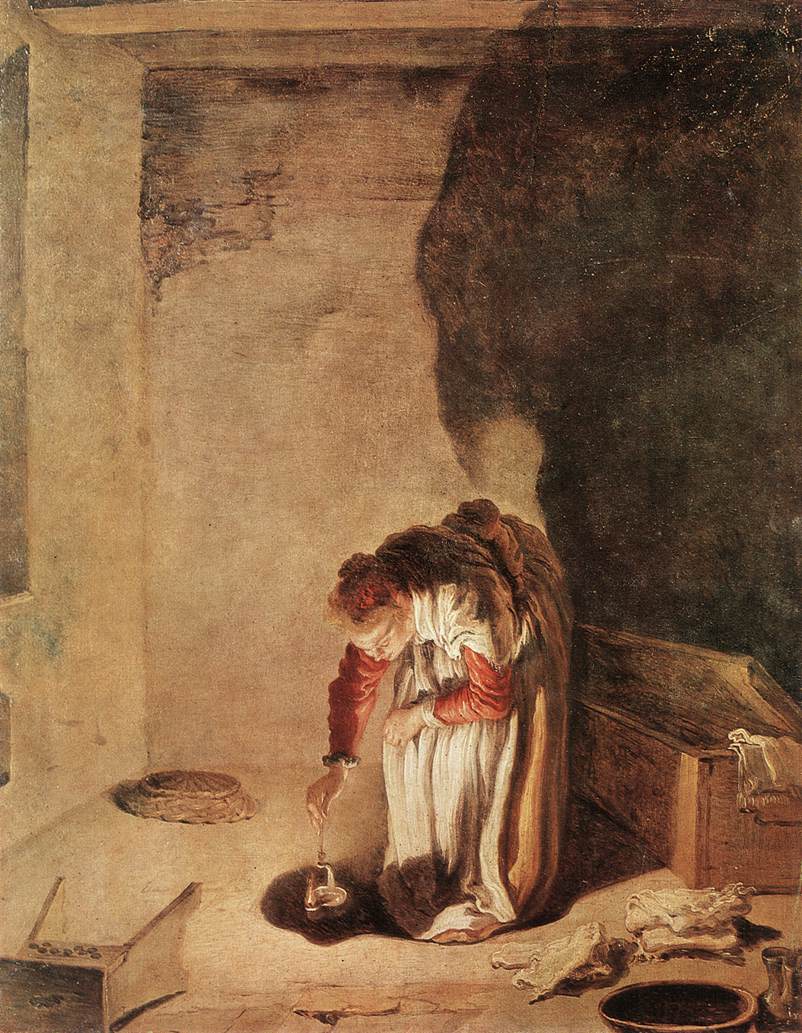
A bare, empty room, with a large shadow on the wall. A woman bends low, holding up her skirt with one hand and a small lamp in the other, close to the floor, searching. On the floor lie an open chest, a few pieces of cloth, an empty basket and a basin. The only light in the room is the little lamp in her hand. How long do you think she has been looking?
Domenico Fetti, Parable of the Lost Drachma, c. 1618–1622, oil on panel, Gemäldegalerie Alte Meister, Dresden, Germany. Public domain. Wikimedia CommonsRead TogetherLuke 15:8-10
(vv. 1–7) Tax collectors and sinners come close to Jesus; the Pharisees and scribes murmur that this man welcomes sinners; Jesus tells the parable of the lost sheep (see the lesson on the lost sheep).
8“Or what woman, if she had ten drachma coins, if she lost one drachma coin, wouldn’t light a lamp, sweep the house, and seek diligently until she found it?
9When she has found it, she calls together her friends and neighbors, saying, ‘Rejoice with me, for I have found the drachma which I had lost!’
10Even so, I tell you, there is joy in the presence of the angels of God over one sinner repenting.”
The Setting
Who was there. This is the second parable Jesus told in answer to the Pharisees and scribes, who had said, “This man welcomes sinners, and eats with them” (Luke 15:2). The first was one sheep lost out of a hundred; this one is one coin lost out of ten; after it comes the story of two sons.
How much is one coin? The coin is a drachma, a Greek silver coin. Thayer’s Greek lexicon says it was of nearly the same weight as the Roman denarius, and Adam Clarke says it was about the same value. The denarius was a day’s wage: the landowner “agreed with the laborers for a denarius a day” (Matt 20:2). So one coin was about a day’s wage, and ten coins about ten days’ wages.
a drachma, a silver coin of (nearly) the same weight as the Roman denarius (see δηνάριον): Luke 15:8f.
The Grecian drachma was worth about sevenpence three farthings of our money; being about the same value as the Roman denarius.
Thayer’s Greek-English Lexicon of the New Testament, G1406; Adam Clarke, Commentary on the Bible, on Luke 15:8.
The sheep and the coin side by side:
| The lost sheep | The lost coin | |
|---|---|---|
| Who lost something | “Which of you men, if you had one hundred sheep” (Luke 15:4) | “what woman, if she had ten drachma coins” (v. 8) |
| How much was lost | one out of a hundred | one out of ten |
| Where the search happens | “leave the ninety-nine in the wilderness and go after the one that was lost” (Luke 15:4) | at home: “light a lamp, sweep the house” (v. 8) |
| How the search goes | “until he found it” (Luke 15:4) | “seek diligently until she found it” (v. 8) |
| After finding | “Rejoice with me, for I have found my sheep” (Luke 15:6) | “Rejoice with me, for I have found the drachma” (v. 9) |
| Jesus’ words | “there will be more joy in heaven over one sinner who repents” (Luke 15:7) | “there is joy in the presence of the angels of God over one sinner repenting” (v. 10) |
The two parables are almost the same; only the person and the place have changed: one is a man in the wilderness, the other a woman at home.
Explanation
What do we see? The woman does three things: she lights a lamp, sweeps the house and searches carefully (v. 8). She lights the lamp because the room is dark; she sweeps because the coin may have rolled into a corner; she searches carefully because a coin is small and easily missed. Matthew Henry pictures her looking into every corner of the house:
The woman lights a candle, to look behind the door, under the table, and in every corner of the house, sweeps the house, and seeks diligently till she finds it.
Matthew Henry, Commentary on the Whole Bible, Vol. V, on Luke 15:1-10.
When she finds it, she calls her friends and neighbors to rejoice with her (v. 9). Henry says she is so glad that she would gladly spend more than the coin on entertaining them:
She was glad that she had found the piece of money, though she should spend it in entertaining those whom she called to make merry with her.
Matthew Henry, Commentary on the Whole Bible, Vol. V, on Luke 15:1-10.
If I had been there. The Pharisees and scribes had just heard the story of the shepherd, and Jesus told another. This time it is not in the wilderness but at home, and it is something everyone has done: lost something, lit a lamp and searched. It is hard for a listener to say, ‘I would never do that.’
Both parables end with the same invitation, “Rejoice with me” (v. 9), in the lost sheep as well (Luke 15:6). The Pharisees and scribes were murmuring; Jesus was inviting them to rejoice too.
What is God like? A coin cannot move by itself, cannot call out, and does not even know it is lost. A sheep that wanders off can still bleat; a coin cannot even do that. Its being found depends entirely on the one who searches.
Jesus says that over one sinner repenting “there is joy in the presence of the angels of God” (v. 10). Heaven rejoices over one person the way this woman rejoices over one coin: not because it is worth a great deal, but because it is hers, and it was lost.
What does this mean for me? One coin is only one out of ten; one person in a great crowd is only one. But in the eyes of the one who searches, the one that is lost is everything.
Reading this parable, first recognize that we are the coin: it is not that we found God, but that God lit a lamp and came looking for us. Then think too: in our homes and our churches, is there anyone who has fallen into a corner, whom no one has noticed for a long time?
Different Views
The three commentators below are English: Matthew Henry (1662–1714), John Gill (1697–1771) and Adam Clarke (c. 1760–1832). Each is quoted in his own words, with the source after each quotation.
What the text itself says (all three follow this): Like the lost sheep, this parable answers the murmuring of the Pharisees and scribes (Luke 15:1-3); the woman searches for the lost coin until she finds it, and calls others to rejoice with her (vv. 8–9); over one sinner repenting there is joy in the presence of the angels of God (v. 10). The two questions below are places the text does not spell out, where readers through the centuries have differed.
1. Who is searching for the coin? What do the lamp and the sweeping stand for?
Gill takes the woman as Christ and the lamp as the gospel. He says the parable means the same as the lost sheep, only here it shows more fully that the sinner is passive in conversion:
and by the "woman" the proprietor of them, is meant Christ
but by this candle is meant, the Gospel itself
only the passiveness of a sinner in conversion is here more fully signified; who can contribute no more to the first act of conversion, which is purely God's work, than a lost piece of silver to its being found
John Gill, Exposition of the Entire Bible, on Luke 15:8.
Henry reads the lamp, the sweeping and the careful search as the ways God brings the lost back to himself:
This represents the various means and methods God makes use of to bring lost souls home to himself: he has lighted the candle of the gospel, not to show himself the way to us, but to show us the way to him
Matthew Henry, Commentary on the Whole Bible, Vol. V, on Luke 15:1-10.
Clarke applies these actions to the sinner himself. He then adds a caution about reading parables like this one:
He must sweep the house - put away the evil of his doings; and seek diligently - use every means of grace, and cry incessantly to God, till he restore to him the light of his countenance.
Though parables of this kind must not be obliged to go on all fours, as it is termed; yet they afford many useful hints to preachers of the Gospel
Only let all such take care not to force meanings on the words of Christ which are contrary to their gravity and majesty.
Adam Clarke, Commentary on the Bible, on Luke 15:8.
How to read it: Here, this is an allegorical reading: finding a counterpart for every item in a parable. The three find different counterparts, and the biggest difference is in ‘who is searching’. Gill and Henry say God is searching, and Gill stresses that the coin is wholly passive; Clarke applies the sweeping and the careful search to the sinner himself. What the text itself says: the one who lights the lamp, sweeps and searches carefully is the woman (v. 8); and Jesus’ conclusion is that “there is joy in the presence of the angels of God over one sinner repenting” (v. 10). How God’s searching and our repentance belong together: churches understand this question in different ways. Please ask the church you belong to.
2. Why a woman this time?
The loser is here supposed to be a woman, who will more passionately grieve for her loss, and rejoice in finding what she had lost, than perhaps a man would do, and therefore it the better serves the purpose of the parable.
Matthew Henry, Commentary on the Whole Bible, Vol. V, on Luke 15:1-10.
John Gill: Reading it as allegory, Gill takes the woman, the owner of the coins, to be Christ (see the first question).
Adam Clarke: Clarke does not explain why it is a woman; he only cautions that parables of this kind cannot be pressed at every point (see the first question).
How to read it: Henry reads it from ordinary human feeling, Gill reads it as allegory, and Clarke warns against reading too much into it. What can be seen in the text: Jesus tells three parables in a row, about a shepherd, a woman and a father — one who keeps sheep, one who keeps a house, one who is a parent — and anyone listening could find their own days in one of them.
Key Word
“If she had ten drachma coins, if she lost one drachma coin” (v. 8).
Thayer’s Greek lexicon explains it as a silver coin of nearly the same weight as the Roman denarius; the passage he lists is Luke 15:8-9.
a drachma, a silver coin of (nearly) the same weight as the Roman denarius (see δηνάριον): Luke 15:8f.
Thayer’s Greek-English Lexicon of the New Testament, G1406.
One silver coin, about a day’s wage: not a large sum, but not small change to be tossed aside either. Matthew Henry says the coin bears God’s image and so is to be given back to him. Elsewhere Jesus too asked, “Whose is this image and inscription?” (Matt 22:20).
it is stamped with God's image and superscription, and therefore must be rendered to him.
Matthew Henry, Commentary on the Whole Bible, Vol. V, on Luke 15:1-10.
This is an allegorical way of reading, but it is a reminder of one thing: whether a coin is worth searching for depends not on how much it is worth, but on whose it is.
Think It Through
There are no right answers and no scores. Write your answers down; they are for you alone.
- Have you ever lost something and turned the whole house upside down looking for it? How did you feel when you found it?
- A coin cannot move by itself; it depends entirely on someone searching for it. Think back on how you came to faith: how much of it was you looking for God, and how much was God looking for you?
- In your home or your church, is there someone like that coin, fallen into a corner, whom no one has noticed for a long time?
- Look at Fetti’s painting again: the room is dark, with only the small lamp in the woman’s hand. If you were the coin she is looking for, which corner would you be in?
This Week
Think of someone near you who has ‘fallen into a corner’: a colleague who seldom speaks, a brother or sister who has not come to church for a long time, someone in your family who is overlooked. This week, go and talk with them a little, or invite them for a meal.
At the end of the week, ask yourself: this week, whom did I light a lamp to look for?
Further Reading
- Matthew Henry, Commentary on the Whole Bible, Vol. V: Luke 15:1-10 (public domain; free to read in full at CCEL)
- Leon Morris, Luke (Tyndale New Testament Commentaries): Luke 15:8-10
- Klyne R. Snodgrass, Stories with Intent: the chapter on the lost coin
More in This UnitUnit 2 · Lost and Found
- The Lost Sheep Luke 15:3-7
- The Lost Coin Luke 15:8-10 This lesson
- The Prodigal Son Luke 15:11-32
- The Good Shepherd John 10:1-18
Scripture: World English Bible (public domain). The commentators in ‘Different Views’ are quoted in their own words from the English originals (public domain).