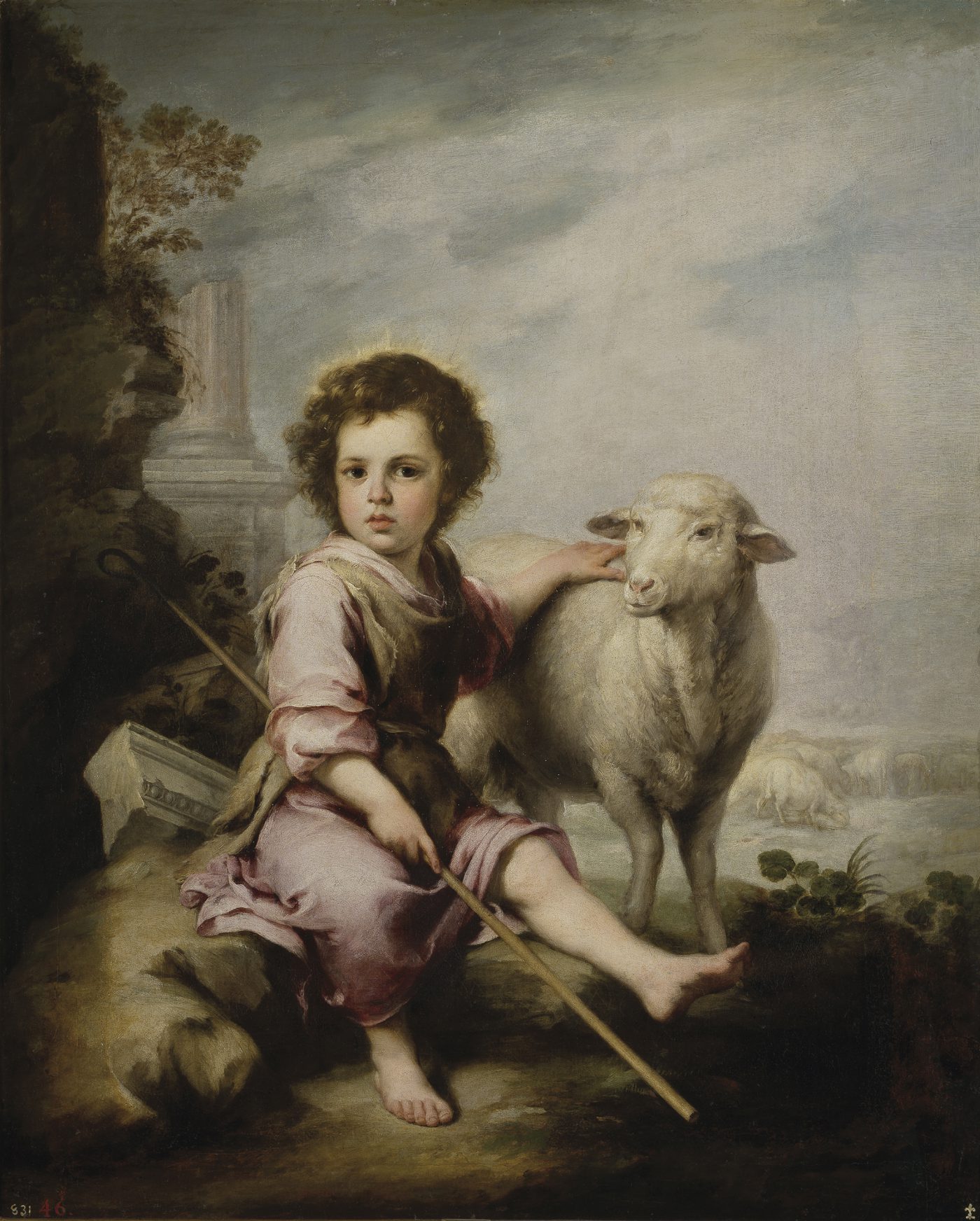
A child sits barefoot on a stone. He is dressed in pink, with an animal skin over his shoulders; in one hand he holds a shepherd’s crook at a slant, and his other hand rests on the back of a sheep beside him. Behind him stands a broken stone column, and at his feet lies a fallen stone carved with a pattern; in the distance, the flock grazes with heads bowed. A faint ring of light circles the child’s head, and he is looking out of the painting at you. The painter has painted the good shepherd as a child. What do you think he wanted people to see?
Bartolomé Esteban Murillo (1617–1682), The Good Shepherd (El Buen Pastor), c. 1660, oil painting, Museo del Prado, Madrid, Spain. Public domain. Wikimedia CommonsRead TogetherJohn 10:1-18
1“Most certainly, I tell you, one who doesn’t enter by the door into the sheep fold, but climbs up some other way, is a thief and a robber.
2But one who enters in by the door is the shepherd of the sheep.
3The gatekeeper opens the gate for him, and the sheep listen to his voice. He calls his own sheep by name and leads them out.
4Whenever he brings out his own sheep, he goes before them; and the sheep follow him, for they know his voice.
5They will by no means follow a stranger, but will flee from him; for they don’t know the voice of strangers.”
6Jesus spoke this parable to them, but they didn’t understand what he was telling them.
7Jesus therefore said to them again, “Most certainly, I tell you, I am the sheep’s door.
8All who came before me are thieves and robbers, but the sheep didn’t listen to them.
9I am the door. If anyone enters in by me, he will be saved, and will go in and go out and will find pasture.
10The thief only comes to steal, kill, and destroy. I came that they may have life, and may have it abundantly.
11“I am the good shepherd. The good shepherd lays down his life for the sheep.
12He who is a hired hand, and not a shepherd, who doesn’t own the sheep, sees the wolf coming, leaves the sheep, and flees. The wolf snatches the sheep and scatters them.
13The hired hand flees because he is a hired hand and doesn’t care for the sheep.
14I am the good shepherd. I know my own, and I’m known by my own;
15even as the Father knows me, and I know the Father. I lay down my life for the sheep.
16I have other sheep which are not of this fold. I must bring them also, and they will hear my voice. They will become one flock with one shepherd.
17Therefore the Father loves me, because I lay down my life, that I may take it again.
18No one takes it away from me, but I lay it down by myself. I have power to lay it down, and I have power to take it again. I received this commandment from my Father.”
The Setting
Who was there. There is no change of scene before this passage. In chapter 9, Jesus “saw a man blind from birth” (John 9:1) and healed him; the Pharisees questioned the man, and in the end “they threw him out” (John 9:34). Jesus later found him (John 9:35), and then spoke a few words to the Pharisees who were there. They answered, “Are we also blind?” (John 9:40). This passage follows straight on. John Gill says these words were spoken to the scribes and Pharisees who had cast out the man Christ had healed of blindness, because he spoke up for Christ:
To the Scribes and Pharisees, who had taken it ill that they should be thought to be blind; and who had cast out the man that Christ had cured of blindness, for speaking in favour of him
John Gill, Exposition of the Entire Bible, on John 10:1.
Matthew Henry, on the other hand, says it may have been spoken later, at the Feast of the Dedication in winter (see John 10:22), and that this is not certain:
It is not certain whether this discourse was at the feast of dedication in the winter
Matthew Henry, Commentary on the Whole Bible, Vol. V, on John 10:1-18.
The shepherd goes ahead. Jesus says that the shepherd “goes before them; and the sheep follow him” (v. 4). Matthew Henry says the shepherd does not drive the sheep from behind but, as was the custom of that time, goes ahead of them; Adam Clarke speaks of the same eastern custom:
he does not drive them, but (such was the custom in those times) he goes before them, to prevent any mischief or danger that might meet them, and they, being used to it, follow him, and are safe.
It was the custom in the eastern countries for the shepherd to go at the head of his sheep, and they followed him from pasture to pasture.
Adam Clarke, Commentary on the Bible, on John 10:4.
By name. “He calls his own sheep by name” (v. 3). John Gill says eastern shepherds gave their sheep names, as Europeans name their horses, and could sit and call them one by one:
in allusion to the eastern shepherds, who gave names to their sheep, as the Europeans do to their horses, and other creatures, and who could sit and call them by their names
John Gill, Exposition of the Entire Bible, on John 10:3.
Shepherds in the Old Testament. The listeners knew the Old Testament well. The prophet Ezekiel had rebuked the shepherds of Israel: “Woe to the shepherds of Israel who feed themselves! Shouldn’t the shepherds feed the sheep?” (Ezek 34:2). And God had promised, “Behold, I myself, even I, will search for my sheep, and will seek them out” (Ezek 34:11). David had sung, “The LORD is my shepherd; I shall lack nothing” (Ps 23:1). When Jesus said, “I am the good shepherd” (v. 11), these words would come to his listeners’ minds.
Explanation
What do we see? The passage falls into two halves. Verses 1–5 are a picture: a thief climbs into the sheepfold some other way; the shepherd enters by the door, calls the sheep by name and leads them out, walking ahead, and the sheep know his voice. Verse 6 says they did not understand. In vv. 7–18 Jesus himself opens up the picture, with two ‘I am’ sayings: “I am the sheep’s door” (v. 7) and “I am the good shepherd” (v. 11).
Several kinds of people appear in the picture. Thieves and robbers, who come “to steal, kill, and destroy” (v. 10); the hired hand, who “sees the wolf coming, leaves the sheep, and flees” (v. 12); and the good shepherd, who “lays down his life for the sheep” (v. 11). Adam Clarke tells the hired hand and the good shepherd apart like this:
The hireling counts the sheep his own, no longer than they are profitable to him; the good shepherd looks upon them as his, so long as he can be profitable to them.
Adam Clarke, Commentary on the Bible, on John 10:12.
If I had been there. The man born blind had just been thrown out (John 9:34). Those who threw him out saw themselves as shepherds of the people. When Jesus spoke of thieves, robbers and a hired hand, the Pharisees could hardly have missed the point. Yet v. 6 says “they didn’t understand what he was telling them” (v. 6).
And the man who had been thrown out was the one Jesus went and found: “Jesus heard that they had thrown him out, and finding him” (John 9:35). When a sheep is driven out of the fold, the good shepherd goes to find it.
What is God like? The good shepherd knows his sheep: “I know my own, and I’m known by my own” (v. 14), “even as the Father knows me, and I know the Father” (v. 15). In this passage Jesus speaks again and again of laying down his life (vv. 11, 15, 17, 18). Matthew Henry calls it a surprising reversal:
Thousands of sheep had been offered in sacrifice for their shepherds, as sin-offerings, but here, by a surprising reverse, the shepherd is sacrificed for the sheep.
Matthew Henry, Commentary on the Whole Bible, Vol. V, on John 10:1-18.
This life was not taken from him: “No one takes it away from me, but I lay it down by myself” (v. 18). Henry says that what looked like a life taken by force was in fact given up:
Though Christ's life seemed to be taken by storm, yet really it was surrendered
Matthew Henry, Commentary on the Whole Bible, Vol. V, on John 10:1-18.
What does this mean for me? “All we like sheep have gone astray. Everyone has turned to his own way” (Isa 53:6). Jesus says his sheep know his voice: “They will by no means follow a stranger” (v. 5). Every day many voices call to us: advertisements, friends, the news, the fears in our own hearts. Which one is the shepherd’s voice?
If you lead others in church, even just one small group, think too about the difference between a hired hand and a shepherd. Adam Clarke gives his readers a caution, and it is said first of all to ourselves:
Let not the reader apply this, or any of the preceding censures, to any particular class or order of men: every religious party may have a hireling priest, or minister
Adam Clarke, Commentary on the Bible, on John 10:12.
Different Views
The three commentators below are English: Matthew Henry (1662–1714), John Gill (1697–1771) and Adam Clarke (c. 1760–1832). Each is quoted in his own words, with the source after each quotation.
What the text itself says (all three follow this): Jesus first tells a picture of shepherding, and the listeners do not understand (vv. 1–6); so he says that he is the door of the sheep (vv. 7, 9) and the good shepherd (vv. 11, 14); the good shepherd lays down his life for the sheep, lays it down of his own accord, and will take it again (vv. 15–18). The three questions below are places the text does not spell out, where readers through the centuries have differed.
1. Who is the ‘gatekeeper’?
Henry first explains the custom of the time. Then, in application, he uses the verse of ministers who come in by the right door, for whom the Spirit of Christ opens a door:
Anciently they had their sheepfolds within the outer gates of their houses, for the greater safety of their flocks, so that none could come to them the right way, but such as the porter opened to or the master of the house gave the keys to.
and to such the porter will open; the Spirit of Christ will set before them an open door
Matthew Henry, Commentary on the Whole Bible, Vol. V, on John 10:1-18.
Gill first admits that Christ’s own explanation does not point to the meaning of this clause. He sets aside several views, grants that taking it of preachers of the gospel has some weight, and himself leans toward God the Father, from whom Christ as man and Mediator has his authority, or else the Holy Spirit:
There is nothing in the explanation of this parable given by Christ, that directs to the sense of this clause
though this is a sense not to be despised
but rather this intends God the Father, from whom Christ, as man and Mediator, derives his authority
or else the Holy Spirit
John Gill, Exposition of the Entire Bible, on John 10:3.
Clarke applies the verse to ministers: the Holy Spirit opens the way for a true minister into the hearts of those who hear him:
In the porter opening the door to the true shepherd, we may discover the second mark of a true minister - his labor is crowned with success. The Holy Spirit opens his way into the hearts of his hearers
Adam Clarke, Commentary on the Bible, on John 10:3.
How to read it: Here, this is an allegorical reading: finding a counterpart for everything in the picture. Gill himself puts it most plainly: when Jesus explained the picture, he spoke of the door, the shepherd, the thief, the hired hand and the wolf, but not of the gatekeeper. What the text itself makes plain is “I am the sheep’s door” (v. 7) and “I am the good shepherd” (v. 11). Who the gatekeeper is can be left open; there is no need to settle it.
2. Who are ‘all who came before me’?
Verse 8 says, “All who came before me are thieves and robbers” (v. 8). Does that include Moses and the prophets?
Gill says the words are to be taken with limits. He takes them of false prophets who came without being sent, shepherds who fed only themselves, and men such as Theudas and Judas of Galilee; and he says whom they do not mean:
This must be understood with some restrictions, not of every individual person, nor of every individual prophet or shepherd; not of Moses, nor of the prophets of the Lord, nor of John the Baptist, who came immediately before Christ
John Gill, Exposition of the Entire Bible, on John 10:8.
Henry takes ‘before’ not as earlier in time, but as going ahead of Christ’s sending:
all that went before him, not in time, many of them were faithful shepherds, but all that anticipated his commission, and went before he sent them
Matthew Henry, Commentary on the Whole Bible, Vol. V, on John 10:1-18.
Clarke notes another way some translate the words, then gives his own view, and adds that the Lord has borne witness to the prophets:
Or, as some translate, all that came instead of me, προ εμου, i.e. all that came as the Christ, or Messiah, such as Theudas, and Judas the Gaulonite
But our Lord probably refers to the scribes and Pharisees, who pretended to show the way of salvation to the people
But our Lord has borne sufficient testimony to their inspiration in a variety of places.
Adam Clarke, Commentary on the Bible, on John 10:8.
Gill and Clarke both mention that a number of ancient manuscripts and versions do not have the words ‘before me’:
The phrase, "before me", is wanting in seven of Beza's exemplars, and in several others
John Gill, Exposition of the Entire Bible, on John 10:8.
How to read it: On one thing the three agree: Jesus is not calling Moses and the prophets thieves. As for exactly whom he means, each names different people. The text itself gives a way to tell: the thief is one who “doesn’t enter by the door” (v. 1), who “only comes to steal, kill, and destroy” (v. 10); and “the sheep didn’t listen to them” (v. 8).
3. Who are the ‘other sheep’? For whom does the good shepherd lay down his life?
“I have other sheep which are not of this fold” (v. 16): all three say this includes the Gentiles. Matthew Henry puts it this way:
One shepherd makes one fold; one Christ makes one church.
Matthew Henry, Commentary on the Whole Bible, Vol. V, on John 10:1-18.
Where they differ: how the ‘sheep’ come to be sheep, and for whom Christ lays down his life:
These Gentiles were not yet called, and many were not yet born, yet they are already called sheep:
are here called sheep, and he is said to have them, though as yet they were uncalled, and many of them unborn, because they were chosen of God, and given to Christ in the counsels of divine love from eternity.
Matthew Henry, Commentary on the Whole Bible, Vol. V, on John 10:1-18.
Gill takes the other sheep as God’s chosen among the Gentiles. On v. 15, “I lay down my life for the sheep” (v. 15), he says these sheep were the Father’s gift to Christ, and that Christ laid down his life for them and no others:
by whom are meant the chosen of God among the Gentiles, who were sheep, though not called and folded
which were his, by the Father's gift, and for no other has he laid down his life.
John Gill, Exposition of the Entire Bible, on John 10:15-16.
Clarke takes the other sheep as the Gentiles and Samaritans. He puts Jesus’ meaning in his own words and cites Hebrews 2:9, which says of Jesus “that by the grace of God he should taste of death for everyone” (Heb 2:9):
The Gentiles and Samaritans. As if our Lord had said, Do not imagine that I shall lay down my life for the Jews, exclusively of all other people; no: I shall die also for the Gentiles; for by the grace, the merciful design and loving purpose of God, I am to taste death for every man, Hebrews 2:9
Adam Clarke, Commentary on the Bible, on John 10:16.
How to read it: What the text itself says: the good shepherd says, “I lay down my life for the sheep” (v. 15); he has other sheep, and “I must bring them also” (v. 16); “They will become one flock with one shepherd” (v. 16). All three believe that Christ laid down his life to save his sheep, and all three believe that the Gentiles will be brought in. Where they differ is how God’s choosing and Christ’s laying down his life are related: whether Christ laid down his life only for the chosen, or tasted death for everyone. Churches understand this question in different ways. Please ask the church you belong to.
Key Word
“I am the good shepherd. The good shepherd lays down his life for the sheep” (v. 11).
The Greek for ‘good’ is καλός. Thayer’s Greek lexicon says the Greeks used it of everything so outstanding in form, excellence, goodness or usefulness as to be pleasing, and so it often means ‘beautiful’. Joined to nouns that name a person by his office, it means competent, able, being what such a person is meant to be; his first example is ποιμήν (shepherd), at John 10:11, 14.
beautiful, applied by the Greeks to everything so distinguished in form, excellence, goodness, usefulness, as to be pleasing
joined to names of men designated by their office, competent, able, such as one ought to be: ποιμήν, John 10:11, 14
Thayer’s Greek-English Lexicon of the New Testament, G2570.
Matthew Henry points to the Greek wording: the shepherd, the good shepherd, the one God had promised:
ho poimen ho kalos—that shepherd, that good Shepherd, whom God had promised.
Matthew Henry, Commentary on the Whole Bible, Vol. V, on John 10:1-18.
So ‘good shepherd’ means more than ‘a kind-hearted shepherd’; it means ‘everything a shepherd is meant to be, he is’. The Old Testament rebuked the shepherds “who feed themselves” (Ezek 34:2). Jesus says, “I am the good shepherd” (v. 11): what a shepherd was always meant to be can be seen in him.
About the Genre
This is one of the six parables in this series that carry a note on genre. Several views are set out below, without a conclusion.
The same name, two Greek words. Verse 6 says, “Jesus spoke this parable to them” (v. 6). The parables in Matthew, Mark and Luke are called parables too; but in Greek it is not the same word. For the sower, the prodigal son and the others, Matthew, Mark and Luke use παραβολή (parabolē); here the word is παροιμία (paroimia). The passages Thayer’s Greek lexicon lists for παραβολή are in Matthew, Mark, Luke and Hebrews; not one is in John. In John, παροιμία appears again in chapter 16: “I have spoken these things to you in figures of speech” (John 16:25); later the disciples say, “now you are speaking plainly, and using no figures of speech” (John 16:29).
How the two words are explained. Thayer gives this as one main meaning of παραβολή:
a narrative, fictitious but agreeable to the laws and usages of human life, by which either the duties of men or the things of God, particularly the nature and history of God's kingdom, are figuratively portrayed
Thayer’s Greek-English Lexicon of the New Testament, G3850.
For παροιμία in John 10:6, though, he gives this:
speech or discourse in which a thing is illustrated by the use of similes and comparisons; an allegory, i. e. extended and elaborate metaphor
Thayer’s Greek-English Lexicon of the New Testament, G3942.
How is it different from the sower or the prodigal son? The sower and the prodigal son are stories, with a beginning, a middle and an end, and the one telling the story stands outside it. This passage has no such storyline: vv. 1–5 are a picture of shepherding, and in vv. 7–18 Jesus steps straight into the picture, saying ‘I am the door’ and ‘I am the good shepherd’. One moment he is the door, the next the shepherd who comes in by the door. Matthew Henry remarks on this:
Though it may be a solecism in rhetoric to make the same person to be both the door and the shepherd, it is no solecism in divinity
Matthew Henry, Commentary on the Whole Bible, Vol. V, on John 10:1-18.
Yet many still call it a parable. All three commentators call it a parable. Clarke says verse 6 tells us it is a parable, showing heavenly things through earthly things. Henry calls it a parable or similitude. Even Thayer, under ‘shepherd’ (ποιμήν), refers to John 10:11, 14 as a parable.
From John 10:6, we learn that this is a parable, i.e. a representation of heavenly things through the medium of earthly things.
Here is the parable or similitude proposed
in the parable, he to whose care and control others have committed themselves, and whose precepts they follow, John 10:11, 14.
Thayer’s Greek-English Lexicon of the New Testament, G4166.
How to read it: Calling it a parable has the support of John 10:6 and of what commentators through the centuries have called it; saying it is not quite a parable like the sower or the prodigal son has the support of the Greek word and of the way this passage is written. Both are set out here. This series includes it because the text itself calls it a παροιμία — “Jesus spoke this parable to them” (v. 6) — and because, of all the places in John where Jesus speaks of himself through a picture, this passage does so most fully. When reading it, there is no need to decide first what kind it is; first listen closely to what the shepherd is saying.
Think It Through
There are no right answers and no scores. Write your answers down; they are for you alone.
- Many voices call to you every day. In the past week, which voice have you heard most? How do you tell which one is the shepherd’s voice?
- “He calls his own sheep by name” (v. 3). When you think that Jesus knows your name and knows you, what do you feel?
- The hired hand “sees the wolf coming, leaves the sheep, and flees” (v. 12). In the things you are responsible for (at home, at work, at church), has there been a time when you wanted to leave as soon as the wolf came?
- Look at Murillo’s painting again: the good shepherd painted as a child, his hand on a sheep, a broken column behind him. If you were to paint ‘the good shepherd’, how would you paint him?
This Week
Every morning, read v. 14: “I am the good shepherd. I know my own, and I’m known by my own” (v. 14). This week, notice one time when you almost ‘followed a stranger’: when a remark, a piece of news or a fear pulled you along. Write it down, and think about what the shepherd would say.
If you lead others, this week get to know one of them a little better: ask how they have been lately, and remember one thing they tell you.
At the end of the week, ask yourself: this week, did I hear the shepherd’s voice?
Further Reading
- Matthew Henry, Commentary on the Whole Bible, Vol. V: John 10:1-18 (public domain; free to read in full at CCEL)
- John (Tyndale New Testament Commentaries): John 10:1-18
More in This UnitUnit 2 · Lost and Found
- The Lost Sheep Luke 15:3-7
- The Lost Coin Luke 15:8-10
- The Prodigal Son Luke 15:11-32
- The Good Shepherd John 10:1-18 This lesson
Scripture: World English Bible (public domain). The commentators in ‘Different Views’ are quoted in their own words from the English originals (public domain).