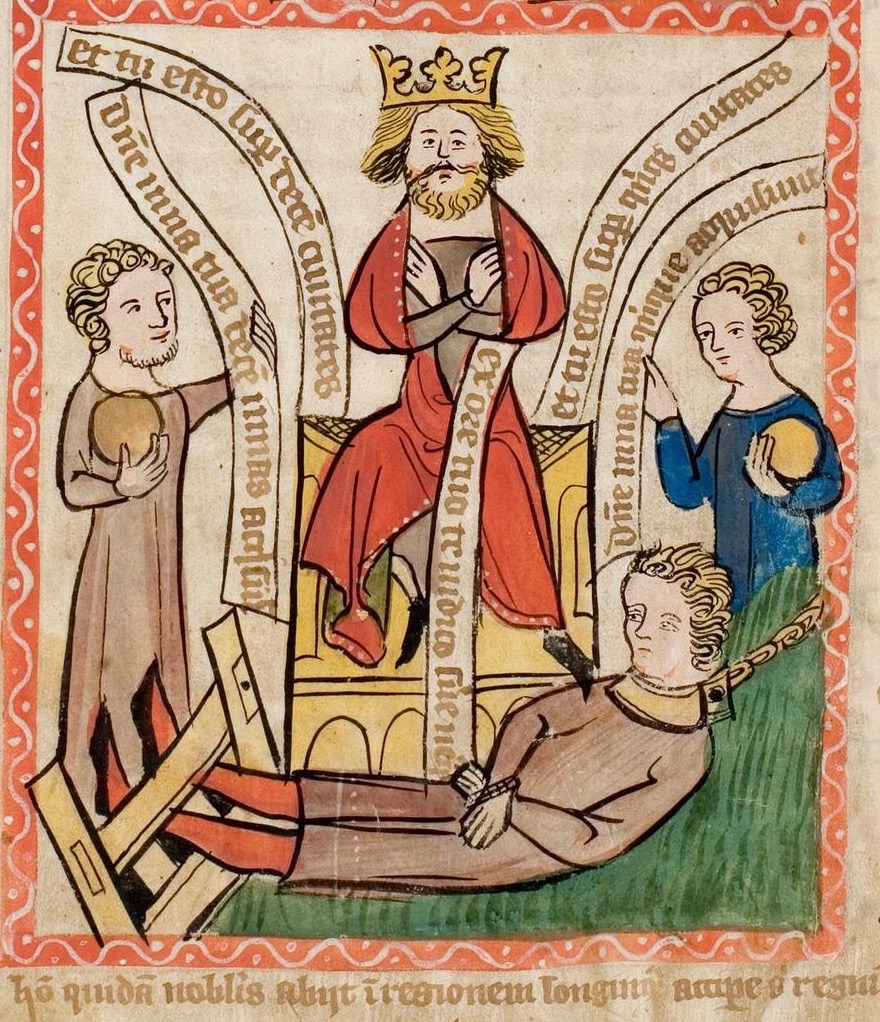
一个戴着王冠、留着胡子的人坐在宝座上,两手交叉放在胸前。左右各站着一个人,手里捧着一个金色的圆东西,另一只手抬起来。几条长长的字条从他们身边飘向宝座,上面写着字。宝座前面,一个人斜躺在草地上,两手被绑着,脖子上套着一个圈,连着一根绳子,两条腿夹在一个木架里。你看,同一个宝座前面,三个人的样子有什么不同?
佚名,《人类得救之镜》(Speculum Humanae Salvationis)手抄本插图,约 1360 年,德国威斯特法伦或科隆,德国达姆施塔特大学与州立图书馆藏(Hs 2505,第 68 张背面),取下半幅。公有领域。 Wikimedia Commons一起读路 19:11-27
(1–10 节)耶稣在耶利哥,住在税吏长撒该家里,说:「今天救恩到了这家」(路 19:9)。
11众人正在听见这些话的时候,耶稣因为将近耶路撒冷,又因他们以为神的国快要显出来,就另设一个比喻,说:
12“有一个贵胄往远方去,要得国回来,
13便叫了他的十个仆人来,交给他们十锭银子,说:‘你们去作生意,直等我回来。’
14他本国的人却恨他,打发使者随后去,说:‘我们不愿意这个人作我们的王。’
15他既得国回来,就吩咐叫那领银子的仆人来,要知道他们作生意赚了多少。
16头一个上来,说:‘主啊,你的一锭银子已经赚了十锭。’
17主人说:‘好,良善的仆人!你既在最小的事上有忠心,可以有权柄管十座城。’
18第二个来,说:‘主啊,你的一锭银子已经赚了五锭。’
19主人说:‘你也可以管五座城。’
20又有一个来,说:‘主啊,看哪,你的一锭银子在这里,我把他包在手巾里存着。
21我原是怕你,因为你是严厉的人:没有放下的还要去拿,没有种下的还要去收。’
22主人对他说:‘你这恶仆,我要凭你的口定你的罪。你既知道我是严厉的人,没有放下的还要去拿,没有种下的还要去收,
23为什么不把我的银子交给银行,等我来的时候,连本带利都可以要回来呢?’
24就对旁边站着的人说:‘夺过他这一锭来,给那有十锭的。’
25他们说:‘主啊,他已经有十锭了。’
26主人说:‘我告诉你们,凡有的,还要加给他;没有的,连他所有的也要夺过来。
27至于我那些仇敌不要我作他们王的,把他们拉来,在我面前杀了吧。’”
当时现场
为什么讲这个比喻。 路加写了两个原因:耶稣「将近耶路撒冷」(11 节),众人又「以为神的国快要显出来」(11 节)。马亨利说,主耶稣这时正在去耶路撒冷的路上,去守最后一次逾越节,要在那里受难、受死;门徒却以为,他要带着地上的排场和权势建立他的国。
Matthew Henry, Commentary on the Whole Bible, Vol. V,路 19:11-27。译自英文原著。
看英文原文
Our Lord Jesus is now upon his way to Jerusalem, to his last passover, when he was to suffer and die
The disciples thought that their Master would introduce it, but with temporal pomp and power
克拉克说,跟随他的人大概多半以为,他一到耶路撒冷就要自立为王。吉尔说,这个比喻的用意,正是要纠正“一个地上的国,而且马上就到”的想法。
Adam Clarke, Commentary on the Bible,路 19:11;John Gill, Exposition of the Entire Bible,路 19:11。译自英文原著。
看英文原文
Perhaps the generality of his followers thought that, on his arrival at Jerusalem, he would proclaim himself king.
now the scope and design of the following parable, is to refute the notion of a temporal kingdom, and its near approach
“往远方去,要得国回来”。 克拉克说,这是借当时的风俗说的:得了王位或管辖权的人,要到罗马去,由皇帝授给这个名位;希律就是这样到罗马去,得罗马皇帝的认可。14 节「打发使者随后去」,也是当时的事:有不满的人,趁这人去受封,派使者去见皇帝,要拦住他。
Adam Clarke, Commentary on the Bible,路 19:12、14。译自英文原著。
看英文原文
there is an allusion to the custom of those days, when they who had kingdoms or governments given unto them went to Rome to receive that dignity from the emperors
Herod went to Rome to receive the sanction and authority of the Roman emperor
some of the discontented citizens took the opportunity to send an embassy to the emperor, to prevent him from establishing the object of their hatred in the government
“一锭银子”有多少。 “锭”原文是“弥拿”。Thayer 说,雅典的一弥拿合一百个德拉克马;上一课他说,一他连得合六十弥拿。德拉克马和得拿利(和合本“一钱银子”)分量差不多。所以一锭银子,比上一课的“一千银子”小得多。
Thayer's Greek-English Lexicon of the New Testament,G3414、G5007、G1406。译自英文原著。
看英文原文
In Attic a weight and a sum of money equal to one hundred drachmae
the Attic talent was equal to 60 Attic minae or 6,000 drachmae
a silver coin of (nearly) the same weight as the Roman denarius
马亨利说,这样讲,也许是要叫门徒谦卑:他们在世上的身份,不是本钱雄厚的大商人,只是小本经营的商人,要花许多心思力气,才能做出一点来。
Matthew Henry, Commentary on the Whole Bible, Vol. V,路 19:11-27。译自英文原著。
看英文原文
But perhaps it is in the parable thus represented to make them the more humble; their honour in this world is only that of traders, and that not of first-rate merchants, who have vast stocks to begin upon, but that of poor traders
“严厉的人”。 21 节的“严厉”,原文是 αὐστηρός。Thayer 说,它本来说味道“涩、辣”,用在人的心性和作风上,是“苛刻、粗硬、严酷”。马亨利说,原文是 anthropos austeros ei,英文里的 austere 就是这个词,意思是“一个尖刻的人”。
Thayer's Greek-English Lexicon of the New Testament,G840;Matthew Henry, Commentary on the Whole Bible, Vol. V,路 19:11-27。译自英文原著。
看英文原文
of mind and manners, harsh, rough, rigid
anthropos austeros ei
a sharp man
讲完以后。 「耶稣说完了这话,就在前面走,上耶路撒冷去」(路 19:28)。
讲解
看见什么。 这个比喻有两条线。一条是十个仆人:每人领一锭银子,主人说「你们去作生意,直等我回来」(13 节)。另一条是本国的人:「我们不愿意这个人作我们的王」(14 节)。主人得国回来,两条线都有交代。克拉克说,这个比喻里有两层教训,一层在本国的人身上,一层在仆人身上。
Adam Clarke, Commentary on the Bible,路 19:12。译自英文原著。
看英文原文
In the following parable there are two distinct morals intended
和上一课放在一起看,很有意思:
| 按才受托(太 25) | 弥拿(路 19) | |
|---|---|---|
| 交给仆人的 | 五千、二千、一千,各不一样 | 每人一锭,都一样 |
| 赚了多少 | 两个仆人各赚了一倍 | 一个赚了十锭,一个赚了五锭 |
| 主人怎么说 | 两人得的称赞一字不差 | 一个管十座城,一个管五座城 |
| 第三个仆人 | 把银子埋在地里 | 把银子包在手巾里 |
如果我在场。 我跟着耶稣,眼看就要到耶路撒冷,心想:他要作王了,我们也要跟着显赫了。马亨利说,门徒这样盼望,耶稣却告诉他们,他要他们作的是“做事的人”。
Matthew Henry, Commentary on the Whole Bible, Vol. V,路 19:11-27。译自英文原著。
看英文原文
But Christ here tells them that, instead of this, he designed them to be men of business
头一个仆人交账,说的是「你的一锭银子已经赚了十锭」(16 节),不是“我赚了十锭”。马亨利替他说:“主啊,不是我勤快,是你的那一锭银子赚了十锭。”保罗也说:「我今日成了何等人,是蒙神的恩才成的」(林前 15:10)。
Matthew Henry, Commentary on the Whole Bible, Vol. V,路 19:11-27。译自英文原著。
看英文原文
Lord, it is not my industry, but thy pound, that has gained ten pounds.
神是怎样的神。 主人称赞的话里有一句:「你既在最小的事上有忠心」(17 节)。一锭银子,在主人眼里是“最小的事”,赏的却是“十座城”。马亨利说,这个仆人没有说“拿一锭银子去做生意,还不如坐着不动,这么小的本钱能做什么”;他甘心从小处做起,正是在往上走的路上。
Matthew Henry, Commentary on the Whole Bible, Vol. V,路 19:11-27。译自英文原著。
看英文原文
and didst not say, 'As good sit still as go to trade with one pound, what can one do with so small a stock?'
Those are in a fair way to rise who are content to begin low.
第三个仆人说主人「是严厉的人」(21 节)。马亨利说,他以为主人是在“没有种的地方收割”,其实主人正是在自己撒过种的地方收割。
Matthew Henry, Commentary on the Whole Bible, Vol. V,路 19:11-27。译自英文原著。
看英文原文
whereas really it was reaping where he had sown
旁边的人看了,忍不住说:「主啊,他已经有十锭了」(25 节)。吉尔说,他们这样说,或是出于嫉妒,或是出于惊讶。主人的回答是:「凡有的,还要加给他」(26 节)。马亨利说,最肯用心去行善的人,神要给他更大的机会去行善。
John Gill, Exposition of the Entire Bible,路 19:25;Matthew Henry, Commentary on the Whole Bible, Vol. V,路 19:11-27。译自英文原著。
看英文原文
which they say either through envy, at his superior gifts, and usefulness
or in surprise, as wondering at the conduct of Christ in giving more to such, who had so much already
those who have laid out themselves most to do good should have their opportunities of doing good enlarged
和我有什么关系。 第三个仆人把银子「包在手巾里存着」(20 节)。马亨利说,把一锭银子包在手巾里的仆人,就是那些以为“我在世上没有害过人”就够了,却没有行过善的人。
Matthew Henry, Commentary on the Whole Bible, Vol. V,路 19:11-27。译自英文原著。
看英文原文
Those are the servants that lay up their pound in a napkin who think it enough to say that they have done no hurt in the world, but did no good.
比喻最后一句很重:「至于我那些仇敌不要我作他们王的,把他们拉来,在我面前杀了吧」(27 节)。可是路加接着写:「耶稣快到耶路撒冷,看见城,就为他哀哭,说:巴不得你在这日子,知道关系你平安的事」(路 19:41-42)。说这句重话的,是一位为这城哭泣的王。
不同的看见
下面三位都是英国的解经家:马亨利(1662–1714)、吉尔(1697–1771)、克拉克(约 1760–1832)。各段都译自英文原著,出处附在后面。
经文自己说的(三家都照这个讲): 主人要往远方去得国,还要回来;仆人领了银子,要“作生意,直等我回来”;主人回来要算账,忠心的得赏,恶仆被夺去所有的;不要他作王的人,要受审判。下面三处,是读法不同的地方。
一、一锭银子指什么?和上一课的银子是一回事吗?
这一处有一部分是寓意读法:把比喻里的东西各对应一样。比喻本身只说:每个仆人领了一锭银子,要拿去作生意。
一锭银子和马太福音平行的那个比喻里的他连得,“指的是同一件事”:基督赐给使徒的一切恩赐,和他们在世上服事基督的机会与能力;其他传道人和信徒,也照着较小的分量领受。
Matthew Henry, Commentary on the Whole Bible, Vol. V,路 19:11-27。译自英文原著。
看英文原文
this signifies the same thing with the talents in the parable that is parallel to this (Matt. xxv.), all the gifts with which Christ's apostles were endued, and the advantages and capacities which they had of serving the interests of Christ in the world, and others, both ministers and Christians, like them in a lower degree.
他看两个比喻的分别。弥拿人人一样,似乎是指福音这一份恩赐,凡听见的人都一样领受;他连得按各人的才干分配,多少不一,似乎是指神给人不同的能力和条件,同一份福音就被善用得有多有少。
Adam Clarke, Commentary on the Bible,路 19:16。译自英文原著。
看英文原文
the mina given to each seems to point out the gift of the Gospel, which is the same to all who hear it; but the talents distributed in different proportions, according to each man's ability, seem to intimate that God has given different capacities and advantages to men, by which this one gift of the Gospel may be differently improved.
仆人指传道人,银子指传道的恩赐,“不是救恩的恩典”。每人一锭,“不可以理解成”传道人的恩赐都一样。
John Gill, Exposition of the Entire Bible,路 19:13。译自英文原著。
看英文原文
but the ministers of the Gospel, who are eminently, and in a special manner, the servants of the most high God
and by these pounds are designed, not special grace
this must not be understood, as if the gifts of ministers were equal and alike
怎么看: 一锭银子是恩赐、是福音,还是传道的才能,三家读法不同;三家都同意,它是主人交下的,要用来“作生意”,不是包起来存着。
二、十座城、五座城:将来的赏赐有没有等次?
他说这暗示天上“有荣耀的等次”:“每个器皿都一样满,却不是一样大。”
Matthew Henry, Commentary on the Whole Bible, Vol. V,路 19:11-27。译自英文原著。
看英文原文
This intimates that there are degrees of glory in heaven; every vessel will be alike full, but not alike large.
管五座城,“并不表示”基督的仆人在荣耀上有不等;至少在最终的福乐里,没有不等,那时众圣徒都要像太阳一样发光。他也说,有人拿这个比喻来证明荣耀有等次,他不这样看。
John Gill, Exposition of the Entire Bible,路 19:13、19。译自英文原著。
看英文原文
which does not denote any inequality of glory in Christ's ministers
at least, there will be no inequality in the ultimate state of happiness, when all the saints shall shine as the sun in the kingdom of their Father
any more than the inequality of their rewards proves degrees in glory; for which sometimes this parable is produced
善用福音所给的恩惠的门徒,要照着他们善用的程度得赏赐。
Adam Clarke, Commentary on the Bible,路 19:12。译自英文原著。
看英文原文
that the disciples of Christ, who are his servants; and who made a good improvement of the favors granted them by the Gospel, should be rewarded in proportion to the improvement made under the means of grace
三家都说,赏赐远远超过仆人所做的;吉尔在 17 节还说,这正可见赏赐是出于恩典,不是出于功劳。将来的赏赐有没有等次,这一问,各教会的理解不尽相同,请向你所在的教会请教。
John Gill, Exposition of the Entire Bible,路 19:17。译自英文原著。
看英文原文
from whence it appears, that since there is no proportion between what they do, and what they shall have, that therefore it is not of merit but of grace
三、14、27 节“本国的人”“仇敌”指谁?
这一处有一部分是寓意读法。比喻本身只说:贵胄本国的人恨他,不要他作王;他得国回来,审判了他们。
本国的人是犹太人;27 节指不久以后耶路撒冷被罗马人攻破。
Adam Clarke, Commentary on the Bible,路 19:14、27。译自英文原著。
看英文原文
Or countrymen - the Jewish people, who professed to be subjects of the kingdom of God.
the Jews, whom I shall shortly slay by the sword of the Romans.
也说特别指犹太人,应验在耶路撒冷被毁;又说,凡天然的人都与基督为敌,基督第二次来的时候,懒惰的信徒和传道人也要受罚。
John Gill, Exposition of the Entire Bible,路 19:27。译自英文原著。
看英文原文
which had its accomplishment in the destruction of Jerusalem
though it is true of all natural men, that they are enemies to Christ; and so of all negligent and slothful professors, and ministers of the word
他说这应验在耶稣升天以后,犹太人普遍不信;但 14 节的话,也是“一切不信的人的口气”:他们愿意基督救他们,却不愿意基督管他们。
Matthew Henry, Commentary on the Whole Bible, Vol. V,路 19:11-27。译自英文原著。
看英文原文
It speaks the language of all unbelievers; they could be content that Christ should save them, but they will not have him to reign over them
怎么看: 三家都把这两节读到耶路撒冷的历史,也都读到每一个人自己身上。读的时候请记得:讲这个比喻的耶稣,自己就是犹太人,第一批门徒也是;他看见那城,「就为他哀哭」(路 19:41)。这段话不是叫我们恨哪一个民族,是问我们自己:愿不愿意他作王。
原文词眼
「你们去作生意,直等我回来」(13 节)
“作生意”,原文是 πραγματεύομαι。Thayer 解作“忙于某事;经营生意”,特别指银钱商或商人的生意。整本新约,这个词只在这一节出现。
Thayer's Greek-English Lexicon of the New Testament,G4231。译自英文原著。
看英文原文
to be occupied in anything; to carry on a business; specifically, to carry on the business of a banker or trader
马亨利说,这句话“更好译作‘你们去做生意,直等我来’”,原文的意思就是“忙起来”。
Matthew Henry, Commentary on the Whole Bible, Vol. V,路 19:11-27。译自英文原著。
看英文原文
Or, as it might much better be translated, Trade till I come, Pragmateusasthe—Be busy. So the word properly signifies.
15 节主人回来,「要知道他们作生意赚了多少」(15 节),原文用的是同一个词加了一个前缀。Thayer 说那是“为求利去经营”,加的前缀有“彻底、认真”的意思。
Thayer's Greek-English Lexicon of the New Testament,G1281。译自英文原著。
看英文原文
thoroughly, earnestly (διά) to undertake a business
contextually, to undertake a business for the sake of gain: Luke 19:15
主人临走交代的是“忙起来”,回来要问的是“认真经营得怎样”。中间那一段,就是“直等我回来”。马亨利说,不论遇到什么难处和拦阻,我们都要照管主人的事,直到他来。
Matthew Henry, Commentary on the Whole Bible, Vol. V,路 19:11-27。译自英文原著。
看英文原文
We must continue to mind our business till our Master comes, whatever difficulties or oppositions we may meet with in it
请思考
没有标准答案,不打分。写下来,只给自己看。
- 门徒以为“神的国快要显出来”,耶稣却讲了一个主人要“往远方去”的比喻。你对神的国,有没有什么期待,是需要被纠正的?
- 头一个仆人说「你的一锭银子已经赚了十锭」(16 节)。你做成的事里,有哪一样,你会说是“你的一锭银子”赚来的?
- 别人“已经有十锭了”,还要再加给他。看见这样的事,你心里通常是什么滋味?
- 「我们不愿意这个人作我们的王」(14 节)。在你生活的哪一块,你愿意耶稣救你,却还不太愿意他管你?
这周去做
“一锭银子”是一样小东西。这一周,找一件你一直觉得“太小,做了也没用”的事:一通电话、一次探访、每天十分钟读经、一个月一点点奉献……
选一样,这周开始做,做满七天。到周末,写一句话:这一锭银子,这周“赚了”什么?
延伸参考
- Matthew Henry, Commentary on the Whole Bible, Vol. V:路 19:11-27(英文原著,公有领域,CCEL 可免费读全文)
- 莫理斯(Leon Morris)著,丁道尔新约注释《路加福音》:路 19:11-27
本单元其它比喻单元六 · 钱财
- 无知的财主 路 12:16-21
- 不义的管家 路 16:1-13
- 财主与拉撒路 路 16:19-31
- 按才受托 太 25:14-30
- 弥拿 路 19:11-27 本课
经文:和合本(1919),用字按本站规则现代化。“不同的看见”里的注释都译自英文原著(公有领域),每段可展开看英文原文。