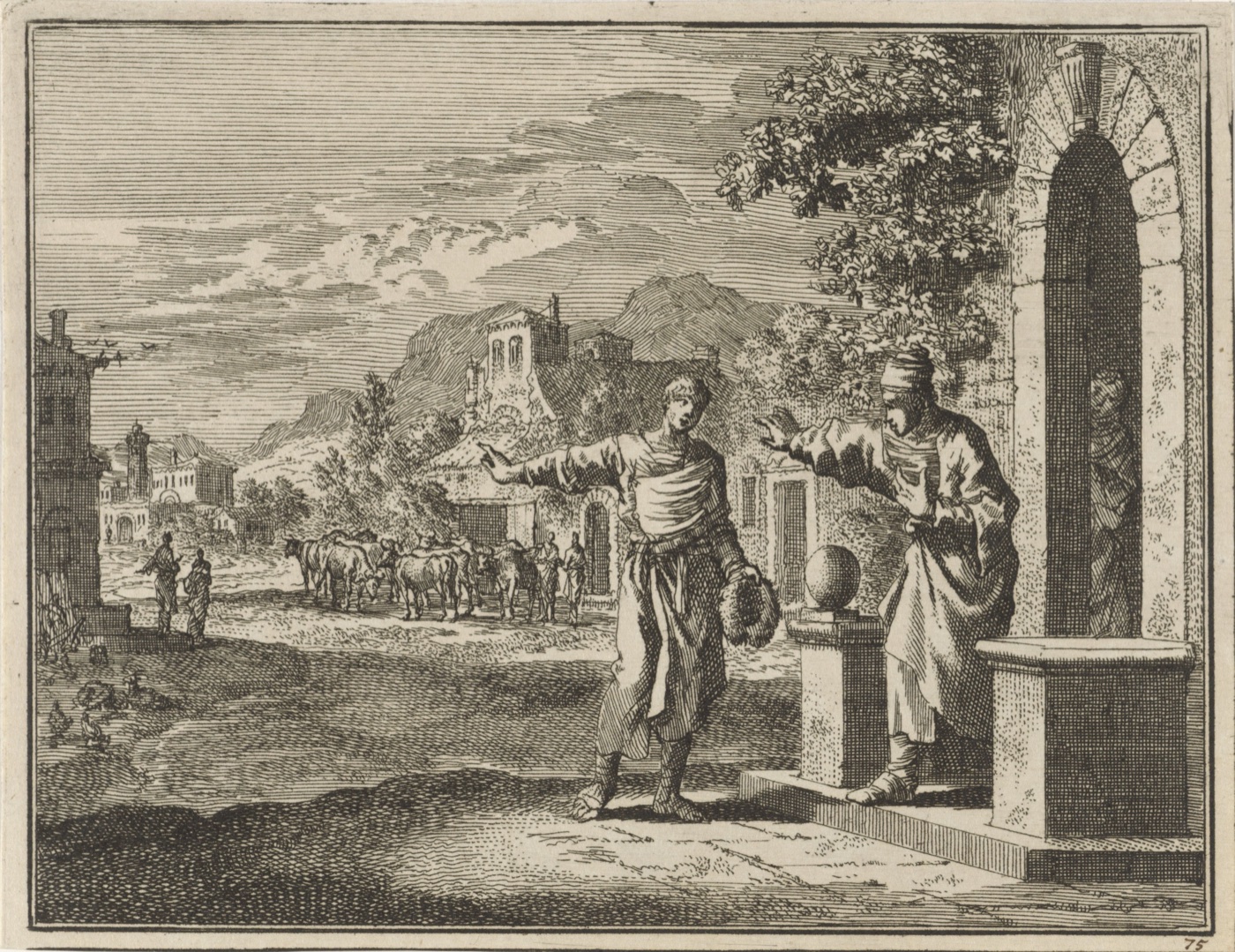
一户人家的门口。一个年轻人一手拿着帽子,另一只手伸开,指着身后的路。门口台阶上站着一个裹着头巾的人,抬起一只手,手掌朝着年轻人。他身后的门洞里,还有一个人探出半个身子。远处路上有一群牛,牛旁边站着两个人;路边另有两个人站着说话,地上有几只鸡。你看,门口这个人抬起手,像在说什么?
扬·吕肯(Jan Luyken),《婚筵的比喻》(Gelijkenis van het bruiloftsfeest),1712 年,蚀刻版画,荷兰阿姆斯特丹国立博物馆藏。公有领域。 Wikimedia Commons一起读路 14:15-24
15同席的有一人听见这话,就对耶稣说:“在神国里吃饭的有福了。”
16耶稣对他说:“有一人摆设大筵席,请了许多客。
17到了坐席的时候,打发仆人去对所请的人说:‘请来吧,样样都齐备了。’
18众人一口同音地推辞。头一个说:‘我买了一块地,必须去看看。请你准我辞了。’
19又有一个说:‘我买了五对牛,要去试一试。请你准我辞了。’
20又有一个说:‘我才娶了妻,所以不能去。’
21那仆人回来,把这事都告诉了主人。家主就动怒,对仆人说:‘快出去到城里大街小巷,领那贫穷的、残废的、瞎眼的、瘸腿的来。’
22仆人说:‘主啊,你所吩咐的已经办了,还有空座。’
23主人对仆人说:‘你出去到路上和篱笆那里,勉强人进来,坐满我的屋子。
24我告诉你们,先前所请的人,没有一个得尝我的筵席。’”
当时现场
在一个法利赛人家里吃饭。 那天是安息日,「耶稣到一个法利赛人的首领家里去吃饭,他们就窥探他」(路 14:1)。席上耶稣医好了一个患水臌的人,又看见客人「拣择首位」(路 14:7),就教他们谦卑;又对请他的主人说:「你摆设筵席,倒要请那贫穷的、残废的、瘸腿的、瞎眼的,你就有福了」(路 14:13)。马亨利说,这个比喻是耶稣把自己赴的这场筵席“讲成了属灵的”。
Matthew Henry, Commentary on the Whole Bible, Vol. V,路 14:15-24。译自英文原著。
看英文原文
Here is another discourse of our Saviour's, in which he spiritualizes the feast he was invited to
晚饭,第二次去请。 17 节说「到了坐席的时候」,打发仆人去对「所请的人」说。这些人早就被请过,现在是筵席齐备,再去提醒一次。马亨利说,这叫晚饭,因为在那些地方,晚饭是请客的正经时候,“一天的事都忙完了”;仆人回来时,这些客人“早就接到通知,好安排自己的事”。
Matthew Henry, Commentary on the Whole Bible, Vol. V,路 14:15-24。译自英文原著。
看英文原文
It is called a supper, because in those countries supper time was the chief feasting time, when the business of the day was over.
though they had had timely notice a good while before, that they might order their affairs accordingly
三卷福音书对照
马太也记了一个筵席的比喻,就是上一课的娶亲筵席。两个比喻很像,但不是同一段经文:
| 马太:娶亲筵席 | 路加:大筵席 | |
|---|---|---|
| 在哪里讲 | 在圣殿里,「耶稣进了殿」(太 21:23) | 「法利赛人的首领家里去吃饭」(路 14:1) |
| 请客的是谁 | 「一个王为他儿子摆设娶亲的筵席」(太 22:2) | 「有一人摆设大筵席」(路 14:16) |
| 被请的人怎样 | 「不理就走了」(太 22:5),有的「拿住仆人,凌辱他们」(太 22:6) | 「众人一口同音地推辞」(路 14:18) |
| 后来请谁 | 「凡遇见的,都召来赴席」(太 22:9) | 「贫穷的、残废的、瞎眼的、瘸腿的」(路 14:21),又到「路上和篱笆那里」(路 14:23) |
| 怎样结尾 | 没有穿礼服的人被丢在外边(太 22:11-13) | 「先前所请的人,没有一个得尝我的筵席」(路 14:24) |
是不是同一个比喻?吉尔说,马太那个比喻“和这个有些相像,如果不是同一个的话”;克拉克说是“相似的比喻,不是在同一个场合讲的”。
John Gill, Exposition of the Entire Bible,路 14:17;Adam Clarke, Commentary on the Bible,路 14:16。译自英文原著。
看英文原文
which parable bears some likeness to this, if it is not the same
See a similar parable to this, though not spoken on the same occasion
讲解
看见什么。 被请的人没有一个说“我不来”。马亨利说:“他们没有直截了当地说不来,却都一口同音地推辞。”
Matthew Henry, Commentary on the Whole Bible, Vol. V,路 14:15-24。译自英文原著。
看英文原文
They did not say flatly and plainly that they would not come, but they all with one consent began to make excuse
三个理由,听起来都有道理。头一个买了地;吉尔说,买之前就该去看,况且这是晚上、吃晚饭的时候,“哪里是去看一块地的时候”。马亨利说,他大可以第二天再去,地还在原处,还是原样。
John Gill, Exposition of the Entire Bible,路 14:18;Matthew Henry, Commentary on the Whole Bible, Vol. V,路 14:15-24。译自英文原著。
看英文原文
he ought to have seen it before he bought it; and however, it was a very improper time, at evening, at supper time, as this was, to go and see a piece of ground
He might have deferred going to see his piece of ground till the next day, and have found it in the same place and plight it was now in, if he had so pleased.
第三个人连“请你准我辞了”都没说,只说「我才娶了妻,所以不能去」(20 节)。律法里确实有一条:「新娶妻之人,不可从军出征」(申 24:5)。可这不是去打仗,是去吃饭。马亨利说:“他推说不能,其实是不肯”;“他本可以带着妻子一同去,两个人都会受欢迎。”
Matthew Henry, Commentary on the Whole Bible, Vol. V,路 14:15-24。译自英文原著。
看英文原文
He pretends that he cannot, when the truth is he will not.
He might have gone and taken his wife along with him; they would both have been welcome.
家主动怒,叫仆人「快出去到城里大街小巷」(21 节),领来的是「贫穷的、残废的、瞎眼的、瘸腿的」,和耶稣刚才对主人说的那一句(路 14:13)是同样四种人。马亨利说,耶稣这里“明明是接着他刚才说的话”。
Matthew Henry, Commentary on the Whole Bible, Vol. V,路 14:15-24。译自英文原著。
看英文原文
Christ here plainly refers to what he had said just before, in direction to us, to invite to our tables the poor and maimed, the lame and blind, v. 13.
这样请了,「还有空座」(22 节),主人又叫仆人出城,到「路上和篱笆那里」(23 节)。最后一句很重:「先前所请的人,没有一个得尝我的筵席」(24 节)。马亨利说:“该接受基督的时候不要他,到想要的时候就得不着了。”
Matthew Henry, Commentary on the Whole Bible, Vol. V,路 14:15-24。译自英文原著。
看英文原文
They that will not have Christ when they may shall not have him when they would.
如果我在场。 我坐在法利赛人首领的席上,听见有人说「在神国里吃饭的有福了」(15 节),大概会跟着点头。马亨利说,耶稣并没有驳他,是接着他的话说:“这话很对,能享受弥赛亚国度好处的人有福了。可是谁能享受呢?”
Matthew Henry, Commentary on the Whole Bible, Vol. V,路 14:15-24。译自英文原著。
看英文原文
It is very true, Blessed are they that shall partake of the privileges of the Messiah's kingdom. But who are they that shall enjoy that privilege?
说“有福了”很容易。比喻里那三个人,早就被请过;筵席齐备的那一天,才各有各的事。
神是怎样的神。 主人要把屋子坐满。马亨利说:“基督在福音里,既是好好地办筵席,也是敞开门办筵席。”又说:“还有空位给更多的人,因为基督的丰富是测不透、用不尽的;在他里面,够所有的人,也够每一个人。”
Matthew Henry, Commentary on the Whole Bible, Vol. V,路 14:15-24。译自英文原著。
看英文原文
Christ in the gospel, as he keeps a good house, so he keeps an open house.
yet still there is room for more; for the riches of Christ are unsearchable and inexhaustible; there is in him enough for all, and enough for each
路上和篱笆那里的人,为什么要“勉强”?马亨利说,他们“会害羞、拘谨,很难相信自己真会受欢迎”,所以要一再恳求。
Matthew Henry, Commentary on the Whole Bible, Vol. V,路 14:15-24。译自英文原著。
看英文原文
they will be shy and modest, and will hardly believe that they shall be welcome, and therefore be importunate with them
和我有什么关系。 三个人推辞的,都是小事,也都是正当的事。马亨利替他们想了一个更合适的回答:“我被请去在神国里吃饭,所以看地、看牛的事,只好请准我辞了。”
Matthew Henry, Commentary on the Whole Bible, Vol. V,路 14:15-24。译自英文原著。
看英文原文
It had better become them to have said, "I am invited to eat bread in the kingdom of God, and therefore must be excused from going to see the ground or the oxen."
他还提醒,不要看谁最热心就放心,也不要看谁最没指望就灰心:“对最积极的人,不要太有把握;对最没有指望的人,也不要绝望。”
Matthew Henry, Commentary on the Whole Bible, Vol. V,路 14:15-24。译自英文原著。
看英文原文
Let us not be confident concerning those that are most forward, nor despair of those that are least promising.
不同的看见
下面三位都是英国的解经家:马亨利(1662–1714)、吉尔(1697–1771)、克拉克(约 1760–1832)。各段都译自英文原著,出处附在后面。
经文自己说的(三家都照这个讲): 先被请的人都推辞了;主人动怒,先叫仆人到城里领来贫穷的、残废的、瞎眼的、瘸腿的,又叫仆人出城到路上和篱笆那里,要坐满他的屋子;先前所请的人,没有一个得尝他的筵席。下面三处,是读法不同的地方。
一、15 节那个人,为什么说这句话?
他给了几种可能。也许是看耶稣先责备客人、又责备主人,“怕他扫了大家的兴”,想把话题岔开;也许是真心佩服耶稣讲的谦卑和怜悯,却看不到这些在眼下行得出来,“就盼望神的国”。
Matthew Henry, Commentary on the Whole Bible, Vol. V,路 14:15-24。译自英文原著。
看英文原文
fearing he should put the company out of humour, started this, to divert the discourse to something else
Admiring the good rules of humility and charity which Christ had now given, but despairing to see them lived up to in the present degenerate state of things, he longs for the kingdom of God
这人听了耶稣的话,“很喜欢,也很受感动,只是不明白”。
John Gill, Exposition of the Entire Bible,路 14:15。译自英文原著。
看英文原文
was pleased and affected with them, though he was ignorant
这话合乎当时一般的期待,以为弥赛亚的国“完全是属世的”;可他又说,同席的人里,“似乎只有他”还能领会耶稣的话、多少摸到其中属灵的意思。
Adam Clarke, Commentary on the Bible,路 14:15。译自英文原著。
看英文原文
This is spoken in conformity to the general expectation of the Jews, who imagined that the kingdom of the Messiah should be wholly of a secular nature.
It does not appear that there was any but this person present, who was capable of relishing the conversation of our Lord, or entering at all into its spiritual reference.
怎么看: 经文没有说他的用意。耶稣也没有说他错,只是讲了一个比喻:神国的筵席是有的,问题是被请的人来不来。
二、“贫穷的、残废的、瞎眼的、瘸腿的”,是照字面讲吗?
“不是照字面,是奥秘的、属灵的意思”:贫穷的,是“没有属灵的食物可吃”的人;瞎眼的,是对神、对基督“没有得救的认识”的人。
John Gill, Exposition of the Entire Bible,路 14:21。译自英文原著。
看英文原文
not in a literal, but in a mystical and spiritual sense
such as have no spiritual food to eat
who are so, as to any saving knowledge of God in Christ
两样都讲。一面说,世上“很穷很卑微的人,在基督那里和富贵的人一样受欢迎”;一面接回 13 节:福音这样看重穷人,“该叫我们也周济他们”。
Matthew Henry, Commentary on the Whole Bible, Vol. V,路 14:15-24。译自英文原著。
看英文原文
Those that are very poor and low in the world shall be as welcome to Christ as the rich and great
For consideration for the countenance which Christ's gospel gives to the poor should engage us to be charitable to them.
他在比喻前面 12 节的注释里说,耶稣不是不许人请朋友,“他在这里教的是周济穷人”。
Adam Clarke, Commentary on the Bible,路 14:12。译自英文原著。
看英文原文
what he inculcates here is charity to the poor
怎么看: 13 节是耶稣对请他的主人说的,是真请客;21 节是比喻里的家主说的。两处用的是同样四种人。比喻讲的是神的国,耶稣讲比喻之前,先叫主人在自己的饭桌上这样做。
三、两次出去请,请的各是谁?
这是寓意读法:给比喻里先后两批客人各找一个对应。
城里大街小巷请来的,是犹太人当中的人,“不是文士和法利赛人”,是“税吏和罪人”;到路上和篱笆那里去请,“指的是外邦人蒙召”,使徒在犹太人不接受的时候转向他们。
Matthew Henry, Commentary on the Whole Bible, Vol. V,路 14:15-24。译自英文原著。
看英文原文
Many of the Jews are brought in, not of the scribes and Pharisees, such as Christ was now at dinner with, who thought themselves most likely to be guests at the Messiah's table, but the publicans and sinners; these are the poor and the maimed.
This refers to the calling of the Gentiles, to whom the apostles were to turn when the Jews refused the offer, and with them the church was filled.
城里的,是犹太人中“比较卑微的、不像文士和法利赛人那样懂律法”的人;路上的,是外邦人,因为他们“在犹太人的国和会以外”。
John Gill, Exposition of the Entire Bible,路 14:21、23。译自英文原著。
看英文原文
though the meaner sort of them, the poor, and such as knew not the law in such sort as the Scribes and Pharisees did
who might be said to be "in the highways", because they were without the commonwealth and church of the Jews
克拉克在这里没有作这样的对应。
怎么看: 比喻里没有说“外邦人”。路加后来在使徒行传里记了保罗和巴拿巴的话:「神的道先讲给你们,原是应当的;只因你们弃绝这道,断定自己不配得永生,我们就转向外邦人去」(徒 13:46)。两家读法可以对照着读;读这个比喻,也可以先问自己:我是哪一批被请来的?
原文词眼
「勉强人进来,坐满我的屋子」(23 节)
“勉强”,原文是 ἀναγκάζω。Thayer 说,这个词是“迫使、驱使、催促,不论是用强力、威吓等等,还是用劝说、恳求等等”。
Thayer's Greek-English Lexicon of the New Testament,G315。译自英文原著。
看英文原文
to necessitate, compel, drive to, constrain, whether by force, threats, etc., or by persuasion, entreaties, etc., or by other means
他列的经文里,几种意思都有:耶稣「催门徒上船」(太 14:22);保罗说提多「没有勉强他受割礼」(加 2:3);保罗回想自己从前在会堂里「强逼他们说亵渎的话」(徒 26:11)。同一个词,是催、是劝、还是强逼,要看上下文。
23 节是哪一种?三家说法一致:马亨利说“不是凭武力,是凭道理”,拿这句话来强迫人的良心,是“再荒谬不过的”;克拉克说是“用最恳切的央求劝他们来”,“别的强迫都是敌基督的”;吉尔说“不是凭外面的强力,是凭有力的话、有力的道理、劝说的力量”。
Matthew Henry, Commentary on the Whole Bible, Vol. V,路 14:15-24;Adam Clarke, Commentary on the Bible,路 14:23;John Gill, Exposition of the Entire Bible,路 14:23。译自英文原著。
看英文原文
not by force of arms, but by force of arguments
Nothing can be more absurd than fetching an argument hence for compelling men's consciences
Prevail on them by the most earnest entreaties.
every other kind of compulsion is antichristian
not by outward force, but by forcible words, by powerful arguments, and by the strength of persuasion
另一个词是「请你准我辞了」(18、19 节)里的“辞”,原文 παραιτέομαι。Thayer 把这两节列在“请求原谅、告罪”的意思下面,说是“一个人推辞,不接受筵席的邀请”。
Thayer's Greek-English Lexicon of the New Testament,G3868。译自英文原著。
看英文原文
to avert displeasure by entreaty, i. e. to beg pardon, crave indulgence, to excuse
of one excusing himself for not accepting an invitation to a feast
同一个词,他也列了希伯来书:「不可弃绝那向你们说话的」(来 12:25)。客客气气地“请你准我辞了”,和“弃绝”,原文是同一个词。
请思考
没有标准答案,不打分。写下来,只给自己看。
- 三个人的理由都不是坏事:买地、买牛、娶妻。你最常拿来推辞神的,是哪一样?
- 说「在神国里吃饭的有福了」很容易。你有没有过嘴上说好、到时候却去不了的时候?
- 路上和篱笆那里的人,“很难相信自己真会受欢迎”。你相信神是真心请你吗?
- 耶稣叫主人请「没有什么可报答你」(路 14:14)的人。你身边有这样的人吗?
这周去做
照 13 节的话,这一周请一个没法回请你的人,一起吃一顿饭,或喝一杯茶。
或者,想一个你一直“请你准我辞了”的邀请:一次聚会、一个小组、一段该读的经文。这一周答应下来。
延伸参考
- Matthew Henry, Commentary on the Whole Bible, Vol. V:路 14:15-24(英文原著,公有领域,CCEL 可免费读全文)
- 莫理斯(Leon Morris)著,丁道尔新约注释《路加福音》:路 14:15-24
- 施诺格拉斯《主耶稣的比喻》:大筵席一章
本单元其它比喻单元四 · 邀请与拒绝
- 不结果的无花果树 路 13:1-9
- 两个儿子 太 21:23-32
- 凶恶园户 太 21:33-46
- 娶亲筵席 太 22:1-14
- 大筵席 路 14:15-24 本课
经文:和合本(1919),用字按本站规则现代化。“不同的看见”里的注释都译自英文原著(公有领域),每段可展开看英文原文。