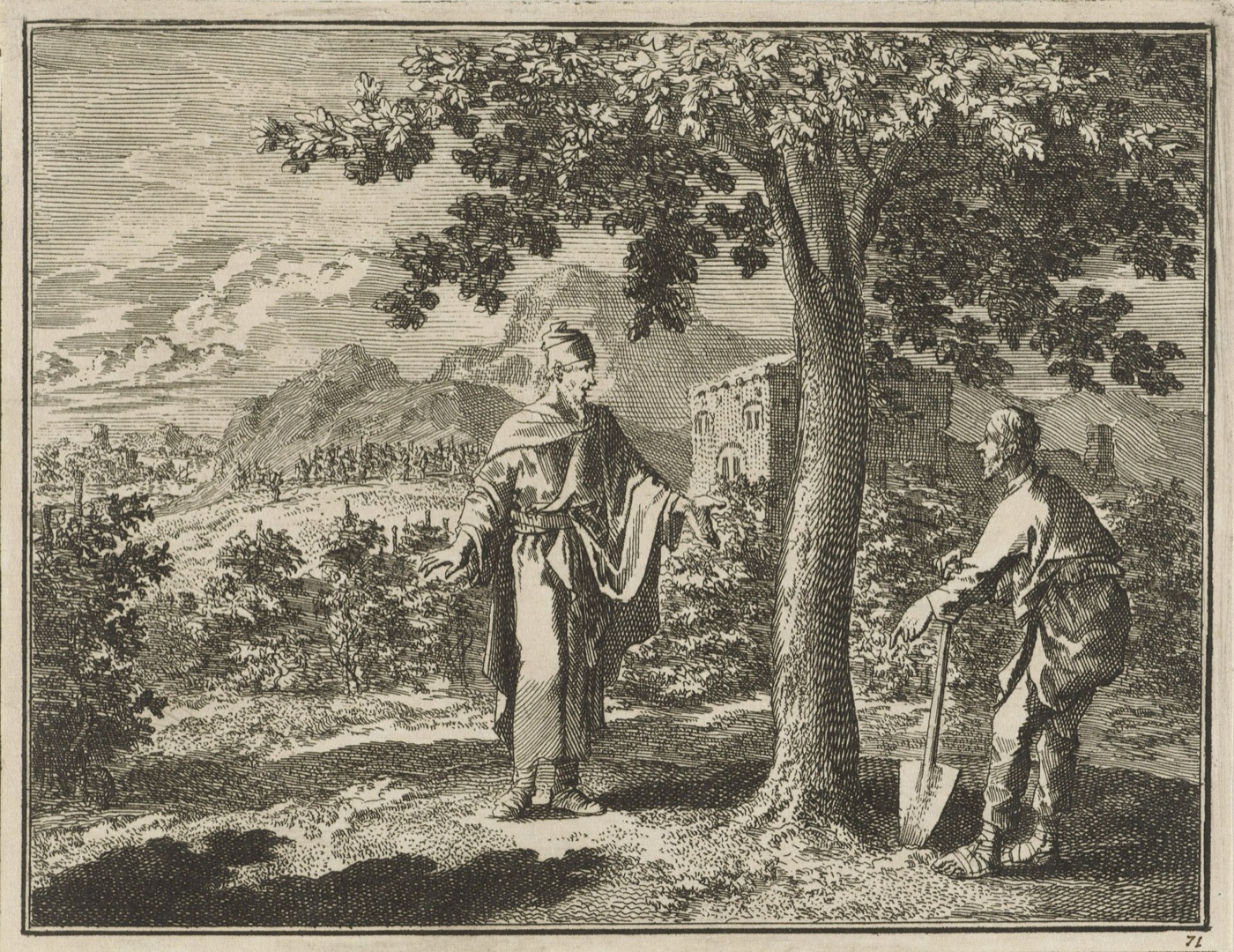
一棵大树,满树的叶子。树左边站着一个穿长袍、戴帽子的人,两手张开,一只手朝着树。树右边一个人扶着铁锹,另一只手指着脚下的地。远处是一片园子、一座塔楼和山。两个人在说什么?你看得出树上有果子吗?
扬·吕肯(Jan Luyken),《不结果的无花果树的比喻》(Gelijkenis van de onvruchtbare vijgenboom),1712 年,蚀刻版画,荷兰阿姆斯特丹国立博物馆藏。公有领域。 Wikimedia Commons一起读路 13:1-9
1正当那时,有人将彼拉多使加利利人的血搀杂在他们祭物中的事,告诉耶稣。
2耶稣说:“你们以为这些加利利人比众加利利人更有罪,所以受这害吗?
3我告诉你们,不是的!你们若不悔改,都要如此灭亡。
4从前西罗亚楼倒塌了,压死十八个人,你们以为那些人比一切住在耶路撒冷的人更有罪吗?
5我告诉你们,不是的!你们若不悔改,都要如此灭亡。”
6于是用比喻说:“一个人有一棵无花果树,栽在葡萄园里。他来到树前找果子,却找不着。
7就对管园的说:‘看哪,我这三年来到这无花果树前找果子,竟找不着,把它砍了吧,何必白占地土呢!’
8管园的说:‘主啊,今年且留着,等我周围掘开土,加上粪;
9以后若结果子便罢,不然再把它砍了。’”
当时现场
两件新闻。 有人来告诉耶稣:彼拉多杀了一些加利利人,他们的血和他们献的祭物搀在一起(1 节)。马亨利说,这件事在当时的史书里查不到。耶稣自己又提了一件:西罗亚的一座楼倒了,压死十八个人(4 节)。克拉克说,这座楼“很可能”盖在西罗亚池旁边的廊子上(参看约 9:7)。
Matthew Henry, Commentary on the Whole Bible, Vol. V,路 13:1-5;Adam Clarke, Commentary on the Bible,路 13:4。译自英文原著。
看英文原文
It is briefly related here, and is not met with in any of the historians of those times.
This tower was probably built over one of the porticoes near the pool, which is mentioned John 9:7.
一件是人祸,一件是意外。来报信的人心里可能有一个问号:他们是不是做了什么,才落到这个地步?
葡萄园里的一棵无花果树。 马亨利说,无花果树平常长在路旁(参看太 21:19),这一棵却栽在葡萄园里:“土更好,得的照顾更多,花的工夫也比别的无花果树多。”旧约先知也用过葡萄园的画面:「我为我葡萄园所作之外,还有什么可作的呢?我指望结好葡萄,怎么倒结了野葡萄呢?」(赛 5:4)
Matthew Henry, Commentary on the Whole Bible, Vol. V,路 13:6-9。译自英文原著。
看英文原文
It was planted in a vineyard, in better soil, and where it had more care taken of it and more pains taken with it, than other fig-trees had, that commonly grew, not in vineyards (Those are for vines), but by the way-side, Matt. xxi. 19.
白占地土。 一棵不结果的树,不只是自己没用。吉尔说,不结果的树“吸走地里的养分,夺去旁边树木的滋养”;克拉克说,砍了它,“好在原处栽一棵更有用的”。
John Gill, Exposition of the Entire Bible,路 13:7;Adam Clarke, Commentary on the Bible,路 13:7。译自英文原著。
看英文原文
for unfruitful trees suck up the juices of the earth, and draw away nourishment from other trees that are near them
The tree itself brings forth no fruit; let it be cut down that a more profitable one may be planted in its place.
讲解
看见什么。 前五节是两件新闻和耶稣的回答。两次,他都先说“不是的”,再说「你们若不悔改,都要如此灭亡」(3、5 节)。马亨利说,接下来的比喻,“是要加强紧接在前面的那句警告”。
Matthew Henry, Commentary on the Whole Bible, Vol. V,路 13:6-9。译自英文原著。
看英文原文
This parable is intended to enforce that word of warning immediately going before
比喻里有三方:主人来找果子,三年都找不着,说砍了吧;管园的求再留一年,他要掘土、加粪;最后一句是「以后若结果子便罢,不然再把它砍了」(9 节)。
请留意:故事停在这里。那棵树后来结了果子没有,经文没有说。
马亨利还注意到一个小地方:9 节的“便罢”(英文钦定本作 well),原文没有这个字,“话是突然断开的:要是它结果子!”后面怎么接,留给读的人。
Matthew Henry, Commentary on the Whole Bible, Vol. V,路 13:6-9。译自英文原著。
看英文原文
The word well is not in the original, but the expression is abrupt: If it bear fruit!—supply it how you please
这一个比喻,不要和耶稣咒诅无花果树(太 21:18-22;可 11:12-14、20-21)混在一起。那是在往耶路撒冷的路上发生的一件事,树当下就枯干了;这里是一个故事,树还有一年。
如果我在场。 我可能也会这样想:出了这样的事,那些人大概有什么问题。耶稣说“不是的”。马亨利说:“我们不能凭人在世上受的苦,来论断他的罪;因为许多人被放进火炉,是像金子一样被炼净,不是像渣滓糠秕一样被烧掉。”又说:“我们若要论断,论断自己就够忙的了。”克拉克也说:以为死在刀下、死于意外的人,在神面前罪最大,“这是很错的”。门徒也问过一样的问题,耶稣说:「也不是这人犯了罪,也不是他父母犯了罪」(约 9:3)。
Matthew Henry, Commentary on the Whole Bible, Vol. V,路 13:1-5;Adam Clarke, Commentary on the Bible,路 13:5。译自英文原著。
看英文原文
we cannot judge of men's sins by their sufferings in this world; for many are thrown into the furnace as gold to be purified, not as dross and chaff to be consumed.
If we will be judging, we have enough to do to judge ourselves
It is very wrong to suppose that those who suffer by the sword, or by natural accidents, are the most culpable before God.
耶稣把问题从“他们”转到“你们”:别问他们有什么罪,问你自己有没有悔改。
神是怎样的神。 他是来找果子的主人,也是肯等的主人。马亨利说:“他要求不高,只指望有果子,不是要很多果子;他也不急,一年又一年,来了三年。”彼得也说,主「不是躭延,乃是宽容你们,不愿有一人沉沦,乃愿人人都悔改」(彼后 3:9)。
Matthew Henry, Commentary on the Whole Bible, Vol. V,路 13:6-9。译自英文原著。
看英文原文
As he was not high in his expectations, he only expected fruit, not much fruit, so he was not hasty, he came three years, year after year
可是忍耐有期限。马亨利说:管园的没有求“永远别砍”,只求“主啊,不是现在”;“缓刑只是一段时候”;“神虽然忍耐得久,却不会永远忍耐”。
Matthew Henry, Commentary on the Whole Bible, Vol. V,路 13:6-9。译自英文原著。
看英文原文
He doth not pray, "Lord, let it never be cut down," but, "Lord, not now.
Reprieves of mercy are but for a time
though God bear long, he will not bear always
和我有什么关系。 那棵树有地、有园子、有人照顾,就是没有果子。马亨利说:“光有叶子不行,光喊‘主啊,主啊’不行;光有花也不行,开头好、许诺得好不行;总得有果子。”施洗约翰早就说过:「你们要结出果子来,与悔改的心相称」(路 3:8)。
Matthew Henry, Commentary on the Whole Bible, Vol. V,路 13:6-9。译自英文原著。
看英文原文
Leaves will not serve, crying, Lord, Lord; blossoms will not serve, beginning well and promising fair; there must be fruit.
管园的为树求情,也答应自己去掘土、加粪。马亨利说:“我们的祷告,总要有我们的努力跟着。”他也提醒:“别人的祷告可以为我们求得缓刑,求不来赦免;总得有我们自己的信心、悔改和祷告。”
Matthew Henry, Commentary on the Whole Bible, Vol. V,路 13:6-9。译自英文原著。
看英文原文
our prayers must always be seconded with our endeavours.
Reprieves may be obtained by the prayers of others for us, but not pardons; there must be our own faith, and repentance, and prayers, else no pardon.
这一年,是给那棵树的,也可能就是给我的。
不同的看见
下面三位都是英国的解经家:马亨利(1662–1714)、吉尔(1697–1771)、克拉克(约 1760–1832)。各段都译自英文原著,出处附在后面。
经文自己说的(三家都照这个讲): 这个比喻接着“你们若不悔改,都要如此灭亡”(3、5 节);主人找果子,管园的求再等一年,不结果子就要砍。三家都读出:神在忍耐,忍耐有期限,要的是悔改的果子。下面三处,是读法不同的地方。
一、主人、管园的、那棵树,各指谁?
这是寓意读法:给比喻里的人和树各找一个对应。
他说“这个比喻有许多种解释”,自己列了八条:主人是“全能的神”;无花果树是“犹太教会”;管园的是“主耶稣”;“且留着”,是“基督被描写成为罪人代求的那一位”。
Adam Clarke, Commentary on the Bible,路 13:6。译自英文原著。
看英文原文
Many meanings are given to this parable, and divines may abound in them
1. A person, τις, God Almighty.
2. Had a fig tree, the Jewish Church.
5. The vine-dresser - the Lord Jesus, for God hath committed all judgment to the Son, John 5:22.
7. Let it alone - Christ is represented as intercessor for sinners, for whose sake the day of their probation is often lengthened
管园的是基督:“基督是那位大代求者,他长远活着,替人祈求。传道人也是代求的人。”
Matthew Henry, Commentary on the Whole Bible, Vol. V,路 13:6-9。译自英文原著。
看英文原文
Christ is the great Intercessor; he ever lives, interceding. Ministers are intercessors
他把人倒过来对:“那个人”可能是父神,“但更可能是主耶稣基督”;那么管园的,就是“传道的人”。树,他说可以用在“只有名义的信徒”身上:“叶子很大,却没有果子”。
John Gill, Exposition of the Entire Bible,路 13:6-7。译自英文原著。
看英文原文
By the "certain man" may be meant, either God the Father, who is sometimes called an husbandman; or rather the Lord Jesus Christ
the vinedresser, or "the gardeners", as the Persic version reads, in the plural number, may signify the ministers of the word
Others are only nominal professors; and are like a fig tree, of which sort was this in the parable, that has large leaves, but no fruit
怎么看: 耶稣自己没有解释这个比喻。克拉克、马亨利把管园的读成为罪人代求的基督;吉尔读成传道人,把主人读成基督。不管怎样对,三家都看见故事里有两样:有人要砍,有人求情。读的时候,可以先不忙着找对应,先站在那棵树的位置上。
二、“这三年”,指什么?
从这一句“可以合理地推断”,耶稣讲这话的时候已经传道三年;可是他接着说:“前面已经说过,路加从不讲究按时间排列。”
Adam Clarke, Commentary on the Bible,路 13:7。译自英文原著。
看英文原文
it may be reasonably concluded that Jesus had been, at the time of saying this, exercising his ministry for three years past
But it has already been remarked that St. Luke never studies chronological arrangement.
“有人认为基督这里指他公开传道的三年”;“但他似乎更是借用无花果树的天性:一棵结果的无花果树,三年里就会结果。”
John Gill, Exposition of the Entire Bible,路 13:7。译自英文原著。
看英文原文
Some think Christ here refers to the three years of his public ministry, which he had now gone through among the Jews with little success; but he seems rather to allude to the nature of fig trees, which, if fruitful, bear in three years time
他给了两种读法:用在犹太人身上,是被掳以前一段、被掳以后一段、施洗约翰和基督传道一段;“也可能是指基督公开传道的三年,这时快满了”。他落在一个总的意思上:“神的忍耐,向许多享有福音却不结果的人,一直延长”。
Matthew Henry, Commentary on the Whole Bible, Vol. V,路 13:6-9。译自英文原著。
看英文原文
or it may allude to the three years of Christ's public ministry, which were now expiring
In general, it teaches us that the patience of God is stretched out to long-suffering with many that enjoy the gospel, and do not bring forth the fruits of it
怎么看: 三年是传道的年数,还是无花果树的常理,三家看法不一,克拉克自己也有保留。三家一致的是:主人等了够久,不是一时性急。
三、“都要如此灭亡”、砍下来:讲当时,还是也讲将来?
“如此灭亡”就是“压在耶路撒冷城和圣殿的废墟底下,那时没有一块石头留在石头上”,和西罗亚楼下的十八个人一样。
John Gill, Exposition of the Entire Bible,路 13:5。译自英文原著。
看英文原文
or perish in the same manner; that is, shall be buried under the ruins of the city and temple of Jerusalem, when one stone should not be left upon another
“主的这个预言照字面应验了”,就是罗马人攻破耶路撒冷的时候。
Adam Clarke, Commentary on the Bible,路 13:5。译自英文原著。
看英文原文
This prediction of our Lord was literally fulfilled.
“有人看重‘如此’这两个字,用在后来临到犹太人、特别是耶路撒冷的毁灭上”;“但它必定看得更远:我们若不悔改,就要永远灭亡。”比喻也是这样:“这个比喻首先指的是犹太国和犹太百姓”;“可是它无疑还有更远的所指”,是叫一切“享有蒙恩的途径、有形教会的权利”的人醒过来。
Matthew Henry, Commentary on the Whole Bible, Vol. V,路 13:1-9。译自英文原著。
看英文原文
Some lay an emphasis upon the word likewise, and apply it to the destruction that was coming upon the people of the Jews, and particularly upon Jerusalem
But certainly it looks further; except we repent, we shall perish eternally, as they perished out of this world.
This parable primarily refers to the nation and people of the Jews.
Yet it has, without doubt, a further reference, and is designed for the awakening of all that enjoy the means of grace, and the privileges of the visible church
怎么看: 三家都说这话在当时有一次应验,马亨利又说它“看得更远”。同一章的末了,耶稣为耶路撒冷叹息:「我多次愿意聚集你的儿女,好像母鸡把小鸡聚集在翅膀底下,只是你们不愿意」(路 13:34)。说这话的,是想救人的那一位。比喻和预言哪些话指当时、哪些指将来,这一问,各教会的理解不尽相同,请向你所在的教会请教。
原文词眼
「主啊,今年且留着」(8 节)。
“且留着”原文是 ἄφες,动词 ἀφίημι。Thayer 的辞典把它列在“容许、准许、不拦阻”这个意思下面,例句里有路 13:8。
Thayer's Greek-English Lexicon of the New Testament,G863。译自英文原著。
看英文原文
to permit, allow, not to hinder
with an accusative of the person or thing permitted: Matthew 3:15 τότε ἀφίησιν αὐτόν, Mark 5:19; Mark 11:6; Mark 14:6; Luke 13:8
这个字我们见过两次。稗子一课,主人说「容这两样一齐长,等着收割」(太 13:30),“容”也是这个字,Thayer 列在同一个意思下面。不饶恕的恶仆一课,主人「把他释放了,并且免了他的债」(太 18:27),“免”还是这个字,Thayer 列在另一个意思下面:“免除、赦免”。
Thayer's Greek-English Lexicon of the New Testament,G863。译自英文原著。
看英文原文
to remit, forgive: τό δάνειον, Matthew 18:27
“留着”不等于“赦免”,辞典把它们分开列;可是同一个字,在中文里成了“容”“留”“免”。留着,是还有一年;免了,是债一笔勾销。管园的求的是前一样。
7 节“何必白占地土”,“白占”原文是 καταργέω。Thayer 说,本义是“使它闲着、不起作用”,用在这里,是“夺去地的力量,使地不出产”。不结果的树,叫一块好地也闲着。
Thayer's Greek-English Lexicon of the New Testament,G2673。译自英文原著。
看英文原文
to render idle, unemployed, inactive, inoperative: τήν γῆν, to deprive of its strength, make barren (A. V. cumber), Luke 13:7
请思考
没有标准答案,不打分。写下来,只给自己看。
- 听到别人遭了灾、出了事,你心里第一个念头常常是什么?
- 那棵树有地、有园子、有人照顾。神给了你哪些“好土”?
- 你身上有没有“叶子很大、没有果子”的地方?在你,果子会是什么?
- 管园的为树求情,又自己去掘土、加粪。你在为谁这样做?或者,谁在为你这样做?
这周去做
想一个你一直说“以后再改”的地方,这一周就开始改一小步,并且告诉一个可信的人,请他为你祷告。
周末问自己:如果这一年就是那“且留着”的一年,我想结出什么果子来?
延伸参考
- Matthew Henry, Commentary on the Whole Bible, Vol. V:路 13:1-9(英文原著,公有领域,CCEL 可免费读全文)
- 莫理斯(Leon Morris)著,丁道尔新约注释《路加福音》:路 13:1-9
- 施诺格拉斯《主耶稣的比喻》:不结果的无花果树一章
本单元其它比喻单元四 · 邀请与拒绝
- 不结果的无花果树 路 13:1-9 本课
- 两个儿子 太 21:28-32 即将上线
- 凶恶园户 太 21:33-46
- 娶亲筵席 太 22:1-14 即将上线
- 大筵席 路 14:15-24 即将上线
经文:和合本(1919),用字按本站规则现代化。“不同的看见”里的注释都译自英文原著(公有领域),每段可展开看英文原文。