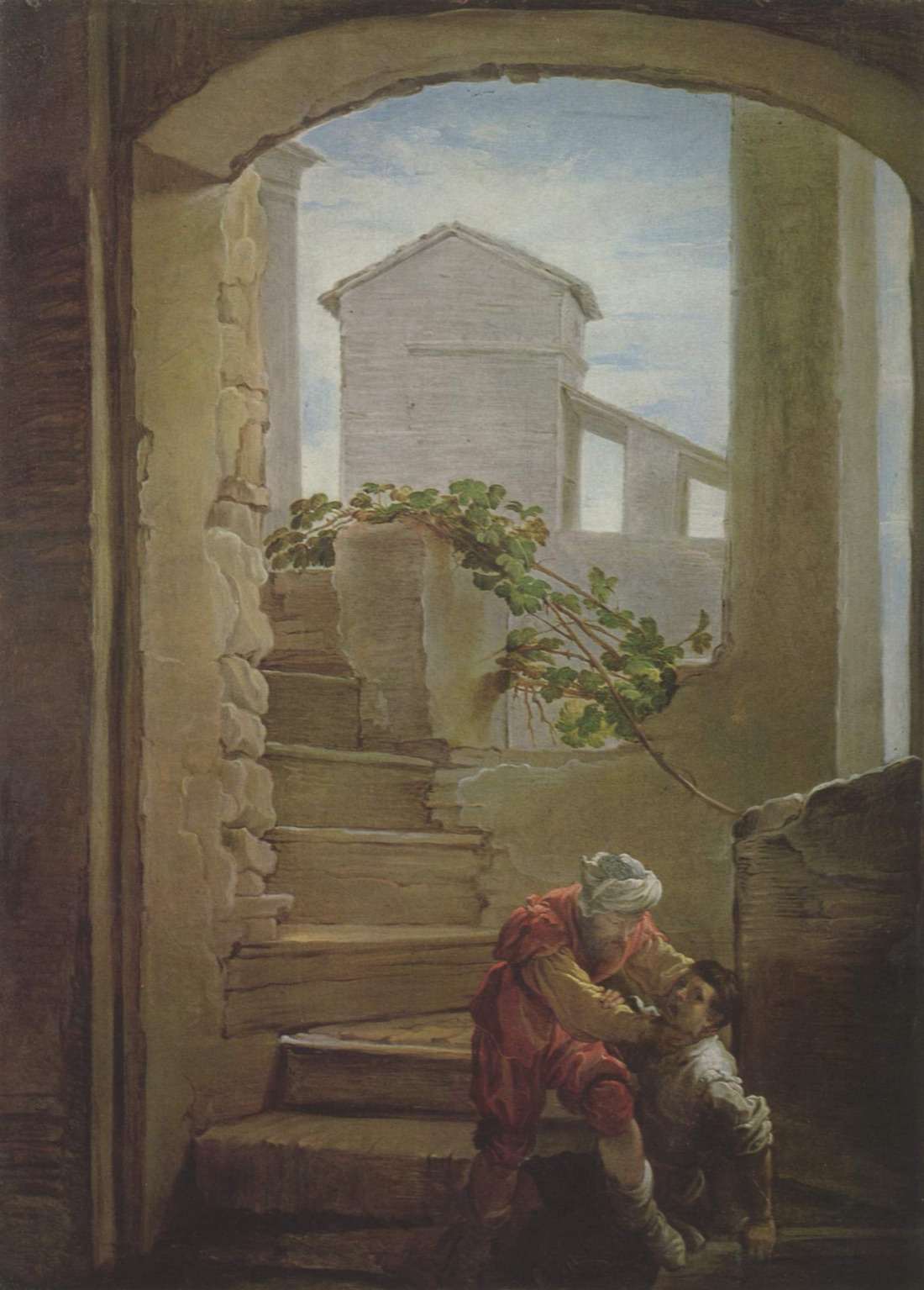
A tall flight of stone steps leads up to a large house. At the foot of the steps, a man in red with a white headcloth holds another man with one hand and grips him by the throat. The man being choked has fallen to the ground. Where do you think the man in red has just come down from?
Domenico Fetti, Parable of the Unforgiving Servant, c. 1619–1621, oil painting, Gemäldegalerie Alte Meister, Dresden, Germany. Public domain. Wikimedia CommonsRead TogetherMatt 18:21-35
21Then Peter came and said to him, “Lord, how often shall my brother sin against me, and I forgive him? Until seven times?”
22Jesus said to him, “I don’t tell you until seven times, but, until seventy times seven.
23Therefore the Kingdom of Heaven is like a certain king who wanted to settle accounts with his servants.
24When he had begun to settle, one was brought to him who owed him ten thousand talents.
25But because he couldn’t pay, his lord commanded him to be sold, with his wife, his children, and all that he had, and payment to be made.
26The servant therefore fell down and knelt before him, saying, ‘Lord, have patience with me, and I will repay you all!’
27The lord of that servant, being moved with compassion, released him and forgave him the debt.
28“But that servant went out and found one of his fellow servants who owed him one hundred denarii, and he grabbed him and took him by the throat, saying, ‘Pay me what you owe!’
29“So his fellow servant fell down at his feet and begged him, saying, ‘Have patience with me, and I will repay you!’
30He would not, but went and cast him into prison until he should pay back that which was due.
31So when his fellow servants saw what was done, they were exceedingly sorry, and came and told their lord all that was done.
32Then his lord called him in and said to him, ‘You wicked servant! I forgave you all that debt because you begged me.
33Shouldn’t you also have had mercy on your fellow servant, even as I had mercy on you?’
34His lord was angry, and delivered him to the tormentors until he should pay all that was due to him.
35So my heavenly Father will also do to you, if you don’t each forgive your brother from your hearts for his misdeeds.”
The Setting
Why Jesus told it. Earlier in this chapter Jesus taught his disciples: “If your brother sins against you” (v. 15), first go to him privately, then take one or two others, then tell the assembly (vv. 15–17). Peter then asked, “Lord, how often shall my brother sin against me, and I forgive him? Until seven times?” (v. 21). Jesus answered, “I don’t tell you until seven times, but, until seventy times seven” (v. 22), and then told this parable.
Seven times and seventy times seven. Seven times, as Peter said, is already a good deal. Gill and Clarke both mention that the Jewish rabbis of the time said forgiveness stopped at three times. Gill quotes the saying itself; Clarke calls it a maxim among the Jews:
A man that commits a sin, the "first" time they pardon him; the "second" time they pardon him; the "third" time they pardon him: the "fourth" time they do not pardon
T. Bab. Yoma, fol. 36. 2. Mainion. Hilch. Teshuba. c. 3. sect. 5.
It was a maxim among the Jews never to forgive more than thrice
John Gill, Exposition of the Entire Bible, on Matt 18:21 (Gill’s own note gives his sources: the Babylonian Talmud, tractate Yoma [on the Day of Atonement]; Maimonides, Laws of Repentance, ch. 3, sect. 5); Adam Clarke, Commentary on the Bible, on Matt 18:21.
On ‘seventy times seven’, Clarke and Gill both ask the reader to compare Lamech’s words in Genesis: “If Cain will be avenged seven times, truly Lamech seventy-seven times” (Gen 4:24). Lamech wanted revenge many times over; Jesus speaks of forgiving again and again.
There is something very remarkable in these words, especially if collated with Genesis 4:24
Adam Clarke, Commentary on the Bible, on Matt 18:22; Gill’s note on the same verse also points to Genesis 4:24.
How large the two debts were. The first servant “owed him ten thousand talents” (v. 24). Clarke says ‘ten thousand’ was the highest number written in Greek arithmetic; Henry says the talent was the largest unit of money or weight in use at the time. The second “owed him one hundred denarii” (v. 28).
Μυριων ταλαντων, a myriad of talents, the highest number known in Greek arithmetical notation
they are talents, the greatest denomination that ever was used in the account of money or weight
Adam Clarke, Commentary on the Bible, on Matt 18:24; Matthew Henry, Commentary on the Whole Bible, Vol. V, on Matt 18:23-35.
A denarius was a day’s wage: a landowner “agreed with the laborers for a denarius a day” (Matt 20:2). One hundred denarii, then, was about a hundred days’ wages: not a small sum, but one that could be repaid. Henry converted both sums into the English pounds of his day: the first came to about £1,875,000, the second to a little over £3. Going by Henry’s figures, the two debts differ by about 600,000 times.
a vast sum, amounting by computation to one million eight hundred and seventy-five thousand pounds sterling
He owed him a hundred pence, about three pounds and half a crown of our money
Matthew Henry, Commentary on the Whole Bible, Vol. V, on Matt 18:23-35.
The two scenes side by side:
| The servant owes his lord | The fellow servant owes him | |
|---|---|---|
| How much | “owed him ten thousand talents” (v. 24) | “owed him one hundred denarii” (v. 28) |
| How he pleads | “fell down and knelt before him”, saying, “Lord, have patience with me, and I will repay you all!” (v. 26) | “fell down at his feet and begged him”, saying, “Have patience with me, and I will repay you!” (v. 29) |
| What happens | “being moved with compassion, released him and forgave him the debt” (v. 27) | “He would not, but went and cast him into prison” (v. 30) |
What the two men say on their knees is almost word for word the same.
Explanation
What do we see? The servant asks, “have patience with me, and I will repay you all” (v. 26): give him a little more time, and he will pay it himself. The lord gives him far more than he asks: he “forgave him the debt” (v. 27). Later the lord says so himself: “I forgave you all that debt because you begged me” (v. 32).
Then “that servant went out” (v. 28) and met his fellow servant. Just forgiven ten thousand talents, he turns around and, over a hundred denarii, “took him by the throat” (v. 28). The fellow servant falls down and says the very words he himself has just said (v. 29). But “He would not, but went and cast him into prison” (v. 30).
The lord was not the only one who saw it. “when his fellow servants saw what was done, they were exceedingly sorry” (v. 31).
If I had been there. The one asking is Peter, and those listening are the disciples. Peter asks for a number: how many times? Jesus does not give him a number; he tells of two debts. Both men in debt in the parable are servants of the same lord: the second is “one of his fellow servants” (v. 28). When the disciples heard this parable, they heard not about outsiders, but about themselves and one another.
What is God like? The lord was “moved with compassion” (v. 27). In Greek this is the same word as for the father in the prodigal son, who “was moved with compassion” (Luke 15:20). He did not forgive part of the debt but all of it: “I forgave you all that debt” (v. 32).
When the lord later grows angry, his question is this: “Shouldn’t you also have had mercy on your fellow servant, even as I had mercy on you?” (v. 33). What he looks for is ‘even as I’.
At the end of the parable Jesus himself says what it means: “So my heavenly Father will also do to you, if you don’t each forgive your brother from your hearts for his misdeeds” (v. 35). These are heavy words. In the Sermon on the Mount Jesus also said: “But if you don’t forgive men their trespasses, neither will your Father forgive your trespasses” (Matt 6:15). How these words are read together with free forgiveness has been understood differently through the centuries; see the third of the ‘Different Views’ below.
What does this mean for me? Peter asked, ‘How many times do I forgive others?’ Jesus’ parable starts with ‘How much have I been forgiven?’
Forgiving is not easy, and the parable does not say it is. A hundred denarii is a hundred days’ wages: a real debt, and a real hurt. But in the parable it is set beside ten thousand talents.
Forgiveness comes “from your hearts” (v. 35). If there is a debt in your heart that you cannot let go of, do not rush to force yourself. Go back to v. 27 and look at what you yourself have been forgiven.
Different Views
The three commentators below are English: Matthew Henry (1662–1714), John Gill (1697–1771) and Adam Clarke (c. 1760–1832). Each is quoted in his own words, with the source after each quotation.
What the text itself says (all three follow this): This parable answers Peter’s question, “how often shall my brother sin against me, and I forgive him?” (v. 21); at the end Jesus says, “So my heavenly Father will also do to you, if you don’t each forgive your brother from your hearts” (v. 35). The three questions below are places the text does not spell out, where readers through the centuries have differed.
1. What is the debt of ten thousand talents?
He also says the parable comments on the fifth petition of the Lord’s Prayer:
Every sin we commit is a debt to God
The parable is a comment upon the fifth petition of the Lord's prayer, Forgive us our trespasses, as we forgive them that trespass against us.
Matthew Henry, Commentary on the Whole Bible, Vol. V, on Matt 18:23-35.
These "ten thousand talents" intend sins, which are called debts, in Scripture; not that they are properly so, or owing to God, for then it would be right to pay them, but because they bind over to punishment.
John Gill, Exposition of the Entire Bible, on Matt 18:24.
He too calls every sin a debt. But first he asks, from the story itself, how a servant could owe so much:
Every sin is a debt contracted with the justice of God
By servant, in the text, we are to understand, a petty king, or tributary prince; for no hired servant could possibly owe such a sum as is here mentioned.
Adam Clarke, Commentary on the Bible, on Matt 18:23.
How to read it: All three read this debt as the debt of sin. Jesus himself, in the Lord’s Prayer, puts ‘debts’ and ‘trespasses’ side by side: “Forgive us our debts, as we also forgive our debtors” (Matt 6:12), and then, “if you forgive men their trespasses” (Matt 6:14). They differ in the details: Gill points out that sin is not a debt we are ‘right to pay’; Clarke notices that the sum in the story is too large for any servant to owe. Perhaps that is just where Jesus meant his hearers to be startled.
2. When does the king ‘settle accounts’?
The king settles accounts with all who profess faith, and Gill says God sometimes calls them to account in this life:
God sometimes calls, and brings, professors of religion to an account, and reckons with them by afflictive dispensations of providence
or by dealing roundly with men's consciences, awakening and convincing them of their sins, of omission and commission, which seems to be intended here.
John Gill, Exposition of the Entire Bible, on Matt 18:23.
the day is at hand in which their Master will settle accounts with them, inquire into their work, and pay them their wages
Adam Clarke, Commentary on the Bible, on Matt 18:23.
He speaks of both:
God now reckons with us by our own consciences
There is another day of reckoning coming
Matthew Henry, Commentary on the Whole Bible, Vol. V, on Matt 18:23-35.
How to read it: The text says only, “the Kingdom of Heaven is like a certain king who wanted to settle accounts with his servants” (v. 23); it does not say when. The three name different times, but they see the same thing: this reckoning is real, and everyone will face it.
3. Why is a debt already forgiven required of him again?
The lord first “forgave him the debt” (v. 27), and later “delivered him to the tormentors until he should pay all that was due to him” (v. 34).
He begins with what is certain, then lists several readings of v. 34, saying the second is more likely, and ends with the scope of the whole parable:
It is certain, that sin, once pardoned by God, he never punishes for it
which act of his grace will never be revoked
Hence some think this man had only the offer of a pardon, and not that itself
others think, that this was a church forgiveness, who looked upon him, judged him, and received him as one forgiven; but for his cruel usage of a fellow member, delivered him to the tormentors, passed censures on him, and excommunicated him, till he should give full satisfaction, which is more likely
others, this forgiveness was only in his own apprehensions
Though after all, this is not strictly to be applied to any particular case or person, but the scope of the parable is to be attended to
John Gill, Exposition of the Entire Bible, on Matt 18:34.
This is not intended to teach us that God reverses his pardons to any, but that he denies them to those that are unqualified for them, according to the tenour of the gospel
Those that do not forgive their brother's trespasses, did never truly repent of their own, nor ever truly believe the gospel; and therefore that which is taken away is only what they seemed to have
Intimations enough we have in scripture of the forfeiture of pardons, for caution to the presumptuous; and yet we have security enough of the continuance of them, for comfort to those that are sincere, but timorous; that the one may fear, and the other may hope.
Matthew Henry, Commentary on the Whole Bible, Vol. V, on Matt 18:23-35.
He does not discuss whether what was forgiven still stands; he speaks of how serious the matter is, and then, on v. 34, of the servant’s greater punishment:
To the unmerciful, God will show no mercy; this is an eternal purpose of the Lord, which never can be changed.
Before, he and all that he had, were only to be sold. Now, as he has increased his debt, so he has increased his punishment
Adam Clarke, Commentary on the Bible, on Matt 18:30, 34.
How to read it: What the text itself says: the lord forgave him the debt (v. 27); later, because he had no mercy on his fellow servant, the lord handed him over to the tormentors (vv. 33–34); and Jesus says, “So my heavenly Father will also do to you” (v. 35). All three agree that Jesus takes forgiving ‘from your hearts’ very seriously. Whether God’s forgiveness can be withdrawn, and whether this servant was truly forgiven in the first place, the three answer differently. Churches understand this question in different ways. Please ask the church you belong to.
Key Word
The lord “forgave him the debt” (v. 27), and later says, “I forgave you all that debt” (v. 32). Peter asks how often his brother may sin against him “and I forgive him” (v. 21), and at the end Jesus says, “if you don’t each forgive your brother” (v. 35). In all four places the English says ‘forgive’, and in Greek it is the same word.
Thayer’s Greek lexicon explains that the word first means to send away from oneself; one of its uses is to let a debt go by not demanding it, that is, to remit or forgive. Under this use he lists Matt 18:27 and 18:32; under ‘to forgive someone’ he lists Matt 18:21 and 18:35.
to send from (ἀπό) oneself
to let go, give up, a debt, by not demanding it (opposed to κρατεῖν, John 20:23), i. e. to remit, forgive: τό δάνειον, Matthew 18:27; τήν ὀφειλήν, Matthew 18:32
absolutely, ἀφιέναι τίνι to forgive one: Matthew 12:32; Matthew 18:21, 35
Thayer’s Greek-English Lexicon of the New Testament, G863.
In the Lord’s Prayer, “Forgive us our debts, as we also forgive our debtors” (Matt 6:12) is also listed by Thayer under this use.
Thayer adds a note here: this word is the opposite of κρατεῖν. κρατέω means to take hold of, to seize, and among the passages Thayer lists for that meaning is v. 28: “he grabbed him and took him by the throat” (v. 28). The lord let the debt go; the servant went out and seized his fellow servant.
to lay hold of, take, seize: τινα, to lay hands on one in order to get him into one's power, Matthew 14:3; Matthew 18:28
Thayer’s Greek-English Lexicon of the New Testament, G2902.
Think It Through
There are no right answers and no scores. Write your answers down; they are for you alone.
- The servant asked, “have patience with me, and I will repay you all” (v. 26), but the lord forgave the whole debt. Between you and God, do you often think, ‘Give me a little more time, and I will pay it back myself’?
- The lord let go; the servant seized. Is there a debt you are still ‘holding on to’? Who owes it to you?
- “when his fellow servants saw what was done, they were exceedingly sorry” (v. 31). Have you ever been one of those who saw? What did you do afterwards?
- Look at Fetti’s painting again: the man in red has just come down the tall stone steps. If he looked back up the steps, what do you think he would remember?
This Week
Think of a debt you are still ‘holding on to’: a hurtful word, something unfair, someone who owes you. You do not need to tell anyone.
Each day this week, read Matt 18:27 once, then pray one sentence for that person. It need not be long, and you need not say ‘I forgive’ all at once. Simply bring the matter before the Lord.
At the end of the week, ask yourself: this week, did my grip grow tighter, or a little looser?
Further Reading
- Matthew Henry, Commentary on the Whole Bible, Vol. V: Matt 18:21-35 (public domain; free to read in full at CCEL)
- R. T. France, Matthew (Tyndale New Testament Commentaries): Matt 18:21-35
- Klyne R. Snodgrass, Stories with Intent: the chapter on the unforgiving servant
More in This UnitUnit 1 · Grace and Responsibility
- The Unforgiving Servant Matt 18:23-35 This lesson
- The Two Debtors Luke 7:41-43
Scripture: World English Bible (public domain). The commentators in ‘Different Views’ are quoted in their own words from the English originals (public domain).