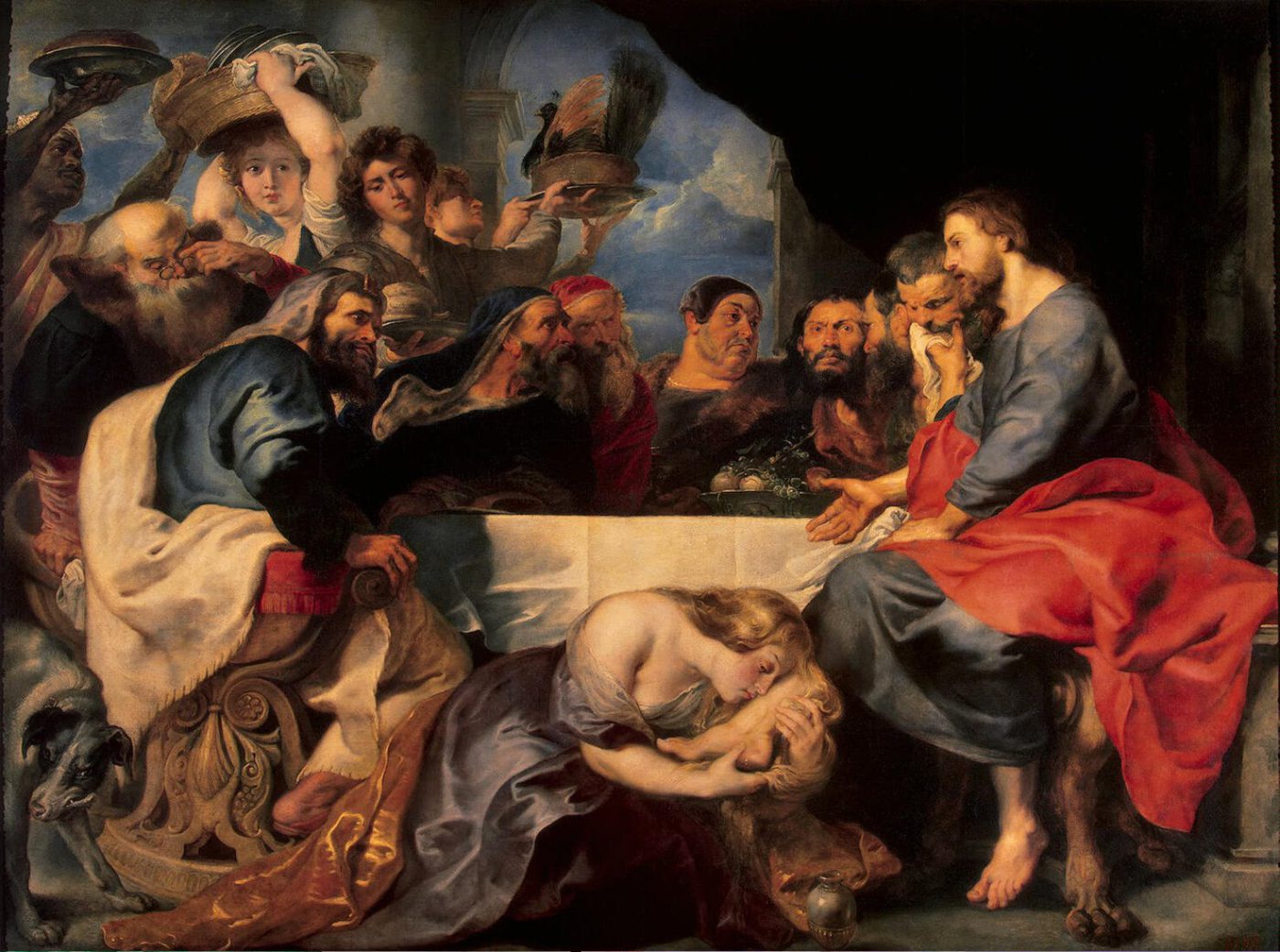
A long table spread with a white cloth, with people all around it. On the right is Jesus, in a red robe, barefoot, one hand open and held out over the table. A long-haired woman kneels at his feet, bent low, holding his feet in both hands, wrapping them in her hair, her face pressed against them; on the floor beside her stands a small jar. Everyone at the table is looking this way: one frowns, one covers his mouth with a cloth, one leans forward. In the upper left, servants are still coming in with dishes and a peacock. That open hand of Jesus: what do you think he is about to say?
Peter Paul Rubens (1577–1640), Feast in the House of Simon the Pharisee, c. 1618–1620, oil painting, Hermitage Museum, Saint Petersburg, Russia. Public domain. Wikimedia CommonsRead TogetherLuke 7:36-50
36One of the Pharisees invited him to eat with him. He entered into the Pharisee’s house and sat at the table.
37Behold, a woman in the city who was a sinner, when she knew that he was reclining in the Pharisee’s house, brought an alabaster jar of ointment.
38Standing behind at his feet weeping, she began to wet his feet with her tears, and she wiped them with the hair of her head, kissed his feet, and anointed them with the ointment.
39Now when the Pharisee who had invited him saw it, he said to himself, “This man, if he were a prophet, would have perceived who and what kind of woman this is who touches him, that she is a sinner.”
40Jesus answered him, “Simon, I have something to tell you.” He said, “Teacher, say on.”
41“A certain lender had two debtors. The one owed five hundred denarii, and the other fifty.
42When they couldn’t pay, he forgave them both. Which of them therefore will love him most?”
43Simon answered, “He, I suppose, to whom he forgave the most.” He said to him, “You have judged correctly.”
44Turning to the woman, he said to Simon, “Do you see this woman? I entered into your house, and you gave me no water for my feet, but she has wet my feet with her tears, and wiped them with the hair of her head.
45You gave me no kiss, but she, since the time I came in, has not ceased to kiss my feet.
46You didn’t anoint my head with oil, but she has anointed my feet with ointment.
47Therefore I tell you, her sins, which are many, are forgiven, for she loved much. But one to whom little is forgiven, loves little.”
48He said to her, “Your sins are forgiven.”
49Those who sat at the table with him began to say to themselves, “Who is this who even forgives sins?”
50He said to the woman, “Your faith has saved you. Go in peace.”
The Setting
Who was there. Just a few verses earlier, Jesus had said how people talked about him: “you say, ‘Behold, a glutton and a drunkard, a friend of tax collectors and sinners!’” (Luke 7:34). Then comes this meal. The host is a Pharisee named Simon (v. 40); the one who came uninvited is a woman of the city, a ‘sinner’. Matthew Henry notes that the text does not say when or where this happened, and that Luke places it here, right after Jesus was reproached as a friend of sinners:
When and where this passage of story happened does not appear; this evangelist does not observe order of time in his narrative so much as the other evangelists do; but it comes in here, upon occasion of Christ's being reproached as a friend to publicans and sinners
Matthew Henry, Commentary on the Whole Bible, Vol. V, on Luke 7:36-50.
How they sat at table. At a meal in those days, people did not sit on chairs. They reclined on one side, with their feet stretched out behind them. Adam Clarke says this is what “Standing behind at his feet” (v. 38) means. So the woman did not need to come round in front of Jesus to reach his feet.
In taking their meals, the eastern people reclined on one side; the loins and knees being bent to make the more room, the feet of each person were turned outwards behind him. This is the meaning of standing Behind at his Feet.
Adam Clarke, Commentary on the Bible, on Luke 7:38.
What the host left undone. When a guest came in from the road, the host gave him water for his feet, greeted him with a kiss, and anointed his head with oil. Clarke cites several Old Testament passages to show that giving a guest water for his feet was a very old custom. Simon did none of these three things (vv. 44–46). Clarke calls it a real lack of courtesy on Simon’s part, whether it came from carelessness or from disdain:
Thou gavest me no water - In this respect Simon was sadly deficient in civil respect, whether this proceeded from forgetfulness or contempt. The custom of giving water to wash the guest's feet was very ancient.
Adam Clarke, Commentary on the Bible, on Luke 7:44.
How much was owed. “The one owed five hundred denarii, and the other fifty” (v. 41). A denarius was a day’s wage: “he had agreed with the laborers for a denarius a day” (Matt 20:2). So one owed five hundred days’ wages, about a year and a half; the other owed fifty, less than two months. Matthew Henry says neither could pay; one simply owed ten times as much as the other:
A man had two debtors that were both insolvent, but one of them owed him ten times more than the other.
Matthew Henry, Commentary on the Whole Bible, Vol. V, on Luke 7:36-50.
Several anointings, side by side. All four Gospels record a woman anointing Jesus with ointment. The table lists only what the texts say:
| Luke 7 | Matthew 26, Mark 14 | John 12 | |
|---|---|---|---|
| Where | “He entered into the Pharisee’s house” (Luke 7:36) | “in Bethany, in the house of Simon the leper” (Matt 26:6) | “Jesus came to Bethany” (John 12:1) |
| When | the text does not say | “after two days the Passover is coming” (Matt 26:2) | “six days before the Passover” (John 12:1) |
| The woman | “a woman in the city who was a sinner” (Luke 7:37) | “a woman came to him” (Matt 26:7) | “Mary took a pound of ointment of pure nard” (John 12:3) |
| Where she anointed him | “anointed them with the ointment”, on his feet (Luke 7:38) | “poured it on his head” (Matt 26:7) | “anointed Jesus’ feet” (John 12:3) |
| Who objected | the Pharisee said to himself, “This man, if he were a prophet” (Luke 7:39) | the disciples said, “Why this waste?” (Matt 26:8) | Judas said, “Why wasn’t this ointment sold for three hundred denarii” (John 12:5) |
| What Jesus said | “Your sins are forgiven” (Luke 7:48) | “she did it to prepare me for burial” (Matt 26:12) |
Whether these are the same event, readers through the centuries have differed; see the second of the ‘Different Views’. This lesson reads only Luke’s account.
Explanation
What do we see? The parable is only three sentences: one lender, two debtors; neither could pay, and the lender forgave them both; then Jesus asks, “Which of them therefore will love him most?” (v. 42).
Simon answers, “He, I suppose, to whom he forgave the most” (v. 43). Adam Clarke says that by this answer Simon, without knowing it, made himself ready for the rebuke that followed:
By this acknowledgment he was, unknowingly to himself, prepared to receive our Lord's reproof.
Adam Clarke, Commentary on the Bible, on Luke 7:43.
Then Jesus turns toward the woman, but he speaks to Simon: “Do you see this woman?” (v. 44). Three sentences follow, each a contrast: you gave me no water, she used her tears; you gave me no kiss, she has not stopped kissing my feet; you did not anoint my head with oil, she anointed my feet with ointment (vv. 44–46). John Gill notes that the whole account, from beginning to end, sets Simon and the woman against each other:
There is, throughout the whole account, an opposition between the conduct of Simon, and this woman
John Gill, Exposition of the Entire Bible, on Luke 7:46.
If I had been there. If I were Simon, I would have invited a well-known teacher to my house for a meal, and then a woman the whole town knew about came in and knelt at my guest’s feet, weeping. What I thought would probably be what Simon thought: “This man, if he were a prophet, would have perceived who and what kind of woman this is who touches him” (v. 39).
Simon never said it aloud, yet Jesus answered it. He did not expose Simon in front of everyone. He only said, “Simon, I have something to tell you” (v. 40), and then told a story and let Simon judge for himself.
What is God like? The most important sentence in the parable is this: “When they couldn’t pay, he forgave them both” (v. 42). The one who owed five hundred could not pay, and the one who owed fifty could not pay either. Matthew Henry puts it this way:
That, whether our debt be more or less, it is more than we are able to pay
Matthew Henry, Commentary on the Whole Bible, Vol. V, on Luke 7:36-50.
Henry also says that Simon was the one who owed less, but he was a debtor too, more than he himself thought:
The Pharisee was the less debtor, yet he a debtor too, which was more than he thought himself
Matthew Henry, Commentary on the Whole Bible, Vol. V, on Luke 7:36-50.
Those at the table asked among themselves, “Who is this who even forgives sins?” (v. 49). That is exactly the question the whole event raises. Henry says that Simon doubted whether Jesus was a prophet, and Jesus showed he was more than a prophet:
Christ shows that he was more than a prophet, for he is one that has power on earth to forgive sins
Matthew Henry, Commentary on the Whole Bible, Vol. V, on Luke 7:36-50.
What does this mean for me? The parable does not ask ‘who owed more’; it asks ‘who will love him more’. The one who owes less finds it easiest to think he hardly owes anything. Henry says that when great sinners repent and find mercy with Christ, we are not to grudge it, but to let their example stir us to examine ourselves:
Instead of grudging greater sinners the mercy they find with Christ, upon their repentance, we should be stirred up by their example to examine ourselves whether we be indeed forgiven, and do love Christ.
Matthew Henry, Commentary on the Whole Bible, Vol. V, on Luke 7:36-50.
The lesson before this one in the unit is the unforgiving servant: a man forgiven ten thousand talents would not forgive his fellow servant one hundred denarii. That lesson asks ‘once forgiven, how do I treat others’; this one asks ‘once forgiven, how do I love him’. Henry, writing on this parable, points to that one too:
Let the unmerciful creditor read that parable, Matt. xviii. 23, &c., and tremble
Matthew Henry, Commentary on the Whole Bible, Vol. V, on Luke 7:36-50.
Different Views
The three commentators below are English: Matthew Henry (1662–1714), John Gill (1697–1771) and Adam Clarke (c. 1760–1832). Each is quoted in his own words, with the source after each quotation.
What the text itself says (all three follow this): Neither debtor could pay, and the lender forgave them both (v. 42); Simon judged that the one forgiven more would love more, and Jesus said, “You have judged correctly” (v. 43); Jesus said to the woman, “Your sins are forgiven” (v. 48), and also, “Your faith has saved you” (v. 50). The three questions below are places where readers through the centuries have differed.
1. ‘For she loved much’: love first, or forgiveness first?
Taken word for word, “her sins, which are many, are forgiven, for she loved much” (v. 47) can sound as if she loved much, and so was forgiven. None of the three reads it that way.
Henry reads her love as the effect of her pardon, not its cause, and ties this to “We love him, because he first loved us” (1 John 4:19):
It should be rendered, therefore she loved much; for it is plain, by the tenour of Christ's discourse, that the loving much was not the cause, but the effect, of her pardon
for we love God because he first loved us; he did not forgive us because we first loved him.
Matthew Henry, Commentary on the Whole Bible, Vol. V, on Luke 7:36-50.
Gill also allows the reading with ‘therefore’, and says the parable itself makes plain which comes first:
or "therefore she loved much": her great love was not the cause of the remission of her sins, but the full and free remission of her many sins, which had been manifested to her, was the cause of her great love
that forgiveness is the cause, and love the effect
John Gill, Exposition of the Entire Bible, on Luke 7:47.
Clarke takes her love as the result of her pardon, so that it fits the parable before it and the words that follow, “one to whom little is forgiven, loves little” (v. 47):
In the common translation her forgiveness is represented to be the consequence of her loving much, which is causing the tree to produce the root, and not the root the tree.
we must suppose her love was the effect of her being pardoned, not the cause of it.
Adam Clarke, Commentary on the Bible, on Luke 7:47.
How to read it: The three read it the same way, for the same reason: in the parable the debt is forgiven first, and the love comes after (vv. 42–43). But v. 47 does say ‘for’, and through the centuries some have read in it that love and repentance belong to receiving forgiveness. The text itself says one more thing: Jesus’ last words to her were “Your faith has saved you” (v. 50). How forgiveness, love and faith fit together: churches understand this question in different ways. Please ask the church you belong to.
2. Who was this woman? Is this the same as the other anointing?
The text says only that she was “a woman in the city who was a sinner” (v. 37). It does not give her name, nor say what her sin was.
In the next chapter Luke introduces “Mary who was called Magdalene, from whom seven demons had gone out” (Luke 8:2); nothing of that is mentioned here.
Who this woman was that here testified so great an affection to Christ does not appear; it is commonly said to be Mary Magdalene, but I find no ground in scripture for it
Matthew Henry, Commentary on the Whole Bible, Vol. V, on Luke 7:36-50.
Gill says she was neither Mary Magdalene nor Mary the sister of Lazarus. He lists several differences to show that this is not the event of Matthew 26, and describes her as a sinner known to the whole town:
Not Mary Magdalene, spoken of in Luke 8:2 under another character
nor Mary the sister of Lazarus
for this was in Galilee, and that in Bethany
the ointment that woman poured, was poured upon his head, this upon his feet: who this woman was, is not certain, nor in what city she dwelt
a notorious sinner, one that was known by all to have been a person of a wicked life and conversation
John Gill, Exposition of the Entire Bible, on Luke 7:37.
Clarke notes that many take this to be the same event as in Matthew 26, Mark 14 and John 12. On what kind of sinner she was, and on Mary Magdalene, he says:
This account is considered by many critics and commentators to be the same with that in Matthew 26:6, etc., Mark 14:3; and John 12:3.
Many suppose that this woman had been a notorious public prostitute; but this is taking the subject by the very worst handle. My own opinion is, that she had been a mere heathen who dwelt in this city
Many suppose this person to be the same as Mary Magdalene, but of this there is no solid proof.
Adam Clarke, Commentary on the Bible, on Luke 7:36-37.
How to read it: The three agree on one thing: there is no basis for saying she was Mary Magdalene. What her sin was, and whether this is the same event as the one at Bethany, they see differently. The text itself gives neither her name nor her sin; all Jesus says to her is “Your sins are forgiven” (v. 48) and “Your faith has saved you” (v. 50).
3. And Simon? Was he forgiven?
In the parable, the one who owed fifty was forgiven too. But the story stops with Jesus’ words, and does not say what became of Simon.
Henry speaks both ways. On one side, Christ seems ready to count him forgiven, though forgiven little; on the other, Simon’s love was so small that there was reason to doubt it:
Christ seems ready to allow him to be in a justified state, and that he was one forgiven, though to him less was forgiven.
he had reason to question whether he loved him at all in sincerity; and, consequently, whether indeed his sin, though comparatively little, were forgiven him.
Matthew Henry, Commentary on the Whole Bible, Vol. V, on Luke 7:36-50.
Gill says Simon hardly felt that he needed forgiving, and so was sparing even in ordinary courtesy toward Jesus:
whose debts, in his own opinion, were few or none, at least ten times less than this woman's; and he had little or no sense of the forgiveness of them
John Gill, Exposition of the Entire Bible, on Luke 7:47.
Clarke says that for all the difference between the two debts, neither could pay. He also mentions that some think this Simon was the leper whom Jesus had healed:
However, we find, notwithstanding this great disparity, both were insolvent. Simon, the religious Pharisee, could no more pay his fifty to God than this poor heathen her five hundred; and, if both be not freely forgiven by the Divine mercy, both must finally perish.
Some think that this very Simon was no inconsiderable debtor to our Lord, as having been mercifully cleansed from a leprosy
Adam Clarke, Commentary on the Bible, on Luke 7:41.
How to read it: The text does not tell how things ended for Simon. Jesus told him this parable, and Simon judged it correctly (v. 43); whether he applied that judgment to himself, the story does not say. The prodigal son ends the same way: Jesus does not say whether the elder son went in. The question is left with Simon, and with everyone who reads it.
Key Word
“When they couldn’t pay, he forgave them both” (v. 42); “He, I suppose, to whom he forgave the most” (v. 43).
The Greek word for ‘forgave’ here is χαρίζομαι, from the same root as ‘grace’ (χάρις). Thayer’s Greek lexicon gives its basic meaning as to do something pleasant, to do someone a favor, to gratify; under the sense ‘to give freely, to bestow’, he says that where a debt is in view it means to forgive, and the verses he lists are these very ones, Luke 7:42-43.
(χάρις); often in Greek writings from Homer down; to do something pleasant or agreeable (to one), to do a favor to, gratify
to give graciously, give freely, bestow
where a debt is referred to, to forgive…Luke 7:42f
Thayer’s Greek-English Lexicon of the New Testament, G5483.
So the forgiving of the debt in the parable is not a lender doing his sums and writing off what he could not get back. He freely gave a gift of grace.
In vv. 47–48, when Jesus speaks of sins being forgiven, the Greek uses a different word, ἀφίημι. Thayer lists Luke 7:47 under it. It is the same word as in the lesson on the unforgiving servant, where the master “forgave him the debt” (Matt 18:27).
Luke 5:20, 23; Luke 7:47 (48)
Thayer’s Greek-English Lexicon of the New Testament, G863.
In English both read ‘forgive’; in Greek the parable speaks of grace, and the application speaks of sins forgiven. As the debt was forgiven, so are the sins.
Think It Through
There are no right answers and no scores. Write your answers down; they are for you alone.
- If you were Simon, and had invited Jesus home for a meal, and a woman like this came in, what would you be thinking?
- Do you feel more like the one who owed fifty, or the one who owed five hundred? Why?
- Simon gave no water for the feet, no kiss, no oil for the head. In your relationship with the Lord, are there ‘proper courtesies’ still in place, while the love has grown less?
- Jesus said, “Your faith has saved you. Go in peace” (v. 50). If these words were spoken to you, where would you most want to carry them back to?
This Week
Each night before bed, write down one grace you received that day and nearly missed, large or small.
At the end of the week, read the seven through, and say one sentence of thanks to the Lord in your own words. Then think: this week, has my love grown more, or less?
Further Reading
- Matthew Henry, Commentary on the Whole Bible, Vol. V: Luke 7:36-50 (public domain; free to read in full at CCEL)
- Leon Morris, Luke (Tyndale New Testament Commentaries): Luke 7:36-50
- Klyne R. Snodgrass, Stories with Intent: the chapter on the two debtors
More in This UnitUnit 1 · Grace and Responsibility
- The Unforgiving Servant Matt 18:23-35
- The Two Debtors Luke 7:41-43 This lesson
Scripture: World English Bible (public domain). The commentators in ‘Different Views’ are quoted in their own words from the English originals (public domain).