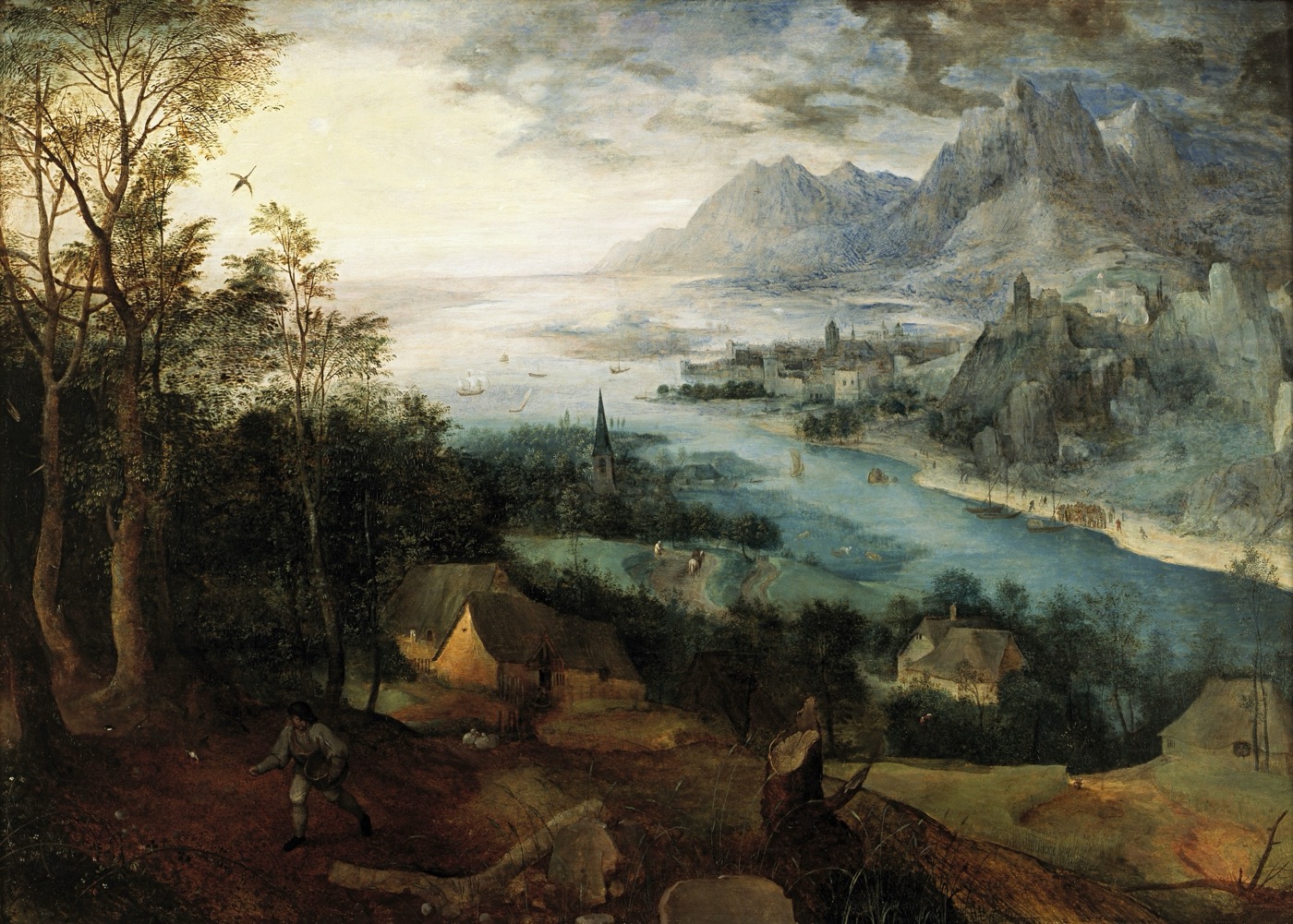
The painting is large, but the sower is small: down in the lower left, on the slope, scattering seed as he walks. Look far off to the right: a crowd has gathered on the riverbank, with a few boats beside it. What do you notice first in this painting?
Pieter Bruegel the Elder, Landscape with the Parable of the Sower, 1557, oil painting, Timken Museum of Art, San Diego. Public domain. Wikimedia CommonsRead TogetherMatt 13:1-9, 18-23
1On that day Jesus went out of the house and sat by the seaside.
2Great multitudes gathered to him, so that he entered into a boat and sat; and all the multitude stood on the beach.
3He spoke to them many things in parables, saying, “Behold, a farmer went out to sow.
4As he sowed, some seeds fell by the roadside, and the birds came and devoured them.
5Others fell on rocky ground, where they didn’t have much soil, and immediately they sprang up, because they had no depth of earth.
6When the sun had risen, they were scorched. Because they had no root, they withered away.
7Others fell among thorns. The thorns grew up and choked them.
8Others fell on good soil and yielded fruit: some one hundred times as much, some sixty, and some thirty.
9He who has ears to hear, let him hear.”
(vv. 10–17) The disciples came and asked Jesus why he spoke to the crowds in parables. That passage is left for the introductory lesson.
18“Hear, then, the parable of the farmer.
19When anyone hears the word of the Kingdom and doesn’t understand it, the evil one comes and snatches away that which has been sown in his heart. This is what was sown by the roadside.
20What was sown on the rocky places, this is he who hears the word and immediately with joy receives it;
21yet he has no root in himself, but endures for a while. When oppression or persecution arises because of the word, immediately he stumbles.
22What was sown among the thorns, this is he who hears the word, but the cares of this age and the deceitfulness of riches choke the word, and he becomes unfruitful.
23What was sown on the good ground, this is he who hears the word and understands it, who most certainly bears fruit and produces, some one hundred times as much, some sixty, and some thirty.”
The Setting
That day. Matthew begins this parable with “On that day” (v. 1), and it follows straight on from the chapter before. There Jesus healed a man who was blind and mute. “All the multitudes were amazed” (Matt 12:23), but the Pharisees said, “This man does not cast out demons except by Beelzebul, the prince of the demons” (Matt 12:24). The same event: some were amazed, some said it was the prince of the demons. At the end of that chapter Jesus pointed to his disciples and said, “whoever does the will of my Father who is in heaven, he is my brother, and sister, and mother” (Matt 12:50).
What Jesus tells next is a parable about ‘hearing’.
Who was listening. So many people came that “he entered into a boat and sat; and all the multitude stood on the beach” (v. 2). The parable was told to the crowd on the shore. The explanation was given to the disciples: Mark records that “When he was alone, those who were around him with the twelve asked him about the parables” (Mark 4:10).
Why read this one first. Mark records Jesus saying, “Don’t you understand this parable? How will you understand all of the parables?” (Mark 4:13). Jesus explained this parable himself, line by line, and it is a key for reading the others.
The Three Gospels
All three Gospels record this parable, each in its own way:
| Matthew | Mark | Luke | |
|---|---|---|---|
| What the seed is | “the word of the Kingdom” (Matt 13:19) | “The farmer sows the word” (Mark 4:14) | “The seed is the word of God” (Luke 8:11) |
| Who takes the word away from the roadside | “the evil one comes” (Matt 13:19) | “immediately Satan comes” (Mark 4:15) | “then the devil comes” (Luke 8:12) |
| What chokes the word | “the cares of this age and the deceitfulness of riches” (Matt 13:22) | adds “the lusts of other things” (Mark 4:19) | “cares, riches, and pleasures of life” (Luke 8:14) |
| What the good soil is like | “hears the word and understands it” (Matt 13:23) | “hear the word, accept it” (Mark 4:20) | “hold it tightly, and produce fruit with perseverance” (Luke 8:15) |
| The harvest | a hundred, sixty, thirty | thirty, sixty, a hundred | “one hundred times as much fruit” (Luke 8:8) |
The three Gospels describe the good soil differently: Matthew says ‘understands’, Mark says ‘accept’, Luke says ‘hold it tightly’ and ‘perseverance’. Taken together, they show how a person takes the word in: understands it, accepts it, keeps hold of it.
Explanation
What do we see? There is one farmer and one kind of seed. What differs is the soil. All four heard: even the roadside is someone who “hears the word of the Kingdom” (v. 19). The question is not whether they heard, but what happened after they heard.
The three soils that fail each fail in a different place:
- The roadside is someone who “hears the word of the Kingdom and doesn’t understand it”, and the evil one “snatches away that which has been sown in his heart” (v. 19) — the word never got in;
- The rocky ground: “he has no root in himself”, and when oppression or persecution comes, “immediately he stumbles” (v. 21) — it got in, but did not take root;
- Among the thorns, the word grows, but “the cares of this age and the deceitfulness of riches choke the word, and he becomes unfruitful” (v. 22) — it grew, but bore no fruit.
One detail is easy to miss: on the rocky ground “immediately they sprang up” (v. 5), and that hearer “immediately with joy receives it” (v. 20). What comes up fastest does not always last longest.
If I had been there. Jesus spoke of sowing, birds, rocks and thorns — things anyone could see at the edge of a field. When he finished speaking from the boat, he did not explain it. He said only, “He who has ears to hear, let him hear” (v. 9). For the people standing on the shore, that was what they heard: this parable and this one sentence. The sentence is not an invitation to judge other people. It asks each listener to look at himself.
What is God like? The farmer in the parable sows widely: seed falls on the roadside, on rocky ground, among thorns. The parable does not say he sowed only on good soil. That day, everyone on the shore heard this parable.
Jesus also wants people to understand. When the disciples asked, he explained it from the beginning: “Hear, then, the parable of the farmer” (v. 18). Near the end of the chapter he asks the disciples, “Have you understood all these things?” (v. 51).
The seed itself has life in it. In good soil it bears “some one hundred times as much, some sixty, and some thirty” (v. 23). Isaiah says the same about God’s word: “it will not return to me void, but it will accomplish that which I please” (Isa 55:11).
What does this mean for me? This parable is easily used to sort other people: ‘he is the roadside’, ‘she is rocky ground’. But the same person, on different days, may have roadside, rocks and thorns in his own heart.
The thorns are worth a longer look. This person has not left, and the word has grown; it has only been choked. What chokes it is “the cares of this age and the deceitfulness of riches” (v. 22) — not some great sin, but the things of every day.
The good soil, too, bears more or less. Jesus puts a hundred, sixty and thirty side by side; the thirtyfold grows in good soil too.
Different Views
The three commentators below are English: Matthew Henry (1662–1714), John Gill (1697–1771) and Adam Clarke (c. 1760–1832). Each is quoted in his own words, with the source after each quotation.
What the text itself says (all three follow this): The seed is the word (Mark 4:14; Luke 8:11), and the four soils are four kinds of hearers (Matt 13:19-23). Jesus himself made this plain, and there is no disagreement about it. The three questions below are places the text does not spell out, where readers through the centuries have differed.
1. Who is the sower?
In this parable, Jesus does not say who the sower is.
The sower that scatters the seed is our Lord Jesus Christ, either by himself, or by his ministers
Matthew Henry, Commentary on the Whole Bible, Vol. V, on Matt 13:18-23.
Gill takes the sower from the explanation of another parable, where Jesus says, “He who sows the good seed is the Son of Man” (Matt 13:37). He then reads the sower’s going out as the incarnation:
By "the sower" is meant "the son of man", as may be learnt from the explanation of another parable, Matthew 13:37 which is Jesus Christ himself
This sower "went forth" from his own house to his field; which, as applied to Christ, may intend his incarnation, his coming into this world by the assumption of human nature
John Gill, Exposition of the Entire Bible, on Matt 13:3.
How to read it: Reading the sower through Jesus’ own explanation of the weeds is letting Scripture explain Scripture, and it has a basis. Reading ‘went forth’ as the incarnation is not something the text says — this is an allegorical reading: finding a counterpart for every detail of a parable. Read that way, a parable can easily be made to say something it never meant. With any parable, start from what Jesus himself explained.
2. Where does the good soil come from?
All three agree that the human heart is not good soil by nature, and that only God can make it good. They differ in how they speak about our side.
On Luke’s phrase, “with an honest and good heart” (Luke 8:15):
"an honest and good heart"; which no man naturally has; nor can any man make his heart so: this is the work of God, and is owing to his efficacious grace.
John Gill, Exposition of the Entire Bible, on Matt 13:23.
But is not the ground naturally bad in every heart? Undoubtedly. And can any but God make it good? None.…No man shall be condemned because he did not change his own heart, but because he did not cry to God to change it
Adam Clarke, Commentary on the Bible, on Matt 13:23.
It is God's grace indeed that gives the understanding, but it is our duty to give our minds to understand.
Matthew Henry, Commentary on the Whole Bible, Vol. V, on Matt 13:18-23.
How to read it: How God’s grace and our response work together: churches understand this question in different ways. Please ask the church you belong to.
3. Does thirtyfold count?
if the ground be good…the heart honest…those who bring forth but thirty-fold shall be graciously accepted of God
Matthew Henry, Commentary on the Whole Bible, Vol. V, on Matt 13:18-23.
all sound believers are not equally fruitful
Adam Clarke, Commentary on the Bible, on Matt 13:23.
though not brought forth in the same quantity in all, yet is of the same quality
John Gill, Exposition of the Entire Bible, on Matt 13:23.
How to read it: The three point the same way: the amounts differ, and thirtyfold is still fruit from good soil.
Key Word
The roadside is someone who “hears the word of the Kingdom and doesn’t understand it” (v. 19); the good soil is someone who “hears the word and understands it” (v. 23). In both places, ‘understand’ is the same Greek word.
The word joins ‘together’ (σύν) and ‘send’ (ἵημι). Thayer’s Greek lexicon explains that it first means to set or bring together; used of the mind, it means to join what is perceived with the thing perceived — that is, to understand.
( σύν , and ἵημι to send); 1. properly, to set or bring together
to put (as it were) the perception with the thing perceived; to set or join together in the mind, i. e. to understand
Thayer’s Greek-English Lexicon of the New Testament, G4920.
In Matthew 13 the word appears in verses 13, 14, 15, 19, 23 and 51. The chapter begins with people who see and hear but “neither do they understand” (v. 13), and comes to Jesus asking his disciples, “Have you understood all these things?” (v. 51) — and they answer him that they have.
Explaining the good soil, Matthew Henry says such hearers understand more than the meaning:
they understand not only the sense and meaning of the word, but their own concern in it
Matthew Henry, Commentary on the Whole Bible, Vol. V, on Matt 13:18-23.
Think It Through
There are no right answers and no scores. Write your answers down; they are for you alone.
- Of the four soils, which is most like your days lately? Has it always been that way, or only sometimes?
- In recent weeks, what ‘cares of this age’ have crowded out your time for reading the Bible and praying?
- On the rocky ground “immediately they sprang up” (v. 5). Have you seen, or been through, a time of great eagerness at the start that later faded? What was missing then?
- Look at Bruegel’s painting again: the sower so small, the crowd on the riverbank so far away. If you were painting this parable, what would you put in the middle?
This Week
Choose a passage you will read this week; the passage for Sunday’s sermon will do. When you have read it, before you move on, write down two sentences:
- one about ‘what this passage says’;
- one about ‘which part of my week it belongs with’.
At the end of the week, read the two sentences again and ask yourself: this week, did anything choke it?
Further Reading
- Matthew Henry, Commentary on the Whole Bible, Vol. V: Matt 13:1-23 (public domain; free to read in full at CCEL)
- R. T. France, Matthew (Tyndale New Testament Commentaries): Matt 13:1-23
- Klyne R. Snodgrass, Stories with Intent: the chapter on the sower
More in This UnitUnit 3 · Parables of the Kingdom
Scripture: World English Bible (public domain). The commentators in ‘Different Views’ are quoted in their own words from the English originals (public domain).