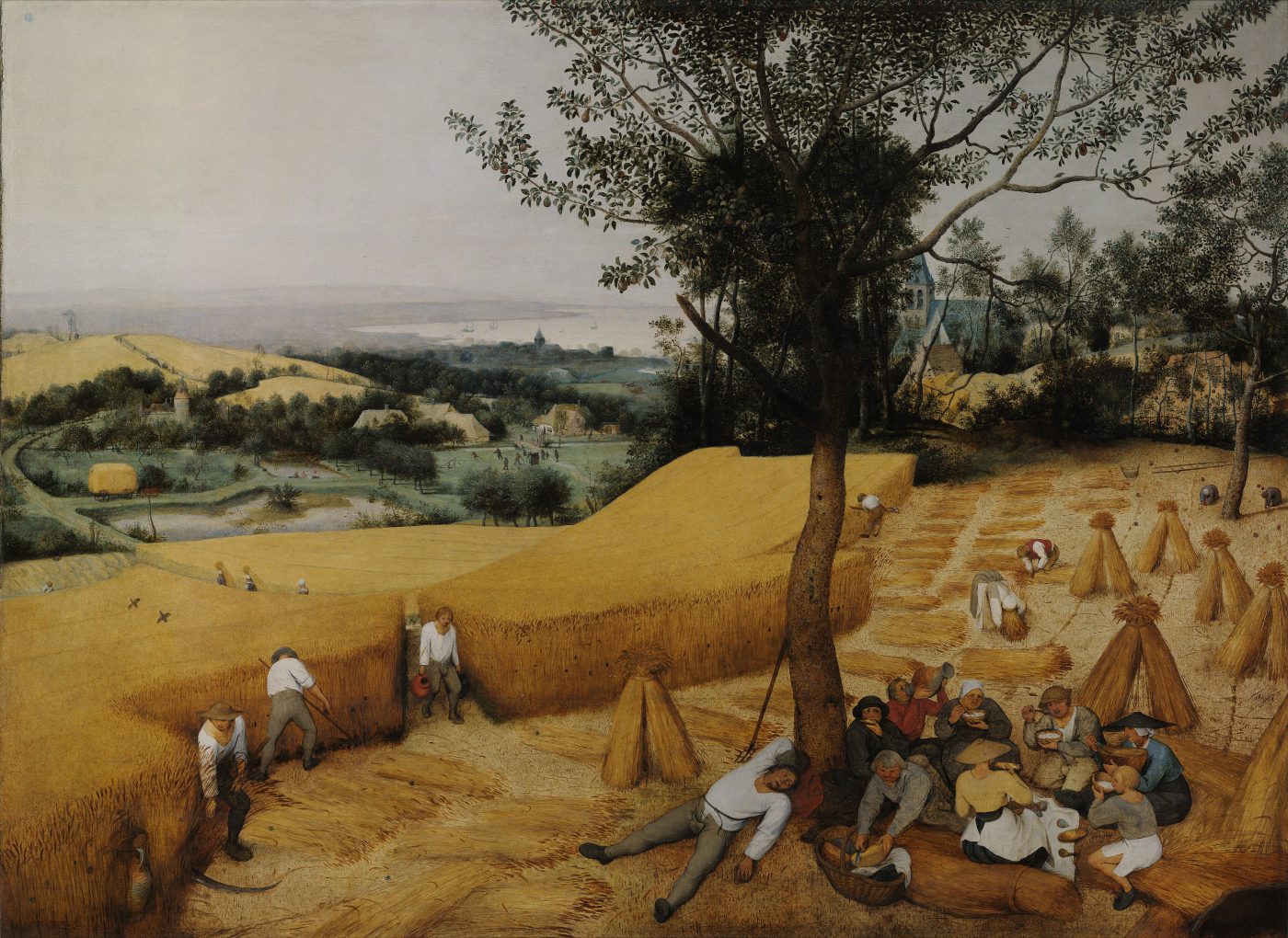
A great field of ripe wheat, golden all the way into the distance. On the left, men bend and swing their scythes, and someone carrying jugs comes out along a path through the wheat; on the right, the cut wheat stands in sheaves in the field, and someone is bending to bind more. Under a tree a group sits eating: some hold bowls, some tip their heads back to drink; beside them a man lies on his back, asleep. Far off are a village, a church and a bay. How many nights and days has this wheat passed through, from the day it was sown until today?
Pieter Bruegel the Elder, The Harvesters, 1565, oil on panel, The Metropolitan Museum of Art, New York. Public domain. It shows a harvest scene, not this parable, and is set beside v. 29. Wikimedia CommonsRead TogetherMark 4:26-29
(vv. 1–25) Sitting in a boat by the sea, Jesus taught the crowd in parables: first the sower, then the lamp put on a stand (see the lesson on the sower).
26He said, “God’s Kingdom is as if a man should cast seed on the earth,
27and should sleep and rise night and day, and the seed should spring up and grow, though he doesn’t know how.
28For the earth bears fruit by itself: first the blade, then the ear, then the full grain in the ear.
29But when the fruit is ripe, immediately he puts in the sickle, because the harvest has come.”
The Setting
Who was there. It is still the day of the sower. Jesus was by the sea, and there were so many people that “he entered into a boat in the sea and sat down” (Mark 4:1), speaking to the crowd on the shore. He told several parables that day. Mark says, “With many such parables he spoke the word to them, as they were able to hear it” (Mark 4:33). Of the four Gospels, only Mark records this one, as Adam Clarke notes:
This parable is mentioned only by Mark
Adam Clarke, Commentary on the Bible, on Mark 4:26.
What the farmer waits for. Once the seed is sown, there is not much a farmer can do: wait for rain, wait for it to sprout, wait for it to ripen. James says, “Behold, the farmer waits for the precious fruit of the earth, being patient over it, until it receives the early and late rain” (Jas 5:7). The man in the parable is the same: he will “sleep and rise night and day” (v. 27). Clarke says this means only sleeping by night and rising by day, with no deeper meaning:
That is, he should sleep by night, and rise by day; for so the words are obviously to be understood.
Adam Clarke, Commentary on the Bible, on Mark 4:27.
Set beside the sower:
| The Sower (Mark 4:3-20) | The Growing Seed (Mark 4:26-29) | |
|---|---|---|
| How it begins | “Behold, the farmer went out to sow” (Mark 4:3) | “a man should cast seed on the earth” (v. 26) |
| What it is about | seed falls on four kinds of soil, with different results | how the seed grows, step by step, once it is sown |
| The sower | after sowing, the parable says no more about him | he will “sleep and rise night and day” (v. 27) |
| What the seed is | “The farmer sows the word” (Mark 4:14) | Jesus does not explain |
| The end | “some thirty times, some sixty times, and some one hundred times” (Mark 4:20) | “immediately he puts in the sickle” (v. 29) |
The earlier parable told the disciples that of the four soils, three bore no fruit. This one goes on to say: seed that falls into the ground grows by itself.
Explanation
What do we see? In these four verses, the man does only two things, one at each end: he sows (v. 26), and he reaps (v. 29). The longest part, in the middle, is the seed growing by itself: it sprouts and grows tall, first the blade, then the ear, then the full grain (vv. 27–28).
The man who sowed does not know how it grows: “though he doesn’t know how” (v. 27). Adam Clarke writes:
How a plant grows is a mystery in nature, which the wisest philosopher in the universe cannot fully explain.
Adam Clarke, Commentary on the Bible, on Mark 4:27.
If I had been there. The disciples had just heard the sower: the seed by the roadside eaten by birds, the seed on rocky ground scorched, the seed among thorns choked. Of four handfuls of seed, three bore no fruit. Hearing that, a sower could easily lose heart.
Then Jesus told this one. The seed is sown, and you go to sleep: it is growing. You get up and do other things: it is still growing. You cannot see how it grows, and it grows all the same.
What is God like? “For the earth bears fruit by itself” (v. 28). ‘By itself’ does not mean without God. John Gill says the earth bears fruit under the sun, the dew and the rain from heaven:
Without any further help, or cultivation from the husbandman; though under the influence of the sun, dews, and showers of rain from heaven
John Gill, Exposition of the Entire Bible, on Mark 4:28.
Matthew Henry says the seed grows this way by the ordinary course of nature, and by the power of God working with it; and he adds a sentence on how God does his work:
according to the ordinary course of nature, and by the concurring power of the God of nature
God carries on his work insensibly and without noise, but insuperably and without fail.
Matthew Henry, Commentary on the Whole Bible, Vol. V, on Mark 4:26-29.
Paul says the same thing: “I planted. Apollos watered. But God gave the increase” (1 Cor 3:6).
What does this mean for me? We often want to know how much we have ‘grown’, and we want to see others grow too. This parable says that growth has an order, “first the blade, then the ear, then the full grain in the ear” (v. 28), and cannot be hurried; and that growth is often unseen. Henry says the prophets do not live for ever, but the word they preached goes on working after they are gone:
The prophets do not live for ever; but the word which they preached, is doing its work, when they are in their graves
Matthew Henry, Commentary on the Whole Bible, Vol. V, on Mark 4:26-29.
For those who share the gospel, lead a small group or teach children, this is a comfort: once the seed is sown, you can go to sleep in peace. For ourselves, it is a reminder: do not dig up the seed every day to see whether it has grown.
Different Views
The three commentators below are English: Matthew Henry (1662–1714), John Gill (1697–1771) and Adam Clarke (c. 1760–1832). Each is quoted in his own words, with the source after each quotation.
What the text itself says (all three follow this): God’s Kingdom is like a man casting seed on the earth (v. 26); the seed springs up and grows by itself, and the man does not know how (v. 27); the growth has an order: blade, ear, full grain (v. 28); when it is ripe, it is reaped (v. 29). Jesus did not explain this parable. The two questions below are places where readers through the centuries have differed.
1. Who is the man who sows and sleeps?
Gill says the man is not Christ but a minister of the Gospel sent out by Christ, and the seed is God’s word:
by "the man", is not meant Christ, for he sleeps not; and besides, he knows how the seed springs and grows; but any Gospel minister, who is sent forth by Christ, bearing precious seed
but the word of God, or Gospel of Christ
John Gill, Exposition of the Entire Bible, on Mark 4:26.
Clarke cites another commentator’s reading, in which Christ gathers in the good seed at the harvest; then he gives his own view:
and then Christ the husbandman, at the time of the harvest, gathers in this good seed into the kingdom of heaven
I see no necessity of inquiring how Christ may be said to sleep and rise night and day; Christ being like to this husbandman only in sowing and reaping the seed.
Adam Clarke, Commentary on the Bible, on Mark 4:26.
Henry speaks from the preacher’s side: the farmer does nothing to make the seed spring up, and so it is with the word of grace in the heart:
The husbandman, when he hath sown the seed, doth nothing toward the springing of it up
Thus the word of grace, when it is received in faith, is in the heart a work of grace, and the preachers contribute nothing to it.
Matthew Henry, Commentary on the Whole Bible, Vol. V, on Mark 4:26-29.
How to read it: this is an allegorical reading: finding a counterpart for the man in the parable. Gill says he is a preacher; Clarke says the one who sows and reaps is Christ; Henry speaks from the preacher’s side. The text itself does not say who this man is. It says only, “God’s Kingdom is as if a man should cast seed on the earth” (v. 26). The three do agree on one thing: how the seed grows does not lie with the one who sowed it.
2. ‘The full grain’ and ‘the harvest’: what do they mean?
Clarke reads the blade, the ear and the grain as three steps in the soul’s growth in grace. Of the full grain he writes the first line below; on v. 29 he takes up a reading that a soul, once completely holy, is taken into God’s Kingdom, and answers it:
The soul is purified from all unrighteousness; and, having escaped the corruption that is in the world, it is made a partaker of the Divine nature, and is filled with all the fullness of God.
It has been supposed that our Lord intimates here that, as soon as a soul is made completely holy, it is taken into the kingdom of God. But certainly the parable does not say so.
God saves men to the uttermost, that they may here perfectly love him
Adam Clarke, Commentary on the Bible, on Mark 4:28-29.
Gill, too, reads the three steps as grace growing little by little: faith small at first, then stronger. The ripe crop is grace come to maturity, and the harvest comes at death or at the end of the world:
faith grows stronger and stronger
signifying that when grace is brought to maturity, and faith is performed with power, and the good work begun is perfected
at death or at the end of the world, which the harvest represents
John Gill, Exposition of the Entire Bible, on Mark 4:28-29.
Henry says the harvest comes when those who received the gospel have finished their course:
When those that receive the gospel aright, have finished their course, the harvest comes, when they shall be gathered as wheat into God's barn
Matthew Henry, Commentary on the Whole Bible, Vol. V, on Mark 4:26-29.
Thayer lists the ‘harvest’ of v. 29 under the word’s figurative use, the time of final judgment:
equivalent to the time of reaping, i. e. figuratively, the time of final judgment, when the righteous are gathered into the kingdom of God
Thayer’s Greek-English Lexicon of the New Testament, G2326.
How to read it: Whether the harvest means the end of one person’s life or the end of the world, the three and Thayer do not say the same; the text says only “because the harvest has come” (v. 29). The larger difference is over ‘the full grain’: how far a believer can grow in this life. Clarke says a believer can love God perfectly in this life; Gill speaks of grace growing gradually to maturity, with the harvest at death or at the end of the world, and does not speak of perfection in this life as Clarke does. How far a believer can grow in this life: churches understand this question in different ways. Please ask the church you belong to.
Key Word
“For the earth bears fruit by itself” (v. 28).
‘By itself’ is a single word in Greek, αὐτόματος. Thayer’s Greek lexicon explains it as moving by one’s own impulse, acting without anyone else prompting or stepping in, and says it is often used of the earth producing plants of itself, and of plants and fruits growing without cultivation; the verse he lists is Mark 4:28.
moved by one's own impulse, or acting without the instigation or intervention of another
often of the earth producing plants of itself, and of the plants themselves and fruits growing without culture
Mark 4:28
Thayer’s Greek-English Lexicon of the New Testament, G844.
Under this entry, Thayer lists only one other New Testament verse besides this one: when the angel led Peter out of prison, the iron gate “opened to them by itself” (Acts 12:10).
of gates opening of their own accord: Acts 12:10
Thayer’s Greek-English Lexicon of the New Testament, G844.
Adam Clarke explains the word this way:
By its own energy, without either the influence or industry of man.
Adam Clarke, Commentary on the Bible, on Mark 4:28.
Growing ‘by itself’ means growing without people’s help; it does not mean that people can grow grace by themselves. John Gill takes care to say so:
this is said, not to denote that man of himself, upon hearing the word, can bring forth the fruit of grace in himself
John Gill, Exposition of the Entire Bible, on Mark 4:28.
The gate opened by itself, and it was God who opened it; the earth bore fruit by itself, and it was God who made it grow.
Think It Through
There are no right answers and no scores. Write your answers down; they are for you alone.
- Have you ever grown something, or raised something? While you waited for it to grow, how did you feel?
- Think back over the years since you came to faith: which changes in you did you only notice once they had already grown?
- Have you prayed for someone, or shared the gospel with them, for a long time, and seen no change? Having read this parable, what would you like to say to yourself?
- “first the blade, then the ear, then the full grain in the ear” (v. 28). Which step do you think you are at now?
This Week
Think of someone you have sown seed for: a family member, a friend, a brother or sister in your small group. This week, pray for them once a day, asking only that God make the seed grow — without pressing them, and without ‘digging it up to look’.
At the end of the week, ask yourself: this week, did I grow more anxious, or more at peace?
Further Reading
- Matthew Henry, Commentary on the Whole Bible, Vol. V: Mark 4:26-29 (public domain; free to read in full at CCEL)
- Mark (Tyndale New Testament Commentaries): Mark 4:26-29
- Klyne R. Snodgrass, Stories with Intent: the chapter on the growing seed
More in This UnitUnit 3 · Parables of the Kingdom
Scripture: World English Bible (public domain). The commentators in ‘Different Views’ are quoted in their own words from the English originals (public domain).