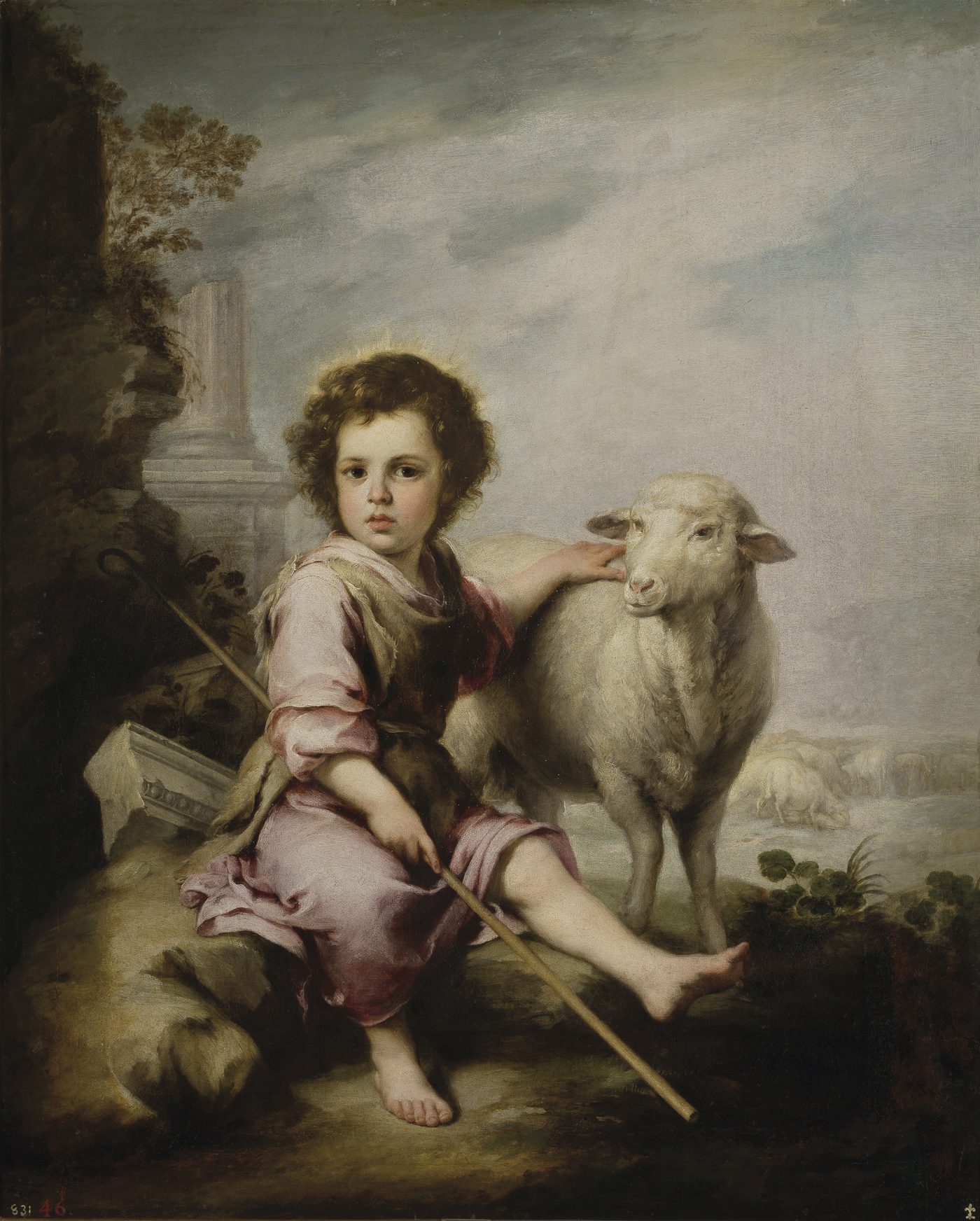
一个孩子光着脚,坐在一块石头上。他穿着粉红色的衣服,肩上披着一块毛皮,手里斜拿着一根牧杖,另一只手搭在身旁一只羊的背上。他身后有一根断了的石柱,脚边倒着一块刻了花纹的石头;远处,羊群在低头吃草。孩子头上有一圈淡淡的光,正看着画外的你。画家把好牧人画成了一个孩子。你觉得他想让人看见什么?
巴托洛梅·埃斯特万·穆里略(Bartolomé Esteban Murillo,1617–1682)《好牧人》(El Buen Pastor),约 1660 年,油画,西班牙马德里普拉多博物馆藏。公有领域。 Wikimedia Commons一起读约 10:1-18
1“我实实在在地告诉你们,人进羊圈,不从门进去,倒从别处爬进去,那人就是贼,就是强盗。
2从门进去的,才是羊的牧人。
3看门的就给他开门,羊也听他的声音。他按着名叫自己的羊,把羊领出来。
4既放出自己的羊来,就在前头走,羊也跟着他,因为认得他的声音。
5羊不跟着生人,因为不认得他的声音,必要逃跑。”
6耶稣将这比喻告诉他们,但他们不明白所说的是什么意思。
7所以耶稣又对他们说:“我实实在在地告诉你们,我就是羊的门。
8凡在我以先来的,都是贼,是强盗;羊却不听他们。
9我就是门,凡从我进来的,必然得救,并且出入得草吃。
10盗贼来,无非要偷窃、杀害、毁坏;我来了,是要叫羊得生命,并且得得更丰盛。
11我是好牧人,好牧人为羊舍命。
12若是雇工,不是牧人,羊也不是他自己的,他看见狼来,就撇下羊逃走;狼抓住羊,赶散了羊群。
13雇工逃走,因他是雇工,并不顾念羊。
14我是好牧人,我认识我的羊,我的羊也认识我,
15正如父认识我,我也认识父一样;并且我为羊舍命。
16我另外有羊,不是这圈里的;我必须领他们来,他们也要听我的声音,并且要合成一群,归一个牧人了。
17我父爱我,因我将命舍去,好再取回来。
18没有人夺我的命去,是我自己舍的。我有权柄舍了,也有权柄取回来。这是我从我父所受的命令。”
当时现场
谁在场。 这段话前面没有换场。第 9 章,耶稣「看见一个人生来是瞎眼的」(约 9:1),医好了他;法利赛人盘问他,最后「把他赶出去了」(约 9:34)。耶稣后来找到他(约 9:35),又对在场的法利赛人说了几句话,他们反问:「难道我们也瞎了眼吗」(约 9:40)?紧接着,就是这一段。吉尔说,这些话是对文士和法利赛人说的,他们“把基督医好的那个瞎子赶了出去,只因他替基督说了话”。
John Gill, Exposition of the Entire Bible,约 10:1。译自英文原著。
看英文原文
To the Scribes and Pharisees, who had taken it ill that they should be thought to be blind; and who had cast out the man that Christ had cured of blindness, for speaking in favour of him
马亨利则说,也可能是后来冬天修殿节时讲的(参约 10:22),“不能确定”。
Matthew Henry, Commentary on the Whole Bible, Vol. V,约 10:1-18。译自英文原著。
看英文原文
It is not certain whether this discourse was at the feast of dedication in the winter
牧人走在前头。 耶稣说,牧人「就在前头走,羊也跟着他」(4 节)。马亨利说,牧人放羊,“不是在后面赶,而是(那时的风俗就是这样)走在前头,先挡住路上可能遇到的祸害;羊走惯了,跟着他,就平安”。克拉克说:“东方的风俗是牧人走在羊群前头,羊跟着他从一片草场走到另一片。”
Adam Clarke, Commentary on the Bible,约 10:4。译自英文原著。
看英文原文
he does not drive them, but (such was the custom in those times) he goes before them, to prevent any mischief or danger that might meet them, and they, being used to it, follow him, and are safe.
It was the custom in the eastern countries for the shepherd to go at the head of his sheep, and they followed him from pasture to pasture.
按着名叫羊。 「他按着名叫自己的羊」(3 节)。吉尔说,东方的牧人给羊起名字,“就像欧洲人给马起名字一样”,坐着就能一只一只叫出来。
John Gill, Exposition of the Entire Bible,约 10:3。译自英文原著。
看英文原文
in allusion to the eastern shepherds, who gave names to their sheep, as the Europeans do to their horses, and other creatures, and who could sit and call them by their names
旧约里的牧人。 听的人熟悉旧约。先知以西结责备过以色列的牧人:「祸哉,以色列的牧人,只知牧养自己!牧人岂不当牧养群羊吗」(结 34:2)?神又应许:「看哪,我必亲自寻找我的羊,将他们寻见」(结 34:11)。大卫也唱过:「耶和华是我的牧者,我必不至缺乏」(诗 23:1)。耶稣说「我是好牧人」,听的人会想起这些话。
讲解
看见什么。 这段话分两半。1–5 节是一幅图画:贼从别处爬进羊圈;牧人从门进去,叫着名字把羊领出来,走在前头,羊认得他的声音。6 节说,他们不明白。7–18 节,耶稣自己解开这幅画,说了两句“我是”:「我就是羊的门」(7 节),「我是好牧人」(11 节)。
图画里出现了几种人:贼和强盗,来是为了「偷窃、杀害、毁坏」(10 节);雇工,看见狼来,「就撇下羊逃走」(12 节);好牧人,「为羊舍命」(11 节)。克拉克这样分雇工和好牧人:“雇工把羊当作自己的,只到羊对他有好处为止;好牧人把羊当作自己的,只要他还能对羊有好处。”
Adam Clarke, Commentary on the Bible,约 10:12。译自英文原著。
看英文原文
The hireling counts the sheep his own, no longer than they are profitable to him; the good shepherd looks upon them as his, so long as he can be profitable to them.
如果我在场。 那个生来瞎眼的人刚被赶出去(约 9:34)。赶他的人,自认是百姓的牧者。耶稣说的贼、强盗、雇工,听在法利赛人耳里,不会听不出来。可是 6 节说,「他们不明白所说的是什么意思」。
而那个被赶出去的人,是耶稣去找到的:「耶稣听说他们把他赶出去,后来遇见他」(约 9:35)。被羊圈赶出来的羊,好牧人去找他。
神是怎样的神。 好牧人认识他的羊:「我认识我的羊,我的羊也认识我」(14 节),就像「父认识我,我也认识父一样」(15 节)。这一段里,耶稣一再说到“舍命”(11、15、17、18 节)。马亨利说:“成千上万的羊曾为牧人献上作赎罪祭;这里却出人意料地倒过来,是牧人为羊被献上。”
Matthew Henry, Commentary on the Whole Bible, Vol. V,约 10:1-18。译自英文原著。
看英文原文
Thousands of sheep had been offered in sacrifice for their shepherds, as sin-offerings, but here, by a surprising reverse, the shepherd is sacrificed for the sheep.
这命不是被人夺去的:「没有人夺我的命去,是我自己舍的」(18 节)。马亨利说:“基督的命看起来像是被强攻夺去的,其实是他自己交出来的。”
Matthew Henry, Commentary on the Whole Bible, Vol. V,约 10:1-18。译自英文原著。
看英文原文
Though Christ's life seemed to be taken by storm, yet really it was surrendered
和我有什么关系。 「我们都如羊走迷,各人偏行己路」(赛 53:6)。耶稣说,他的羊认得他的声音,「羊不跟着生人」(5 节)。每天有很多声音在叫我们:广告、朋友、新闻、心里的害怕。哪一个是牧人的声音?
如果你在教会里带人,哪怕只带一个小组,也想一想雇工和牧人的分别。克拉克提醒:“读的人不要把这些责备套在哪一类、哪一等人身上:每一个宗派都可能有雇工。”这话先是对自己说的。
Adam Clarke, Commentary on the Bible,约 10:12。译自英文原著。
看英文原文
Let not the reader apply this, or any of the preceding censures, to any particular class or order of men: every religious party may have a hireling priest, or minister
不同的看见
下面三位都是英国的解经家:马亨利(1662–1714)、吉尔(1697–1771)、克拉克(约 1760–1832)。各段都译自英文原著,出处附在后面。
经文自己说的(三家都照这个讲): 耶稣先讲一幅牧羊的图画,听的人不明白(1–6 节);他就说自己是羊的门(7、9 节),是好牧人(11、14 节);好牧人为羊舍命,命是他自己舍的,也要再取回来(15–18 节)。下面三处,是经文没有讲明、历代读法不同的地方。
一、“看门的”是谁?
他先讲当时的风俗:“古时候,羊圈设在住家外门的里面,为的是羊群更安全;所以除了看门的给他开门、或家主给了钥匙的人,没有人能从正路到羊那里去。”讲到应用,他把这一句用在传道人身上:他们要从正当的门进去,“这样的人,看门的会给他开门;基督的灵会在他们面前开一扇门”。
Matthew Henry, Commentary on the Whole Bible, Vol. V,约 10:1-18。译自英文原著。
看英文原文
Anciently they had their sheepfolds within the outer gates of their houses, for the greater safety of their flocks, so that none could come to them the right way, but such as the porter opened to or the master of the house gave the keys to.
and to such the porter will open; the Spirit of Christ will set before them an open door
他先承认:“基督对这个比喻的解释里,没有一处指明这一句的意思。”他列了好几种说法都不取,也说把它看作传福音的人“这种意思也不可轻看”;他自己倾向于“指父神,基督作为人、作为中保的权柄是从父来的”,“或者是圣灵”。
John Gill, Exposition of the Entire Bible,约 10:3。译自英文原著。
看英文原文
There is nothing in the explanation of this parable given by Christ, that directs to the sense of this clause
though this is a sense not to be despised
but rather this intends God the Father, from whom Christ, as man and Mediator, derives his authority
or else the Holy Spirit
他把这一节用在传道人身上:“看门的给真牧人开门,从这里可以看出真传道人的第二个记号——他的劳苦有果效:圣灵为他打开听众的心。”
Adam Clarke, Commentary on the Bible,约 10:3。译自英文原著。
看英文原文
In the porter opening the door to the true shepherd, we may discover the second mark of a true minister - his labor is crowned with success. The Holy Spirit opens his way into the hearts of his hearers
怎么看: 这是寓意读法:给图画里的每一样东西找一个对应。吉尔自己说得最清楚:耶稣解释的时候,讲了门,讲了牧人,讲了贼、雇工和狼,没有讲看门的。经文自己讲明的,是「我就是羊的门」(7 节)和「我是好牧人」(11 节)。看门的指谁,可以存着,不必定论。
二、“凡在我以先来的”指谁?
8 节说:「凡在我以先来的,都是贼,是强盗」。难道摩西和先知也是?
“这话要有限定地理解……不是指摩西,不是指主的先知,也不是指紧挨在基督前面来的施洗约翰”,而是指没有奉差遣就来的假先知、只顾喂养自己的牧人,以及丢大、加利利的犹大这类人。
John Gill, Exposition of the Entire Bible,约 10:8。译自英文原著。
看英文原文
This must be understood with some restrictions, not of every individual person, nor of every individual prophet or shepherd; not of Moses, nor of the prophets of the Lord, nor of John the Baptist, who came immediately before Christ
“在他以先”不是指时间上在他以前,“他们中间许多是忠心的牧人”,而是指那些抢在他的差遣之前、没有被差就去了的人。
Matthew Henry, Commentary on the Whole Bible, Vol. V,约 10:1-18。译自英文原著。
看英文原文
all that went before him, not in time, many of them were faithful shepherds, but all that anticipated his commission, and went before he sent them
他说有人把这几个字译作“代替我来的”,就是冒充基督的人,像丢大和加利利的犹大;“但我们的主大概是指文士和法利赛人,他们自称能指示百姓得救的路。”他又说:“我们的主在许多地方充分证明了先知是受默示的。”
Adam Clarke, Commentary on the Bible,约 10:8。译自英文原著。
看英文原文
Or, as some translate, all that came instead of me, προ εμου, i.e. all that came as the Christ, or Messiah, such as Theudas, and Judas the Gaulonite
But our Lord probably refers to the scribes and Pharisees, who pretended to show the way of salvation to the people
But our Lord has borne sufficient testimony to their inspiration in a variety of places.
吉尔和克拉克还都提到,有不少古抄本和古译本没有“在我以先”这几个字。
John Gill, Exposition of the Entire Bible,约 10:8。译自英文原著。
看英文原文
The phrase, "before me", is wanting in seven of Beza's exemplars, and in several others
怎么看: 三家在一件事上是一致的:耶稣不是说摩西和众先知是贼。至于具体指谁,三家各举了不同的人。经文自己给的分辨方法是:贼「不从门进去」(1 节),来了「无非要偷窃、杀害、毁坏」(10 节);而「羊却不听他们」(8 节)。
三、“另外的羊”是谁?好牧人为谁舍命?
「我另外有羊,不是这圈里的」(16 节),三家都说包括外邦人。马亨利说:“一个牧人,就有一个羊圈;一位基督,就有一个教会。”
Matthew Henry, Commentary on the Whole Bible, Vol. V,约 10:1-18。译自英文原著。
看英文原文
One shepherd makes one fold; one Christ makes one church.
不一样的地方,在“羊”是怎样成为羊的、基督为谁舍命:
这些外邦人还没有蒙召,许多还没有出生,就已经被称为羊,“因为他们是神所拣选的,在神慈爱的定旨里,从永远就赐给了基督”。
Matthew Henry, Commentary on the Whole Bible, Vol. V,约 10:1-18。译自英文原著。
看英文原文
are here called sheep, and he is said to have them, though as yet they were uncalled, and many of them unborn, because they were chosen of God, and given to Christ in the counsels of divine love from eternity.
另外的羊,是“外邦人中神所拣选的”;说到 15 节「我为羊舍命」,他说这些羊是父赐给基督的,“除他们以外,他没有为别人舍命”。
John Gill, Exposition of the Entire Bible,约 10:15-16。译自英文原著。
看英文原文
by whom are meant the chosen of God among the Gentiles, who were sheep, though not called and folded
which were his, by the Father's gift, and for no other has he laid down his life.
另外的羊是“外邦人和撒玛利亚人”。他把耶稣的意思说成:“不要以为我只为犹太人舍命……不,我也要为外邦人死;因着神的恩典……我要为人人尝死味”,并引希伯来书 2:9。那节经文说:「叫他因着神的恩,为人人尝了死味」(来 2:9)。
Adam Clarke, Commentary on the Bible,约 10:16。译自英文原著。
看英文原文
The Gentiles and Samaritans. As if our Lord had said, Do not imagine that I shall lay down my life for the Jews, exclusively of all other people; no: I shall die also for the Gentiles; for by the grace, the merciful design and loving purpose of God, I am to taste death for every man, Hebrews 2:9
怎么看: 经文自己说的:好牧人「为羊舍命」(15 节);他另外还有羊,「我必须领他们来」(16 节);「并且要合成一群,归一个牧人了」(16 节)。三家都相信基督舍命拯救他的羊,也都相信外邦人要被领进来。分歧在于:神的拣选和基督的舍命是什么关系,基督是只为蒙拣选的人舍命,还是为人人尝了死味。这一问,各教会的理解不尽相同,请向你所在的教会请教。
原文词眼
「我是好牧人,好牧人为羊舍命」(11 节)。
“好”字原文是 καλός。Thayer 的希腊文辞典说,希腊人用这个字形容“在样子、优点、良善或用处上出众,因而叫人喜欢”的一切,所以常有“美好”的意思。它和表示职分的名词连用时,意思是“称职、能干,是他该是的样子”;他举的第一个例子就是 ποιμήν(牧人),经文是约翰 10:11、14。
Thayer's Greek-English Lexicon of the New Testament,G2570。译自英文原著。
看英文原文
beautiful, applied by the Greeks to everything so distinguished in form, excellence, goodness, usefulness, as to be pleasing
joined to names of men designated by their office, competent, able, such as one ought to be: ποιμήν, John 10:11, 14
马亨利说,原文是“ho poimen ho kalos——那位牧人,那位好牧人,就是神所应许的那一位”。
Matthew Henry, Commentary on the Whole Bible, Vol. V,约 10:1-18。译自英文原著。
看英文原文
ho poimen ho kalos—that shepherd, that good Shepherd, whom God had promised.
所以“好牧人”不只是“心地好的牧人”,更是“一个牧人该有的样子,他全都有”。旧约责备过那些牧人「只知牧养自己」(结 34:2)。耶稣说「我是好牧人」(11 节):牧人本来该是什么样子,在他身上看得见。
体裁说明
这一则是 6 则“有体裁说明”的比喻之一。下面把几种看法摆出来,不下结论。
中文都叫“比喻”,原文却是两个词。 6 节说「耶稣将这比喻告诉他们」。和合本在这里译作“比喻”,在马太、马可、路加里也译作“比喻”;但原文不是同一个词。马太、马可、路加讲撒种、浪子那些比喻,用的是 παραβολή(parabolē);这里用的是 παροιμία(paroimia)。Thayer 的希腊文辞典给 παραβολή 列的经文,在马太、马可、路加和希伯来书,没有一处在约翰福音。约翰福音里 παροιμία 还出现在第 16 章,和合本也译作“比喻”:「这些事,我是用比喻对你们说的」(约 16:25);门徒后来说:「如今你是明说,并不用比喻了」(约 16:29)。
这两个词怎么解释。 Thayer 解释 παραβολή 的一个主要意思是“一段叙事,虽是虚构,却合乎人生的常理和习惯,用来比喻人的本分或神的事”。
Thayer's Greek-English Lexicon of the New Testament,G3850。译自英文原著。
看英文原文
a narrative, fictitious but agreeable to the laws and usages of human life, by which either the duties of men or the things of God, particularly the nature and history of God's kingdom, are figuratively portrayed
他解释约 10:6 的 παροιμία,却是“一段话,借着比方和比较来说明一件事;一种寓言,就是延伸、铺展开的比喻”。
Thayer's Greek-English Lexicon of the New Testament,G3942。译自英文原著。
看英文原文
speech or discourse in which a thing is illustrated by the use of similes and comparisons; an allegory, i. e. extended and elaborate metaphor
和撒种、浪子有什么不一样。 撒种、浪子是一个故事,有开头、经过、结局,讲故事的人站在故事外面。这一段没有那样一条故事线:1–5 节是一幅牧羊的图画,7–18 节耶稣直接走进图画里,说“我就是门”“我是好牧人”。他一会儿是门,一会儿是从门进去的牧人。马亨利说:“同一个人又是门又是牧人,在修辞上也许不通,在神学上却不是不通。”
Matthew Henry, Commentary on the Whole Bible, Vol. V,约 10:1-18。译自英文原著。
看英文原文
Though it may be a solecism in rhetoric to make the same person to be both the door and the shepherd, it is no solecism in divinity
可是,许多人还是叫它比喻。 三位注释家都叫它 parable。克拉克说:“从 6 节我们知道这是一个比喻,就是借着地上的事来表明天上的事。”马亨利称它“比喻或比方”。连 Thayer 自己,在“牧人”(ποιμήν)一条下面,也把约 10:11、14 称作“这个比喻”。
Thayer's Greek-English Lexicon of the New Testament,G4166。译自英文原著。
看英文原文
From John 10:6, we learn that this is a parable, i.e. a representation of heavenly things through the medium of earthly things.
Here is the parable or similitude proposed
in the parable, he to whose care and control others have committed themselves, and whose precepts they follow, John 10:11, 14.
怎么看: 说它是比喻,有约 10:6 的话和历代注释家的叫法为凭;说它不太像撒种、浪子那样的比喻,有原文用词和这段话的写法为凭。两样都摆在这里。本栏目收它,是因为经文自己把它叫作 παροιμία(和合本译作“比喻”),而且约翰福音里耶稣用一幅图画讲他自己,这一段讲得最完整。读的时候,不必先定它是哪一类;先听清楚那位牧人在说什么。
请思考
没有标准答案,不打分。写下来,只给自己看。
- 每天叫你的声音有很多。最近一个星期,哪一个声音你听得最多?你怎样分辨哪一个是牧人的声音?
- 「他按着名叫自己的羊」(3 节)。想到耶稣知道你的名字、认识你,你心里是什么感觉?
- 雇工「看见狼来,就撇下羊逃走」(12 节)。在你负责的事上(家里、工作上、教会里),有没有“狼来了就想走”的时候?
- 再看一次穆里略的画:好牧人被画成一个孩子,手搭在羊身上,身后是断了的石柱。如果让你画“好牧人”,你会怎么画?
这周去做
每天早上读一遍 14 节:「我是好牧人,我认识我的羊,我的羊也认识我」。这一周,留意一次你差一点“跟着生人走”的时候:被一句话、一个消息、一种害怕牵着走。记下来,想一想牧人会怎么说。
如果你在带人,这周去认识其中一个人多一点:问问他最近怎么样,记住他说的一件事。
周末问自己:这一周,我听见牧人的声音了吗?
延伸参考
- Matthew Henry, Commentary on the Whole Bible, Vol. V:约 10:1-18(英文原著,公有领域,CCEL 可免费读全文)
- 丁道尔新约注释《约翰福音》:约 10:1-18
本单元其它比喻单元二 · 失丧与寻找
- 迷羊 路 15:3-7
- 失钱 路 15:8-10
- 浪子回头 路 15:11-32
- 好牧人 约 10:1-18 本课
经文:和合本(1919),用字按本站规则现代化。“不同的看见”里的注释都译自英文原著(公有领域),每段可展开看英文原文。