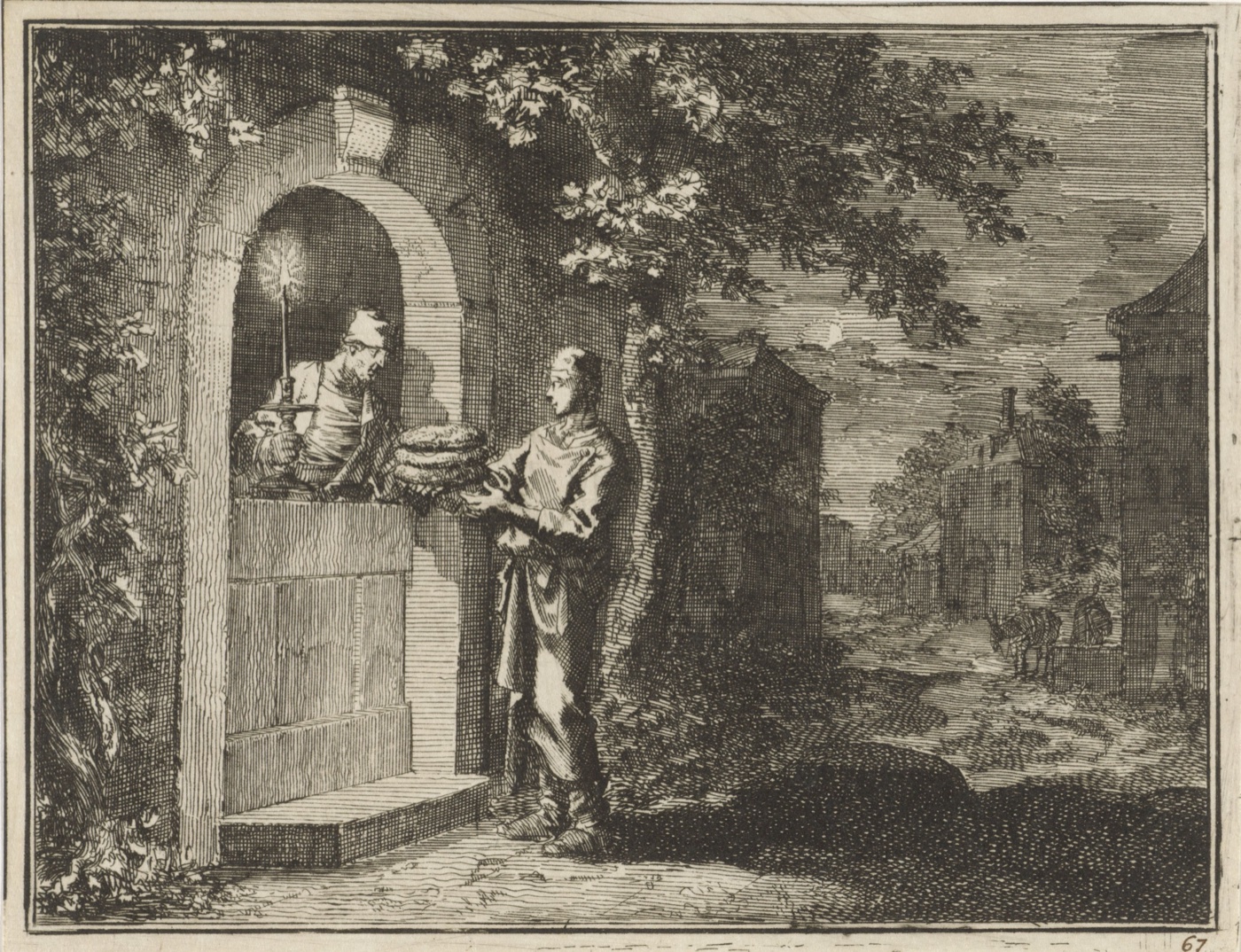
夜里,云缝里露出一弯月亮。一扇拱门下面,门的下半截关着,一个戴着睡帽的人从门里探出身子,一只手举着点亮的蜡烛,另一只手托着叠在一起的三个圆饼。门外站着一个年轻人,两手伸过去接。远处的街上,一头牲口低着头,旁边站着一个人。你看,门里的人脸上是什么神情?
扬·吕肯(Jan Luyken),《夜里到朋友那里求三个饼的人的比喻》(Gelijkenis van de man die 's nachts bij zijn vriend drie broden komt vragen),1712 年,蚀刻版画,荷兰阿姆斯特丹国立博物馆藏。公有领域。 Wikimedia Commons一起读路 11:5-13
(1–4 节)耶稣祷告完了,有个门徒对他说:「求主教导我们祷告」(路 11:1)。耶稣就教他们说:「我们在天上的父」(路 11:2)……
5耶稣又说:“你们中间谁有一个朋友,半夜到他那里去说:‘朋友,请借给我三个饼,
6因为我有一个朋友行路,来到我这里,我没有什么给他摆上。’
7那人在里面回答说:‘不要搅扰我,门已经关闭,孩子们也同我在床上了,我不能起来给你。’
8我告诉你们,虽不因他是朋友起来给他,但因他情词迫切地直求,就必起来照他所需用的给他。
9我又告诉你们,你们祈求,就给你们;寻找,就寻见;叩门,就给你们开门。
10因为凡祈求的,就得着;寻找的,就寻见;叩门的,就给他开门。
11你们中间作父亲的,谁有儿子求饼,反给他石头呢?求鱼,反拿蛇当鱼给他呢?
12求鸡蛋,反给他蝎子呢?
13你们虽然不好,尚且知道拿好东西给儿女,何况天父,岂不更将圣灵给求他的人吗?”
当时现场
为什么讲这个比喻。 耶稣自己刚祷告完,一个门徒说:「求主教导我们祷告,像约翰教导他的门徒」(路 11:1)。耶稣先教了他们一段祷告(2–4 节),接着讲了这个比喻。马亨利说,耶稣这样讲,是要激励我们祷告时恒切、火热、不住地求。
Matthew Henry, Commentary on the Whole Bible, Vol. V,路 11:1-13。译自英文原著。
看英文原文
He stirs up and encourages importunity, fervency, and constancy, in prayer
半夜。 吉尔说,半夜去敲门,看起来很不是时候,若不是真有急难、没有别的办法,没有人会这样做。克拉克说,6 节「行路,来到我这里」,更照字面可以译作“走岔了路来到我这里”:一个朋友赶夜路、迷了路,才找上门来。这样,事情就更急了。
John Gill, Exposition of the Entire Bible,路 11:5;Adam Clarke, Commentary on the Bible,路 11:6。译自英文原著。
看英文原文
which may seem a very unseasonable time, and which nothing but real distress, not knowing what otherwise to do, would put a man upon
A friend of mine is come to me out of his way
a friend of mine, benighted, belated, and who has lost his way, is come unto me
which renders the case more urgent
“门已经关闭”。 马亨利说,门已经关上、上了闩,孩子们就睡在同一间屋里,一出声就会把他们吵醒。克拉克说,他的小孩子跟他睡在一张床上,这就更难答应邻舍的请求了。
Matthew Henry, Commentary on the Whole Bible, Vol. V,路 11:1-13;Adam Clarke, Commentary on the Bible,路 11:7。译自英文原著。
看英文原文
The door is shut and locked, his children are asleep in bed, in the same room with him, and, if he make a noise, he shall disturb them.
we may conceive that he had his little children
in bed with him; and this heightened the difficulty of yielding to his neighbor's request
借饼不是为自己。 马亨利说,这人半夜去借饼,不是为自己,是为一个没想到会来的朋友。
Matthew Henry, Commentary on the Whole Bible, Vol. V,路 11:1-13。译自英文原著。
看英文原文
not for himself, but for his friend that came unexpectedly to him
讲解
看见什么。 门外的人求了一次,门里的人说了四句不肯的话:「不要搅扰我」「门已经关闭」「孩子们也同我在床上了」「我不能起来给你」(7 节)。可是到最后,他还是「起来照他所需用的给他」(8 节)。耶稣说,他起来,不是「因他是朋友」,是「因他情词迫切地直求」(8 节)。马亨利说,那邻舍不肯罢休,一直敲门,说不拿到就不走。
Matthew Henry, Commentary on the Whole Bible, Vol. V,路 11:1-13。译自英文原著。
看英文原文
But his neighbour will have no nay, and therefore he continues knocking still, and tells him he will do so till he has what he comes for
9–13 节和马太福音的一段话很像,可以放在一起看:
| 太 7:7-11 | 路 11:9-13 | |
|---|---|---|
| 祈求、寻找、叩门 | 一样 | 一样 |
| 儿子求什么 | 饼、鱼 | 饼、鱼、鸡蛋 |
| 天父给什么 | 「把好东西给求他的人」(太 7:11) | 「将圣灵给求他的人」(13 节) |
如果我在场。 我是那个门徒,刚听耶稣祷告完,心里想:我也要学会这样祷告。耶稣没有先讲方法,却讲了一个半夜敲门借饼的人。马亨利说,我们来到神面前,要像一个人到邻舍、朋友家里去,知道那人爱他、肯善待他,所以放胆、有把握。
Matthew Henry, Commentary on the Whole Bible, Vol. V,路 11:1-13。译自英文原著。
看英文原文
We must come to God with boldness and confidence for what we need, as a man does to the house of his neighbour or friend, who, he knows, loves him, and is inclined to be kind to him.
神是怎样的神。 这个比喻不是说神像那个不肯起来的人。马亨利说,不是神会被缠得没办法;我们搅扰不了他,也不能这样改变他的旨意。我们缠着人,人答应,是因为人嫌烦;我们恒切求神,神答应,是因为神喜欢。
Matthew Henry, Commentary on the Whole Bible, Vol. V,路 11:1-13。译自英文原著。
看英文原文
Not that God can be wrought upon by importunity; we cannot be troublesome to him, nor by being so change his counsels. We prevail with men by importunity because they are displeased with it, but with God because he is pleased with it.
所以耶稣接着讲的,不是朋友,是父亲:「你们中间作父亲的,谁有儿子求饼,反给他石头呢」(11 节)。马亨利说,地上的父母虽然不好,尚且这样仁慈;我们在天上的父,智慧和良善都远远超过肉身的父,更要把圣灵给我们。
Matthew Henry, Commentary on the Whole Bible, Vol. V,路 11:1-13。译自英文原著。
看英文原文
much more will our heavenly Father, who infinitely excels the fathers of our flesh both in wisdom and goodness, give us his Holy Spirit
和我有什么关系。 门外那人是替别人求。马亨利说,我们祷告,要为自己求,也要为别人求;约伯为他的朋友祈祷,耶和华就悦纳他(伯 42:10)。
Matthew Henry, Commentary on the Whole Bible, Vol. V,路 11:1-13。译自英文原著。
看英文原文
We must come to him by prayer for others as well as for ourselves. This man did not come for bread for himself, but for his friend.
他手上没有饼,是因为朋友突然来了,不是他自己懒。马亨利说,神安排落到我们身上的担子,我们可以欢欢喜喜地再交还给神。
Matthew Henry, Commentary on the Whole Bible, Vol. V,路 11:1-13。译自英文原著。
看英文原文
This man would not have wanted bread if his friend had not come in unexpectedly. The care which Providence casts upon us, we may with cheerfulness cast back upon Providence.
接到下一课。 吉尔说,这个比喻的用意,和寡妇与不义的法官那个比喻一样,那个比喻「是要人常常祷告,不可灰心」(路 18:1)。那个官「不惧怕神,也不尊重世人」(路 18:2),这里那人也不是看交情;起作用的,都是不住地求。
John Gill, Exposition of the Entire Bible,路 11:8。译自英文原著。
看英文原文
the design of this parable, is the same with that of the widow and the unjust judge, in Luke 18:1 which is to show the force of importunity
where friendship, as here, and the fear of God, and regard of men, which were wanting there, have no influence
and so to encourage to constancy and perseverance in prayer, with earnestness; taking no denial at the hand of God, but still continuing to make pressing instances
不同的看见
下面三位都是英国的解经家:马亨利(1662–1714)、吉尔(1697–1771)、克拉克(约 1760–1832)。各段都译自英文原著,出处附在后面。
经文自己说的(三家都照这个讲): 要恒切地求,不可求一次就停;神比地上的父亲更肯把好的给求他的人。下面两处,是读法不同的地方。
一、「凡祈求的,就得着」:求了没有得着,怎么理解?
或是得着所求的那一样,或是得着与它相当的:或是身上的刺挪去,或是赐下够用的恩典。神若没有立刻应允,到了时候必应允,只要我们继续祷告。
Matthew Henry, Commentary on the Whole Bible, Vol. V,路 11:1-13。译自英文原著。
看英文原文
either the thing itself you shall ask or that which is equivalent; either the thorn in the flesh removed, or grace sufficient given in.
If he do not answer our prayers presently, yet he will in due time, if we continue to pray.
有人求了却得不着,是因为妄求(雅 4:3)。人若求得对,就得着所求的,或是立刻得着,或是至少可以确信,到神定的时候必得着。
John Gill, Exposition of the Entire Bible,路 11:10。译自英文原著。
看英文原文
Some indeed ask and receive not, because they ask amiss, James 4:3
he has the petitions which he asks, either immediately, or, at least, he may be assured he shall have them in God's due time
恒切地求神,主要不是去说动神救你,而是叫自己有合宜的心,去领受神本来就一直乐意给的怜悯。
Adam Clarke, Commentary on the Bible,路 11:9。译自英文原著。
看英文原文
Be importunate with God, not so much to prevail on him to save you, as to get yourselves brought into a proper disposition to receive that mercy which he is ever disposed to give.
怎么看: 三家没有一位说“求什么就一定立刻得着什么”。马亨利、吉尔看重神的时候和神给的方式,克拉克看重求的人自己的改变。三家都说:要继续求。
二、13 节“将圣灵给求他的人”,求圣灵是指什么?
马太福音平行的地方说的是「把好东西给求他的人」(太 7:11),路加写的是「将圣灵给求他的人」(13 节)。
我们要求圣灵;圣灵不但是我们好好祷告所必需的,也包括了我们该求的一切好处。圣灵这份恩赐,是我们每个人都该恳切、不住地求的。
Matthew Henry, Commentary on the Whole Bible, Vol. V,路 11:1-13。译自英文原著。
看英文原文
We must ask for the Holy Spirit, not only a necessary in order to our praying well, but as inclusive of all the good things we are to pray for
The gift of the Holy Ghost is a gift we are every one of us concerned earnestly and constantly to pray for.
这里无疑是指圣灵的恩赐和恩典,和属地父母给儿女的好东西分开,而且比那些更好。
John Gill, Exposition of the Entire Bible,路 11:13。译自英文原著。
看英文原文
doubtless intends the gifts and graces of the Holy Spirit, in distinction from, and as preferable to the good things given by earthly parents, to their children
怎么看: 两家都说,天父最肯给的,是圣灵。至于圣灵怎样赐下、恩赐包括哪些,这一问,各教会的理解不尽相同,请向你所在的教会请教。
原文词眼
「但因他情词迫切地直求,就必起来照他所需用的给他」(8 节)
“情词迫切”,原文是一个词:ἀναίδεια。Thayer 说,它是从“羞耻心”这个词来的,加上否定,意思是“不知羞耻、厚脸皮”。用在这一节,是说“一个恳求不休的人”。整本新约,这个词只在这一节出现。
Thayer's Greek-English Lexicon of the New Testament,G335。译自英文原著。
看英文原文
a sense of shame
shamelessness, impudence: Luke 11:8 (of an importunate man
半夜敲门,一敲再敲,在别人眼里是“不识相、不怕丢脸”。和合本译作“情词迫切”,钦定本译作 importunity(缠求不休)。耶稣说的,正是这种不怕难为情的求。
7 节门里的人说「不要搅扰我」(7 节)。“搅扰”,Thayer 解作“叫人受累,给人添事”,他把这一节和下一课的路 18:5 列在一起:那个官说「只因这寡妇烦扰我」(路 18:5),用的是同一个说法。
Thayer's Greek-English Lexicon of the New Testament,G2873。译自英文原著。
看英文原文
to cause one trouble, make work for him
马亨利说,恒切的求,在人那里能成事,在神那里更是这样:那个邻舍被人求烦了、还生着气,尚且起来给他;神比我们待彼此仁慈得多,不但不恼我们这样求,反而悦纳。
Matthew Henry, Commentary on the Whole Bible, Vol. V,路 11:1-13。译自英文原著。
看英文原文
If importunity could prevail thus with a man who was angry at it, much more with a God who is infinitely more kind and ready to do good to us than we are to one another, and is not angry at our importunity, but accepts it
请思考
没有标准答案,不打分。写下来,只给自己看。
- 门徒说「求主教导我们祷告」(路 11:1)。你现在祷告,最想学会的是什么?
- 门外那人是为一个突然来到的朋友去借饼。你身边有没有一个人,他的需要突然落到了你手上,你自己却“没有什么给他摆上”?
- 你有没有一件事,求了一阵就不求了?是什么让你停下来?
- 耶稣说天父「岂不更将圣灵给求他的人吗」(13 节)。你上一次专门为这件事祷告,是什么时候?
这周去做
那个人半夜去敲门,不是为自己,是为朋友。
这一周,选一个人,为他的一件具体的事祷告,每天一次,连续七天。不必说长,可以只说一句。到周末,写下两句话:这七天,我为他求了什么?这七天,我自己有什么改变?
延伸参考
- Matthew Henry, Commentary on the Whole Bible, Vol. V:路 11:1-13(英文原著,公有领域,CCEL 可免费读全文)
- 莫理斯(Leon Morris)著,丁道尔新约注释《路加福音》:路 11:5-13
本单元其它比喻单元七 · 神与祷告
- 半夜的朋友 路 11:5-13 本课
- 寡妇与不义的法官 路 18:1-8 即将上线
- 法利赛人与税吏 路 18:9-14
经文:和合本(1919),用字按本站规则现代化。“不同的看见”里的注释都译自英文原著(公有领域),每段可展开看英文原文。