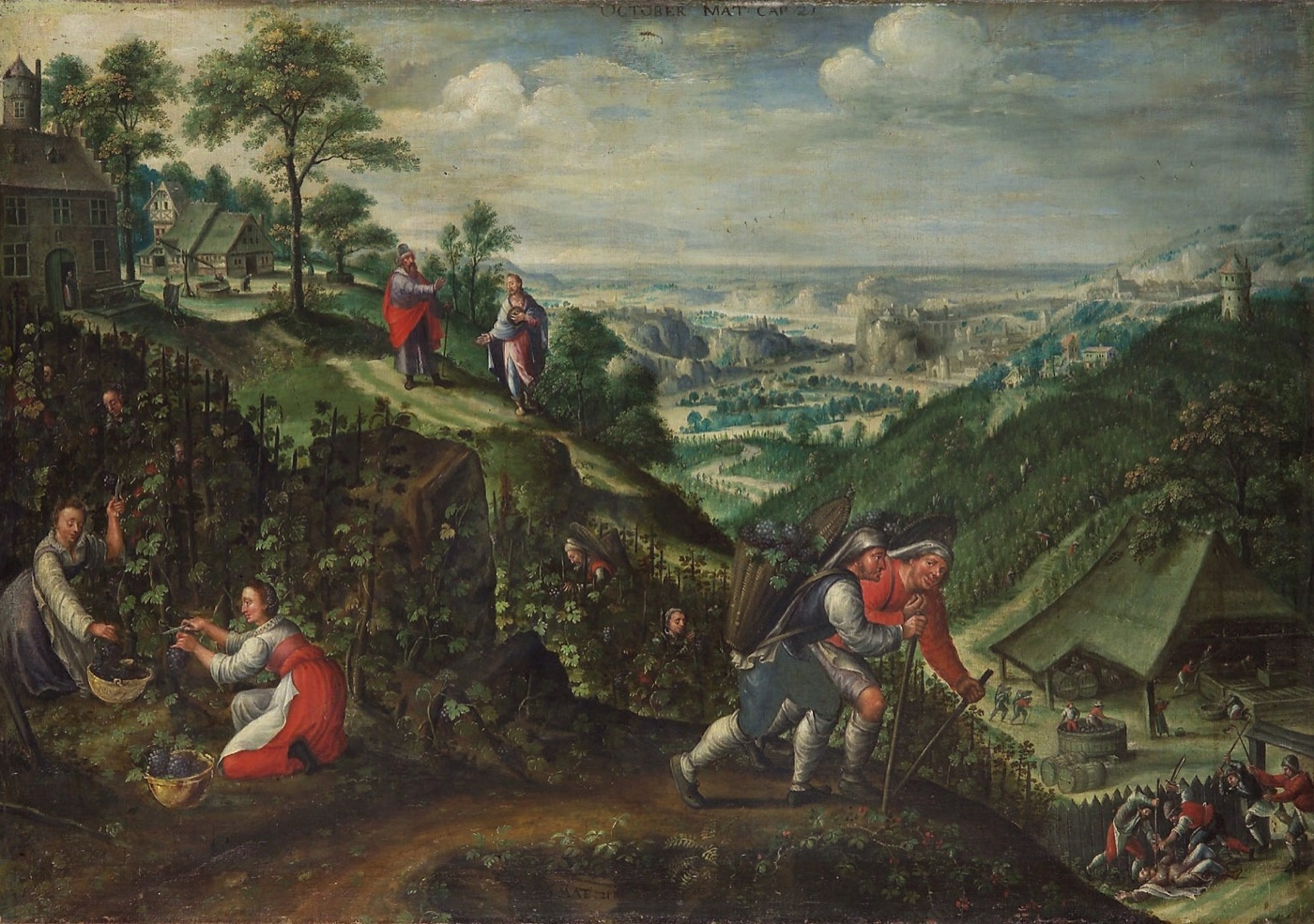
October, the season of the grape harvest. On the left, people are picking grapes; two men carry baskets full of grapes down the slope; on the right, under a shed, grapes are being trodden and put into barrels. In the lower right corner, by the fence, several men with raised clubs surround a man lying on the ground. Across the top of the painting is written ‘OCTOBER MAT CAP 21’ (October, Matthew chapter 21). In the whole painting, which part do you see first?
Marten van Valckenborch, Parable of the Wicked Husbandmen (October), c. 1580–1590, oil painting, Kunsthistorisches Museum, Vienna, Austria. Public domain. Wikimedia CommonsRead TogetherMatt 21:33-46
33“Hear another parable. There was a man who was a master of a household who planted a vineyard, set a hedge about it, dug a wine press in it, built a tower, leased it out to farmers, and went into another country.
34When the season for the fruit came near, he sent his servants to the farmers to receive his fruit.
35The farmers took his servants, beat one, killed another, and stoned another.
36Again, he sent other servants more than the first; and they treated them the same way.
37But afterward he sent to them his son, saying, ‘They will respect my son.’
38But the farmers, when they saw the son, said among themselves, ‘This is the heir. Come, let’s kill him and seize his inheritance.’
39So they took him and threw him out of the vineyard, then killed him.
40When therefore the lord of the vineyard comes, what will he do to those farmers?”
41They told him, “He will miserably destroy those miserable men, and will lease out the vineyard to other farmers who will give him the fruit in its season.”
42Jesus said to them, “Did you never read in the Scriptures, ‘The stone which the builders rejected was made the head of the corner. This was from the Lord. It is marvelous in our eyes’?
43“Therefore I tell you, God’s Kingdom will be taken away from you and will be given to a nation producing its fruit.
44He who falls on this stone will be broken to pieces, but on whomever it will fall, it will scatter him as dust.”
45When the chief priests and the Pharisees heard his parables, they perceived that he spoke about them.
46When they sought to seize him, they feared the multitudes, because they considered him to be a prophet.
The Setting
Who was there. It is a few days before Jesus was crucified, in the temple. As Jesus was teaching, the chief priests and the elders of the people came to him and said, “By what authority do you do these things? Who gave you this authority?” (v. 23). Jesus first asked them in return where John’s baptism came from (vv. 24–27), then told the parable of the two sons (vv. 28–32), and then said, “Hear another parable” (v. 33). And when it was over: “When the chief priests and the Pharisees heard his parables, they perceived that he spoke about them” (v. 45).
An old song. Adam Clarke points out where the parable comes from:
Our Lord takes this parable from Isaiah 5:1, etc.
Adam Clarke, Commentary on the Bible, on Matt 21:33.
That chapter is a song about a vineyard. The owner “dug it up, gathered out its stones, planted it with the choicest vine, built a tower in the middle of it, and also cut out a wine press in it” (Isa 5:2), and the song says plainly, “the vineyard of the LORD of Armies is the house of Israel” (Isa 5:7). The listeners were chief priests and elders who knew the Scriptures well; from the opening words they knew whom the vineyard meant.
Put the two stories side by side, and one thing is different. In Isaiah the trouble is with the vineyard: “He looked for it to yield grapes, but it yielded wild grapes” (Isa 5:2). In Jesus’ parable, nothing is said about the vineyard failing to bear: “the season for the fruit came near” (v. 34). The trouble is with the farmers who looked after it.
Collecting the fruit. Clarke explains that this follows the old way of paying rent:
Alluding to the ancient custom of paying the rent of a farm in kind; that is, by a part of the produce of the farm.
Adam Clarke, Commentary on the Bible, on Matt 21:34.
So when the owner sent his servants, they went to collect the share that was already owed.
The Three Gospels
All three Gospels record this parable, each in its own way:
| Matthew | Mark | Luke | |
|---|---|---|---|
| What happens to the servants | “beat one, killed another, and stoned another” (Matt 21:35); later ones, “other servants more than the first” (Matt 21:36) | sent one at a time, then “many others, beating some, and killing some” (Mark 12:5) | all three servants are beaten, “sent him away empty” (Luke 20:10) |
| The son | “he sent to them his son” (Matt 21:37) | “still having one, his beloved son” (Mark 12:6) | “I will send my beloved son” (Luke 20:13) |
| How he is killed | “threw him out of the vineyard, then killed him” (Matt 21:39) | “killed him, and cast him out of the vineyard” (Mark 12:8) | “threw him out of the vineyard and killed him” (Luke 20:15) |
| Who states the ending | the hearers themselves: “He will miserably destroy those miserable men” (Matt 21:41) | Jesus: “He will come and destroy the farmers” (Mark 12:9) | Jesus says it, and the hearers answer, “May that never be!” (Luke 20:16) |
| ‘God’s Kingdom will be taken away from you’ | yes (Matt 21:43) | no | no |
Mark and Luke both say ‘beloved son’: the last one the owner sent was the one he loved most. Who states the ending differs in the three Gospels. Clarke noticed this too:
But Luke relates it differently: according to him, they said μη γενοιτο, God forbid!
Adam Clarke, Commentary on the Bible, on Matt 21:41.
What Matthew records is this: the hearers pass judgment on the farmers themselves, and only then find that the parable was about them (v. 45).
Explanation
What do we see? The master of the household did a great deal for this vineyard: he planted it, set a hedge about it, dug a wine press and built a tower (v. 33). Then he leased it out and “went into another country” (v. 33). The vineyard was his; the farmers were only renting it.
When the season for the fruit came, he sent his servants, and they were beaten and killed (v. 35). He sent more servants, “and they treated them the same way” (v. 36). Last of all he sent his own son, thinking, “They will respect my son” (v. 37).
The farmers knew who he was: “This is the heir” (v. 38). They killed him precisely because they knew him: “Come, let’s kill him and seize his inheritance” (v. 38).
If I had been there. The chief priests and elders had just asked Jesus, “Who gave you this authority?” (v. 23). Jesus did not answer directly; he told a story about an owner who sent his son.
Jesus asked, “what will he do to those farmers?” (v. 40), and they answered quickly (v. 41). Then Jesus quoted Psalm 118: “The stone which the builders rejected was made the head of the corner” (v. 42). Only then “they perceived that he spoke about them” (v. 45). They “sought to seize him” (v. 46). What the farmers in the parable wanted to do, the listeners wanted to do on the spot.
What is God like? The owner sends people again and again (vv. 34, 36, 37). After they are beaten and killed, he still sends more, and at last he sends his own son.
Adam Clarke says of the son in the parable:
This requires no comment. Our Lord plainly means himself.
Adam Clarke, Commentary on the Bible, on Matt 21:37.
Matthew Henry points readers to Hebrews:
out of the holy city for he was crucified without the gate, Heb. xiii. 12
Matthew Henry, Commentary on the Whole Bible, Vol. V, on Matt 21:33-46.
Hebrews says that Jesus, “that he might sanctify the people through his own blood, suffered outside of the gate” (Heb 13:12). In the parable, the farmers “threw him out of the vineyard, then killed him” (v. 39). A few days after Jesus told this parable, he was crucified on a cross outside the city.
The stone that was rejected became the head of the corner. The psalm Jesus quoted goes on: “This was from the Lord. It is marvelous in our eyes” (v. 42).
What does this mean for me? This parable was told to the chief priests and Pharisees, and they heard it for themselves (v. 45). Matthew Henry says the farmers are they and their leaders, and that what convicts them is a caution to everyone who enjoys the privileges of the church:
they and their leaders are the husbandmen here
what is spoken for conviction to them, is spoken for caution to all that enjoy the privileges of the visible church, not to be high-minded, but fear
Matthew Henry, Commentary on the Whole Bible, Vol. V, on Matt 21:33-46.
The vineyard did not belong to the farmers; it was leased to them. What the owner wants is not the vineyard but farmers “who will give him the fruit in its season” (v. 41). When we read this parable, the easiest thing is to pass judgment on others, as the hearers did that day (v. 41). The hard thing is to ask ourselves first: whose vineyard am I looking after? When the season for the fruit comes, will I have fruit to give?
Different Views
The three commentators below are English: Matthew Henry (1662–1714), John Gill (1697–1771) and Adam Clarke (c. 1760–1832). Each is quoted in his own words, with the source after each quotation.
What the text itself says (all three follow this): The farmers are aimed at the chief priests and Pharisees (v. 45); the owner’s son is killed, and the rejected stone becomes the head of the corner (vv. 39, 42). The three questions below are places the text does not spell out, where readers through the centuries have differed.
1. The hedge, the wine press, the tower: what does each stand for?
The covenant of circumcision and the ceremonial law were a hedge or a wall of partition about the Jewish church
The altar of burnt-offerings was the wine-press, to which all the offerings were brought.
Matthew Henry, Commentary on the Whole Bible, Vol. V, on Matt 21:33-46.
By this "hedge" is designed, either the law…or else the protection of them by the power of God, which was an hedge about them, is here intended
John Gill, Exposition of the Entire Bible, on Matt 21:33.
Clarke gives his own reading. He also lists readings that apply these things to the Christian church, and then adds:
The fence - the Divine protection. The wine-press - the law and sacrificial rites. The tower - the temple, in which the Divine presence was manifested.
But this parable cannot go on all fours in the Christian cause, as any one may see.
Adam Clarke, Commentary on the Bible, on Matt 21:33.
How to read it: All three readings are of one kind — this is an allegorical reading: finding a counterpart for every item. The hedge, Henry says, is circumcision and the ceremonial law; Gill says the law or God’s protection; Clarke says God’s protection. The wine press is the altar of burnt offering for one, the law and the sacrifices for another. When Jesus told the parable, he did not mention the hedge, the wine press or the tower again; he went on to speak of farmers, servants, a son and fruit (vv. 34–43). Taken together, these things say that the owner had done everything for his vineyard, just as the song in Isaiah asks: “What could have been done more to my vineyard, that I have not done in it?” (Isa 5:4).
2. ‘More than the first’: more in number, or more honorable?
their number was greater, though their office was the same, at least not higher
John Gill, Exposition of the Entire Bible, on Matt 21:36.
Clarke argues for ‘more honorable’, and adds that the King James rendering, ‘more than the first’, says nothing at all:
More than the first - Or, more honorable, so I think πλειονας should be translated; for, as the fullness of the time approached, each prophet more clearly and fully pointed out the coming of Christ.
Our translation, which says, more than the first, conveys no meaning at all.
Adam Clarke, Commentary on the Bible, on Matt 21:36.
Henry takes it as ‘more’, and counts John the Baptist and Jesus’ disciples among these later servants:
He sent other servants, more than the first; though the first sped not, but were abused. He had sent them John the Baptist, and him they had beheaded; and yet he sent them his disciples, to prepare his way.
Matthew Henry, Commentary on the Whole Bible, Vol. V, on Matt 21:33-46.
How to read it: The World English Bible reads “other servants more than the first” (v. 36). Henry and Gill take it as ‘more’; Clarke argues for ‘more honorable’; Gill and Clarke say exactly opposite things. Whichever reading you take, the three see the same thing: the owner did not stop because the earlier servants were beaten and killed. Each time he sent more, or someone of greater weight, and at last he sent his son (v. 37).
3. Who is ‘a nation producing its fruit’?
Jesus says, “God’s Kingdom will be taken away from you and will be given to a nation producing its fruit” (v. 43).
He will give it ethnei—to the Gentile world, that will bring forth the fruit of it.
Matthew Henry, Commentary on the Whole Bible, Vol. V, on Matt 21:33-46.
he gives it to another "nation"; to the Gentiles, to all the nations of the world
for not one particular nation is meant, unless the nation of God's elect, among all nations, can be thought to be designed.
John Gill, Exposition of the Entire Bible, on Matt 21:43.
the Gospel shall be taken from you, and given to the Gentiles, who will receive it, and bring forth fruit to the glory of God.
Adam Clarke, Commentary on the Bible, on Matt 21:43.
All three read it as the Gentiles; Gill reads it more broadly: God’s elect among all nations. The text itself says three things. This saying was spoken to the chief priests and Pharisees, who “perceived that he spoke about them” (v. 45). The mark of this nation is that it is “producing its fruit” (v. 43). And Thayer’s lexicon lists the Greek word here under the sense ‘race, nation’, not under the plural sense ‘Gentiles’; the singular ‘a nation’ fits well with what Gill calls the ‘nation’ of God’s elect among all nations.
3. race, nation: Matthew 21:43
4. (τά ἔθνη, like הַגויִם in the O. T., foreign nations not worshipping the true God, pagans, Gentiles
Thayer’s Greek-English Lexicon of the New Testament, G1484.
How this saying bears on the place of the people of Israel from now on is something Paul discusses in Romans: “did God reject his people? May it never be!” (Rom 11:1); and to Gentile believers he says, “Don’t be conceited, but fear” (Rom 11:20). Churches understand this question in different ways. Please ask the church you belong to.
Key Word
“The stone which the builders rejected” (v. 42). In Greek, ‘rejected’ is a single word.
Thayer’s Greek lexicon explains it as to disapprove, to reject, to repudiate. He points the reader to δοκιμάζω, which means to test or examine a thing to see whether it is genuine, and also, after examining it, to recognize it as genuine, that is, to approve it. The builders’ rejecting was not a failure to notice this stone: they looked at it, measured it, and judged it unfit for use.
to disapprove, reject, repudiate: Matthew 21:42; Mark 8:31; Mark 12:10; Luke 9:22; Luke 17:25; Luke 20:17; 1 Peter 2:4, 7
ἀποδοκιμάζω: (see δοκιμάζω)
to test, examine, prove, scrutinize (to see whether a thing be genuine or not)
to recognize as genuine after examination, to approve, deem worthy
Thayer’s Greek-English Lexicon of the New Testament, G593, G1381.
Among the verses Thayer lists under this word are Jesus’ own words foretelling his suffering: to “be rejected by the elders, the chief priests, and the scribes” (Mark 8:31), and to “be rejected by this generation” (Luke 17:25). There the word is the same as in ‘the stone which the builders rejected’. Peter, writing later, puts the two together: “a living stone, rejected indeed by men, but chosen by God, precious” (1 Pet 2:4).
Think It Through
There are no right answers and no scores. Write your answers down; they are for you alone.
- The hearers were quick to pass judgment on the farmers (v. 41), and only later found the parable was about them (v. 45). Have you ever been through something like this: seeing someone else’s fault first, and only later seeing the same thing in yourself?
- The vineyard was leased; it did not belong to the farmers. Of the things in your care (time, family, work, gifts), which do you often treat as your own?
- The owner sent people again and again. Over the years, whom has God sent to remind you? How did you treat them?
- Look at Valckenborch’s painting again: on the same hillside, some are harvesting grapes and some are beating a man. If you were in this painting, where would you be?
This Week
Think of one thing you have always treated as ‘mine’: some money, some time, a gift, a position. This week, spend one minute each day placing it before God, and say: ‘This is yours; I am only its steward.’
If someone gives you a reminder or a word of advice this week, do not rush to defend yourself first. Say, ‘Thank you for telling me.’
At the end of the week, ask yourself: this week, what fruit did I give?
Further Reading
- Matthew Henry, Commentary on the Whole Bible, Vol. V: Matt 21:33-46 (public domain; free to read in full at CCEL)
- R. T. France, Matthew (Tyndale New Testament Commentaries): Matt 21:33-46
- Klyne R. Snodgrass, Stories with Intent: the chapter on the wicked tenants
More in This UnitUnit 4 · Invitation and Refusal
- The Barren Fig Tree Luke 13:1-9
- The Two Sons Matt 21:23-32
- The Wicked Tenants Matt 21:33-46 This lesson
- The Wedding Feast Matt 22:1-14
- The Great Banquet Luke 14:15-24
Scripture: World English Bible (public domain). The commentators in ‘Different Views’ are quoted in their own words from the English originals (public domain).