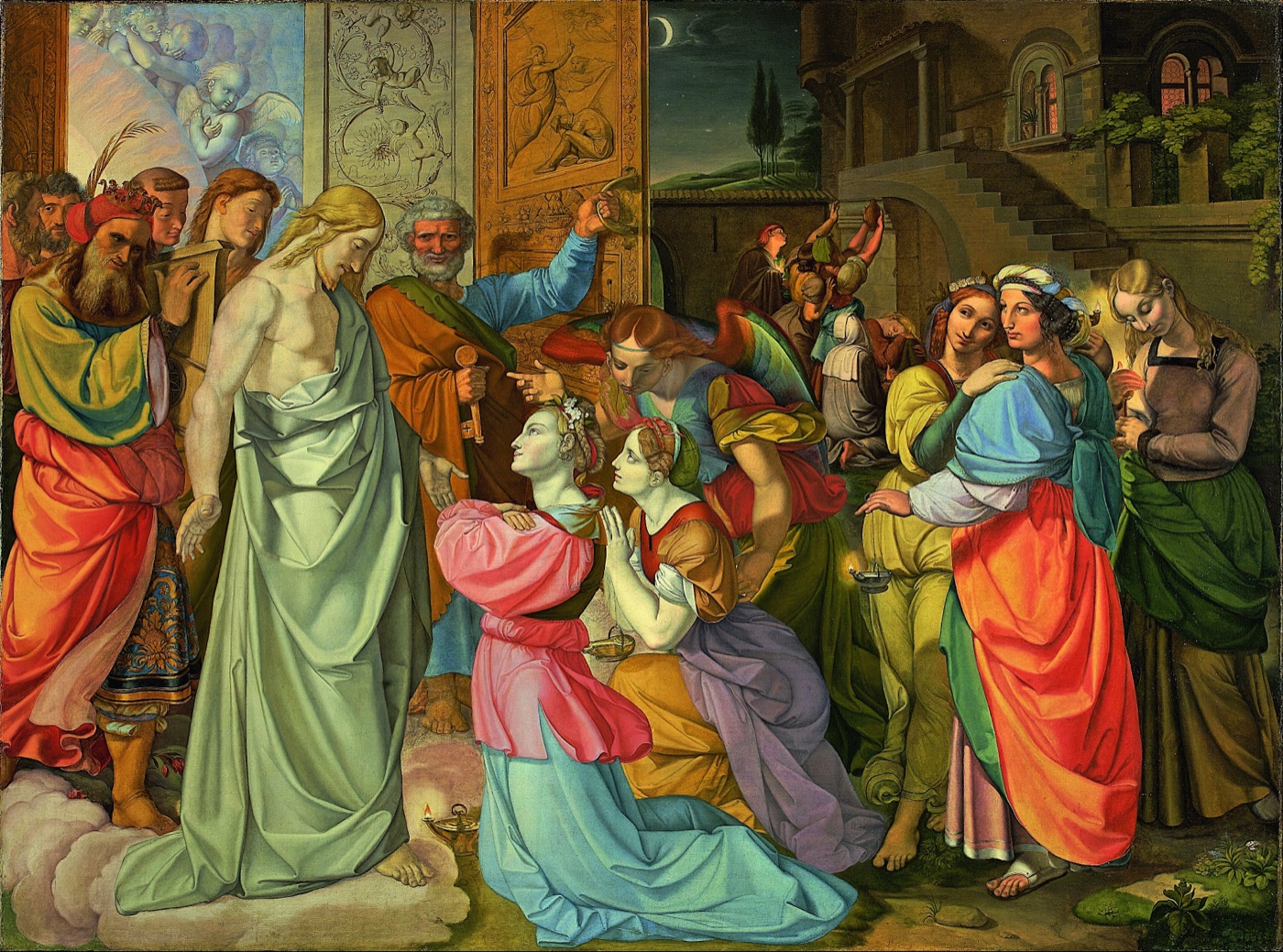
A great door is about to close. Beside it stands a figure in a long robe; an old man holds a key in one hand and the door knocker in the other. In front of the door two women kneel, looking up into the doorway; to the right, several women crowd together, one bending over the small lamp in her hands to shield it. A crescent moon hangs in the sky: it is night. Whom has the painter put inside the door, and whom outside?
Peter von Cornelius, The Parable of Wise and Foolish Virgins (unfinished), c. 1813–1816, oil painting, Museum Kunstpalast, Düsseldorf. Public domain. Wikimedia CommonsRead TogetherMatt 25:1-13
1“Then the Kingdom of Heaven will be like ten virgins who took their lamps and went out to meet the bridegroom.
2Five of them were foolish, and five were wise.
3Those who were foolish, when they took their lamps, took no oil with them,
4but the wise took oil in their vessels with their lamps.
5Now while the bridegroom delayed, they all slumbered and slept.
6But at midnight there was a cry, ‘Behold! The bridegroom is coming! Come out to meet him!’
7Then all those virgins arose, and trimmed their lamps.
8The foolish said to the wise, ‘Give us some of your oil, for our lamps are going out.’
9But the wise answered, saying, ‘What if there isn’t enough for us and you? You go rather to those who sell, and buy for yourselves.’
10While they went away to buy, the bridegroom came, and those who were ready went in with him to the wedding feast, and the door was shut.
11Afterward the other virgins also came, saying, ‘Lord, Lord, open to us.’
12But he answered, ‘Most certainly I tell you, I don’t know you.’
13Watch therefore, for you don’t know the day nor the hour in which the Son of Man is coming.
The Setting
Who was there. This is a few days before Jesus’ suffering, on the Mount of Olives. The disciples came to him privately and asked, “Tell us, when will these things be? What is the sign of your coming, and of the end of the age?” (Matt 24:3). Jesus said a great deal, and one sentence was: “no one knows of that day and hour, not even the angels of heaven, but my Father only” (Matt 24:36).
Several parables in a row. Then Jesus said, “Watch therefore, for you don’t know in what hour your Lord comes” (Matt 24:42), and told the parable of the faithful and wicked servants (Matt 24:45-51), the ten virgins, and the talents (Matt 25:14-30). The evil servant says in his heart, “My lord is delaying his coming” (Matt 24:48); the parable of the ten virgins says, “while the bridegroom delayed” (v. 5). Thayer’s Greek lexicon lists both places under the same word, ‘to delay, to tarry’.
to linger, delay, tarry: Matthew 25:5
followed by an infinitive, Matthew 24:48
Thayer’s Greek-English Lexicon of the New Testament, G5549.
Meeting the bridegroom at night. Matthew Henry describes a custom the Jews sometimes followed: late at night the bridegroom, with his friends, came to the bride’s house, and the young women attending the bride, hearing that he was near, went out with lamps to light him in. Adam Clarke also notes that Jewish weddings were usually held at night. So the lamps had to stay lit, and there had to be enough oil.
It was a custom sometimes used among the Jews on that occasion, that the bridegroom came, attended with his friends, late in the night, to the house of the bride
The Jewish weddings were generally celebrated in the night
Matthew Henry, Commentary on the Whole Bible, Vol. V, on Matt 25:1-13; Adam Clarke, Commentary on the Bible, on Matt 25:6.
The ten virgins side by side:
| The five foolish | The five wise | |
|---|---|---|
| At the start | “when they took their lamps, took no oil with them” (v. 3) | “took oil in their vessels with their lamps” (v. 4) |
| The bridegroom delays | “they all slumbered and slept” (v. 5) | “they all slumbered and slept” (v. 5) |
| The midnight cry | “arose, and trimmed their lamps” (v. 7), but “our lamps are going out” (v. 8) | “arose, and trimmed their lamps” (v. 7) |
| The outcome | go to buy oil, and on their return “the door was shut” (v. 10) | “went in with him to the wedding feast” (v. 10) |
All ten carry lamps, all go out to meet him, all fall asleep, all are woken. Only one thing differs: whether they brought oil.
Explanation
What do we see? The ten virgins look the same: they all carry lamps and all go out to meet the bridegroom (v. 1). The bridegroom is late, and “they all slumbered and slept” (v. 5). The wise sleep too, and the parable blames no one for it.
The difference only shows at midnight. When the cry comes, all ten get up and trim their lamps; the foolish find that “our lamps are going out” (v. 8). They ask the wise for oil, and the wise answer, “What if there isn’t enough for us and you?” (v. 9). Matthew Henry notices how the wise virgins answer:
These wise virgins do not upbraid the foolish with their neglect, nor boast of their own forecast, nor torment them with suggestions tending to despair, but give them the best advice the case will bear
Matthew Henry, Commentary on the Whole Bible, Vol. V, on Matt 25:1-13.
But going to buy oil takes time. “While they went away to buy, the bridegroom came” (v. 10).
If I had been there. The disciples had asked ‘when’ (Matt 24:3). Jesus did not give them a date; he told them how ten people waited. The last sentence of the parable answers their question: “you don’t know the day nor the hour” (v. 13). Because they do not know, they are to be ready.
For the word ‘wise’, Thayer’s lexicon gives ‘prudent, mindful of one’s interests’. Among the passages he lists are “a wise man who built his house on the rock” (Matt 7:24) and “the faithful and wise servant” (Matt 24:45). In Matthew’s Gospel these ‘wise’ people are all the same kind of person: they hear and do, and they stay faithful while the master is away.
prudent, i. e. mindful of one's interests: Matthew 10:16; Matthew 24:45; Luke 12:42; opposed to μωρός, Matthew 7:24
Thayer’s Greek-English Lexicon of the New Testament, G5429.
What is God like? The bridegroom may be delayed, but he will surely come: “at midnight there was a cry, ‘Behold! The bridegroom is coming!’” (v. 6). Matthew Henry puts it this way:
But though Christ tarry past our time, he will not tarry past the due time.
Matthew Henry, Commentary on the Whole Bible, Vol. V, on Matt 25:1-13.
After the door is shut, those outside say, “Lord, Lord, open to us” (v. 11), and what they hear is “I don’t know you” (v. 12). These are heavy words. At the end of the Sermon on the Mount Jesus also said, “Not everyone who says to me, ‘Lord, Lord,’ will enter into the Kingdom of Heaven, but he who does the will of my Father who is in heaven” (Matt 7:21), and there too is the sentence “I never knew you” (Matt 7:23). This parable does not ask us to guess who is outside the door. It asks us to be ready ourselves, now.
What does this mean for me? Oil cannot be borrowed, and it cannot be bought at the last minute. Matthew Henry says:
Getting grace is a work of time, and cannot be done in a hurry.
Matthew Henry, Commentary on the Whole Bible, Vol. V, on Matt 25:1-13.
All ten have lamps; from the outside you cannot tell who has oil. Whether there is oil is prepared in ordinary days, little by little.
Different Views
The three commentators below are English: Matthew Henry (1662–1714), John Gill (1697–1771) and Adam Clarke (c. 1760–1832). Each is quoted in his own words, with the source after each quotation.
What the text itself says (all three follow this): The difference between the ten virgins is whether they had prepared oil (vv. 3–4); “those who were ready went in with him to the wedding feast, and the door was shut” (v. 10); Jesus’ conclusion is “Watch therefore, for you don’t know the day nor the hour” (v. 13). The three questions below are places the text does not spell out, where readers through the centuries have differed.
1. What does the oil stand for?
The heart is the vessel, which it is our wisdom to get furnished
Grace is the oil which we must have in this vessel
Matthew Henry, Commentary on the Whole Bible, Vol. V, on Matt 25:1-13.
by oil is meant, not temporal blessings, nor spiritual ones, nor the Gospel, nor the gifts of the Spirit, all which are sometimes signified by oil; but either the Spirit of God himself
or the regenerating and sanctifying grace of the Spirit, even all the graces which are implanted by him in conversion
John Gill, Exposition of the Entire Bible, on Matt 25:3.
The oil, the grace and salvation of God, or that faith which works by love. The vessel, the heart in which this oil is contained. The lamp, the profession of enjoying the burning and shining light of the Gospel of Christ.
Adam Clarke, Commentary on the Bible, on Matt 25:1.
How to read it: What the three do here — this is an allegorical reading: finding a counterpart for each thing in the story. All three read the vessel as the heart and the oil as something inside it: Henry says grace, Gill says the Spirit or the Spirit’s grace, Clarke says grace, salvation or faith. Jesus himself does not say what the oil is. What he says is that those with oil are “those who were ready” (v. 10), and his conclusion is “Watch therefore, for you don’t know the day nor the hour” (v. 13). On one point the three readings agree: the lamp is what can be seen from outside, the oil is inside; the same on the outside, different within.
2. What does ‘they all slumbered and slept’ mean?
Henry reads it as slackness. He also mentions that most of the ancients, and Calvin, took it as death, and does not follow them:
They all slumbered and slept; as if they had given over looking for him
The wise virgins kept their lamps burning, but did not keep themselves awake.
The ancients generally understood the virgins' slumbering and sleeping of their dying
So Calvin. But I think it is rather to be taken as we have opened it.
Matthew Henry, Commentary on the Whole Bible, Vol. V, on Matt 25:1-13.
Clarke reads it as death:
As sleep is frequently used in the sacred writings for death, so drowsiness, which precedes sleep, may be considered as pointing out the decays of the constitution, and the sicknesses which precede death.
Adam Clarke, Commentary on the Bible, on Matt 25:5.
by this slumber, and sleep, is not meant a natural death
but a dead, lifeless, and sleepy frame of spirit in the wise virgins
John Gill, Exposition of the Entire Bible, on Matt 25:5.
How to read it: The three give exactly three readings: Henry says slackness, Clarke says death, Gill says spiritual drowsiness. What the text itself says is that “they all slumbered and slept” (v. 5), the wise as well, and the parable blames no one for sleeping; what divides them is whether they had oil. So the ‘watch’ of verse 13 is not only staying awake; it is being among “those who were ready” (v. 10).
3. The bridegroom delays: for how long, and what time does it point to?
The space of time here referred to, is either from the ascension of Christ, to his coming to take vengeance on the Jews; or from thence to his second coming
this interval of time seems to regard that period which is pointed out by the Laodicean church state, which will usher in the coming of Christ, and the last judgment
John Gill, Exposition of the Entire Bible, on Matt 25:5.
Clarke reads the coming in two ways, and adds that the parable seems to concern both the destruction of Jerusalem and the day of judgment:
The coming of the bridegroom to an individual may imply his death: his coming to the world - the final judgment. The delay - the time from a man's birth till his death, in the first case; in the second, the time from the beginning to the end of the world.
for the parable appears to relate to both those periods
Adam Clarke, Commentary on the Bible, on Matt 25:1, 5.
What we look for as certain, we are apt to think is very near; many in the apostles' times imagined that the day of the Lord was at hand, but it is not so.
Matthew Henry, Commentary on the Whole Bible, Vol. V, on Matt 25:1-13.
How to read it: How long the delay is, and which period it refers to, the three answer differently: Gill ties it to a period of church history; Clarke says it can mean a person’s lifetime, or the end of the world; Henry warns against thinking it is just at hand. The text itself says only one thing: “you don’t know the day nor the hour” (v. 13), and in the chapter before, Jesus also said “no one knows of that day and hour” (Matt 24:36). The time and order of the Lord’s return: churches understand this question in different ways. Please ask the church you belong to.
Key Word
The last sentence of the parable: “Watch therefore, for you don’t know the day nor the hour” (v. 13).
Thayer’s Greek lexicon explains that the word comes from ‘to have been roused from sleep, to be awake’, and first means to keep watch, to be awake; used figuratively, it means to give strict attention, to be cautious, to take heed lest through slackness and idleness some disaster suddenly overtake one. Among the passages he lists are Matthew 24:42 and Matthew 25:13.
from ἐγρήγορα, to have been roused from sleep, to be awake
Metaphorically, to watch i. e. give strict attention to, be cautious, active: — to take heed lest through remissness and indolence some destructive calamity suddenly overtake one, Matthew 24:42; Matthew 25:13
Thayer’s Greek-English Lexicon of the New Testament, G1127.
It is striking that in the parable all ten virgins fall asleep (v. 5), and still Jesus’ conclusion is ‘watch’. Watching here is not staying up all night; it is what Thayer calls not being slack: in ordinary days, having the oil ready. Paul urges the same: “let’s not sleep, as the rest do, but let’s watch and be sober” (1 Thess 5:6).
Think It Through
There are no right answers and no scores. Write your answers down; they are for you alone.
- From the outside, the ten virgins all look the same. In your faith, what is the ‘lamp’ (what others can see), and what is the ‘oil’ (what only God can see)?
- The bridegroom delayed, and all ten fell asleep. Have you had a time when you grew tired of waiting for God, and your faith, too, began to doze?
- The foolish hoped to borrow oil at the last minute. Is there something you keep putting off with ‘later’?
- Look at Cornelius’s painting again: the door is about to close, some kneel before it, some shield the small lamps in their hands. If you were in this painting, where would you be?
This Week
Each day this week, set aside ten minutes for nothing else but reading the Bible and praying — think of it as adding a little oil to the vessel.
Think of one thing to do with God that you keep putting off with ‘later’ (a reconciliation, a confession, a service you promised), and take the first step this week.
At the end of the week, ask yourself: this week, is there still oil in my lamp?
Further Reading
- Matthew Henry, Commentary on the Whole Bible, Vol. V: Matt 25:1-13 (public domain; free to read in full at CCEL)
- R. T. France, Matthew (Tyndale New Testament Commentaries): Matt 25:1-13
- Klyne R. Snodgrass, Stories with Intent: the chapter on the ten virgins
More in This UnitUnit 8 · The End of the Age
- The Budding Fig Tree Matt 24:32-35
- The Faithful and Wicked Servants Matt 24:45-51
- The Ten Virgins Matt 25:1-13 This lesson
- The Sheep and the Goats Matt 25:31-46
Scripture: World English Bible (public domain). The commentators in ‘Different Views’ are quoted in their own words from the English originals (public domain).