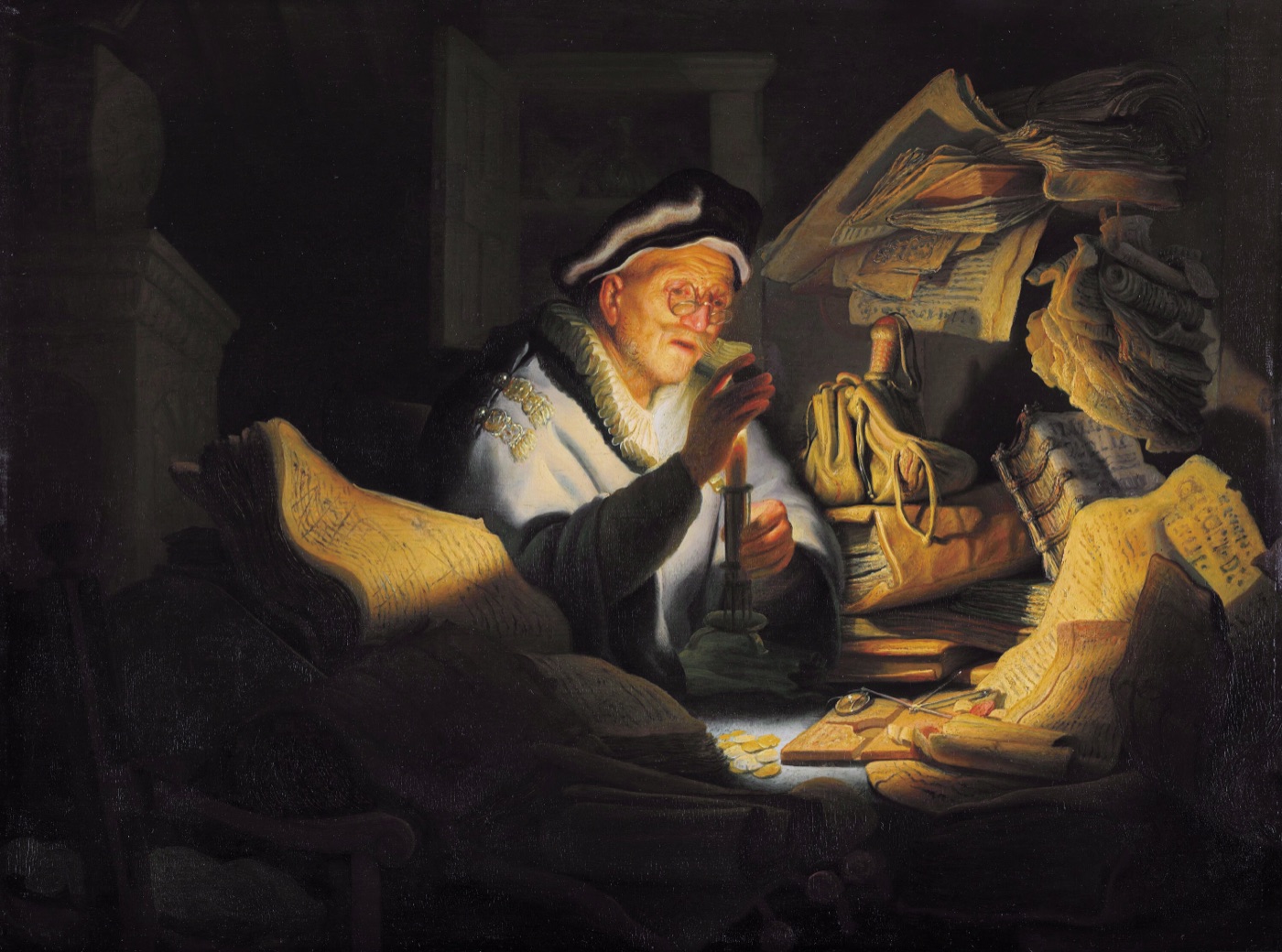
At night, an old man in spectacles sits among great piles of ledgers, papers and money bags. In one hand he holds up a candle, with the other he shades the light, and he leans close to look at something small in his hand, perhaps a coin. Gold coins lie scattered on the table, and beside them is a small pair of scales. All around him is dark. He is looking very carefully. What does he see? And what does he not see?
Rembrandt van Rijn, The Parable of the Rich Fool, 1627, oil on panel, Gemäldegalerie, Berlin. Public domain. Wikimedia CommonsRead TogetherLuke 12:13-21
13One of the multitude said to him, “Teacher, tell my brother to divide the inheritance with me.”
14But he said to him, “Man, who made me a judge or an arbitrator over you?”
15He said to them, “Beware! Keep yourselves from covetousness, for a man’s life doesn’t consist of the abundance of the things which he possesses.”
16He spoke a parable to them, saying, “The ground of a certain rich man produced abundantly.
17He reasoned within himself, saying, ‘What will I do, because I don’t have room to store my crops?’
18He said, ‘This is what I will do. I will pull down my barns, build bigger ones, and there I will store all my grain and my goods.
19I will tell my soul, “Soul, you have many goods laid up for many years. Take your ease, eat, drink, and be merry.”’
20“But God said to him, ‘You foolish one, tonight your soul is required of you. The things which you have prepared—whose will they be?’
21So is he who lays up treasure for himself, and is not rich toward God.”
The Setting
Who was there. A great crowd was around Jesus at this time: “a multitude of many thousands had gathered together” (Luke 12:1). “One of the multitude said to him, ‘Teacher, tell my brother to divide the inheritance with me’” (v. 13).
Dividing an inheritance. Under the law of Moses, the firstborn received a double share when the inheritance was divided: “by giving him a double portion of all that he has” (Deut 21:17). This man wanted Jesus to step in and make his brother divide it with him, so there was clearly a quarrel between the brothers over the family property.
Jesus does not take the case. Jesus said, “who made me a judge or an arbitrator over you?” (v. 14). Matthew Henry says this probably refers to how Moses was treated by his own people in Egypt, when one of them said to him, “Who made you a prince and a judge over us?” (Exod 2:14). Henry goes on to say that this shows the nature of Christ’s kingdom:
Probably he refers to the indignity done to Moses by his brethren in Egypt
It is a spiritual kingdom, and not of this world.
Matthew Henry, Commentary on the Whole Bible, Vol. V, on Luke 12:13-21.
The parable is told to the crowd. Jesus did not divide the inheritance for him. Instead he turned and “said to them, ‘Beware! Keep yourselves from covetousness’” (v. 15), and then told this parable.
What the rich man says, and what God says. Only two people speak in the parable: the rich man, and God. Side by side:
| The rich man to himself | God to him | |
|---|---|---|
| Whose are these things? | “I don’t have room to store my crops” (v. 17); “I will pull down my barns” (v. 18); “all my grain and my goods” (v. 18) | “The things which you have prepared—whose will they be?” (v. 20) |
| How long? | “many goods laid up for many years” (v. 19) | “tonight your soul is required of you” (v. 20) |
| The soul | “Soul, … Take your ease, eat, drink, and be merry” (v. 19) | “tonight your soul is required of you” (v. 20) |
The rich man keeps talking to himself: “He reasoned within himself” (v. 17), “I will tell my soul” (v. 19). There is no one else in his plans.
Explanation
What do we see? “The ground of a certain rich man produced abundantly” (v. 16). That is a good thing. His problem was having too much: “What will I do, because I don’t have room to store my crops?” (v. 17).
His plan was thorough: pull down the old barns, build bigger ones, store everything away, and then tell his soul it could rest (vv. 18–19). He thought far ahead, with ‘many years’ all planned out.
But he left one thing out. God said to him, “You foolish one, tonight your soul is required of you” (v. 20). He had counted on many years, and had not counted on tonight.
If I had been there. The man who came asking about the inheritance was thinking of ‘the share I am owed’. Jesus did not rule on who was right, but he warned the crowd: “Keep yourselves from covetousness” (v. 15). This parable is not told only for rich people. The man quarrelling with his brother over the family property was listening too.
What is God like? God speaks only once in this parable, yet that one sentence is the turning point. The rich man says ‘my’; God asks, “The things which you have prepared—whose will they be?” (v. 20). The rich man thought the goods were his, and the days were his too; God shows him that neither was in his hands.
God calls him “You foolish one” (v. 20). Thayer’s lexicon explains this word as without reason: senseless, foolish, thoughtless, acting rashly, and notes that it is a strong term.
properly, without reason
senseless, foolish, stupid; without reflection or intelligence, acting rashly: Luke 11:40; Luke 12:20
A strong term
Thayer’s Greek-English Lexicon of the New Testament, G878.
Matthew Henry points out one thing the rich man left out when he made his plans: the words ‘If the Lord wills’. James says the same: “For you ought to say, ‘If the Lord wills, we will both live, and do this or that’” (Jas 4:15).
without so much as that necessary proviso, If the Lord will, I shall live, Jam. iv. 13-15.
Matthew Henry, Commentary on the Whole Bible, Vol. V, on Luke 12:13-21.
What does this mean for me? Jesus said, “a man’s life doesn’t consist of the abundance of the things which he possesses” (v. 15). The parable ends: “So is he who lays up treasure for himself, and is not rich toward God” (v. 21).
Jesus then told his disciples not to be anxious about food and clothing (vv. 22–30), and said, “For where your treasure is, there will your heart be also” (v. 34). The rich man’s treasure was in his barns, and so was his heart.
Reading this parable, you might start by counting: lately, when I say ‘my’, what am I talking about? And tonight, whose will those things be?
Different Views
The three commentators below are English: Matthew Henry (1662–1714), John Gill (1697–1771) and Adam Clarke (c. 1760–1832). Each is quoted in his own words, with the source after each quotation.
What the text itself says (all three follow this): Jesus told this parable so that the crowd would “Keep yourselves from covetousness” (v. 15). God calls the rich man “You foolish one” (v. 20), because he “lays up treasure for himself, and is not rich toward God” (v. 21). The three questions below are places the text does not spell out, where readers through the centuries have differed.
1. Was the man asking about the inheritance wronged, or did he want more?
Under the law the firstborn received a double portion, but here the elder brother seems to have wanted to keep it all:
the elder brother here, it seems, was for keeping all, and would not divide any part to his younger brother
John Gill, Exposition of the Entire Bible, on Luke 12:13.
It is likely the person complained of in the text was the elder brother; and he wished to keep the whole to himself - a case which is far from being uncommon.
Adam Clarke, Commentary on the Bible, on Luke 12:13.
He sets out both possibilities: that the brother had wronged him, or that he wanted to wrong his brother, hoping Jesus would set aside the firstborn’s double portion so that the two would share equally. Henry says which he suspects, and why:
Some think that his brother did him wrong, and that he appealed to Christ to right him, because he knew the law was costly.
Others think that he had a mind to do his brother wrong, and would have Christ to assist him
I suspect that this was the case, because Christ takes occasion from it to warn against covetousness
It was not a lawful desire of getting his own, but a sinful desire of getting more than his own.
Matthew Henry, Commentary on the Whole Bible, Vol. V, on Luke 12:13-21.
How to read it: The text does not say who was right, and Jesus did not rule on it. He said, “who made me a judge or an arbitrator over you?” (v. 14), and then warned the crowd, “Keep yourselves from covetousness” (v. 15). Whether this man had been wronged or wanted more, Jesus turned the conversation from ‘how much am I owed’ to ‘my heart’.
2. What did the rich man do wrong? Is being rich itself the problem?
He calls a good harvest a great blessing, though one that can become a snare to the wicked. The rich man’s first folly, he says, was calling the harvest ‘my’ fruits and ‘my’ goods, when all we have is only lent to us:
The fruitfulness of the earth is a great blessing, but it is a blessing which God often gives plentifully to wicked men, to whom it is a snare
It was folly for him to call the fruits of the ground his fruits and his goods.
whereas what we have is but lent us for our use, the property is still in God; we are but stewards of our Lord's goods
Matthew Henry, Commentary on the Whole Bible, Vol. V, on Luke 12:13-21.
The rich man gave no thought to God as the source of all he had, and none to the poor, whose empty houses could have held much of it:
he did not think of God, or that there was one, and much less that he was the author, of all his outward prosperity and plenty
not thinking of the empty bellies, barns, and houses of the poor, where he might have stowed much.
John Gill, Exposition of the Entire Bible, on Luke 12:17.
He takes a heavier view of riches themselves:
Riches, though ever so well acquired, produce nothing but vexation and embarrassment.
Moderate poverty, as one justly observes, is a great talent in order to salvation; but it is one which nobody desires.
Adam Clarke, Commentary on the Bible, on Luke 12:17, 19.
How to read it: All three agree the rich man was wrong; they differ in where they put the weight. Henry says his error was treating God’s things as ‘mine’, Gill says he had no room in his heart for God or for the poor, and Clarke is the most wary of riches themselves. What the text itself says is that he “lays up treasure for himself, and is not rich toward God” (v. 21); of the good harvest itself, the text says nothing bad (v. 16). Paul’s charge to the rich does not tell them to become poor either: “Charge those who are rich in this present age that they not be arrogant, nor have their hope set on the uncertainty of riches, but on the living God, who richly provides us with everything to enjoy; that they do good, that they be rich in good works, that they be ready to distribute, willing to share” (1 Tim 6:17-18).
3. What does it mean to be ‘rich toward God’?
rich in the account of God, whose accounting us rich makes us so (Rev. ii. 9), rich in the things of God, rich in faith (Jam. ii. 5), rich in good works
Matthew Henry, Commentary on the Whole Bible, Vol. V, on Luke 12:13-21.
one that is rich towards God, acknowledges that he receives all his riches from God
he gives up all into the hands of God, depends upon his providence for the increase, security, and continuance of it; and uses it to his honour and glory
John Gill, Exposition of the Entire Bible, on Luke 12:21.
He comes at it from the other side, from what it means to lay up treasure ‘for himself’:
This is the essential characteristic of a covetous man: he desires riches; he gets them; he lays them up, not for the necessary uses to which they might be devoted, but for himself
Adam Clarke, Commentary on the Bible, on Luke 12:21.
How to read it: Each of the three speaks to one side of it: Henry to faith and good works, Gill to owning that everything comes from God and putting it in God’s hands, Clarke to laying up riches ‘for himself’. Later in the same chapter, Jesus himself shows one picture of being rich toward God: “Make for yourselves purses which don’t grow old, a treasure in the heavens that doesn’t fail” (v. 33). It is worth noticing that verse 21 speaks of one “who lays up treasure for himself” (v. 21), and later Jesus says, “Make for yourselves purses which don’t grow old” (v. 33). Both are ‘for yourself’; what differs is where the treasure is kept.
Key Word
Jesus said, “Beware! Keep yourselves from covetousness” (v. 15).
Thayer’s Greek lexicon explains the word as the greedy desire to have more. The first verse he lists is Luke 12:15, and Colossians is among them too: “covetousness, which is idolatry” (Col 3:5).
greedy desire to have more, covetousness, avarice: Luke 12:15; Romans 1:29; Ephesians 4:19; Ephesians 5:3; Colossians 3:5
Thayer’s Greek-English Lexicon of the New Testament, G4124.
In his note on verse 15, Adam Clarke takes the word apart, and describes a heart that is never satisfied. Matthew Henry, too, describes it as wanting more than God has given us.
Πλεονεξιας, from πλειον, more, and εχειν, to have; the desire to have more and more, let a person possess whatever he may. Such a disposition of mind is never satisfied; for, as soon as one object is gained, the heart goes out after another.
a desire of having more, more than God in his providence has allotted us
Adam Clarke, Commentary on the Bible, on Luke 12:15; Matthew Henry, Commentary on the Whole Bible, Vol. V, on Luke 12:13-21.
Covetousness is not only wanting what belongs to someone else. The rich man did not steal or rob. He only wanted ‘more’, and kept all of that ‘more’ for himself.
Think It Through
There are no right answers and no scores. Write your answers down; they are for you alone.
- The rich man said ‘my’ again and again (vv. 17–19). What do you often call ‘mine’ these days? Time, money, a house, children, reputation?
- The rich man’s plan was thorough, but he never said ‘If the Lord wills’ (Jas 4:15). Is God part of the plan you care about most right now?
- Is there an ‘after …, then I can rest’ in your heart? What is that ‘after’?
- Look at Rembrandt’s painting again: the old man holds up the candle and leans close to what is in his hand, with darkness all around. If you stood behind him, what would you want to say to him?
This Week
Find something you have always treated as ‘mine’ (a sum of money, a possession, a stretch of time), and this week give part of it to someone in need, or use it in God’s house. It need not be much, but make it specific.
Each day this week, before you go out, say one sentence: ‘If the Lord wills, today I will …’
At the end of the week, ask yourself: this week, where was my heart?
Further Reading
- Matthew Henry, Commentary on the Whole Bible, Vol. V: Luke 12:13-21 (public domain; free to read in full at CCEL)
- Leon Morris, Luke (Tyndale New Testament Commentaries): Luke 12:13-21
- Klyne R. Snodgrass, Stories with Intent: the chapter on the rich fool
More in This UnitUnit 6 · Money
- The Rich Fool Luke 12:16-21 This lesson
- The Shrewd Manager Luke 16:1-13
- The Rich Man and Lazarus Luke 16:19-31
- The Talents Matt 25:14-30
- The Minas Luke 19:11-27
Scripture: World English Bible (public domain). The commentators in ‘Different Views’ are quoted in their own words from the English originals (public domain).