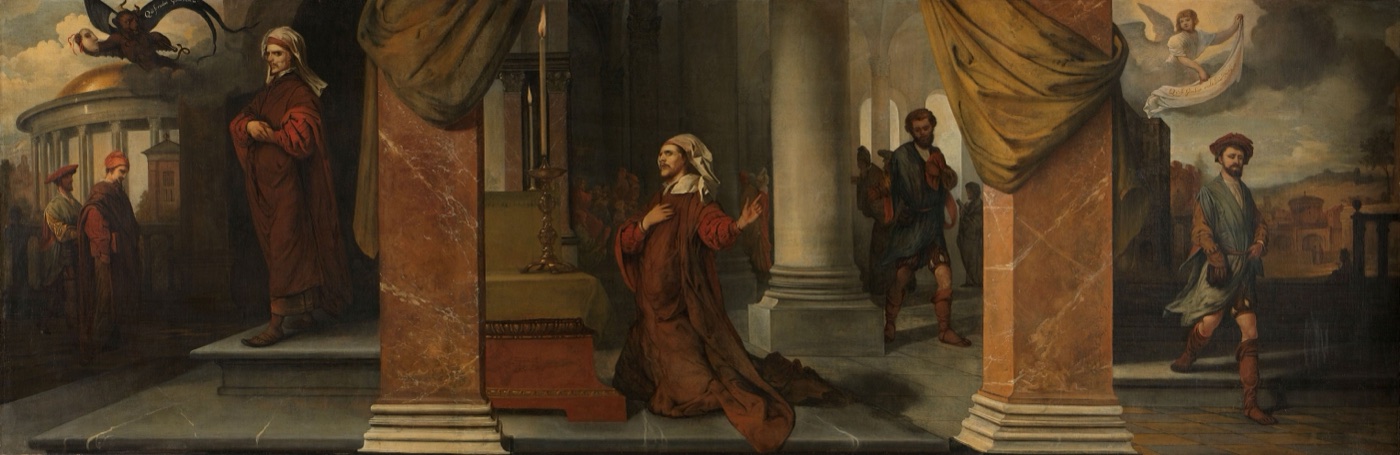
A wide temple, cut into sections by marble columns. In the middle a man kneels before the altar, head raised, one hand open; on the steps to the left stands a man in a red robe, arms crossed over his chest; to the right, behind a column, a man bows his head with one hand on his chest; at the far right, someone is walking out of the temple. In the top left corner is a dark winged figure, in the top right an angel, each holding a banner with writing on it. The painting does not say who is the Pharisee and who is the tax collector. How would you tell? What are you going by?
Barent Fabritius, The Pharisee and the Tax Collector (De Farizeeër en de tollenaar), 1661, oil painting, Rijksmuseum, Amsterdam. Public domain. Wikimedia CommonsRead TogetherLuke 18:9-14
9He also spoke this parable to certain people who were convinced of their own righteousness, and who despised all others:
10“Two men went up into the temple to pray; one was a Pharisee, and the other was a tax collector.
11The Pharisee stood and prayed by himself like this: ‘God, I thank you that I am not like the rest of men: extortionists, unrighteous, adulterers, or even like this tax collector.
12I fast twice a week. I give tithes of all that I get.’
13But the tax collector, standing far away, wouldn’t even lift up his eyes to heaven, but beat his chest, saying, ‘God, be merciful to me, a sinner!’
14I tell you, this man went down to his house justified rather than the other; for everyone who exalts himself will be humbled, but he who humbles himself will be exalted.”
The Setting
Who it was told to. Before the parable, Luke says who it is for: “He also spoke this parable to certain people who were convinced of their own righteousness, and who despised all others” (v. 9). Before the story begins, the listeners already know whom it is aimed at.
Two kinds of men. The Pharisees were the group who kept the law most carefully in those days. Tax collectors collected taxes for Rome, and ordinary people put them in the same class as sinners: the Pharisees and scribes once asked Jesus’ disciples, “Why do you eat and drink with the tax collectors and sinners?” (Luke 5:30). One was a good man in everyone’s eyes; the other was a sinner in everyone’s eyes.
Up to the temple. Both men “went up into the temple to pray” (v. 10), and afterwards the tax collector “went down to his house justified” (v. 14). Gill explains the ‘down’: the temple stood on a mountain.
went down to his house; from the temple which was built on a mountain
John Gill, Exposition of the Entire Bible, on Luke 18:14.
A tenth. The law of Moses told the people, “You shall surely tithe all the increase of your seed, that which comes out of the field year by year” (Deut 14:22). This Pharisee says, “I give tithes of all that I get” (v. 12). Gill notes that this goes beyond anything the law or the tradition asked of him:
but of every thing he had, which was not required by either of them
John Gill, Exposition of the Entire Bible, on Luke 18:12.
The two prayers side by side:
| The Pharisee | The tax collector | |
|---|---|---|
| Where he stands | “The Pharisee stood and prayed” (v. 11) | “standing far away” (v. 13) |
| His eyes | the text does not say | “wouldn’t even lift up his eyes to heaven” (v. 13) |
| About himself | “I am not like the rest of men” (v. 11); “I fast twice a week” (v. 12) | “to me, a sinner” (v. 13) |
| About others | “or even like this tax collector” (v. 11) | mentions no one else |
| What he asks for | asks for nothing | “God, be merciful to me, a sinner!” (v. 13) |
In the Pharisee’s words there is “God, I thank you” (v. 11), and a long string of ‘I’, but not one request. The tax collector says only one sentence, and it is a request.
Explanation
What do we see? The things the Pharisee lists are probably all true: he is not an extortioner, not unrighteous, not an adulterer; he fasts twice a week and gives a tenth of all he gets (vv. 11–12). He also knows to thank God: “God, I thank you” (v. 11).
But his thanks quickly turn into comparison: “I am not like the rest of men … or even like this tax collector” (v. 11). He can see the tax collector, yet he seems not to see that God is looking at him.
The tax collector mentions nothing good he has done. He only asks: “God, be merciful to me, a sinner!” (v. 13).
Jesus’ conclusion: “this man went down to his house justified rather than the other” (v. 14).
If I had been there. Jesus told this parable to “certain people who were convinced of their own righteousness, and who despised all others” (v. 9). Hearing the Pharisee’s part, they would probably nod: here is a good man. Only at the end do they find that the one declared righteous is the tax collector.
Two things in this parable belong together: being ‘convinced of their own righteousness’ and having ‘despised all others’ (v. 9). The better a person thinks he is, the easier it is to look down on others.
What is God like? The tax collector does not dare to lift his eyes, does not dare to come near, and only asks for mercy; yet God declares him righteous (vv. 13–14). God does not look at who says more or does more, but at who knows he needs mercy.
The Old Testament already said so: “O God, you will not despise a broken and contrite heart” (Ps 51:17). What Jesus says here, “everyone who exalts himself will be humbled, but he who humbles himself will be exalted” (v. 14), he also said elsewhere (Luke 14:11; Matt 23:12).
What does this mean for me? Reading this parable, the easiest thing is to take the tax collector’s side at once, and then say in our hearts: ‘God, I thank you that I am not like this Pharisee.’ The moment we say that, we have become the Pharisee in the parable.
This parable does not ask us to work out who is a Pharisee. It asks us to stand before God ourselves and say the tax collector’s sentence: “God, be merciful to me, a sinner!” (v. 13).
Different Views
The three commentators below are English: Matthew Henry (1662–1714), John Gill (1697–1771) and Adam Clarke (c. 1760–1832). Each is quoted in his own words, with the source after each quotation.
What the text itself says (all three follow this): This parable is aimed at “certain people who were convinced of their own righteousness, and who despised all others” (v. 9); the one who goes home justified is the tax collector who asked for mercy (vv. 13–14). The three questions below are places the text does not spell out, where readers through the centuries have differed.
1. Was the Pharisee telling the truth? Where did he go wrong?
Henry takes the good things the Pharisee says as true and praiseworthy. Where he goes wrong: his thanks are only a formality; he boasts, and leans on these things as his own righteousness; and he asks for nothing.
A great many good things he said of himself, which we will suppose to be true.
Now all this was very well and commendable.
Here is not one word of prayer in all he saith.
Matthew Henry, Commentary on the Whole Bible, Vol. V, on Luke 18:9-14.
Clarke warns against making the Pharisee worse than he was, since he gives God the credit for his good. His problem is that he does not seek atonement:
How many of those called Christians are not half as good as this Pharisee! And, yet, he was far from the kingdom of God.
but let us not make them worse than they were - for this is disclaimed by the Pharisee in the text, who attributes all the good he had to God
restraining grace must not be put in the place of the great atonement
Adam Clarke, Commentary on the Bible, on Luke 18:11, 13.
Gill judges him more severely:
and yet he was as other men, and no better
he thanks God, in order to exalt himself, and places his righteousness in his own works
John Gill, Exposition of the Entire Bible, on Luke 18:11.
How to read it: Henry and Clarke both grant that the good things he names may be true; Gill says he was no better than other men. The faults all three see come back to the two things in verse 9: being convinced of his own righteousness, and despising others. His problem is not the fasting or the giving; those are good things. His problem is that he stands before God on them, and uses them to look down on others.
2. What does ‘be merciful to me’ mean?
For Henry, the tax collector is asking for mercy, forgiveness and reconciliation:
O God, be merciful, be propitious, to me; forgive my sins; be reconciled to me; take me into thy favour
Matthew Henry, Commentary on the Whole Bible, Vol. V, on Luke 18:9-14.
Clarke connects the Greek word with sacrifice and atonement:
Be propitious toward me through sacrifice - or, let an atonement be made for me.
often signifies to make expiation for sin
Adam Clarke, Commentary on the Bible, on Luke 18:13.
to show mercy to him, through the propitiary sacrifice of the Messiah
John Gill, Exposition of the Entire Bible, on Luke 18:13.
All three say this is a plea for mercy and forgiveness; Gill and Clarke also connect it with the sacrifice of atonement. Thayer’s lexicon lists the word in verse 13 under the sense ‘be gracious, be merciful’; for the other use of the same word, ‘make atonement’, he lists Hebrews 2:17: “to make atonement for the sins of the people” (Heb 2:17).
be propitious, be gracious, be merciful
to expiate, make propitiation for (as ἐξιλάσκεσθαι in the O. T.): τάς ἁμαρτίας, Hebrews 2:17
Thayer’s Greek-English Lexicon of the New Testament, G2433.
When the tax collector said this in the temple, he was probably not thinking of the letter to the Hebrews. But where the mercy he asked for comes from, the later New Testament makes very clear. Reading this verse, start by learning his one sentence: no conditions, only a plea for mercy.
3. Standing far away, not lifting his eyes, beating his chest: does posture matter?
Gill points out that standing was itself a posture of prayer, and the text does not fault the Pharisee for it:
Standing was a praying posture; See Gill on Matthew 6:5 nor is this observed, as if it was something amiss
John Gill, Exposition of the Entire Bible, on Luke 18:11.
On the tax collector’s lowered eyes:
A sign of deep distress.
Of a consciousness and confession of guilt.
It was the very posture that the Jewish rabbins required in those who prayed to God.
So the Pharisee appears to have forgotten one of his own precepts.
Adam Clarke, Commentary on the Bible, on Luke 18:13.
his gesture, when he addressed himself to his devotions, was expressive of great seriousness and humility, and the proper clothing of a broken, penitent, and obedient heart
Matthew Henry, Commentary on the Whole Bible, Vol. V, on Luke 18:9-14.
How to read it: Both men stood (vv. 11, 13). All three say the tax collector’s gestures show outwardly what was in his heart: Henry calls them its ‘clothing’, Clarke a ‘sign’. The text itself does not say which posture God accepts. What Jesus judges them by is what verses 9 and 14 say: one was among those “convinced of their own righteousness” (v. 9); of the other, Jesus says “he who humbles himself will be exalted” (v. 14). A person can kneel and still trust in himself; a person can stand and still be broken. What matters is not how we stand before God, but who we think we are before him.
Key Word
Jesus says the tax collector “went down to his house justified rather than the other” (v. 14). ‘Justified’ is one Greek word, δικαιόω; the form in verse 14, δεδικαιωμένος, is passive: it is not something he achieved, but something declared over him.
Thayer’s Greek lexicon explains that one main meaning of the word is to declare or pronounce someone righteous. Under this meaning he lists two places where people justify themselves: the lawyer, “desiring to justify himself” (Luke 10:29), and the Pharisees, “You are those who justify yourselves in the sight of men” (Luke 16:15).
to declare, pronounce, one to be just, righteous, or such as he ought to be
ἑαυτόν, Luke 10:29
ἑαυτόν, Luke 16:15
Thayer’s Greek-English Lexicon of the New Testament, G1344.
He also adds a note on this very parable:
Luke 18:14 teaches that a man δικαιοῦται by deep sorrow for his sins, which so humbles him that he hopes for salvation only from divine grace.
Thayer’s Greek-English Lexicon of the New Testament, G1344.
The Pharisee wanted to declare himself righteous, and he did not go home justified; the tax collector only asked for mercy, and went home justified by God. Later Paul speaks of God in the same way: “him who justifies the ungodly” (Rom 4:5).
Think It Through
There are no right answers and no scores. Write your answers down; they are for you alone.
- The Pharisee says, “I am not like the rest of men” (v. 11). Is there a sentence in your heart that goes ‘At least I’m not like …’? Who comes after it?
- The last time you prayed, what did you say most: thanks, what you had done, or requests?
- If you were to pray to God in one sentence, as the tax collector did, what would you say?
- Look at Fabritius’s painting again: whom did you first take to be the Pharisee, and whom the tax collector? What were you going by? How is that judgment connected with this parable?
This Week
Each day this week, find a quiet moment and pray only the tax collector’s sentence: “God, be merciful to me, a sinner!” (v. 13). Then be quiet for a minute.
If this week you catch yourself saying in your heart ‘At least I’m not like him’, stop, and pray one sentence for that person.
At the end of the week, ask yourself: this week, before God, did I stand near, or far away?
Further Reading
- Matthew Henry, Commentary on the Whole Bible, Vol. V: Luke 18:9-14 (public domain; free to read in full at CCEL)
- Leon Morris, Luke (Tyndale New Testament Commentaries): Luke 18:9-14
- Klyne R. Snodgrass, Stories with Intent: the chapter on the Pharisee and the tax collector
More in This UnitUnit 7 · God and Prayer
- The Friend at Midnight Luke 11:5-13
- The Widow and the Unjust Judge Luke 18:1-8
- The Pharisee and the Tax Collector Luke 18:9-14 This lesson
Scripture: World English Bible (public domain). The commentators in ‘Different Views’ are quoted in their own words from the English originals (public domain).