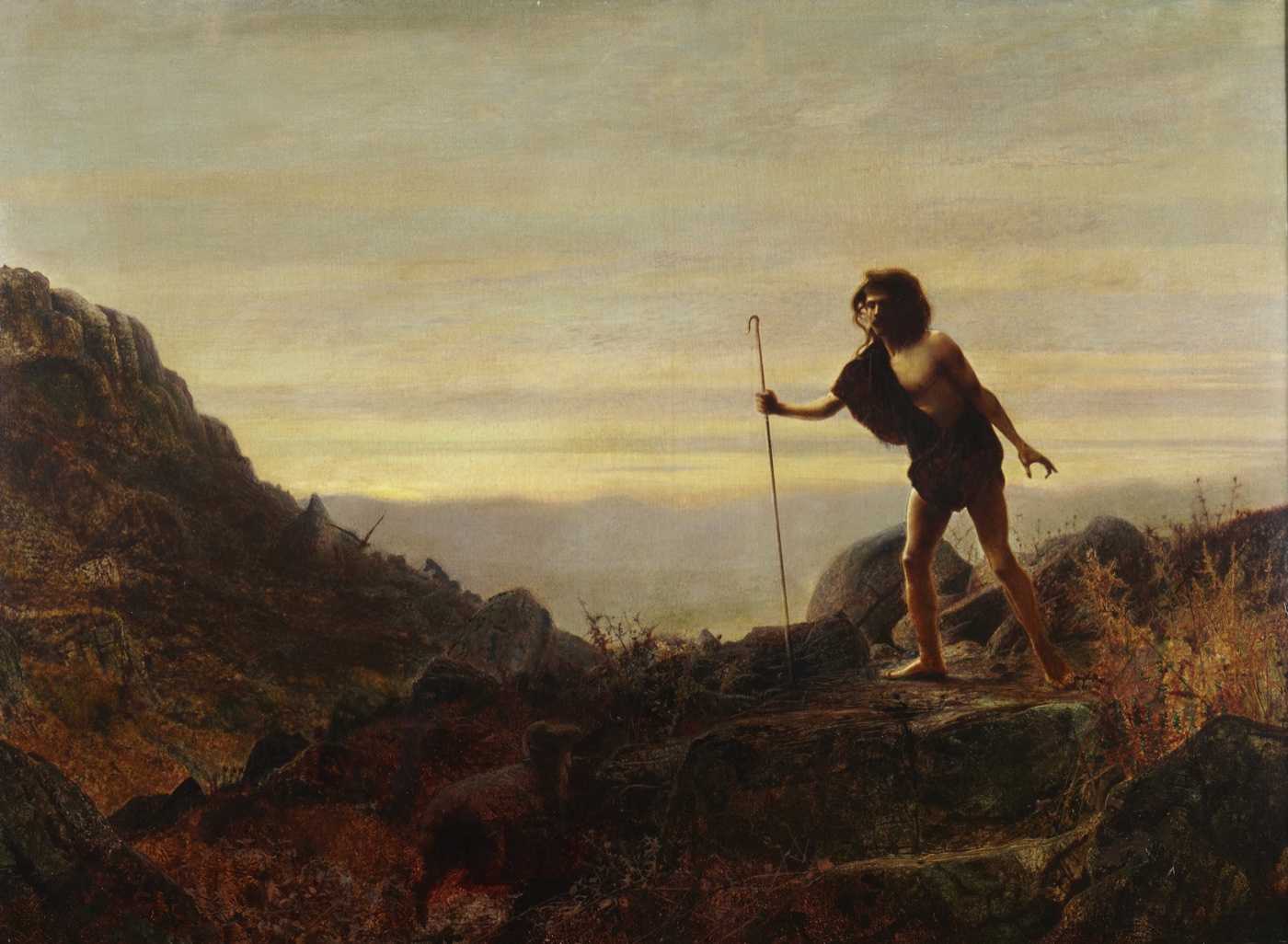
天色昏黄,荒山上满是乱石和枯草。一个牧人光着脚,拄着杖,站在石头上,弯着身子往远处张望,一只手伸出去,像在叫唤。左下方的暗处,有一团看不清的黑影——是石头,还是那只走失的羊?牧人还在找。
约翰·阿特金森·格里姆肖(John Atkinson Grimshaw,1836–1893)《迷羊的比喻》(The Parable of the Lost Sheep),1860 年代末,油画,美国普林斯顿大学美术馆藏。公有领域。 Wikimedia Commons一起读路 15:1-7
1众税吏和罪人都挨近耶稣,要听他讲道。
2法利赛人和文士私下议论说:“这个人接待罪人,又同他们吃饭。”
3耶稣就用比喻说:
4“你们中间谁有一百只羊失去一只,不把这九十九只撇在旷野,去找那失去的羊,直到找着呢?
5找着了,就欢欢喜喜地扛在肩上,回到家里,
6就请朋友邻舍来,对他们说:‘我失去的羊已经找着了,你们和我一同欢喜吧!’
7我告诉你们,一个罪人悔改,在天上也要这样为他欢喜,较比为九十九个不用悔改的义人欢喜更大。”
当时现场
谁在场。 这一章开头,围着耶稣的有两群人:「众税吏和罪人都挨近耶稣,要听他讲道」(1 节);「法利赛人和文士私下议论」,说的是「这个人接待罪人,又同他们吃饭」(2 节)。迷羊是耶稣对这句议论讲的第一个比喻,接着是失钱(8–10 节)和浪子回头(11–32 节)。
为什么讲。 吉尔说,耶稣用这个比喻“为自己与罪人来往辩护”:“如果一个有一百只羊的人,失了一只,撇下其余的,去找那一只直到找着,是对的;那么基督所做的也是对的。”
John Gill, Exposition of the Entire Bible,路 15:4。译自英文原著。
看英文原文
for if it was right for an owner of an hundred sheep, when he had lost one of them, to leave all the rest, and go in search after that one till he had found it; then it was right in Christ to do what he did.
羊自己回不来。 克拉克说:“没有一种动物比羊更容易走散,更不留神;一旦走失了,也没有一种动物比羊更找不到回羊群的路。”他还说,走失的羊“会咩咩叫着找羊群,却一直往羊群相反的方向跑——这是我常常看见的”。马亨利也说,迷了路的羊“自己找不到回羊圈的路”。
Adam Clarke, Commentary on the Bible,路 15:4;Matthew Henry, Commentary on the Whole Bible, Vol. V,路 15:1-10。译自英文原著。
看英文原文
No creature strays more easily than a sheep; none is more heedless; and none so incapable of finding its way back to the flock, when once gone astray
it will bleat for the flock, and still run on in an opposite direction to the place where the flock is: this I have often noticed
he cannot of himself find the way back to the fold.
三卷福音书对照
这个比喻马太、路加都记了,讲给不同的人听:
| 马太 | 路加 | |
|---|---|---|
| 讲给谁听 | 门徒问「天国里谁是最大的」(太 18:1) | 法利赛人和文士议论「这个人接待罪人」(路 15:2) |
| 羊怎么了 | 「一只走迷了路」(太 18:12) | 「失去一只」(路 15:4) |
| 九十九只 | 撇下这九十九只,「往山里去找」(太 18:12) | 「把这九十九只撇在旷野」(路 15:4) |
| 找着以后 | 「他为这一只羊欢喜」(太 18:13) | 「欢欢喜喜地扛在肩上」,请朋友邻舍来(路 15:5-6) |
| 结论 | 「你们在天上的父,也是这样不愿意这小子里失丧一个」(太 18:14) | 「一个罪人悔改,在天上也要这样为他欢喜」(路 15:7) |
马亨利说:在马太那里,这个比喻是要显明“神怎样看顾保守圣徒”,所以门徒不可绊倒他们;在路加这里,是要显明“神怎样喜悦罪人归正”,所以我们也该一同欢喜。吉尔认为,这个比喻“我们的主讲过两次,是在两个不同的场合”。
Matthew Henry, Commentary on the Whole Bible, Vol. V,路 15:1-10;John Gill, Exposition of the Entire Bible,太 18:13。译自英文原著。
看英文原文
There it was designed to show the care God takes for the preservation of saints, as a reason why we should not offend them; here it is designed to show the pleasure God takes in the conversion of sinners, as a reason why we should rejoice in it.
it seems to me that this parable was twice delivered by our Lord, and that on two different occasions
“失去”和“走迷”,原文也是两个词。Thayer 的希腊文辞典注明:路加 15:4 用的是“失去的”,马太 18:12 用的是“走迷的”。
Thayer's Greek-English Lexicon of the New Testament,G622。译自英文原著。
看英文原文
Used of sheep, straying from the flock: properly, Luke 15:4 (τό ἀπολωλός, in Matthew 18:12 τό πλανώμενον)
讲解
看见什么。 耶稣一开口就问听的人:「你们中间谁有一百只羊失去一只……」(4 节)他是请他们自己判断:换了你,你会不会去找?
牧人去找,「直到找着」(4 节)。找着了,他没有责备羊,也没有赶着它走回来,而是「欢欢喜喜地扛在肩上」(5 节)。回到家,他请朋友邻舍来一同欢喜(6 节)。
马亨利留意到一个小地方:牧人说「我失去的羊」(6 节)。“他叫它‘我的羊’,虽然它是一只走散了、四处乱跑的羊。”
Matthew Henry, Commentary on the Whole Bible, Vol. V,路 15:1-10。译自英文原著。
看英文原文
Observe, he calls it his sheep, though a stray, a wandering sheep.
如果我在场。 税吏和罪人听见的,是有一个牧人走进旷野找他们。法利赛人和文士听见的,是有人请他们一同欢喜:「你们和我一同欢喜吧」(6 节)。他们刚刚还在议论:「这个人接待罪人」(2 节)。
马亨利说,牧人们从来不会唱“和我一同欢喜吧,我一只羊也没有失去”。
Matthew Henry, Commentary on the Whole Bible, Vol. V,路 15:1-10。译自英文原著。
看英文原文
whereas they never sung, Rejoice with me, for I have lost none.
神是怎样的神。 羊走失了,是羊自己的事;可是去找的,是牧人。旧约早有这样的应许:「主耶和华如此说:看哪,我必亲自寻找我的羊,将他们寻见」(结 34:11)。耶稣后来也说:「人子来,为要寻找拯救失丧的人」(路 19:10)。
牧人把羊扛在肩上。马亨利说,这“表明他用能力扶持、背负他们;他扛在肩上的,永不会灭亡”。
Matthew Henry, Commentary on the Whole Bible, Vol. V,路 15:1-10。译自英文原著。
看英文原文
here he is said to bear them upon his shoulders, denoting the power wherewith he supports and bears them up; those can never perish whom he carries upon his shoulders.
和我有什么关系。 「我们都如羊走迷,各人偏行己路」(赛 53:6)。读这个比喻,先认出自己是那只羊:不是自己找回来的,是被找回来、被扛回来的。
然后,再看看身边。也许有人正像那只羊,离群很久了。耶稣问的是:「你们中间谁……不……去找」(4 节)?
不同的看见
下面三位都是英国的解经家:马亨利(1662–1714)、吉尔(1697–1771)、克拉克(约 1760–1832)。各段都译自英文原著,出处附在后面。
经文自己说的(三家都照这个讲): 这个比喻是回答法利赛人和文士的议论(2–3 节);牧人去找那失去的羊,直到找着,并且请人一同欢喜(4–6 节);一个罪人悔改,天上也这样欢喜(7 节)。下面两处,是经文没有讲明、历代读法不同的地方。
一、九十九个“不用悔改的义人”,是谁?
不是天使,也不是已经蒙恩的人,“而是那些看起来是义人、或自以为是义人的”:“那些因基督接待罪人而发怨言的文士和法利赛人,就是这九十九个义人。”
John Gill, Exposition of the Entire Bible,路 15:7。译自英文原著。
看英文原文
rather therefore, such who seem to be just, or are so in their own opinion, are here meant
the Scribes and Pharisees, that murmured at Christ's receiving sinners, are the ninety and nine just persons
指生活规矩的人:他们“不需要像这些人那样改变心意和方向——他们没有那样放荡,也不能为自己从没犯过的罪悔改”。他又说:“有些人认为,我们的主说的九十九个义人是指天使;这个看法不必急着否定。”
Adam Clarke, Commentary on the Bible,路 15:7。译自英文原著。
看英文原文
Who do not require such a change of mind and purpose as these do - who are not so profligate, and cannot repent of sins they have never committed.
There are some, and their opinion need not be hastily rejected, who imagine that by the ninety and nine just persons, our Lord means the angels
他把比喻推到救赎上时说:“有一个圣天使的世界,就像那九十九只羊,是一群高贵的羊;神却差他的儿子来寻找拯救失丧的人。”
Matthew Henry, Commentary on the Whole Bible, Vol. V,路 15:1-10。译自英文原著。
看英文原文
There is a world of holy angels that are as the ninety-nine sheep, a noble flock
怎么看: 吉尔说是自以为义的法利赛人,克拉克说是生活规矩的人,马亨利在推到救赎时说是天使。经文自己说的:这个比喻是对着法利赛人和文士的议论讲的(2 节)。耶稣没有说这九十九个是谁,只说为一个悔改的罪人,天上的欢喜“更大”(7 节)。同一章的浪子回头,结尾也停在一个“不用悔改”的大儿子身上——这一问,可以留给每一个觉得自己“不用悔改”的读者。
二、“不愿意这小子里失丧一个”:是神的定旨,还是神的心愿?
马太记这个比喻的结尾是:「你们在天上的父,也是这样不愿意这小子里失丧一个」(太 18:14)。
这是“神不改变的旨意和定旨:这些小子,就是最小的一个,也不会永远灭亡”。
John Gill, Exposition of the Entire Bible,太 18:14。译自英文原著。
看英文原文
it is his unalterable will of purpose, or his unchangeable decree, that not one of them, even the meanest, shall perish eternally
“如果有哪个灵魂终于失丧,不是因为神的旨意或计划不要他得救,也不是因为没有为他预备得救的路,而是因为光虽然来到世间,他却爱黑暗过于爱光,因为他舍不得自己的恶行。”
Adam Clarke, Commentary on the Bible,太 18:14。译自英文原著。
看英文原文
If any soul be finally lost, it is not because God's will or counsel was against its salvation, or that a proper provision had not been made for it; but that, though light came into the world, it preferred darkness to light, because of its attachment to its evil deeds.
“这里隐含的比说出来的多。神不愿意有一人灭亡,而且,他愿意这些小子得救。”他又说:“神不但关心他整个羊群,也关心属于他的每一只小羊、每一只羊。”
Matthew Henry, Commentary on the Whole Bible, Vol. V,太 18:10-14。译自英文原著。
看英文原文
More is implied than is expressed. It is not his will that any should perish, but, 1. It is his will, that these little ones should be saved
God is graciously concerned, not only for his flock in general, but for every lamb, or sheep, that belongs to it.
怎么看: 三家都同意,天父不愿意一个小子失丧。不同在于:吉尔读作神的定旨,蒙拣选的一个也不会灭亡;克拉克读作神的心愿,人若失丧,是人自己不要;马亨利两样都讲。神的旨意和人的选择怎样放在一起理解、信徒会不会终于失丧,这一问,各教会的理解不尽相同,请向你所在的教会请教。
原文词眼
牧人说「我失去的羊已经找着了」(6 节)。
Thayer 的希腊文辞典解释,这个词有两组意思:一组是“毁灭,灭亡”;另一组是“失去”。他在“失去”下面列的第一组经文,就是路 15:4、8、9:失去的羊,失落的钱。
Thayer's Greek-English Lexicon of the New Testament,G622。译自英文原著。
看英文原文
to destroy i. e. to lose
properly: Matthew 10:42; Mark 9:41 (τόν μισθόν αὐτοῦ); Luke 15:4, 8, 9
他又说,旧约把以色列比作羊群;那些“被宗教教师撇下、没有人引导、四处流离”的百姓,被称为“以色列家迷失的羊”;“基督把他们从罪恶里领回来,就好比牧人”,所以经上说「人子来,为要寻找拯救失丧的人」(路 19:10)。
Thayer's Greek-English Lexicon of the New Testament,G622。译自英文原著。
看英文原文
the Jews, neglected by their religious teachers, left to themselves and thereby in danger of losing eternal salvation, wandering about as it were without guidance
and Christ, reclaiming them from wickedness, is likened to a shepherd and is said ζητεῖν καί σῴζειν τό ἀπολωλός: Luke 19:10
“失去”和“灭亡”是同一个词。羊走失了,若没有人去找,就会灭亡。牧人去找,是把它从“灭亡”里找回来。
请思考
没有标准答案,不打分。写下来,只给自己看。
- 你有没有过一段像那只羊的日子:走着走着,离群了,自己也找不到回来的路?后来是怎么回来的?
- 牧人是「欢欢喜喜地扛在肩上」(5 节),不是骂着赶回来。你想到神怎样对待走失的你,脑子里的画面是哪一种?
- 九十九只和那一只,你这些日子比较像哪一边?
- 再看一次格里姆肖的画:牧人光着脚站在乱石上找,左下方的暗处那团黑影,看不清是石头还是羊。你会怎样形容那只还没被找着的羊?它知不知道有人在找它?
这周去做
想一个已经很久没来聚会、或者离开信仰的人。这周用他的名字为他祷告一次。
如果合适,给他发一句问候,不提他为什么不来,只说“想起你”。
周末问自己:这一周,我是在旷野里找羊,还是在家里议论?
延伸参考
- Matthew Henry, Commentary on the Whole Bible, Vol. V:路 15:1-10、太 18:10-14(英文原著,公有领域,CCEL 可免费读全文)
- 莫理斯(Leon Morris)著,丁道尔新约注释《路加福音》:路 15:1-7
- 施诺格拉斯《主耶稣的比喻》:迷羊一章
本单元其它比喻单元二 · 失丧与寻找
- 迷羊 路 15:3-7 本课
- 失钱 路 15:8-10
- 浪子回头 路 15:11-32
- 好牧人 约 10:1-18 即将上线
经文:和合本(1919),用字按本站规则现代化。“不同的看见”里的注释都译自英文原著(公有领域),每段可展开看英文原文。