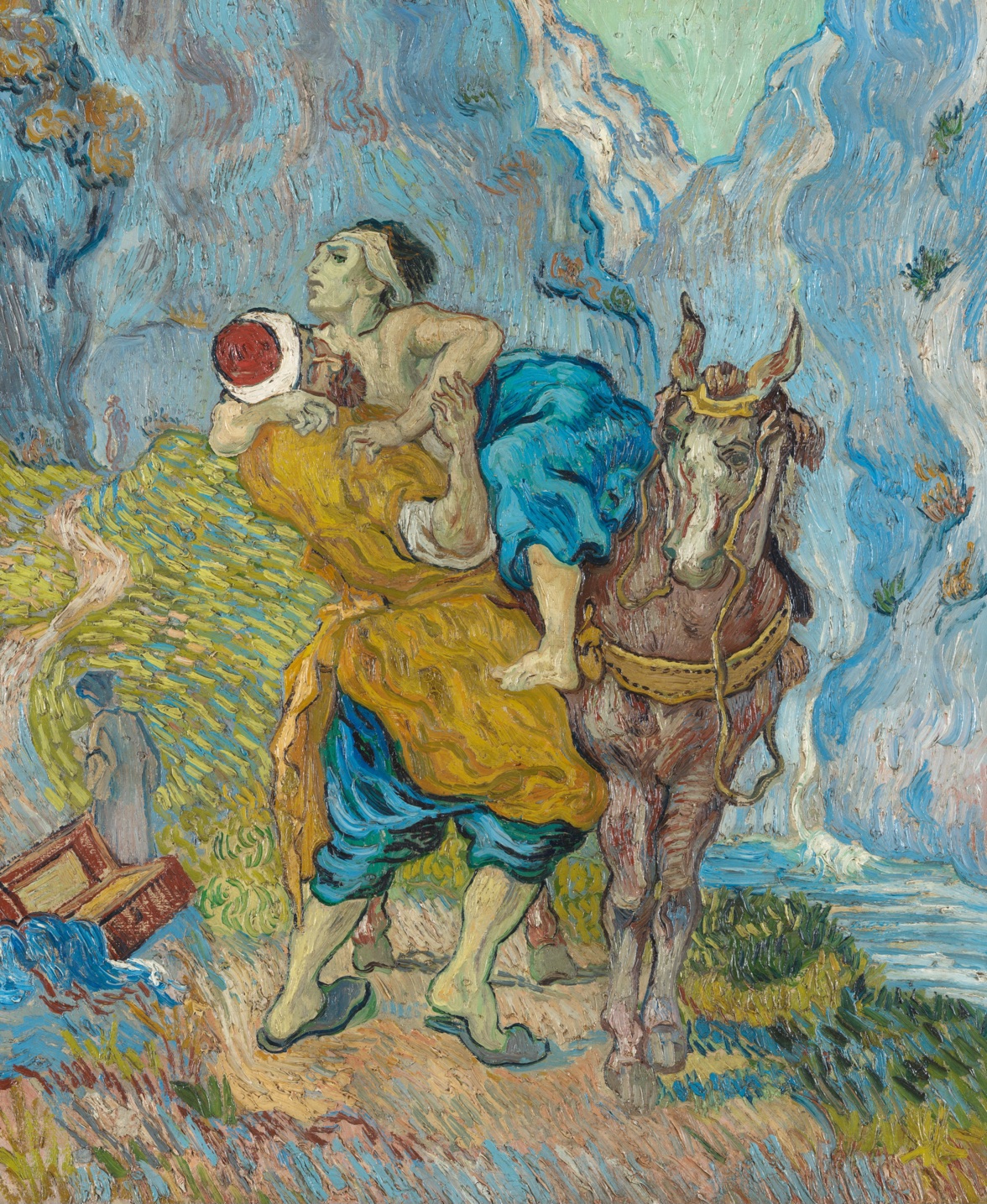
A man in a turban braces his whole body against a wounded man, pushing him up onto a horse. The wounded man has almost no clothes on, and his feet are bare. By the road lies an open, empty chest. Far off on the road to the left, someone is walking away with his back to us. Do you think the ones walking away saw him?
Vincent van Gogh, The Good Samaritan (after Delacroix), 1890, oil painting, Kröller-Müller Museum, the Netherlands. Public domain. Wikimedia CommonsRead TogetherLuke 10:25-37
25Behold, a certain lawyer stood up and tested him, saying, “Teacher, what shall I do to inherit eternal life?”
26He said to him, “What is written in the law? How do you read it?”
27He answered, “You shall love the Lord your God with all your heart, with all your soul, with all your strength, and with all your mind; and your neighbor as yourself.”
28He said to him, “You have answered correctly. Do this, and you will live.”
29But he, desiring to justify himself, asked Jesus, “Who is my neighbor?”
30Jesus answered, “A certain man was going down from Jerusalem to Jericho, and he fell among robbers, who both stripped him and beat him, and departed, leaving him half dead.
31By chance a certain priest was going down that way. When he saw him, he passed by on the other side.
32In the same way a Levite also, when he came to the place and saw him, passed by on the other side.
33But a certain Samaritan, as he traveled, came where he was. When he saw him, he was moved with compassion,
34came to him, and bound up his wounds, pouring on oil and wine. He set him on his own animal, brought him to an inn, and took care of him.
35On the next day, when he departed, he took out two denarii, gave them to the host, and said to him, ‘Take care of him. Whatever you spend beyond that, I will repay you when I return.’
36Now which of these three do you think seemed to be a neighbor to him who fell among the robbers?”
37He said, “He who showed mercy on him.” Then Jesus said to him, “Go and do likewise.”
The Setting
Who was there. “A certain lawyer stood up and tested him” (v. 25). A lawyer was someone who studied and taught the law of Moses. He asked a big question: “what shall I do to inherit eternal life?” (v. 25).
Two rounds of questions. This passage is two rounds of question and answer, and the parable sits inside the second. Side by side:
| First round | Second round | |
|---|---|---|
| The lawyer asks | “what shall I do to inherit eternal life?” (v. 25) | “Who is my neighbor?” (v. 29) |
| Jesus asks back | “What is written in the law? How do you read it?” (v. 26) | after the parable: “which of these three do you think seemed to be a neighbor to him who fell among the robbers?” (v. 36) |
| The lawyer answers | “You shall love the Lord your God with all your heart, with all your soul, with all your strength, and with all your mind; and your neighbor as yourself” (v. 27) | “He who showed mercy on him” (v. 37) |
| Jesus says | “Do this, and you will live” (v. 28) | “Go and do likewise” (v. 37) |
Both times the lawyer gives the answer himself, and both times Jesus brings it down to ‘doing’.
Both parts of the lawyer’s answer come from the law of Moses: “You shall love the LORD your God with all your heart, with all your soul, and with all your might” (Deut 6:5), and “you shall love your neighbor as yourself” (Lev 19:18).
Who the Samaritans were. Samaria lay between Judea and Galilee. In those days Jews and Samaritans looked down on each other: “For Jews have no dealings with Samaritans” (John 4:9). Just one chapter earlier, as Jesus set out for Jerusalem and passed through a Samaritan village, “They didn’t receive him” (Luke 9:53), and James and John even asked Jesus, “do you want us to command fire to come down from the sky and destroy them” (Luke 9:54). Adam Clarke says the parable names a Samaritan only to show that he was the last person a Jew could expect help from, because of the enmity between the two peoples:
Samaritan is mentioned merely to show that he was a person from whom a Jew had no right to expect any help or relief, because of the enmity which subsisted between the two nations.
Adam Clarke, Commentary on the Bible, on Luke 10:33.
Going ‘down’ to Jericho. John Gill explains why the text says the man was going ‘down’:
the man is said to go down from the one to the other, because Jerusalem stood on high ground, and Jericho in a valley.
John Gill, Exposition of the Entire Bible, on Luke 10:30.
Two denarii. Elsewhere a denarius is a day’s pay: the landowner in another parable “agreed with the laborers for a denarius a day” (Matt 20:2). What the Samaritan left with the host was two days’ wages, and he promised to pay back whatever more was spent when he returned (v. 35).
Explanation
What do we see? Three men came along this road, and all three saw him (vv. 31, 32, 33). The priest: “When he saw him, he passed by on the other side” (v. 31). The Levite came closer, “when he came to the place and saw him”, and still “passed by on the other side” (v. 32). The Samaritan: “When he saw him, he was moved with compassion” (v. 33). All three saw the same man. What differed was what came after seeing.
Once he was moved with compassion, the Samaritan did one thing after another: he “came to him, and bound up his wounds, pouring on oil and wine. He set him on his own animal, brought him to an inn, and took care of him” (v. 34). The next day he left money too, and said, “Whatever you spend beyond that, I will repay you when I return” (v. 35). He did not do one thing and leave; he cared for the man until someone else could take over.
If I had been there. The lawyer asked, “Who is my neighbor?” (v. 29). He wanted a boundary: which people count as my neighbor, the ones I am to love, and which do not, the ones I can leave alone. The text says he asked this “desiring to justify himself” (v. 29).
When Jesus finished the parable, he turned the question around: “which of these three do you think seemed to be a neighbor to him who fell among the robbers?” (v. 36). The lawyer asked ‘who is fit to be my neighbor?’; Jesus asked ‘who acted as his neighbor?’
The lawyer answered, “He who showed mercy on him” (v. 37). He did not say the word ‘Samaritan’. Adam Clarke says his prejudice would not let him name the Samaritan, though his conscience made him admit that this man alone had done right. Matthew Henry also notices that the lawyer would not answer plainly that it was the Samaritan.
His prejudice would not permit him to name the Samaritan, yet his conscience obliged him to acknowledge that he was the only righteous person of the three.
To this the lawyer would not answer, as he ought to have done, "Doubtless, the Samaritan was;"
Adam Clarke, Commentary on the Bible, on Luke 10:37; Matthew Henry, Commentary on the Whole Bible, Vol. V, on Luke 10:25-37.
What is God like? The Samaritan, “When he saw him, he was moved with compassion” (v. 33). The father in the Prodigal Son, who “saw him and was moved with compassion” (Luke 15:20), and the master in the Unforgiving Servant, “being moved with compassion” (Matt 18:27), are described with the same Greek word (see the Key Word in the Prodigal Son lesson). In all three parables, the one who is moved with compassion goes on to act: the father runs and embraces his son, the master forgives the debt, the Samaritan comes to the man and binds his wounds.
Earlier in Luke, Jesus said, “Therefore be merciful, even as your Father is also merciful” (Luke 6:36). A heart of mercy toward others is learned from the Father.
The lawyer’s first answer was not wrong: Jesus said, “You have answered correctly” (v. 28). Matthew Henry says that when Jesus went on, “Do this, and you will live” (v. 28), the lawyer began to sense where this was leading, and that is why he turned to ask who his neighbor was:
he began to be aware that Christ intended to draw from him an acknowledgment that he had not done this
Matthew Henry, Commentary on the Whole Bible, Vol. V, on Luke 10:25-37.
What does this mean for me? We often ask as the lawyer did: who am I responsible for? Does this person count? Jesus does not answer ‘who counts’. He tells of a man who ‘acted as a neighbor’.
The word the lawyer said was ‘mercy’: “He who showed mercy on him” (v. 37). Thayer’s Greek lexicon explains this mercy as kindness toward those who suffer, joined with a desire to relieve them; among the verses he lists for mercy shown by one person to another is Luke 10:37.
mercy; kindness or good will toward the miserable and afflicted, joined with a desire to relieve them
to show, afford, mercy to one, Luke 10:37
Thayer’s Greek-English Lexicon of the New Testament, G1656.
The Samaritan did not go off to clear that road of every robber. He cared for the one man lying by the road. Jesus said, “Go and do likewise” (v. 37): see in the same way, be moved in the same way, come near in the same way.
Different Views
The three commentators below are English: Matthew Henry (1662–1714), John Gill (1697–1771) and Adam Clarke (c. 1760–1832). Each is quoted in his own words, with the source after each quotation.
What the text itself says (all three follow this): The parable answers the lawyer’s question, “Who is my neighbor?” (v. 29); Jesus’ conclusion is “Go and do likewise” (v. 37). The three questions below are places the text does not spell out, where readers through the centuries have differed.
1. Why did the priest and the Levite pass by on the other side?
He lists several possibilities: that the priest took him for dead and kept away so as not to be defiled by touching him (see Num 19:16); that he could not bear the sight; or, more likely, hardness of heart:
when he saw him naked, and in such a bloody condition, he might take him for one really dead, and therefore crossed the way on purpose, lest he should any ways touch him, and be defiled by him, and so break the law, and incur the penalty of it, mentioned in Numbers 19:16 or to shun so horrible a sight; or rather, through hardness of heart, and want of compassion.
John Gill, Exposition of the Entire Bible, on Luke 10:31.
He reports what some have suggested, and then says what the Samaritan understood:
Some think that the priest and Levite pretended they could not stay to help the poor man, because they were in haste to go and attend the temple-service at Jerusalem.
he understood that both his own business and God's sacrifice too must give place to such an act of mercy as this.
Matthew Henry, Commentary on the Whole Bible, Vol. V, on Luke 10:25-37.
He finds no excuse for them, and points to Deuteronomy 22: “You shall not see your brother’s donkey or his ox fallen down by the way, and hide yourself from them. You shall surely help him to lift them up again” (Deut 22:4).
these were the persons who, from the nature of their office, were most obliged to perform works of mercy
their inhuman conduct here was a flat breach of the law, Deuteronomy 22:1-4.
Adam Clarke, Commentary on the Bible, on Luke 10:31.
How to read it: The text gives no reasons. It only says they ‘saw’ and ‘passed by’ (vv. 31, 32). Gill guesses fear of defilement, Henry mentions the suggestion that they were hurrying to the temple, and Clarke says no reason holds. The text says only that “a certain priest was going down that way” (v. 31); it does not say where he was going or why he was in a hurry. Reading this verse, there is no need to find excuses for them, nor to hurry to condemn them. We can ask ourselves: when I passed by on the other side, what reason did I give myself?
2. Is the Samaritan a picture of Christ?
He first says the general purpose of the parable is to answer the lawyer, then that it can also be read as a picture of humanity’s fall and recovery by Christ. On this reading the Samaritan is Christ (the Jews once called Jesus a Samaritan, John 8:48), the inn is the church, and the host is the ministers of the gospel.
though the general design of it is in answer to the lawyer's question, to show who may be called a neighbour
yet it may be considered, as representing the sad estate and condition of mankind by the fall, and their recovery by Christ
and brought him to an inn; a church of Christ
and gave them to the host; or the keeper and master of the inn; by whom are meant, the ministers of the Gospel
John Gill, Exposition of the Entire Bible, on Luke 10:30, 33-35.
Now this parable is applicable to another purpose than that for which it was intended; and does excellently set forth the kindness and love of God our Saviour towards sinful miserable man.
Matthew Henry, Commentary on the Whole Bible, Vol. V, on Luke 10:25-37.
He sets out this whole reading in full, and then says:
What I have given here is generally true in itself, but certainly does not follow from the text.
but let no man say this is the meaning of the relation; no: but he may say, we may make this use of it.
Adam Clarke, Commentary on the Bible, on Luke 10:37.
How to read it: this is an allegorical reading: finding a counterpart for every detail. All three in fact agree that the parable’s own purpose is to answer ‘who is my neighbor’: Gill calls that its general design, Henry speaks of the purpose it was intended for, and Clarke says the other reading does not follow from the text. That Christ has mercy on sinners is true; but when Jesus finished this parable, what he said to the lawyer was “Go and do likewise” (v. 37). Reading this parable, take hold of that command first.
3. A true event, or a parable?
The mentioning of those places intimates that it was matter of fact, and not a parable; probably it happened lately, just as it is here related.
Matthew Henry, Commentary on the Whole Bible, Vol. V, on Luke 10:25-37.
It is very likely that what our Lord relates here was a real matter of fact, and not a parable; otherwise the captious lawyer might have objected that no such case had ever existed
Adam Clarke, Commentary on the Bible, on Luke 10:37.
He allows either:
which may either be considered as a narrative of matter of fact, or as a supposed case, and delivered by way of parable
John Gill, Exposition of the Entire Bible, on Luke 10:30.
How to read it: The word ‘parable’ does not appear in this passage; Jesus simply begins, “A certain man was going down from Jerusalem to Jericho” (v. 30). Whether it is a true event or a parable, the three differ, and the text does not say. Either way, the question Jesus asks (v. 36) and the command he gives (v. 37) are the same.
Key Word
The lawyer asked, “Who is my neighbor?” (v. 29), and Jesus asked which of the three “seemed to be a neighbor to him who fell among the robbers” (v. 36). In both places ‘neighbor’ is the same Greek word.
Thayer’s Greek lexicon explains that the word was first an adverb meaning ‘near’. In the Old Testament and Jewish understanding, a neighbor was a member of the Hebrew people; in the teaching of Christ, a neighbor is any other person we live with or happen to meet, whatever their race or religion, and Thayer notes that the parable in Luke 10:25-37 makes this plain.
adverb, from Homer down, near
according to the O. T. and Jewish conception, a member of the Hebrew race and commonwealth
according to the teaching of Christ, any other man irrespective of race or religion with whom we live or whom we chance to meet (which idea is clearly brought out in the parable Luke 10:25-37)
Thayer’s Greek-English Lexicon of the New Testament, G4139.
Thayer also treats verses 29 and 36 separately: in verse 29 the sense is passive, someone worthy to be treated as a friend; in verse 36 it is active, someone who does what a friend does.
in a passive sense, worthy to be regarded as a friend and companion, Luke 10:29; actively, to perform the offices of a friend and companion, Luke 10:36
Thayer’s Greek-English Lexicon of the New Testament, G4139.
The lawyer asked: who is worthy to be my neighbor? Jesus asked: who went and acted as a neighbor?
Think It Through
There are no right answers and no scores. Write your answers down; they are for you alone.
- The lawyer wanted a boundary: who counts as my neighbor. Is there a line like that in your own heart? Who is outside it?
- The priest and the Levite both saw him (vv. 31, 32). Lately, whose trouble have you seen, and still “passed by on the other side” (v. 31)? What reason did you give yourself then?
- The Samaritan was someone the Jews looked down on. Have you ever been helped by someone you never expected help from?
- Look at Van Gogh’s painting again: the Samaritan braces his whole body against the man. How much strength do you think it takes to lift a wounded man onto a horse?
This Week
This week, notice one person right beside you who is going through something hard: a colleague, a neighbor, someone in your family or your church.
Do one concrete, small thing to help: a meal, a ride, a phone call, sitting with them for a while. It need not be big, but do ‘come near’.
At the end of the week, ask yourself: this week, whose neighbor was I?
Further Reading
- Matthew Henry, Commentary on the Whole Bible, Vol. V: Luke 10:25-37 (public domain; free to read in full at CCEL)
- Leon Morris, Luke (Tyndale New Testament Commentaries): Luke 10:25-37
- Klyne R. Snodgrass, Stories with Intent: the chapter on the Good Samaritan
More in This UnitUnit 5 · Discipleship
- The Two Builders Matt 7:24-27
- The Good Samaritan Luke 10:25-37 This lesson
- The Workers in the Vineyard Matt 20:1-16
- The Tower and the King at War Luke 14:28-33
- The Unworthy Servants Luke 17:7-10
- The Watchful Servants Luke 12:35-40
Scripture: World English Bible (public domain). The commentators in ‘Different Views’ are quoted in their own words from the English originals (public domain).