💬 Famous Quotes
📋 Basic Information
📖 Biography
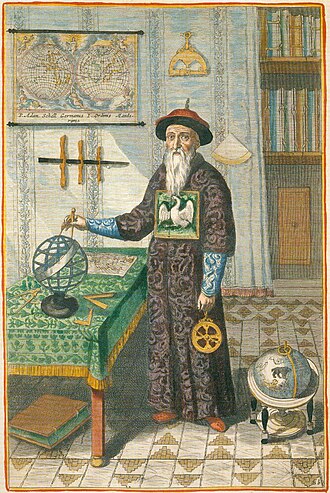
Johann Adam Schall von Bell (German: Johann Adam Schall von Bell, usually shortened to Adam Schall; 1 May 1591 – 15 August 1666), courtesy name Daowei (道未), came from the Electorate of Cologne in the Holy Roman Empire (today Cologne in North Rhine-Westphalia). A Roman Catholic Jesuit brother, priest, scholar and missionary, he came to China at the end of the Ming and beginning of the Qing and did missionary work there for 47 years. He rose to the first official rank (the badge on his robe bore a crane) and never returned to his home in Europe. In his memory, Beijing and Cologne have become friendship cities.
On the 21st day of the 8th month of the 8th year of Shunzhi, an imperial patent conferred on the grandfather, Tang Yuhan (汤玉函), and the father, Tang Liguo (汤利国), of Schall von Bell—Chief Minister of the Court of Imperial Sacrifices in charge of the Imperial Astronomical Bureau—the titles Tongyi Dafu (通议大夫) and Chief Minister of the Court of Imperial Sacrifices; his grandmother, née Lang (郎氏), and his mother, née Xie (谢氏), were made Shuren (淑人, ladies of rank); and Schall von Bell himself was given the rank of Tongyi Dafu.
Early Years
On 1 May 1591 Schall von Bell was born into a noble family in the city of Cologne on the Rhine in Germany, in the Holy Roman Empire. His German name was Johann Adam Schall von Bell, and his parents were devout Catholics. When he was born, his parents carried him to church to be baptized and named Johann Adam. After coming to China he took the Chinese name Tang Ruowang (汤若望), following the sound of Johann Adam and the transliteration practice of the time, and, after the old Chinese custom, the courtesy name Daowei, from the Mencius phrase “gazing toward the Way as though he had not yet seen it.”
To this day the family's old castle still stands at Lüftelberg (Lueftelberg) near Bonn, among green hills in quiet surroundings. Schall von Bell spent his childhood on this estate and received a good education. He went to secondary school at the “Three Crowns” school founded by the Jesuits, and on graduating was chosen as an outstanding student to go on to a Catholic institution of higher learning, the German College in Italy.
In 1608, at 16, he left home to study in Rome. He first studied philosophy for three years, then theology, astronomy and mathematics, four years in all. In 1611 he entered the Society of Jesus in Rome, and he later gained admission to the Roman College founded by the founder of the Jesuits.
Mission in the Late Ming
On 16 April 1618, led by the French Jesuit Nicolas Trigault (金尼阁), who had come back to Europe from China, 22 missionaries, among them Schall von Bell, Johann Schreck (邓玉函, 1576 – 11 May 1630) and Giacomo Rho (罗雅各), set sail eastward from Lisbon, Portugal. So Schall von Bell bade farewell to his European homeland, never to return.
Arrival in Macau
On 4 October 1618, after a hard voyage of five and a half months, the ship reached Goa in India, where they spent several months recovering. In May 1619 they set out again: Trigault and Schreck on one ship, Schall von Bell and Wenceslaus Kirwitzer (齐惟才) on another, sailing one after the other toward the South China Sea. Two months later they landed at Macau. On 15 July 1619 (the 20th day of the 6th month of the 47th year of Wanli), Schall von Bell and his companions arrived in Macau. The Nanjing Persecution (南京教案) started by Shen Cui (沈漼) had only recently died down, so the missionaries had to stay for a time at St. Paul's College in Macau, studying Chinese language and culture.
On 23 June 1622 (the 15th day of the 5th month of the 2nd year of Tianqi), the Jesuits Bruno, Giacomo Rho and Schall von Bell directed gunners who drove back an Anglo-Dutch force invading Macau. Friends of the Jesuits at court, such as Xu Guangqi (徐光启), petitioned the Tianqi Emperor to invite the missionaries to the capital to help the court and turn back the decline of the Ming. But the missionaries objected to using this as a pretext for going to the capital, stressing that on the one hand they knew nothing about military weapons, and on the other such a step was not in keeping with their faith. To this Li Zhizao (李之藻) replied, urging them: “Use this title the way a tailor uses a needle. The needle is useful while the clothes are being sewn; once it has been used, it is laid aside. Once you have the emperor's permission to stay in the capital, you can easily put down the sword and take up the pen.” So Schall von Bell traveled by way of Guangzhou and the provinces of Jiangxi, Zhejiang and others, and finally reached Beijing on 25 January 1623 (the 25th day of the 12th month of the 2nd year of Tianqi).
First Period in Beijing
Following the example of Matteo Ricci (利玛窦), Schall von Bell drew up a catalogue of the mathematical and astronomical books he had brought from Europe and presented it to the court, and displayed the scientific instruments he had brought from Europe at his residence for officials and scholars to see.
Soon after arriving in Beijing he successfully predicted the lunar eclipse of 8 October that year (1623, the 3rd year of Tianqi; the 15th day of the 9th lunar month), and later the lunar eclipse of September (the 8th lunar month) of the following year (1624, the 4th year of Tianqi). He also used a Roman method of calculating lunar eclipses to work out the distance between the meridian of Beijing and the meridian of Rome. He then completed Jiaoshi Shuo [On Eclipses], on calculating solar and lunar eclipses, which was printed, given to officials, and presented to the court.
In the summer of 1627 (the 7th year of Tianqi), because the eunuch Wei Zhongxian (魏忠贤) held power, the climate for mission work in Beijing was poor. At the same time, at the earnest request of the believer Wang Zheng (王征), Schall von Bell was sent to Xi'an to take Trigault's place. Inside the city of Xi'an he built a small church, and besides his religious work he kept up his scientific research and writing. Earlier, in 1626 (the 6th year of Tianqi), he had written in Chinese Yuanjing Shuo [On the Telescope], introducing the telescope of Galileo (Galileo Galilei, 15 February 1564 – 8 January 1642). Well illustrated, the book described the Galilean telescope in detail—its principles, structure and functions, and how to use it—and became a foundational work on optics and the telescope in the history of Chinese science and technology, with an important influence on later use. Schall von Bell and Schreck were among the first missionaries to bring the telescope into China, but it was Schall von Bell who finally succeeded in bringing the telescope to Beijing and putting it into wide use.
Second Period in Beijing
In 1630 (the 3rd year of Chongzhen), after Schreck died, Xu Guangqi, Minister of Rites, who was directing the revision of the calendar, urgently needed people skilled in astronomy, and petitioned the Chongzhen Emperor, strongly recommending that Schall von Bell return to Beijing to serve in the Calendar Bureau of the Imperial Astronomical Bureau, where he held the post of Gongshi (贡仕) of the Calendar Bureau. At the bureau Schall von Bell helped Xu Guangqi compile the Chongzhen Lishu [Chongzhen Calendar Compendium], promoted astronomy, and made instruments.
In 1631 Xu Guangqi and his subordinates observed a solar eclipse through a telescope for the first time. Afterward Xu, filled with admiration, wrote in a memorial to the Chongzhen Emperor: “Without this method, relying only on the eye, the glare makes it impossible to see truly.”
Besides this, Schall von Bell wrote and translated a great many books, mostly on the fixed stars and eclipses.
Under Xu Guangqi's direction, Schall von Bell took part in surveying and drawing a large star chart. The chart they drew “broke through two thousand years of Chinese tradition” and “formed the basis of modern Chinese star charts.” All the data used in drawing it were newly measured under Xu Guangqi's direction. This star chart “was the product of joining the theory and practice of modern stellar astronomy. From then on, in many respects—the way stars were named, the organization and system of the constellations, the measurement and calculation of the stars, the form and method of drawing the charts, the enlarged number of constellations and stars—it improved the form and content of China's long-established traditional star charts. It brought fundamental change, in the period of Europe's scientific revolution, to the ancient Chinese star chart that stands out in the history of world astronomy, making it an outstanding, epoch-making star chart.” Two of the large star charts they drew survive in the Vatican Library in Rome.
In December 1634 (the 11th month of the 7th year of Chongzhen), under the direction of Xu Guangqi and Schall von Bell, after more than ten years of hard work, the Imperial Astronomical Bureau at last completed the massive Chongzhen Lishu, in 46 works and 137 juan (volumes). The Chongzhen Lishu was a major reform of the traditional Chinese calendar. It drew on the cosmic system of Tycho Brahe (第谷); although it did not adopt the heliocentric theory, the revised early-Qing edition, Xiyang Xinfa Lishu [Calendar Compendium by the New Western Method], in its Wuwei Lizhi, Part 1 [Explanations of the Five Planets], quoted extensively from Copernicus's On the Revolutions of the Heavenly Spheres and introduced it. On 6 January 1639 (the 3rd day of the 12th month of the 11th year of Chongzhen), the Chongzhen Emperor, who greatly valued the calendar work of Schall von Bell and the others, personally bestowed on the Jesuit residence at the South Church (Nantang) in Beijing a plaque bearing four large characters in his own hand, “imperial praise for the heavenly learning” (钦褒天学). Volume 2 of Xichao Chongzheng Ji (熙朝崇正集) records Gu Xichou's (顾锡畴) memorial of the 11th year of Chongzhen, “Memorial of the Ministry of Rites Approving the Granting of the Plaque ‘Imperial Praise for the Heavenly Learning’,” which says: “The distant subject Tang Ruowang created methods and made instruments that accord marvelously with the movement of the heavens; his past labors in calculation are already manifest, and the fruits of his explanations are just now new. His merit should be recorded first.”
In 1640 (the 13th year of Chongzhen), Schall von Bell also worked with the Chinese scholar Li Tianjing (李天经) to translate De re Metallica, the great work on 16th-century European mining and metallurgy written in 1550 by the German mining and metallurgy scholar Georgius Agricola; the Chinese version was titled Kunyu Gezhi (坤舆格致). When it was completed, Schall von Bell presented it to the court, and the Chongzhen Emperor wrote in reply: “Issue the complete Kunyu Gezhi; let the local officials consider the lie of the land and mine as is convenient.” But because the Ming dynasty quickly collapsed, the book was never printed.
When Schall von Bell first came to China, the Ming dynasty was beset with troubles at home and abroad; the brave soldiers and fierce generals of the Manchus under Nurhaci (努尔哈赤) and Hong Taiji (皇太极) “could not be resisted without firearms and war carts.” In 1642 (the 15th year of Chongzhen), Schall von Bell was ordered by the emperor to set up a foundry and cast cannon. But he “did his utmost to find excuses, hoping the court would pardon him for not obeying. He insisted that making weapons for war did not fit his calling, and that in casting cannon he had only a little book knowledge and no practical experience. But his plea was not accepted, and he had to submit to the emperor's command.” This shows Schall von Bell's inner struggle. Yet with only this “little book knowledge” he managed to cast 20 bronze cannon in two years. During this time he not only produced good cannon but also wrote, with the Chinese scholar Jiao Xu (焦勖), Huogong Qieyao [Essentials of Gunnery].
Though it was the turmoil of war at the end of the Ming, Schall von Bell, because of his faith, remained calm. To keep the woodblocks of the Chongzhen Lishu from being destroyed, he stayed quietly in his church guarding them, and boldly petitioned the Chongzhen Emperor: “Your subject came east across the ocean eighty thousand li from the Great Western Sea. I have neither married nor sought office; my foundation is to serve the Lord on High reverently and to proclaim the holy teaching of the Lord of Heaven, and my task is to urge people to be loyal to their ruler, filial to their parents, chaste and honest, and law-abiding… I have been a guest in the capital for a number of years. By order of the late emperor of the former dynasty I revised the calendar and wrote many volumes of calendrical works, which were given to craftsmen to be cut into blocks; the work is not yet finished, but the blocks are already piled high…” He therefore begged to be allowed to “remain in my former residence and continue the revision reverently as before.”
Every line shows that, although Schall von Bell took the path of mission through science, he was still very clear that his first purpose in coming to China was mission.
Mission in the Early Qing: Remaining in Beijing
After the Qing army entered through the Shanhai Pass, he went over to the Qing and was appointed the first Director of the Imperial Astronomical Bureau (the bureau of astronomy and the calendar) of the Qing dynasty. In 1644 (the 17th year of Chongzhen) Qing troops occupied Beijing and needed to issue a new calendar; Schall von Bell's Xiyang Xinfa Lishu was adopted and issued as the Shixian Calendar (时宪历). Schall von Bell enjoyed the deep trust of the Qing regent Dorgon (多尔衮) and the Shunzhi Emperor. In September 1651 (the 8th month of the 8th year of Shunzhi), on a single day, he was given the titles of Chief Minister of the Court of the Imperial Stud (太仆寺卿) and Chief Minister of the Court of Imperial Sacrifices (太常寺卿). In 1655 (the 12th year of Shunzhi) he was made Commissioner of the Office of Transmission (通政使), raised to the first rank, and honors were conferred on three generations of his family.
The Kangxi Calendar Case
After the Shunzhi Emperor died, the Kangxi Emperor came to the throne. The regent Oboi (鳌拜) opposed Western learning, and in 1664 (the 3rd year of Kangxi) the “calendar case” broke out; Schall von Bell was sentenced to death by slicing. In 1665 (the 4th year of Kangxi) an earthquake struck the capital; Schall von Bell was spared death but kept in prison, and was released by special decree of Grand Empress Dowager Xiaozhuang (孝庄).
Death
Schall von Bell died of illness in the capital on 15 August 1666 (the 15th day of the 7th month of the 5th year of Kangxi), aged 75. In 1669 (the 8th year of Kangxi), the Kangxi Emperor cleared his name.
Historic Sites
The workroom at the Beijing Ancient Observatory where he observed the heavens and compiled calendars, his residence at the South Church (Nantang) in Beijing, and his grave (note: damaged during the Cultural Revolution) are all preserved today and open to visitors. He is buried together with 60 other foreign scientists, painters and missionaries at Tenggong Zhalan (滕公栅栏, the Zhalan Cemetery) in Beijing; the cemetery lies in Chegongzhuang, within the grounds of what is today the Party School of the Beijing Municipal Committee of the Communist Party of China / Beijing Administrative College (one institution under two names).
Associates
Ming dynasty: the court
- Xu Guangqi (徐光启), fellow believer and collaborator.
- The Chongzhen Emperor, who gave Schall von Bell important posts.
Qing dynasty: members of the imperial house
- Dorgon, Prince Rui (睿亲王多尔衮), who gave Schall von Bell important posts.
- Grand Empress Dowager Xiaozhuang (Mongol).
- The Shunzhi Emperor, who respectfully called Schall von Bell “Mafa” (Manchu for “grandfather”).
- The Kangxi Emperor, who cleared Schall von Bell's name and led the mourners in honoring him, and posthumously conferred on him the title Guanglu Dafu (光禄大夫, senior first rank).
Members of the royal house of Joseon (Korea)
- Crown Prince Sohyeon (昭显世子), heir to the Joseon throne and a hostage after the Byeongja (丙子) Manchu invasion; a friend of Schall von Bell and the hope for bringing the gospel to the Joseon kingdom, but sadly he died young.
Jesuit missionaries
- Ferdinand Verbiest (南怀仁), who helped Schall von Bell manage church affairs in Beijing.
Opponents of Christianity, Western learning and the new calendar
- Yang Guangxian (杨光先), agitator against Western learning and false accuser in the Kangxi calendar case.
- Wu Mingxuan (吴明炫), a Hui, formerly Autumn Officer of the Muslim Section of the Imperial Astronomical Bureau, and vice-director of the bureau when Yang Guangxian headed it.
Colleagues at the Imperial Astronomical Bureau, accused with him in the Kangxi calendar case
- Du Ruyu (杜如预)
- Yang Hongliang (杨宏量)
- Li Zubai (李祖白), fellow believer
- Song Kecheng (宋可成)
- Song Fa (宋发)
- Zhu Guangxian (朱光显)
- Liu Youtai (刘有泰)
Profile
- Courtesy name: Daowei
- Born: Johann Adam Schall von Bell, 1 May 1591, Electorate of Cologne, Holy Roman Empire of the German Nation
- Died: 15 August 1666 (aged 75), the capital, Shuntian Prefecture, Zhili, Great Qing Empire
- Burial place: Tenggong Zhalan (Zhalan Cemetery), Chegongzhuang (now within the Party School of the Beijing Municipal Committee of the Communist Party of China / Beijing Administrative College)
- Religion: Roman Catholic
- Nationality: Holy Roman Empire of the German Nation; Great Ming; Great Qing Empire
- Works: Xiyang Xinfa Lishu, Jiaoshi Shuo, and others
- Profession: religious brother, priest, missionary, astronomer
- Order: Society of Jesus
- Offices: under Chongzhen of the Ming, Gongshi (贡仕) of the Calendar Bureau; under Shunzhi of the Qing, Director of the Imperial Astronomical Bureau, Commissioner of the Office of Transmission, Chief Minister of the Court of the Imperial Stud, Chief Minister of the Court of Imperial Sacrifices
📚 Major Works


🎬 Videos
The Missionary (Documentary Excerpt): Schall von Bell, Verbiest and the Kangxi Emperor
The Great Jesuit Scholars Ricci, Schall and Verbiest (The China History Podcast, Ep. 98)
Videos are hosted on YouTube and uploaded by their original producers. YouTube loads only when you press play and may be unavailable in some regions.