💬 Famous Quotes
📋 Basic Information
📖 Biography
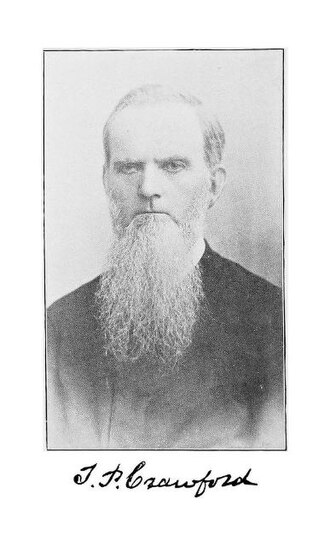
Tarleton Perry Crawford (8 May 1821 – 7 April 1902) was a Baptist missionary who, together with his wife, did missionary work in Shandong for 50 years.
Early Life and Education
Crawford was born in Warren County, Kentucky. He was the fourth son of John and Lucretia Crawford. After he became a Christian at 16, he said, “I will spend my life telling of the great mercy and compassion of Jesus.” He gave his whole life to mission work in China.
Crawford worked on a farm in Denmark, Tennessee, to raise money for college tuition. He attended the Denmark boys' school and was one of the best in his class. The Big Hatchie Baptist church helped pay his tuition to enter Union University in Murfreesboro, Tennessee. The women of the Brown Creek Baptist Church, Big Black Creek Baptist Church, Maple Springs Baptist Church and Clover Creek Baptist Church all held sales on Sundays, selling their own eggs and milk to help support him; among them was Lottie Moon (慕拉第), later a well-known woman missionary. He was baptized at Big Black Creek Baptist Church in Denmark, Tennessee. His pastor, Brother Obadiah Dodson, was very zealous for missions.
In early 1848 he entered Union University in Murfreesboro, Tennessee. He graduated first in his class in 1851.
Marriage and Family
Crawford married Martha Foster (another account dates the marriage to 1845); she had become a Baptist in 1845. She had studied at LaFayette College in Alabama. A week after their engagement, they were married on 12 March 1851 at home in Tuscaloosa County, Alabama.
Missionary Career
At the end of 1850 Crawford was appointed a missionary to Shanghai by the Foreign Mission Board of the Southern Baptist Convention. In 1852 Crawford and his wife Martha moved to Dengzhou, Shandong—perhaps in order to have less supervision. Crawford's domineering character aroused much opposition, and some Americans worried that he would be reprimanded by the American consul in Shanghai.
Crawford held that preaching was a missionary's only duty. He was shocked by the failure of Charles Gutzlaff's Chinese missionaries. From then on he insisted that the expenses of local churches should not be paid from mission funds but should be raised locally and used locally. His friend Dr. George Burton was worn out by too much medical work in Shanghai, which further strengthened Crawford's core convictions. Crawford went about the local villages, visiting 131 villages in 1875 alone.
Perhaps out of jealousy of her success at Shaling with Lottie Moon (罗蒂-文), he closed his wife's school in 1879.
He went on criticizing the Foreign Mission Board of the Southern Baptist mission, holding that it should have no say in mission affairs. The board disagreed, and in 1892 it dismissed him.
Crawford founded the Gospel Mission, and 8 (14) Southern Baptist missionaries joined him. By the turn of the century the Gospel Mission had grown to 19. All the Gospel Mission missionaries wore Chinese clothes, lived in Chinese houses and did nothing but preach the gospel. This was similar to the practice of the China Inland Mission missionaries. Southern Baptist missionaries criticized Crawford as “full of tiresome social philosophy, and refusing to give Chinese Christians reasonable leadership” (Hyatt, 1976:59).
Although Martha Crawford disagreed with some of her husband's views, she remained loyal to him. In 1867 she started a boys' school in their home. Several of its students later became successful pastors at the Huangxian and Pingdu stations. She also wrote a children's book, Sanguniang [The Three Girls], which later circulated widely throughout China. At the second missionary conference (1877) she gave an address on “women's work for women,” stressing that missionaries' wives should visit from house to house, teach local women in person, and prepare suitable literature for them.
In his book The Patriarchal Dynasties, Crawford set out his belief that in 1876 the world was 14,376 years old, and he regarded the Garden of Eden as a theocratic confederation with a population of 1,174,405,120 (about 1.17 billion).