💬 Famous Quotes
📋 Basic Information
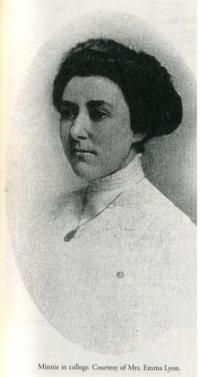
📖 Biography
Minnie Vautrin (Wilhelmina "Minnie" Vautrin; September 27, 1886 – May 14, 1941), also transliterated in Chinese as Wotelin (沃特林), Chinese name Wei Huaqun (魏华群), was born in Secor, Illinois, USA. She was an American missionary to China with the Disciples of Christ (Christian Church), a diarist, and a witness of the Nanjing Massacre.
Life
Vautrin was born in Secor, Illinois. She studied at Illinois State Normal University and graduated from the University of Illinois in 1912 and in the same year was sent to China by the mission of the American Disciples of Christ, serving as principal of the Disciples' Sanyu Girls' School in Luzhou Prefecture (now Hefei), Anhui Province. When Ginling College was founded in Nanjing in 1916, she became head of its education department. In 1918 she received a master's degree in education from Columbia University. From 1919 to 1922, while the president, Mrs. Lawrence Thurston (Matilda Thurston), returned to the United States to raise funds, she served as acting president. She later became dean of studies of Ginling Women's College of Arts and Sciences.
In 1937 the Japanese army captured Nanjing. Most of the faculty and staff of Ginling Women's College of Arts and Sciences withdrew in stages to Chengdu, Sichuan, where the college continued on the campus of West China Union University. Vautrin stayed in Nanjing to look after the Ginling campus; she volunteered to form a caretaker committee with members of the college's staff and served as acting head of the college. During the Nanjing Massacre she worked actively to rescue Chinese refugees, using the college to protect more than ten thousand Chinese women and children. Her diary, from August 12, 1937, to April 1940, recorded in detail conditions in Nanjing under Japanese occupation, and she mailed it to alumnae on the college's board of trustees in New York. On the last page of the diary, dated Sunday, April 14, 1940, she wrote: "I am nearly exhausted. In the past, although the work progressed slowly, I could still plan it step by step; now I cannot even do that, and my hands will not obey me. I hope I can go on leave right away." Two weeks later she suffered a mental breakdown and returned to the United States. On May 14, 1941, at her home in Indianapolis, she took her own life by turning on the kitchen gas. She was buried in Salt River Cemetery in Shepherd, Michigan.
Because Vautrin strove to protect the Chinese people while the Japanese army occupied Nanjing, carried out the Nanjing Massacre and abused the Chinese population, she was widely praised by the Chinese people, especially the people of Nanjing. In 1938 the Nationalist Government awarded her the Order of the Brilliant Jade (采玉勋章). Her gravestone bears the words "Ginling Forever" (永生金陵), and a statue of her still stands in Nanjing today.
The Vautrin diary and the Rabe diary, which record the crimes of the Japanese army during the Nanjing Massacre, are both held in the special collections of the Yale Divinity School Library. While writing The Rape of Nanking: The Forgotten Holocaust of World War II, the author Iris Chang (张纯如) consulted these special collections, and she became an important figure in bringing the Rabe and Vautrin diaries to public attention.
Writings
- Wei Telin Riji (The Diary of Minnie Vautrin), Jiangsu People's Publishing House, 2000