💬 Famous Quotes
1) Am I honest? Would I lie under any circumstances? Can I keep my promise to tell the truth at any cost? Yes or no? I don't mince words, make excuses, or offer explanations. Yes or no?
2) Am I upright? Can I be absolutely trustworthy with money? Can I do so at work even without supervision? Can I uphold the reputation of others? Yes or no?
3) Am I pure in my own eyes? Or would I make excuses or even protect myself? Are my habits pure? Are my thoughts pure? Are my motives pure? Are my relationships with the opposite sex pure? Yes or no?
4) Am I selfish? Do I make excessive demands on my family, wife, husband, or colleagues? Are my emotions unbalanced? Am I moody, cold one day and warm the next?"
📋 Basic Information
📖 Biography
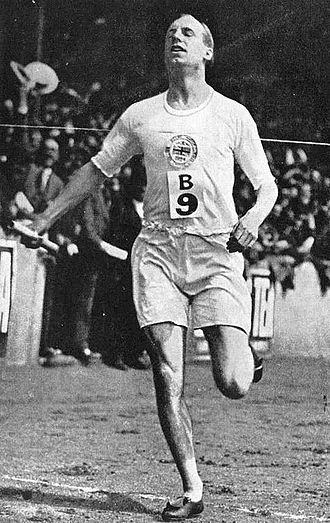
Eric Henry Liddell (Chinese names Li Airui 李爱锐 and Li Da 李达, also transliterated 伊利克·里达尔; 16 January 1902 – 21 February 1945) was a Scottish athlete and Protestant missionary. He was the first Olympic gold medallist born in China.
From Tianjin to Scotland
Liddell was born in the British Concession in Tianjin. His father, Rev. James Dunlop Liddell (李德修; given in the source as “Rev & Mrs James Dunlop Liddell”), was a missionary of the London Missionary Society then working in China. Eric lived in China until he was 5. At 6 he and his 8-year-old brother Robert (李劳伯) returned to Britain and entered Eltham College (伊尔撒姆学院), a boys' boarding school for the sons of London Missionary Society missionaries, while his parents and his sister Jenny went back to China to continue their mission work. At Eltham Eric showed a gift for sport: he was voted the school's athlete of the year and captained the college's cricket and rugby teams. His sprint times were remarkable, and many in the press believed he could one day win Britain's first Olympic gold medal in the 100-metre sprint.
In 1920, like his brother, Liddell entered the University of Edinburgh to study science. At university he ran the 100 yards and 220 yards and was a mainstay of the rugby team. He graduated after the 1924 Summer Olympics with a Bachelor of Science degree.
The Paris Olympics
The schedule of the 1924 Summer Olympics in Paris placed the men's 100 metres on a Sunday. Liddell was a devout Christian who held that Sunday was for the worship of God, so he did not run in that event. Instead he trained for the 400 metres, in which no one gave him much chance. After several weeks of hard training he unexpectedly won the 400-metre gold medal at the Paris Olympics. He also won bronze in the 200 metres. The 100-metre gold went to another British athlete, Harold Abrahams.
The Minyuan Stadium Pastor
In the second year after the Olympics, Liddell decided, like his father, to go to North China as a missionary. In 1925 he returned to Tianjin, the city of his birth, where he taught chemistry and physical education at the mission school Tientsin Anglo-Chinese College (新学书院; now Tianjin No. 17 Middle School) and also ran a Sunday school.
Because of Liddell's standing in world athletics and his wide experience of competing in many places, the Municipal Council of the British Concession invited him in 1925 to take part in rebuilding the Minyuan Stadium (民园体育场). Drawing on his racing experience, he proposed modelling it on Stamford Bridge (now Chelsea's home ground), where he had won and whose track he rated most highly. He also made a series of proposals on the structure of the track, the lighting and the tiers of the stands, which were advanced for the time. Under his planning and supervision the Minyuan Stadium was transformed and became the foremost multi-purpose stadium in Asia at that time.
In 1929 Liddell competed at the International Athletics Meeting held by the authorities of the British Concession at the Minyuan Stadium. According to records, he defeated the German runner Otto Peltzer (奥托·佩尔策), holder of the men's 500-metre world record, and also won the 400-metre gold medal at that meeting, the last gold medal of his athletic career.
In 1932 Liddell was formally ordained a minister. On 27 March 1934 he married Florence Mackenzie, organist of the Union Church (合众会堂) and daughter of Canadian missionaries. The wedding took place at the Union Church (at the corner of today's Baoding Road and Tangshan Road; the church was destroyed in the 1976 Tangshan earthquake). Their new home was at what is now 38 Chongqing Road (70 Cambridge Road in the days of the British Concession), where a memorial plaque now marks the house as his former residence.
Missionary in an Internment Camp
In 1937 full-scale war broke out between China and Japan. To help his brother Robert, a medical missionary who had fallen ill, Liddell went to work in the poor rural town of Xiaozhang (肖张镇), Zaoqiang County, Hengshui, Hebei (one of the London Missionary Society's 2 mission stations in Hebei Province). Supplies there were desperately short because of war and famine, there were many sick people, and the area also came under Japanese occupation.
In 1941, as the situation worsened further, Florence decided to take their daughters back to Canada. In 1943 Liddell was taken prisoner by the Japanese army and interned, together with religious workers from the China Inland Mission's Chefoo School, in the Weixian camp at the Courtyard of the Happy Way (乐道院) in Weifang, Shandong. In the camp he remained cheerful, kept on preaching, and even prayed for the Japanese soldiers who had captured him. He was elected chairman of the camp's recreation committee. He also wrote chemistry booklets, taught the children in the camp and led them in physical exercise himself. The Japanese side proposed to Britain, the United States and other countries an exchange of the foreign civilians in the camp for prisoners of war, and Eric was on the first list. But he gave this chance of escape to someone else and stayed on in the camp to help others. In the end, worn down by forced overwork and malnutrition, Eric Liddell died of a brain tumour in the camp in 1945.
Remembrance
According to some reports, Liddell was buried after the war in the North China Military Region Martyrs' Cemetery in Shijiazhuang, Hebei Province, where Norman Bethune, Dwarkanath Kotnis and others also lie. However, the cemetery says it has no records of Liddell, and there is no evidence that he was reburied there.
According to other reports, Liddell was buried in a small garden behind the Japanese officers' quarters of the camp. When a staff member of the Eric Liddell Foundation in Hong Kong rediscovered the grave at Weifang Middle School in 1989, it had been almost forgotten. In 1991 the University of Edinburgh erected a memorial of Scottish granite at the site, inscribed with words from the Book of Isaiah: “They will mount up with wings like eagles. They will run, and not be weary.” In 2005, during events marking the 60th anniversary of the liberation of the Weixian camp, the Weifang municipal government laid a wreath at Liddell's memorial.
On 8 August 2008, the opening day of the 29th Summer Olympic Games, the British newspaper The Scotsman named Eric the most popular athlete in Scottish history.
In 2012, during a visit by Eric's eldest daughter, the University of Edinburgh announced a scholarship for talented student athletes named after Liddell.
Film
The story of Liddell at the Paris Olympics, together with that of Harold Abrahams, a Jewish athlete who competed in the face of antisemitism, was adapted into the 1981 film Chariots of Fire. The film won four Academy Awards, including Best Picture. Eric's running style in the film, upper body upright and mouth wide open, is considered a true depiction.
The story of Liddell's return to China after the Paris Olympics and his time in the internment camp was made into the film Zhongji Shengli (终极胜利, The Ultimate Victory) in 2016, produced by Beijing Forbidden City Film Co. and directed by Hong Kong director Stephen Shin (冼杞然). It was released in Europe and North America in 2017 under the English title On Wings of Eagles.
Profile
- Original name: Eric Liddell
- Born: 16 January 1902, British Concession, Tianjin
- Died: 21 February 1945 (aged 43), Weixian internment camp, Shandong Province, Republic of China
- Education: University of Edinburgh
- Years active: 1920–1945
- Spouse: Florence Mackenzie (married 1934; until 1945)
- Sport: athletics; event: sprint
Results and Titles
National finals:
- 1923 AAA Championships: 100 yards, 1st
- 1923 AAA Championships: 220 yards, 1st
- 1924 AAA Championships: 220 yards, 2nd
- 1924 AAA Championships: 440 yards, 1st
Olympic finals:
- 1924 Summer Olympics: 200 metres, 3rd
- 1924 Summer Olympics: 400 metres, 1st
Personal bests:
- 100 yards: 9.7 s (hand-timed) (1923)
- 200 metres: 21.8 s (hand-timed) (1924)
- 220 yards: 21.6 s (hand-timed) (1923)
- 300 yards: 32.0 s (hand-timed) (1924)
- 400 metres: 47.6 s (hand-timed) (1924)
- 440 yards: 49.2 s (hand-timed) (1925)