💬 Famous Quotes
📋 Basic Information
📖 Biography
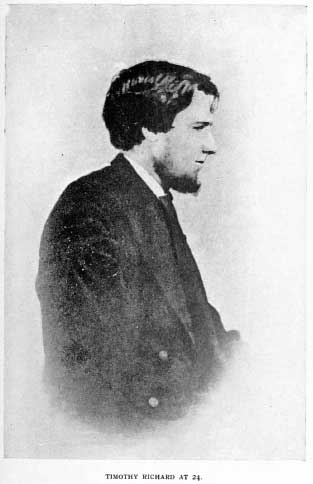
Timothy Richard (10 October 1845 – 17 April 1919), courtesy name Puyue (菩岳), was a British missionary of the Baptist Missionary Society. This society opened three mission fields in China in succession: Shandong, Shanxi and Shaanxi.
Early Years
Timothy Richard was born into a blacksmith's family in Wales. As a child he helped his father farm and attended primary school for a few years. At 16 he taught at a primary school in a mining district, and at 18 he became its headmaster. At 20 he entered a theological college, and at 23 he joined the Baptist Missionary Society (大英浸信会) and volunteered to go to China as a missionary.
Famine Relief and Mission
He left Britain on 17 November 1869 and arrived in Shanghai in February 1870 (the 1st month of the 9th year of Tongzhi), then went on to Yantai and Qingzhou in Shandong to preach, while also studying Buddhist, Confucian and Islamic writings. From 1876 to 1879 (the 2nd to 5th years of Guangxu) an unprecedented drought struck five provinces of North China (the Dingwu Famine, 丁戊奇荒). He was active in famine relief in Qingzhou and took in orphans, and Qingzhou later became the centre of the Baptist Missionary Society's Shandong field. Today there is a church in Qingzhou built in memory of Timothy Richard; it is the largest Protestant church in the area.
In 1877 (the 3rd year of Guangxu) he went to Shanxi, where the famine was even more severe, to carry out relief work, and so opened the Baptist Missionary Society's mission field in Taiyuan, Shanxi, while also making friends among Chinese officials and gentry. In the Xinghualing (杏花岭) and Dongjiaxiang (东夹巷) area of Taiyuan he built a church and the Jesus Hospital (耶稣医院), and also set up a primary school and an orphanage.
Dealings with Officials
In 1880 (the 6th year of Guangxu), during a dispute between China and Russia, Timothy Richard printed a pamphlet, Yihe Lun (议和论) [On Making Peace], arguing that the dispute should be settled through diplomacy. In September of that year Li Hongzhang (李鸿章) invited him to a meeting in Tianjin. After returning to Shanxi he began lecturing officials and others (on the natural sciences).
In 1886 (the 12th year of Guangxu) Timothy Richard came to Beijing, where he mainly lectured and wrote. He published Qiguo Xinxue Beiyao (七国新学备要) (Modern Education), introducing education in the Western countries, and proposed that the Qing government set aside 1 million taels of silver (100万两) each year to fund educational reform. During the Hundred Days' Reform movement he built good personal relationships with Liang Qichao (梁启超) and Kang Youwei (康有为).
The Christian Literature Society
In 1890 (the 16th year of Guangxu), at Li Hongzhang's invitation, Timothy Richard went to Tianjin as temporary chief editor of the Chinese edition of the China Times (中国时报), frequently publishing editorials on reform in China. For most of the rest of his life he was chiefly in charge of the work of the Guangxuehui (广学会; Christian Literature Society) in Shanghai (1891–1916). From 1891 to 1915 the society was one of the largest and most important modern publishers in China. Its range was very wide, including books, pamphlets, leaflets and magazines. The society also did some missionary work, but it was basically a publisher and literary institution. It published two thousand books and pamphlets. He directed the translation of a number of well-known books, which had a great influence on Chinese society. His main translations, more than 20 in all, include Modern Education (七国新学备要), Tianxia Wu Dazhou Ge Daguo (天下五大洲各大国) [The Great Nations of the Five Continents], Bainian Yi Jue (百年一觉) (Looking Backward), Ouzhou Ba Da Diwang Zhuan (欧洲八大帝王传) [Lives of Eight Great European Monarchs], The Nineteenth Century: A History (泰西新史揽要) and Xin Zhengce (新政策) [New Policies].
The Nineteenth Century: A History was written by the Briton Robert Mackenzie and translated by Timothy Richard together with Cai Erkang (蔡尔康, 1851–1921); it was published in 1895 (the 21st year of Guangxu). It recounts the history of how the countries of Europe and America reformed and grew strong in the 19th century. It was hugely popular on publication, with 30,000 copies printed, and was one of the main reference books used by the Guangxu Emperor during the Hundred Days' Reform.
Friendships with China's Elite
Timothy Richard's method of mission resembled that of Matteo Ricci (利玛窦): using Western culture to attract intellectuals and the upper classes. He had close dealings with many government officials, such as Li Hongzhang and Zhang Zhidong (张之洞); Zhang Zhidong once granted one thousand taels to support the society. He also befriended influential figures such as Kang Youwei and Sun Yat-sen (孙中山), and Liang Qichao served as his Chinese secretary. Timothy Richard had a great influence on China's reform movement.
During the First Sino-Japanese War, the Hundred Days' Reform and the Boxer Movement, he was active among the upper classes.
According to Lei Jiasheng's (雷家圣) book Shiluo de Zhenxiang: Wan Qing Wuxu Zhengbian Shishi Xin Tan (失落的真相:晚清戊戌政变史事新探) [The Lost Truth: New Research on the 1898 Coup in the Late Qing], during the Hundred Days' Reform the former Japanese prime minister Itō Hirobumi visited China. Timothy Richard then suggested to Kang Youwei, the leader of the reformers, that the Qing side engage Itō as an adviser and even give him real power. After Itō arrived in China, reformist officials accordingly submitted memorials one after another asking that he be given an important role, which alarmed the conservative officials. The conservative official Yang Chongyi (杨崇伊) even sent a secret memorial to the Empress Dowager Cixi: “I have heard it rumoured that the former Japanese prime minister Itō Hirobumi is to take control of the government. If Itō is indeed employed, the realm handed down by the ancestors will be as good as handed over to others.” Such vehement words prompted the Empress Dowager Cixi to return from the Summer Palace to the Forbidden City on 19 September 1898 (the 4th day of the 8th month of the 24th year of Guangxu) to find out what the Guangxu Emperor thought of Itō.
The Proposal for a Federation
Later Timothy Richard proposed to Kang Youwei a “federation of China, the United States, Britain and Japan.” Accordingly, at Kang Youwei's prompting, the reformist official Yang Shenxiu (杨深秀) submitted a memorial to the Guangxu Emperor on 20 September 1898 (the 5th day of the 8th month of the 24th year of Guangxu): “Above all I humbly hope that Your Majesty will soon settle on a great plan and bind together the three countries of Britain, America and Japan, and not mind that the name of federation sounds unattractive.” Another reformist official, Song Bolu (宋伯鲁), also submitted a memorial on 21 September 1898 (the 6th day of the 8th month of the 24th year of Guangxu), saying: “He (Timothy Richard) has come proposing to unite China, Japan, America and Britain as a federation, jointly choosing one hundred men versed in current affairs and familiar with the institutions of each country to manage the military affairs, tariffs and all foreign affairs of the four countries, and separately to train a number of battalions of troops for defence against aggression. … I now request that Your Majesty quickly appoint a senior minister well versed in foreign affairs and famed throughout the world, such as Grand Secretary Li Hongzhang, to go and see the missionary Timothy Richard and the Japanese prime minister Itō Hirobumi and discuss arrangements with them.”
Lei's book argues that after returning to the Forbidden City on 19 September 1898 (the 4th day of the 8th month of the 24th year of Guangxu), the Empress Dowager Cixi learned of this on 20–21 September, realized how serious the situation was, and acted decisively to launch a coup, resume her personal supervision of government and bring the Hundred Days' Reform to an end.
Timothy Richard's suggestion to Kang Youwei was that China, the United States, Britain and Japan hand their military, financial and diplomatic powers to a “committee of one hundred” to administer, forming a federation more closely united than today's European Union, in order to resist Russia.
However, the edict for Kang Youwei's arrest that Cixi issued on 21 September, the day she resumed control of government, did not accuse Kang Youwei of betraying the country; it said only: “Instruction to the Grand Councillors: Kang Youwei, a secretary of the Board of Works, has formed a faction for private ends and disturbed the government with evil words, and has repeatedly been impeached. Let him be dismissed from office and, together with his brother Kang Guangren (康广仁), be arrested by the Gendarmerie and handed to the Board of Punishments to be punished according to law.” Moreover, Yang Shenxiu and Song Bolu had both memorialized in favour of a four-country federation, but when Cixi determined their crimes after the coup, this charge was mentioned for neither of them: Song Bolu was charged with “recklessly recommending bad men” and “having a bad reputation,” and Yang Shenxiu with forming a faction with Kang Youwei. Lei Jiasheng believes this was because Cixi did not yet know how far Britain, the United States and Japan were involved, and accusing them rashly would have made diplomatic disputes even harder to resolve, so she could only pass over the matter with vague charges.
Shanxi University
After the Boxer Movement the Qing government awarded Timothy Richard the button of the first rank and the Order of the Double Dragon, second class, conferred honours on three generations of his family, and specially appointed him to advise on missionary cases. Taking this opportunity, Timothy Richard submitted to Li Hongzhang his Regulations for Settling the Shanxi Missionary Cases (办理山西教案章程), proposing that Shanxi Province pay a special fine of 500,000 taels of silver to be used to establish Shanxi University (山西大学堂). He believed that a fundamental cause of the events of 1900 (庚子事变) was that education was not universal; if education were universal, anti-foreign incidents of this kind could be reduced.
In 1902 (the 28th year of Guangxu), because he had helped settle the Shanxi missionary cases, the Empress Dowager agreed to the opening of Shanxi University, and the governor of Shanxi, Cen Chunxuan (岑春煊), appointed him director of its Western Studies department (西学书斋). After that he travelled back and forth between Taiyuan and Shanghai.
Later Years
In 1916 Timothy Richard resigned because of illness as general secretary of the Christian Literature Society and returned to Britain, where he published his English autobiography, Forty-Five Years in China. He died in London on 17 April 1919.
Writings
Timothy Richard wrote many books in his lifetime, some of them in Chinese, presenting Western ideas and concepts, including Christian doctrine. This made him a very distinctive figure among the missionaries of his time: his work was chiefly literary.
Richard translated The Nineteenth Century: A History, which introduced modern Western political ideas such as democracy and freedom. Li Hongzhang, Zhang Zhidong, Weng Tonghe (翁同龢) and others all praised the book. Liang Qichao considered that it “recounts how the countries of Europe and America have reformed and strengthened themselves over the past hundred years, and is the best of Western histories.” Richard also translated Wu Cheng'en's (吴承恩) Journey to the West (西游记) and wrote books in English introducing Buddhism.
Yang Wenhui (杨文会) worked with Timothy Richard to translate The Awakening of Faith in the Mahayana (大乘起信论) into English and circulate it abroad.