💬 Famous Quotes
📋 Basic Information
📖 Biography
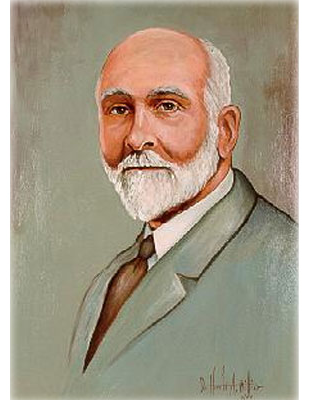
Jonathan Goforth (Chinese name Gu Yuedan, 顾约拿单, also rendered Gu Yuehan, 古约翰; 1859–1936) was a Canadian missionary born in Ontario who came to China in 1888.
Life
Jonathan Goforth (February 10, 1859 – October 8, 1936) was born in Oxford County, Ontario, Canada, the 7th of 11 children. When he was still very young, his mother often read the Psalms aloud to him. By about the age of ten he already took the spiritual growth of his faith seriously, and questions such as the salvation of the soul gradually took root in his heart.
As a youth Goforth aspired to become a politician or lawyer who would influence political life, and he often made speeches in a loud voice in his family's backyard and took part in many political meetings. After coming to faith at seventeen he set out on the path of serving the Lord. Zealous as he was, he regularly went about the streets handing out gospel tracts, or taught Sunday school at church. Later, after reading the memoir of Robert M'Cheyne, he wished to give himself as Robert had given himself for the salvation of the souls of the Jews, and he decided to devote his whole life to the Lord.
At first Goforth had no thought of going overseas as a missionary, until on one occasion he heard a sermon and call from the overseas missionary Dr. Mackay (马偕), and felt the stirring God had placed in his heart, strongly calling him to mission in China. So Goforth entered Knox College to begin his training. When he first enrolled he still met with teasing and bullying from his classmates, but through this he experienced God's grace and love. Goforth, single-minded in his love for the Lord and eager for mission, moved all his classmates, and later, when he set out for China, he was supported by the prayers, encouragement, and gifts of the entire student body of the college.
He graduated from the University of Toronto in 1887, and in 1915 received an honorary Doctor of Divinity degree from Knox College. During his training Goforth studied while continuing to preach in the slums and prisons of the city. In a missionary fellowship in Toronto he met his future wife, Rosalind Bell Smith (Rosalind). Born in London, England, and raised in Montreal, Quebec, Canada, she had resolved, before she knew Goforth, to marry a husband who put the Lord's will first. They were married on October 25, 1887, during Goforth's last year at Knox College. On February 4 of the following year, the Goforths were sent to northern Henan, China, as missionaries. The gospel work they faced was very hard: of their 11 children, 5 died of illness in China.
Influence
Goforth first arrived at Yantai, Shandong Province, where he lived for nine months to learn Chinese; after that his first settled field was Henan. Hudson Taylor (戴德生) was by then a leader to many missionaries, and many Western missionaries held him in high regard. Taylor encouraged the newly arrived missionary, saying, “Go forward on your knees.” He meant that if you want to enter inland China, you must rely on prayer to ask God to guide and lead you; do not think that with your feet and running legs you can go fast and far to do something for God.
Goforth often traveled on preaching circuits, and in the end chose Zhangde (now Anyang), Henan, as his permanent home. Once settled, the Goforths adopted an “open home” method of evangelism, letting people come into their house to look around and preaching the gospel to them. Curious about how foreigners lived, people came in an endless stream to tour the Westerners' bungalow. On one day the number of visitors exceeded 2,000, and in the first five months 25,000 people heard the gospel in their home. Between 1894 and 1899, thousands came to believe in the Lord this way.
After hearing the news from Britain of the great Welsh Revival, he began to spend more time in prayer and Bible reading, seeking revival, and he read the books of the American revivalist Charles Finney, pursuing the spiritual laws of revival. In 1907 he made a trip to Korea and witnessed the great Pyongyang Revival; on his way back he passed through Manchuria (Northeast China) and reported to the churches there what he had seen and heard in Korea. In 1908 Goforth led a great revival in the churches of Manchuria. His main theme was Zechariah 4:6: “Not by might, nor by power, but by my Spirit” (World English Bible). At that time he preached this message again and again. During the great Manchurian revival several thousand people were baptized.
Death
Early in 1930 he returned to Canada and found that the retina of his right eye had detached; even surgery could not cure it, and he became completely blind in the right eye. During four months of rest in hospital he dictated accounts of his mission experiences in China, which he and his wife Rosalind later made into a jointly written book, Miracle Lives of China (1931). After recovering, he returned to China. In 1933 his remaining left eye also went blind, yet he still preached from the platform, deeply moving his hearers, and many came to faith and were saved. Because Rosalind's health was declining, the couple returned to settle in Canada in December 1934.
During two years in North America, Goforth led meetings in many places in Canada and the United States; some churches welcomed him, while others criticized him as too emotional. On October 7, 1936, he preached at a meeting in Wyoming, Ontario on the topic “How the Fire of the Holy Spirit Spread Through Korea,” because in the great Korean Revival of 1907 he had witnessed the inspiring work of the Holy Spirit. That night he went to bed late at his son's home in Wallaceburg, Ontario. The next morning, when his wife came to his side to wake him, she found that Goforth had gone home to heaven peacefully in his sleep, after a sojourn of 77 years on earth. Goforth's funeral was held at Knox Church in Toronto, and he was buried in Mount Pleasant Cemetery in the same city.