💬 Famous Quotes
📋 Basic Information
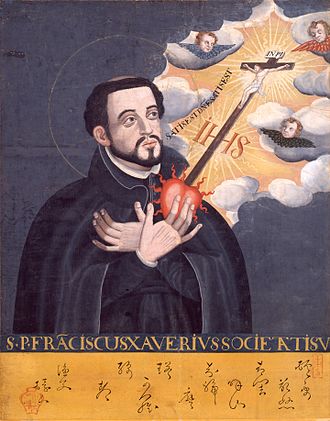
📖 Biography
Saint Francis Xavier (Latin: Franciscus Xaverius; Basque: Frantzisko Xabierkoa; French: François Xavier; Spanish: Francisco Javier; Portuguese: Francisco Xavier; also rendered in Chinese as 圣方济·萨威, 圣方济各·沙勿略 and other forms; secular name Francisco de Jasso y Azpilicueta; April 7, 1506 – December 3, 1552) was a Spanish Catholic missionary and one of the co-founders of the Society of Jesus. The “Xaverians,” a congregation founded long after his death, are named after him; he was the first to bring the Catholic faith to Malacca and Japan in Asia. The Catholic Church calls him “the greatest missionary in history” and “the Apostle of East Asia,” and also honors him as patron of China and Japan and of the two dioceses of Goa and Macau.
Early Life
Francis Xavier was born in 1506 into a prominent Basque family at Xavier Castle in the Kingdom of Navarre (now Navarre, Spain). In 1512 the Spanish invaded Navarre; many local family castles, including the Xaviers', were destroyed at that time, and the family lost its lands for good. In 1515 Francis's father died.
In 1525, at the age of 19, Xavier went to the Collège Sainte-Barbe of the University of Paris in France to study philosophy. Five years later he received a master's degree and began working as a lecturer. In Paris a fellow countryman fifteen years his senior, Ignatius of Loyola, shared lodgings with him. This countryman sought the glory of God, and he often repeated to Xavier a verse from the Bible: “For what will it profit a man, if he gains the whole world, and forfeits his life?” (Matthew 16:26). Under Ignatius's long influence Xavier's thinking gradually changed, and he joined the ranks of those following Ignatius.
On August 15, 1534, seven men including Loyola and Xavier together took vows of poverty and chastity at Montmartre in Paris, founding the Society of Jesus. They had originally intended to go to Jerusalem, but because Venice was at war with the Ottoman Empire no ship could sail, so they went instead to Rome to place themselves at the pope's disposal. On September 27, 1540, Pope Paul III formally approved the founding of the Society of Jesus and made Loyola its first superior general. Xavier was appointed one of the Society's first missionaries.
At that time King John III of Portugal welcomed Jesuits to go and preach in the eastern lands opened up by Portugal. In 1540 Xavier went to Portugal. In 1541 he and two other companions set out along the eastern sea route opened by the Portuguese to preach in India, China, Japan and elsewhere.
Missionary Work: India
On April 7, 1541, Xavier set out from Lisbon, Portugal, with Camerino (M. P. de Camerino) and Mansilla (F. Mansillas).
On May 6, 1542, Xavier reached Goa, the center of Portuguese India. Soon after arriving, without even time to learn the local languages, culture and customs, he was baptizing thousands upon thousands of people in the fishing villages along the southeastern coast of India's Deccan Peninsula.
In January 1545 Francis Xavier wrote in a letter: “Within one month I have baptized more than ten thousand people. My method is this: when I come to the villages of heathen who wish to turn to Christ, I gather all the men and children in one place. I begin by proclaiming the holy names of God the Father, the Son and the Holy Spirit, and have them make the sign of the cross three times, calling on the name of the Holy Trinity and confessing that there is only one God. Then we recite the Act of Contrition, the Creed, the Ten Commandments, the Lord's Prayer, the Hail Mary and the Salve Regina. Within two years I translated all these prayers into their language, and I can recite them myself. Little by little, adults and children alike learn to repeat them. When the prayers are over, I explain to them the articles of the Creed and the meaning of the Ten Commandments. Then I have them publicly ask God's forgiveness for their past lives. When the instruction is finished, I ask them whether they truly believe what the articles of the Creed contain, and all answer with one voice that they believe. Then I recite each article aloud, and after each one I ask whether they believe it; they cross their hands in the form of a cross over their breasts and answer together that they believe. In this way I baptize them, and I write down a saint's name and give it to each of them. After the men are baptized, they go home and send their wives and families to me, and I baptize them in the same way. When everyone has been baptized, I order them to destroy all their temples and idols.”
Xavier translated the Apostles' Creed from Latin into Tamil, Malabar, Malay and other languages.
At the end of August 1545 Xavier went from Malabar to Malacca, and did not leave until January 1546, when he went to preach in the Moluccas. In 1547 he returned to Malacca, and in August of that year he met a Japanese man, Yajirō (弥次郎).
Japan
On August 15, 1549 (the Feast of the Assumption), through the introduction of a Japanese friend, Yajirō, Francis Xavier, accompanied by two Jesuits, Father Torres (岛来斯) and Brother Fernández (斐迪南), traveled by way of the Strait of Malacca and at length reached Yajirō's hometown, Kagoshima in Kyushu in southern Japan. He became the first Catholic missionary to set foot on Japanese soil. By the end of that year 150 people in Kagoshima and 450 in the surrounding area had been baptized.
After landing in Japan, Xavier soon found that conditions there were very different from India: Japanese customs, thought and culture were far more complex than India's. He realized that the methods he had used in India could not simply be transferred to Japan; here he first had to learn the Japanese language and come to know Japanese culture and philosophy, adopt Japanese customs, and expect it to take a long time to bring a person to Christ. Xavier's letters from Japan to Europe were published at once, drew the interest of countless people and struck a deep chord. For a time he was hailed as the modern missionary.
Although he gained the support of local daimyo and planned to go to Kyoto to see the emperor and obtain the right to preach throughout Japan, neither aim succeeded. In 1551 he left Japan for China. By then there were a thousand Christians in Japan. A monument to Xavier still stands in Kagoshima today.
China
Xavier found that Chinese culture had deeply influenced Japan, and he resolved to visit China as soon as possible. At that time, however, it was very difficult for a foreign missionary to enter Ming China, which strictly enforced a ban on maritime trade. In 1552 (the 31st year of Jiajing) he organized a Portuguese embassy to China to seek an audience with the Ming emperor. But at the end of May the embassy was detained at Malacca by the governor, Dom Álvaro d'Ataide da Gama (亚戴德). He then resolved to go to China alone. At the end of August 1552 (the 7th month of the 31st year of Jiajing) he made Shangchuan Island (part of Taishan), very close to the coast of Guangdong, his base and planned to slip into the country. But the Chinese merchant who had promised to smuggle them in changed his mind and never came.
On the morning of December 3, 1552 (the 18th day of the 11th month of the 31st year of Jiajing), Xavier died of malaria on the island, aged only 46, without having fulfilled his wish to enter mainland China. On October 6 of the same year, Matteo Ricci was born in Macerata, Italy. Thirty years later Ricci succeeded in bringing the Catholic faith into China. When the Jesuits built their first cathedral in China between 1847 and 1853, they named it St. Francis Xavier Church (Dongjiadu, Shanghai).
Commemoration
It is said that Xavier's body did not decay for a long time and was shown to people along the way; it was not buried in Goa, India, until 1554. On 12 March 1622 Pope Gregory XV canonized Xavier on the same day as Ignatius, and his tomb became a place of pilgrimage. Malacca, Rome, Tokyo and St. Joseph's Seminary in Macau also each treasure part of Xavier's relics.
2006 was the 500th anniversary of the birth of St. Francis Xavier. The commemorations were to last a full year, and pilgrimages were begun in his homeland of Navarre, in Goa, India, where he is buried, and in Malacca, the Philippines and Japan.
Named after Him
Catholic churches
- St. Francis Xavier Church, Dongjiadu, Shanghai
- Basilica of Bom Jesus, Goa, India
- Church of the Gesù, Rome, Italy
- Kanda Catholic Church, Tokyo (also called St. Francis Xavier Church)
Secondary schools
- Xavier School (光启学校)
- St. Francis Xavier's College, Shanghai → St. Francis Xavier's College, Hong Kong
- St. Francis Xavier's School, Tsuen Wan, Hong Kong
- St. Francis Xavier High School, a private school in Taoyuan City, Taiwan (振声高级中学)
📚 Major Works

🎬 Videos
A Burning Heart for Souls: St. Francis Xavier
St. Francis Xavier
Saint of December: St. Francis Xavier
St. Francis Xavier: The Great Missionary
Videos are hosted on YouTube and uploaded by their original producers. YouTube loads only when you press play and may be unavailable in some regions.