💬 Famous Quotes
📋 Basic Information
📖 Biography
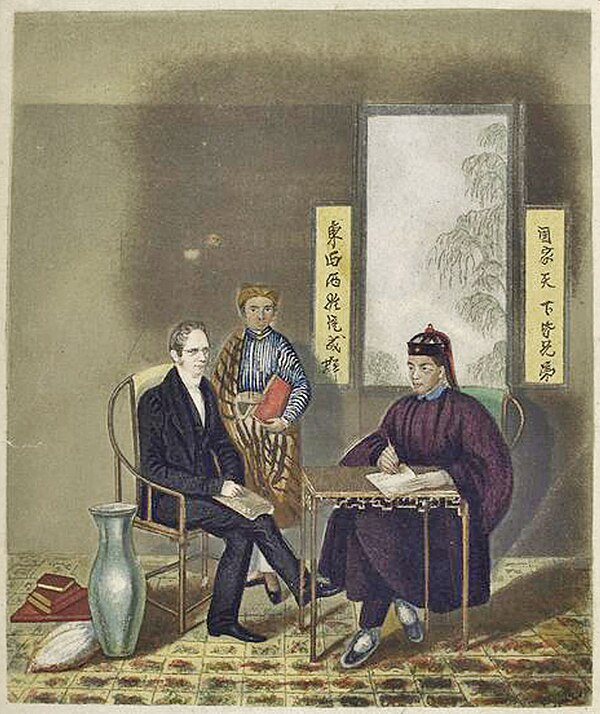
Walter Henry Medhurst (29 April 1796 – 24 January 1857), formerly transliterated in Chinese as Maitehesituo (麦特赫斯脱), Chinese name Mai Dusi (麦都思), was a British Congregationalist missionary and sinologist, who styled himself Mohai Laoren (墨海老人, “the Old Man of Mohai”).
Life
Medhurst was born in London, England, in 1796. He learned printing in London. In 1816 he was sent to Malacca by the London Missionary Society. In Malacca he learned Malay, Chinese and several Chinese dialects, and helped edit the Chinese periodical Chashisu Meiyue Tongjizhuan (Chinese Monthly Magazine). In 1819 he was ordained a minister in Malacca; he worked as a missionary in Malacca, Penang and Batavia (now Jakarta), and printed 30 Chinese books by woodblock and lithography. During his years in Malaya, besides publishing various missionary tracts in Chinese and Malay, Medhurst devoted himself to the study of Chinese history and culture. In 1838 he published the results of his research in London: China: Its State and Prospects, a book of nearly 600 pages that introduced Chinese history and civilization to Europeans in depth. Its chapters include:
- Chinese chronology and territory
- The population of China
- Chinese civilization
- Etiquette, Chinese wisdom, the compass, printing, gunpowder, astronomy, botany, medicine, surgery, painting, carving, silk, porcelain, papermaking, lacquerware
- The government and laws of China
- The language and literature of China
- The religions of China
- The Christian church in China
- The Jesuit church in China
In 1843 Medhurst came to Shanghai on behalf of the London Missionary Society, the first Protestant missionary to reside in Shanghai. In 1843, with William Charles Milne and other missionaries, he founded the London Missionary Society Press (Mohai Shuguan) in Shanghai to print and publish Chinese books; William Muirhead and Joseph Edkins joined later. At the press, with the help of Wang Tao, Medhurst translated the Bible into Chinese (the high classical, or Shen Wenli, Bible).
In March 1845 Medhurst stayed overnight in a small town on the banks of the Wusong River. The next day, adopting local customs, he shaved his forehead, fixed a false queue to the back of his head, put on dark crystal spectacles, dressed in the clothes of ordinary Chinese people and wore a skullcap, and took a boat to the silk and tea producing areas of Jiangsu and Zhejiang, where he investigated the cultivation of mulberry trees, silkworm raising, and the picking and processing of tea. He wrote a book on it, A Glance at the Interior of China, Obtained during a Journey through the Silk and Green Tea Districts.
The London Missionary Society station he established around Shandong Road, including the Mohai Press, the Tian'an Church (Union Church) and the Renji Hospital, was known as “Maijiaquan” (the Medhurst compound). In March 1848 Medhurst, in violation of Qing government regulations, went to Qingpu to preach and came into conflict with the grain-transport boatmen there, leading to the Qingpu Incident. In the 8th month of 1854 he travelled with Wang Tao and William Muirhead to Dongshan near Suzhou and climbed the highest peak of Mount Moli; in the same year he was elected to the first Shanghai Municipal Council. In 1856 Medhurst left his post and returned to Britain. He died in London in 1857.
In 1904 the London Missionary Society, in memory of Medhurst, founded Medhurst College (Mailun Shuyuan, now Mailun Middle School) on Zhaofeng Road (now Gaoyang Road) in Hongkou, Shanghai. In the past, the Shanghai International Settlement had a road named after him (or his son), Medhurst Road, today's Taixing Road.
Medhurst's son, Sir Walter Henry Medhurst (麦华陀), served as British consul in Shanghai.
Writings
- Mazupo Shengri zhi Lun [On the Birthday of Mazu], 1826, Batavia
- Shentian Shitiao Shengjie Zhujie [Commentary on the Ten Commandments], 1826, Batavia
- Xiongdi Xutan [Conversations between Brothers], 1828, Batavia
- Tahuo zhi Shi Lun [On Fire-Walking], 1828, Batavia
- Dongxi Shilüe Hehe [Harmonized Outline of Eastern and Western History], 1829, Batavia
- Yesu Shuzui zhi Lun [On the Atonement of Jesus], 1829, Batavia
- Xiangxun [Village Instructions], 1829, Batavia
- Wenda Qianzhu Yesu Jiaofa [Catechism with Simple Notes on the Religion of Jesus], 1832, Batavia
- Shenli Zonglun [General Treatise on Theology], 1833, Batavia
- Fuyin Tiaohe [Harmony of the Gospels], 1834, Batavia
- Lun Shan'e Ren Si [On the Deaths of the Good and the Wicked], 1829, Malacca
- Xin Yizhao Shu [New Testament], 1837, Batavia
- Lunyu Xinzuan [New Compilation of Sayings], 1840, Batavia
- Shengjiao Yaoli [Essentials of the Holy Religion], 1844, Shanghai
- Qidao Shiwen [Forms of Prayer], 1844, Shanghai
- Za Du [Miscellany], 1844, Shanghai
- Zhenli Tongdao [Way to the Truth], 1846, Shanghai
- Yesu Jiaolüe [Outline of the Religion of Jesus], 1846, Shanghai
- Yesu Jiangshi Zhuan [Life of Jesus], 1846, Shanghai
- Mataifuyin Zhu [Commentary on Matthew], 1846, Shanghai
- Yuehan Chuan Fuyin Shu [The Gospel of John], 1847, Shanghai
- Tiandi Zongzhi Lun [On the Purposes of the Supreme God], 1848, Shanghai
- Jiushizhu Zhi Yesu Yiren [Jesus the Only Saviour], 1856, Shanghai
- Shi Yang Gui Mu [The Lost Sheep Returns to the Shepherd], 1856, Shanghai
- Junzi Zhongri Weishan [The Gentleman Does Good All Day], 1856, Shanghai
- Suizhong Zicha Xingwei [Examining One's Conduct at Year's End], 1856, Shanghai
- E Zhe Bude Ru Tianguo [The Wicked Shall Not Enter the Kingdom of Heaven], 1856, Shanghai
- Chinese and English Dictionary, 2 volumes.
- English and Chinese Dictionary, 2 volumes.
- [Account of Travels in Java and Bali], 1829
- A Dictionary of the Hok-këèn Dialect of the Chinese Language, 1832–1837 (Macau).
- China: Its State and Prospects, 1838.
- A Glance at the Interior of China, Obtained during a Journey through the Silk and Green Tea Districts, by Medhurst, published by the London Missionary Society Press, 1845.
- [Comparative Vocabulary of the Chinese, Korean and Japanese Languages]
- An Inquiry into the Proper Mode of Rendering the Word God in Translating the Sacred Scriptures into the Chinese Language, 1848
Translations:
- The Old Testament, 1855, Shanghai
- The New Testament, 1852, Shanghai
- The Thousand Character Classic, translated by Medhurst, Batavia, 1835
- Dictionary of the Favorlang language (of Formosa), by Gilbertus Happart, 1650, translated by Medhurst, 1840
- The Shoo King (Book of Documents), translated by Medhurst, published by the London Missionary Society Press, 1846
- Wang Dahai's Haidao Yizhi: Chinaman Abroad, or a desultory account of Malayan archipelago by Ong tae hae, translated by Medhurst, London Missionary Society Press, 1849, Shanghai
- Nongzheng Quanshu [Complete Treatise on Agriculture], abridged translation, 1849, London Missionary Society Press, Shanghai