💬 Famous Quotes
📋 Basic Information
📖 Biography
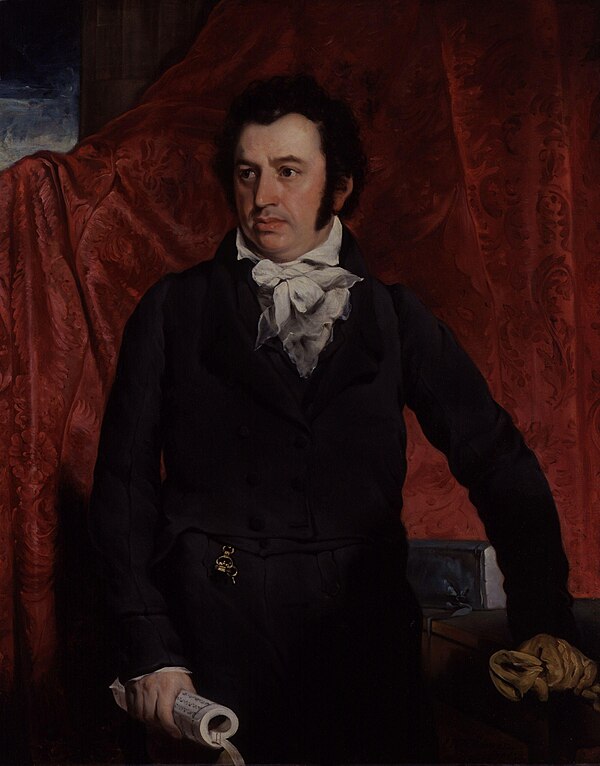
Robert Morrison (5 January 1782 – 1 August 1834) (also rendered in Chinese as 罗拔・摩理臣) was an English-born Scottish missionary, born at Buller's Green, Morpeth, Northumberland, England, the son of James Morrison and Hannah Nicholson. In 1807 (the 12th year of Jiaqing of the Qing dynasty) he was sent to China by the London Missionary Society and arrived in Guangzhou (Canton). He was the first Protestant missionary sent to China from abroad, and worked for the British East India Company for 25 years. In Guangzhou he did a great deal of cultural work: he was the first to translate the entire Bible into Chinese and publish it; he single-handedly compiled China's first Chinese–English dictionary, Huaying Zidian (A Dictionary of the Chinese Language); and he wrote Zhongguo Yilan [A View of China], the Vocabulary of the Canton Dialect (1828) and other important works of early modern cultural exchange between China and the West. He baptized Cai Gao (蔡高), the first Chinese Protestant, and ordained Liang Fa (梁发), the first Chinese pastor. With William Milne and others he founded in Malacca the Anglo-Chinese College, the Chinese monthly Chashisu Meiyue Tongjizhuan (the Chinese Monthly Magazine) and the English periodical The Indo-Chinese Gleaner, and in Macau he published the Chinese periodical Zawen Pian (杂闻篇). The Anglo-Chinese College was the first Chinese-language school opened by modern missionaries, and Morrison served as its chaplain. He also helped James Matheson run The Canton Register, the first English-language newspaper published in China. He died in Guangzhou on 1 August 1834, aged 52, and was buried in the Old Protestant Cemetery in Macau.
Life and Career
In 1804, aged 22 and having already studied theology for two years, Morrison joined the London Missionary Society (LMS), a British overseas mission organization, and was appointed to go to China. He wrote: “I ask God to place me in the mission field where the difficulties are greatest and where, in human eyes, success is hardest.” After his application was accepted, the LMS engaged Yang Sande (杨三德), a Chinese man living in England, to teach Morrison Chinese. He also studied some astronomy and medicine, hoping, like Matteo Ricci, to enter China as one who could impart Western science and technology, for he knew well that the Qing dynasty was then closed and there was no freedom to preach. To enter China he needed another point of entry; medicine and astronomy were fields in which the West was then more advanced, so he hoped to use them as a medium of exchange to enter China.
In 1807 Morrison set out from England for China. At that time the British East India Company held a monopoly on the route from London to Guangzhou, and to avoid offending the Qing government, which banned missionary work, by carrying a missionary, the company refused him passage. He therefore went first to New York and from there to Guangzhou, changing ships and arranging his papers in New York. While he was completing the formalities, a clerk of the New York shipping company, learning that he was bound for China, said to him scornfully, “Morrison, do you think that you alone can change China's 5000 years of idol worship?” Morrison gave a famous reply: “I cannot, but I believe God can.” With this conviction and faith he reached China. He left New York on 12 May 1807 aboard the merchant ship Trident and arrived in Macau on 4 September (the 3rd day of the 8th month of the 12th year of Jiaqing).
On 7 September 1807 (the 6th day of the 8th month of the 12th year of Jiaqing), Morrison entered Guangzhou. Because he could not enter other parts of China, he stayed at the Thirteen Factories (十三洋行) in Guangzhou, living in hiding under the protection of a consul at the American consulate in Guangzhou. For 1 year he lived in hiding in Guangzhou and Macau, studying Chinese hard. In 1809 (the 14th year of Jiaqing) he married the daughter of Morton, a British army surgeon, and in the same year was engaged as senior translator by the East India Company, which sold opium. From then on Morrison had a public identity as an employee of the East India Company, moving between Guangzhou and Macau. He studied Chinese in secret, to understand Chinese culture and to prepare to preach the gospel to the Chinese. At first he met many difficulties, but later his Chinese became quite good.
Work
Preparing for mission
In 1812 (the 17th year of Jiaqing) Morrison began compiling a Chinese grammar (Zhongwen Wenfa, also called Zhongwen Facheng), because he knew that although he could not preach freely, Western missionaries who came to China would have to learn Chinese well.
While secretly printing missionary books, Morrison came to know a group of block-cutters and printers who worked for him. On 9 September 1814 (the 16th day of the 7th month of the 19th year of Jiaqing), Cai Ke (蔡科) of Xiangshan County, Guangdong (a not very reliable 20th-century document gives his name as Cai Gao, which is mistaken), became a Protestant and was baptized by Morrison; he was the first Chinese Protestant believer.
In 1818 (the 23rd year of Jiaqing) he founded the Anglo-Chinese College in Malacca, together with a movable-type printing press.
In December 1823 (the 11th month of the 3rd year of Daoguang), Morrison appointed Liang Fa a lay evangelist of the London Missionary Society; in 1827 (the 7th year of Daoguang) he ordained him as a minister, making Liang Fa the first Chinese Protestant minister. Liang Fa assisted Morrison with printing. In 1832 Liang Fa wrote in Chinese a book called Quanshi Liangyan [Good Words to Admonish the Age], which he handed out to candidates at the provincial examinations. This book later became the basis of the thinking of Hong Xiuquan (洪秀全), founder of the Taiping Heavenly Kingdom.
In 1823 (the 3rd year of Daoguang) Morrison published an important Chinese–English dictionary, Huaying Zidian (A Dictionary of the Chinese Language). At that time most Europeans understood English, so missionaries who knew English could use this dictionary to learn Chinese or to do translation work. The dictionary and his tracts on Christian doctrine were therefore Morrison's important contributions. In this foundational work he was helped by Liang Fa and one or two other Chinese assistants.
Translating the Bible
In 1810 (the 15th year of Jiaqing), only three years after coming to China, Morrison had already begun translating Acts, Luke and John. In 1813 (the 18th year of Jiaqing) he finished translating the whole New Testament (耶稣基利士督我主救者新遗诏书, Yesu Jilishidu Wo Zhu Jiuzhe Xin Yizhao Shu) and published it secretly in Guangzhou. In 1819 (the 24th year of Jiaqing) Morrison and William Milne, another LMS missionary, completed the translation of the Old Testament, which was published in Malacca. By 1823 (the 3rd year of Daoguang) the Old and New Testaments were published together under the title Shentian Shengshu (神天圣书) (during celebrations of Morrison's arrival in China a few years ago, a facsimile edition was published in Hong Kong). Morrison's Chinese Bible was the first Chinese Bible published on Chinese soil (slightly later than the Marshman translation published abroad); after it came the Chinese Bible translated by Elijah Coleman Bridgman (1863, the 2nd year of Tongzhi) and other classical-Chinese versions. Morrison's version came very early and its translation was careful and apt, so his Chinese Bible had considerable influence on later versions.
Publishing periodicals
On 5 August 1815 (the 1st day of the 7th month of the 20th year of Jiaqing), Morrison published in Malacca the first Chinese-language newspaper aimed at Chinese readers, Chashisu Meiyue Tongjizhuan (the Chinese Monthly Magazine). It introduced Western science, law and other new knowledge, and also explained Christian doctrine and the Bible. Through this new material he gave Chinese readers some understanding of Western culture and of the teaching of the Bible.
Morrison set up a printing works with movable metal type attached to the Anglo-Chinese College in Malacca. Its movable Chinese metal type was created by Samuel Dyer (台约尔), an LMS missionary and the father-in-law of Hudson Taylor, and made it possible to print Bibles and mission magazines in large quantities.
On 29 April 1833 (the 10th day of the 3rd month of the 13th year of Daoguang), Morrison published the Chinese periodical Zawen Pian in Macau; it ceased publication on 17 October of the same year (the 5th day of the 9th month of the 13th year of Daoguang). It was printed on both sides of a single sheet in the style of a modern periodical; three issues appeared, each of 4 pages, and most of the content promoted the Protestant faith. It was also the earliest Chinese periodical printed with metal movable type, the earliest published within China, and the earliest published in the history of Macau, and it is evidence that “Macau was the first place where Western movable-type printing was used to print Chinese.”
Teaching Chinese and founding schools
Morrison was fluent in both Cantonese and Nanjing Mandarin. From the 1810s to the 1830s the East India Company's Canton Factory employed Morrison as its Chinese translator and ran Chinese classes, at first teaching only Nanjing Mandarin. In 1828 the head of the Canton Factory ordered the staff to learn Cantonese as well, and Morrison took the opportunity to compile the Vocabulary of the Canton Dialect as a textbook. Morrison's teaching of Nanjing Mandarin and Cantonese was the earliest teaching of Chinese as a second language in Britain, and laid the documentary foundation for the institutionalization of Chinese teaching and research in 19th-century Britain.
In 1818 (the 23rd year of Jiaqing) Morrison founded the Anglo-Chinese College in Malacca to educate Chinese youths and children and to train future missionaries to China; it was the first Western-style school for Chinese. In 1843 (the 23rd year of Daoguang) the college moved to Hong Kong, where it produced many Christian workers for Hong Kong.
In 1828 (the 8th year of Daoguang) Liang Fa and Gu Tianqing (古天青) also set up the first Christian private school, a school for children, in Gaoming County, Guangdong. It was an early new-style school; besides literature and culture, it taught the Bible and introduced Western science, geography and English.
Family
Morrison married twice. His first marriage, in Macau, was to Mary Morton; they had two sons and a daughter:
- His eldest son, James, died soon after birth.
- His eldest daughter, Mary Rebecca Morrison, married the missionary Benjamin Hobson.
- His second son, John Robert Morrison, was a translator in the negotiations for the Treaty of Nanking and a member of Hong Kong's first Executive Council and Legislative Council.
After Mary Morton died of illness in Macau in 1821 (the 1st year of Daoguang), Morrison remarried in England three years later and had five children.
Things Named after Him
- Hong Kong
- Morrison Hill, in Wan Chai
- The Morrison School (马礼逊学堂), Hong Kong's first Western-style school
- Morrison Hill Technical Institute, Hong Kong's first technical institute, now called the Hong Kong Institute of Vocational Education (Morrison Hill)
- Morrison Hill Swimming Pool, the public swimming pool at Morrison Hill
- Morrison Hill Road, the road at the foot of Morrison Hill
- Morrison Street, in Sheung Wan
- The Morrison memorial, in the Hong Kong Cemetery, Happy Valley
- The Morrison Memorial Centre, in Mong Kok, now the headquarters of the Hong Kong Council of the Church of Christ in China
- Morrison Hall, in the University of Hong Kong's Jockey Club Student Village II, Pok Fu Lam
- Morrison House, a house of YMCA of Hong Kong Christian College, founded by the YMCA of Hong Kong
- Morrison Building, a declared monument, beside the Church of Christ in China Hoh Fuk Tong College
- Macau
- The Morrison memorial (Macau), in the Protestant Cemetery, Macau
- Guangzhou
- The Morrison Memorial Church, originally near Wuxianmen, Changdi, Guangzhou; since demolished
- Taiwan
- Morrison Academy, Taichung, in Shuinan, Taichung
- Shanghai
- Morrison Road, now Maolin Road, Hongkou District
- Born: 5 January 1782, Bullers Green, Northumberland, England
- Died: 1 August 1834 (aged 52), Guangzhou, Guangdong Province, Qing China
- Burial: Protestant Cemetery, Macau
- Nationality: British
- Occupation: translator for the British East India Company; missionary
- Known for: the first Protestant missionary to arrive in China
- Faith: Protestant Christianity
- Parents: James Morrison and Hannah Nicholson
📚 Major Works


🎬 Videos
The First Protestant Missionary to China (Bibles Not Bombs: Day 4)
The Missionary (Documentary Excerpt): Robert Morrison's Years of Hardship
Church History, Missionary Series (5): Robert Morrison
Great Missionaries (1): Robert Morrison
Robert Morrison Memorial Mission Conference: Morrison's Missionary Strategy
Videos are hosted on YouTube and uploaded by their original producers. YouTube loads only when you press play and may be unavailable in some regions.