💬 Famous Quotes
📋 Basic Information
📖 Biography
Joachim Bouvet (1656–1730), Chinese name Bai Jin (白晋, also written 白进), courtesy name Mingyuan (明远), was a French Jesuit missionary.
Mission to China
Bouvet was born in Le Mans, France. He entered the Society of Jesus in 1678, and in 1684 was chosen by King Louis XIV to go on a mission to China. Before setting out he was given the title of “King’s Mathematician” and made a member of the French Academy of Sciences. His companions were Jean de Fontaney (洪若翰), Claude de Visdelou (刘应), Guy Tachard (塔夏尔), Louis Le Comte (李明) and Jean-François Gerbillon (张诚).
On 3 March 1685 the party sailed from Brest. When they passed through Siam, Tachard was retained by the King of Siam. The other five reached Ningbo, Zhejiang, in the 26th year of Kangxi (1687). Because the maritime ban had not yet been lifted, foreigners could not travel into the interior, and the Qing government ordered them to return home. But Ferdinand Verbiest (南怀仁) explained that they had been sent by the King of France and were skilled in astronomy and the calendar. The following year they entered Beijing; Bouvet and Gerbillon were retained by Kangxi to attend him at court, while the other three returned to Zhejiang. Bouvet taught Kangxi Euclidean geometry. In the 32nd year of Kangxi (1693), Kangxi sent Bouvet to France as his envoy.
Mapping China
In the 47th year of Kangxi (1708), Bouvet, Jean-Baptiste Régis (雷孝思) and other missionaries were ordered by the emperor to survey and map China. Bouvet had only just left the capital when his horse took fright and threw him; his back was injured so badly that he could not go on. He stayed in Shenmu County, Shaanxi, to recover, and later returned to Beijing to rest, where he gathered the regional maps drawn by the various missionaries and combined them into a general map of all China. In the 56th year of Kangxi (1717), the emperor named it the Huangyu Quanlan Tu (皇舆全览图, “Complete Map of the Imperial Territories”).
Writings
- Portrait historique de l'empereur de la Chine (Paris, 1697) [a historical portrait of the Kangxi Emperor]
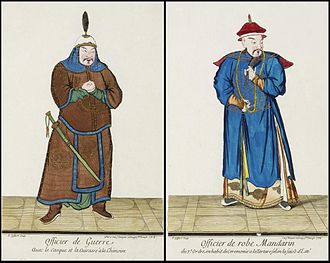
- L'Etat présent de la Chine (Paris, 1697) [illustrations of present-day China]
- Tianxue Benyi (天学本义) [The Original Meaning of the Learning of Heaven]
- Gujin Jingtian Jian (古今敬天鉴) [Mirror of Reverence for Heaven, Ancient and Modern]
- Yi Kao (易考) [A Study of the Book of Changes]