💬 Famous Quotes
📋 Basic Information
📖 Biography
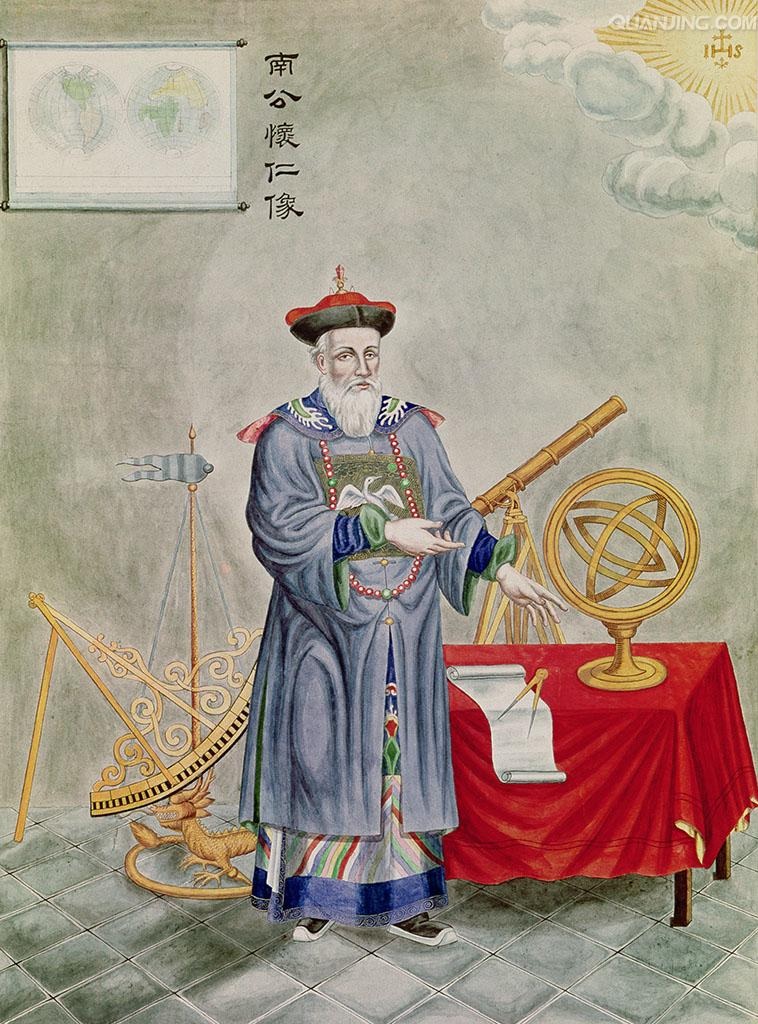
Father Ferdinand Verbiest (Dutch: Ferdinand Verbiest, 9 October 1623 – 28 January 1688), Chinese name Nan Huairen (南怀仁), courtesy names Dunbo (敦伯) and Xunqing (勋卿), was a Fleming of the Netherlands, born in Pittem (now in Belgium). He was a Catholic Jesuit religious and priest, and a missionary who came to China in the Kangxi era of the Qing dynasty. He has a biography in the Draft History of Qing (Qingshi Gao).
Life
Verbiest was born on 9 October 1623 in the small Belgian town of Pittem, the eldest son of Joos Verbiest, a bailiff and tax collector. From the age of 12 he attended a Jesuit school, and at 17 he began studying at the Faculty of Arts of the University of Leuven. While studying at this old Catholic university, Verbiest was introduced systematically to the teachings of Aristotle, especially his logic and philosophy, and through the study of cosmology he gained knowledge of astronomy, mathematics, calendrical calculation, geography and other subjects.
Verbiest entered the Society of Jesus on 2 September 1641. In 1658 he set out for China with Martino Martini, and in 1659 (the 16th year of Shunzhi) he arrived in Macau. Verbiest was first a missionary in Shanxi; in 1660 (the 17th year of Shunzhi) he was summoned to Beijing to assist Father Johann Adam Schall von Bell. After Schall's death, on 1 April 1669 (the 1st day of the 3rd month of the 8th year of Kangxi), Verbiest succeeded him and was appointed vice-director of the Imperial Board of Astronomy (Qintianjian). Verbiest also cast Hongyi (“red barbarian”) cannons for the Qing court. In 1669 (the 8th year of Kangxi) he wrote Lifa Budeyi Bian [A Refutation of “Budeyi” on the Calendar], refuting point by point the errors of Yang Guangxian and Wu Mingxuan in calendrical calculation. Against traditional Chinese ideas such as omen-reading from celestial phenomena, geomancy and divination, he also wrote in the same year Wangtui Jixiong zhi Bian [Refutation of False Predictions of Good and Ill Fortune], Wangzhan Bian [Refutation of False Divination] and Wangze Bian [Refutation of False Selection of Days].
In 1672 (the 11th year of Kangxi) Verbiest designed a vehicle powered by steam for the Kangxi Emperor of China. It was a toy vehicle 65 cm long, unable to carry passengers or a driver. It is not certain whether the vehicle he designed was ever successfully built. This may be the earliest automobile ever designed. (A picture of the vehicle appears in an 18th-century publication.)
In 1688 (the 27th year of Kangxi) Verbiest died in Beijing. The Kangxi Emperor posthumously conferred on him the title of Junior Vice-Minister of Works (gongbu you shilang) and the posthumous name Qinmin (勤敏). He was buried in the same cemetery as Matteo Ricci and Johann Adam Schall von Bell, now located at the Tenggong Zhalan Maweigou church outside Fuchengmen.
Major Works
Religious works:
- Jiaoyao Xulun [Introduction to the Essentials of the Faith], 1 juan (1670)
- Shan'e Bao Lüeshuo [Brief Account of the Recompense of Good and Evil], 1 juan (1670)
Scientific works:
- Yulan Xifang Yaoji [Essential Account of the West, for Imperial Reading], 1 juan (1669)
- Ceyan Jilüe [Brief Record of Astronomical Verification], 1 juan (1669)
- Astronomia Europaea (a work in Latin), 1 juan (1687)