💬 Famous Quotes
📋 Basic Information
📖 Biography
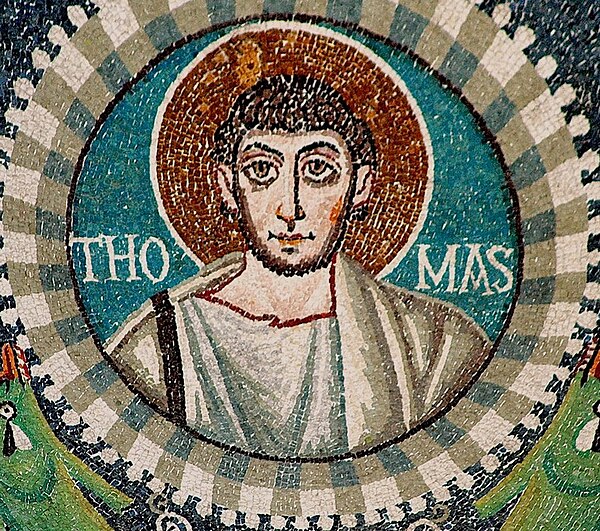
Thomas (in Chinese Catholic usage Duomo, 多默), also called “Didymus” (meaning “twin”), was one of the twelve disciples of Jesus. In recent years some scholars have argued that Thomas was Jesus' twin brother, but this view still awaits verification. The Synoptic Gospels and the Acts of the Apostles include him in the lists of the disciples (Matthew 10:3, Mark 3:18, Luke 6:15), but there is little information about him; the accounts of him are concentrated in the Gospel of John.
Thomas in the New Testament
The Gospel of John mentions him several times. When Lazarus had just died, Jesus told the disciples that he would go into Judea again, and the disciples said this would be a dangerous journey (John 11:7–8), because the Jews had earlier sought to stone him. When Jesus made his determination clear, Thomas said to the other apostles, “Let's go also, that we may die with him!” (John 11:16)
At the Last Supper, when Jesus told the disciples plainly that he was about to leave, assured them that he would come again and take them to the place he had prepared so that they would live with him, and also said that they knew the way (John 14:1–4), Thomas objected that they did not know (John 14:5). In reply Jesus gave a detailed and hard-to-understand discourse about his relationship with God.
Thomas is best known from John 20:24–25: he doubted that Jesus had risen and said that he would believe it only if he could touch his wounds; and Jesus showed the wounds on his body, proving that he had risen. After seeing the living Jesus, Thomas declared, “My Lord and my God!” Jesus said to him, “Stop doubting and believe… Because you have seen me, you have believed; blessed are those who have not seen and yet have believed.”
Thomas in Church Tradition
According to church tradition, Thomas later went to India to preach the gospel and was martyred there. Historically it cannot be determined whether Thomas visited northern India, though it is not impossible; tradition says he was martyred in southern India. Tradition holds that he was martyred in AD 72 near present-day Chennai, killed by local Hindus. Indian church tradition keeps 3 July as the day of his martyrdom, observed as “St Thomas Day” (the Catholic Church today also commemorates him on 3 July; the older calendar and the Anglican Church use 21 December, and the Eastern Orthodox Church 6 October). In India there is also a group who call themselves “Thomas Christians,” because they believe that Thomas brought Christianity to Kerala in AD 52 and afterwards stayed in India without returning, until his martyrdom.
Jerome, honoured as the most learned Latin Father of the Western Church, a Christian scholar and Bible translator, wrote in his Letter to Marcella (Letter 59) that Christ was “with Thomas in India, with Peter at Rome…” Traces of Thomas can also be seen in the church records mentioned in the works of Eusebius of Caesarea. Thomas carried the Christian faith to the buffer kingdom of Osrhoene to the northeast. According to Eusebius's Ecclesiastical History, King Abgar of its capital, Edessa, wrote to Jesus asking to be healed; after Jesus' ascension, Thomas sent Thaddaeus (known in Syriac tradition as Addai), one of the seventy disciples recorded in Luke chapter 10, to Edessa. Tradition holds that Thomas was killed with a spear. The early church used a spear and a carpenter's square as emblems symbolizing Thomas's faithfulness and sacrifice. He is the patron saint of the blind, and of India, Pakistan and Sri Lanka.
The Gospel of Thomas
In the early church a Gospel of Thomas circulated, said to have been written by the apostle Thomas. In the mid-fourth century, Bishop Cyril of Jerusalem (315–386) held that this document came from one of the three disciples of Mani. However, about a third of the document overlaps with the Synoptic Gospels, and it is the closest to the canonical Gospels of any ancient document found so far. This sayings-style apocryphal gospel contains a good many passages close to the spirituality of Zen Buddhism.
The Gospel of Thomas was not accepted into the canon of Scripture by the early church, precisely because of its Gnostic content.
📚 Major Works
🎬 Videos
Thomas the Apostle's Mission to India
Videos are hosted on YouTube and uploaded by their original producers. YouTube loads only when you press play and may be unavailable in some regions.