💬 Famous Quotes
📋 Basic Information
📖 Biography
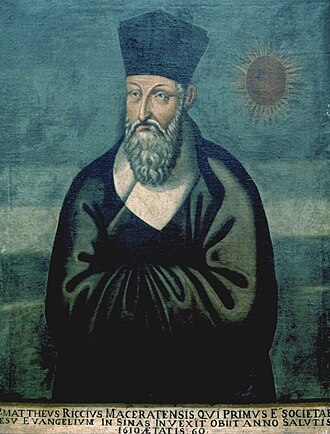
Matteo Ricci (6 October 1552 – 11 May 1610), Chinese name Li Madou (利玛窦), with the sobriquet Xitai (西泰) and the further sobriquets Qingtai (清泰) and Xijiang (西江), was an Italian Catholic priest of the Society of Jesus, a missionary and a scholar. In 1583 (the 11th year of Wanli, under Emperor Shenzong of Ming) he went to live in Ming China. He was highly respected by the Ming scholar-officials, who honoured him as “the Confucian scholar from the Far West” (泰西儒士). He was one of the pioneers of Catholic missionary work in China, and the first Western scholar to read Chinese literature and make a close study of the Chinese classics. Besides spreading Catholic teaching, he made friends widely among Chinese officials and prominent people and passed on Western scientific and technical knowledge in astronomy, mathematics, geography and other fields. His writings made an important contribution to exchange between China and the West, and also had an important influence on how Japan and the states of the Korean Peninsula came to know Western civilization.
In 1984 he received the title Servant of God. In 2011 the Catholic Diocese of Macerata began proceedings for the beatification of the Jesuit Father Matteo Ricci. On December 17, 2022, Pope Francis declared Ricci Venerable.
Becoming a Jesuit
Ricci was born in 1552 (the 31st year of Jiajing in the Ming calendar) in the city of Macerata in the Papal States (now in the Marche region of Italy). It was still the Renaissance, and the peninsula was divided among many city-states. His family ran the Ricci pharmacy and was a leading family of the town. Ricci studied at a local secondary school run by the Jesuits, and his father was always worried that he would join the Society of Jesus.
At sixteen Ricci went to Rome and did preparatory studies at the college of Sant'Andrea, and on the Feast of the Assumption in 1571 (the 5th year of Longqing in the Ming calendar) he joined the Society of Jesus. In 1572 (the 6th year of Longqing) he studied philosophy and theology at the Jesuit-run Roman College, and studied astronomy and mathematics under the mathematician Christopher Clavius; Alessandro Valignano was also his teacher at that time. During this period he also learned Latin and Greek, and could use Portuguese and Spanish as well.
Journey to India
In 1577 (the 5th year of Wanli) Ricci received permission to go to the Far East as a missionary. On 24 March 1578 (the 6th year of Wanli) he sailed from Lisbon with 14 other Jesuits for mission work in India. Rounding the Cape of Good Hope and passing by Mozambique, after a voyage of 6 months they finally reached Goa in India, Portugal's most important colony in Asia, on 13 September. The journey was very hard: before they reached Goa, 13 of the 400 slaves from Mozambique on board had died.
Before coming to India, because of Francis Xavier's earlier praise of the country and the Church's idealized picture of it, the India Ricci had heard of was a most attractive place where mission work was relatively easy. The contrast with reality left him greatly puzzled. In 1580 (the 8th year of Wanli), in a letter written in Portuguese to the Jesuit historian Maffei, he said: “If one looks at the commentaries and maps concerning India and Japan, one finds obvious errors everywhere.” Still, the Jesuit mission in Japan was going very well, and in India believers of the Nestorian branch of Christianity (Jingjiao, 景教) had been found. This greatly lifted the spirits of Ricci and his companions.
Ricci worked as a missionary in Goa, Cochin and elsewhere in India for four years. During that time he also studied the humanities at the seminary in Goa, and after being ordained priest on 26 July 1580 (the 8th year of Wanli) he went on to study theology. In India he came to believe that local people should also be allowed to study European learning such as philosophy, doctrine and theology, and he wrote to the Jesuit headquarters raising this question. In his view: “If we prevent them from taking up office alongside others — from rising through learning — I fear they will hate us, and the chief purpose of our Society in India, the mission of moving the heathen to convert to our holy faith, will come to nothing.” This was also the attitude Ricci held after he entered Ming China, and he kept this view all his life. The Life of Matteo Ricci (Li Madou Zhuan, 利玛窦传) by Luo Guang (罗光) says that “it was through this very spirit that he was able to win the respect of our country's scholar-officials.”
Arrival in Macau; Living in Guangzhou
In 1581 (the 9th year of Wanli) Father Michele Ruggieri recommended Ricci to Alessandro Valignano, Visitor of the missions in the East. In 1582 (the 10th year of Wanli) Ricci was called to go to China as a missionary, and on 7 August he arrived in Macau.
The missionaries wanted to attract Ming officials and common people by writing on Catholic teaching in Chinese — “practising writing in their language, as a means of attracting and capturing their hearts.” So they first worked hard at learning Chinese in Macau. He took off Western clothes and put on Chinese dress, studied two forms of early modern Chinese at the same time — the Nanjing Mandarin of the day and the Guangzhou (Cantonese) dialect — and read a great many Chinese books. Ricci was excited by Chinese characters, so completely different from alphabetic writing. Besides this, while he was in Macau the Tenshō embassy to Europe from Japan happened to pass through, and Ricci took the opportunity to learn a little Japanese.
In Guangzhou Ricci stayed at the Huaiyuan Hostel (怀远驿). On 10 September 1583 he travelled along the West River (Xijiang) to Zhaoqing. Seeing the beauty of its lakes and hills and the kindness of its people, he decided to stay and begin mission work there.
Settling in Zhaoqing
In 1583 (the 11th year of Wanli) Ricci and Father Michele Ruggieri received permission to live in Zhaoqing, Guangdong, and were received by Guo Yingpin (郭应聘), Viceroy of Guangdong and Guangxi, and Wang Pan (王泮), Prefect of Zhaoqing (the official title was zhifu, prefect). They told the Chinese officials that they came from “Tianzhu” (India), so that the Chinese took them for Buddhists. Ricci explained why they had come to China: “We are clergy who have come from the distant West. Because we admire China, we hope we may stay and serve the Lord of Heaven here until we die.” He did not dare to state openly that their purpose was to spread the faith, or he might have been expelled. For the sake of their mission they had brought many objects from the West, such as images of the Virgin Mary, maps, astrolabes and prisms. Among them was Euclid's Elements, which Ricci taught to scholars in Zhaoqing and Shaozhou. This was the beginning of Chinese study of Western geometry.
The many new Western things Ricci brought attracted a great many curious Chinese. The maps he brought, in particular, opened Chinese eyes to the wider world.
In August of that year they built the Xianhua Temple (僊花寺; 僊 is the same as 仙) in Zhaoqing and began mission work. At first they worked very quietly. The fathers acted with great care and spent most of their energy learning Chinese and Chinese etiquette and customs, in order to win the trust of the Chinese, above all the officials. They wore the robes of Buddhist monks, thinking that this would win people's goodwill, and they also felt it was not very different from the dress of Catholic priests. This made the Chinese all the more convinced that they were monks from afar. They hung up a picture of the Virgin Mary there, and many scholars and officials, even monks, came and knelt before it, which greatly excited them. From the Chinese point of view, however, this was more a matter of courtesy and had no religious meaning. Some accounts also say that they worried the Chinese would see the picture of the Virgin Mary and think their God was a woman, and so replaced it with a picture of Christ.
In the 12th year of Wanli under Emperor Shenzong of Ming (1584), Ricci drew the Daying Quantu (大瀛全图) [Complete Map of the Great Seas]. Ricci used every chance to explain Western things as an opportunity to introduce their Catholic faith as well. They translated the Ten Commandments, the Lord's Prayer and the Hail Mary, as well as a catechism. Before long some Chinese became interested in Catholicism. Ricci then began to distribute Tianzhu Shilu (天主实录) [A True Record of the Lord of Heaven], written by Ruggieri, which explained Catholic doctrine in Chinese. Many Chinese took a great interest in this book. Yet in any case, whether it was the founding of the Xianhua Temple or the printing of the Tianzhu Shilu, the Chinese still regarded it all as just one more branch of Buddhism; they did not yet have much real understanding of Christianity.
To Shaozhou
In the summer of 1589 (the 17th year of Wanli), Liu Jiwen (刘继文), the new Viceroy of Guangdong, took over the Western-style building where Ricci lived for himself, declared Ricci's religion a “heresy” and expelled him from the Zhaoqing area, so Ricci moved to Shaozhou. In Shaozhou Ricci met with an accident: they were attacked by robbers. Ricci was slightly injured, but fortunately they frightened the robbers off, and the robbers were soon arrested. Another misfortune during the Shaozhou years was that two of Ricci's colleagues died one after the other: Father Antonio de Almeida died in 1591 (the 19th year of Wanli), and Father Francesco de Petris died in 1593 (the 21st year of Wanli). The other father, Michele Ruggieri, had long since returned to Europe, and now Ricci alone was left to carry on the mission in China. To his comfort, the scholar Qu Rukui (瞿汝夔, courtesy name Taisu 太素), whom he had met in Zhaoqing, became his good friend and disciple, and later followed Ricci to Shaozhou, studied mathematics under him, and translated the first book of Euclid's Elements into Chinese (the translation was never printed). Through Qu Rukui's promotion, and through gifts to high officials of Western objects Ricci made himself — celestial globes, terrestrial globes and sundials for telling time — Ricci's name gradually spread among the local dignitaries. During this time he was also invited by a friend of Qu Rukui's to visit Nanxiong. In 1591 (the 19th year of Wanli), in Shaozhou, he got to know Wang Honghui (王弘诲, courtesy name Zhongming 忠铭), Minister of Rites in Nanjing.
In Shaozhou Ricci studied the Four Books, and for the first time translated them into Latin. Through contact with Qu Rukui and many other members of Chinese upper society, Ricci learned that the dress of Buddhist monks was not respected in Chinese society at the time and that their social standing was rather low. To make it easier to deal with Chinese officials, and with Valignano's consent, from 1594 (the 22nd year of Wanli) Ricci began to let his hair and beard grow and to wear the dress of Confucian scholars of the day.
To Nanchang
In 1595 (the 23rd year of Wanli), on the pretext of treating the illness of the son of an official travelling north to take up a post, Ricci obtained the chance to go to Nanjing. But after they reached Nanjing, the official he was accompanying gradually lost interest in him, and Ricci had to find his own way of staying in Nanjing. This time, however, he failed. He had to turn back to Nanchang, where he was given permission to live. On 22 September 1596 (the 24th year of Wanli) Ricci successfully predicted a solar eclipse, which quickly made him a well-known figure. During this time he made friends with Confucian scholars and dignitaries such as Zhang Huang (章潢), once lectured at the White Deer Grotto Academy, and was warmly entertained by the Prince of Jian'an (建安王, Zhu Duojie 朱多㸅). In a report to the Society of Jesus he explained why he had become famous: first, because people there had never seen a foreigner; second, because Ricci's memory was extremely good, so that many Chinese wanted to learn it — for this reason he also wrote a book in Chinese, Xiguo Jifa (西国记法) [The Western Art of Memory], to introduce his memory method; third, because he could use the Four Books and Five Classics to preach Christian teaching; fourth, his knowledge of natural science; fifth, a rumour that he knew alchemy; and sixth, that some people asked him about Christianity. Also in this year, to practise writing essays in Chinese, Ricci wrote a work on friendship, Jiaoyou Lun (交友论) [On Friendship], which unexpectedly won the appreciation of the scholars.
In August 1597 (the 25th year of Wanli) Valignano appointed Ricci superior of the Jesuit mission in China, giving him full charge of mission activities in China. He also instructed Ricci to find a way to go to Beijing and have an audience with the Chinese emperor, so as to secure firm protection for the mission in China. Many gifts intended for the Chinese emperor were also sent from Macau.
To Nanjing
Having received his new assignment, Ricci began to plan a journey to Beijing. Before long he contacted Wang Zhongming, who was going north to take up the post of Minister of Rites in Nanjing, to take him to Nanjing, and Wang Zhongming also said he would take him on to Beijing. So on 25 June 1598 (the 26th year of Wanli) Ricci and another priest, Father Lazzaro Cattaneo, left Nanchang with Wang Zhongming for Nanjing. They reached Nanjing in early July and arrived in Beijing on 7 September. But this was the time of the Japanese invasion of Korea and the Wanli campaign to aid Korea; as a foreigner Ricci could not stay long in Beijing, and he also ran into financial difficulties. After little more than a month he had to go back, and on 6 February of the following year (the 27th year of Wanli) he arrived in Nanjing again.
While living in Nanjing, with the help of Qu Taisu, Ricci made friends with many well-known men, such as Ye Xianggao (叶向高), Vice Minister of Rites in Nanjing, the thinker Li Zhi (李贽), and Xu Guangqi (徐光启). Of course, this was mainly because people admired his knowledge of natural science. It is worth mentioning that in Nanjing Ricci also held a debate with a monk named Sanhuai (三淮; that is, the monk Xuelang 雪浪 of the Great Bao'en Temple), in which Ricci, with his scientific reasoning, clearly had the upper hand. He also built China's fourth Catholic church on Chongli Street (now Shangshu Lane) on the west side of Hongwu Hill inside Zhengyang Gate (now Guanghua Gate), and his residence at Luosi Zhuanwan in the west of the city later became a well-known Catholic church, the Shigu Road Catholic Church. These activities made Nanjing one of the most important mission centres in the history of Catholicism in China.
Settling in Beijing
On 18 May 1600 (the 28th year of Wanli) Ricci set out for the capital again with Father Diego de Pantoja and the gifts prepared for the emperor, and reached Beijing on 24 January 1601 (the 29th year of Wanli). He presented a self-striking clock, the Bible, the Kunyu Wanguo Quantu (坤舆万国全图) [Map of the Myriad Countries of the World], a Western keyboard instrument and other local products, and gained the trust of Emperor Shenzong. In the same year Emperor Shenzong issued an edict allowing Ricci and the others to live permanently in Beijing. But the court never noticed that Ricci's purpose in living in Beijing was to spread Catholicism.
After this, Ricci used his wide learning in both Eastern and Western knowledge to make friends with Chinese scholar-officials in Beijing. He often talked with his guests about the Lord of Heaven, the soul, heaven and hell. At the same time he compiled new books, including Ershiwu Yan (二十五言) [Twenty-five Sayings] written in Chinese, and won the respect of many Chinese intellectuals. The historical records say: “After Matteo entered China, his followers came in ever greater numbers.” By 1605 (the 33rd year of Wanli) there were 200 Catholics in Beijing, several of them high officials. The best known among them, and the most influential later on, was Xu Guangqi, a jinshi degree holder and member of the Hanlin Academy.
On 11 May 1610 (the 38th year of Wanli) Ricci died of illness in Beijing, aged 57. He was granted burial at Tenggong Zhalan in Erligou outside Pingze Gate. Before his death he named Niccolò Longobardo to succeed him in his church office.
After His Death
According to Ming custom, missionaries who died in China had to be taken back to Macau for burial in the seminary cemetery. After Ricci died in Beijing in May 1610, the other missionaries and the believers Ricci had baptized all hoped to obtain the emperor's permission to bury Ricci in Beijing, as a way of recognizing the legal existence of the Church and of Catholicism in China. For this purpose the Jesuit Father Diego de Pantoja submitted a memorial to the Wanli Emperor, asking that, as an exception, land be granted for Ricci's burial. Pantoja's memorial said:
“Matteo Ricci has died of old age and illness, a truly pitiable case. Moreover, your servant Matteo Ricci, since entering your sacred dynasty, gradually became steeped in its bright civilization, read books and understood principles, was reverent morning and night, burned incense and prayed to Heaven, and with one mind praised the sovereign; his loyal heart, like that of a dog or horse repaying kindness, is known to all the officials and people of the capital — we do not dare to embellish. In life he was known for his love of learning and was able to write. Formerly, in the lands across the sea, he was a man of some name; and on coming to your great country he was also commended by the gentry. We, humble servants from foreign lands, grieve that in death he has no place for burial. Weeping tears of blood, we beg the heavenly grace to grant some idle land of an acre or so, or a few idle rooms of an abandoned temple, so that the remains of one from a foreign land may be buried; and so that we four who are now here may also stay together in life and death, keep the rules of our religion, enjoy the blessings of peace in this happy land of the heavenly dynasty, and fulfil the sincerity of service of humble foreign subjects, small as ants.
Although some at court opposed it, through the many efforts of Grand Secretary Ye Xianggao and others the matter was soon approved by the Wanli Emperor. In 1611, with Xu Guangqi presiding, Ricci was buried at Tenggong Zhalan in Erligou outside Pingze Gate on land granted by the Wanli Emperor, and the Church could own the property without paying for it. By the end of the 19th century more than a hundred European missionaries had been buried at Tenggong Zhalan. In 1900 the cemetery was wrecked by the Boxers: the graves were dug up and the stone tablets smashed. Afterwards the Qing government, under the Boxer Protocol, paid to restore the damaged cemetery and also erected a stone tablet of apology. By the early 20th century the site had become a public Catholic cemetery, and its area kept growing. By the founding of the People's Republic of China, several hundred Western missionaries had been buried at the Zhalan cemetery, making it the place where the largest number of Western missionaries in the East since the Ming and Qing had been laid to rest.
After the founding of the People's Republic of China in 1949, foreign priests were forced to leave China because of the political situation of the time. In 1954, on the instructions of the Religious Affairs Office of the Culture and Education Committee of the Government Administration Council, only three tombstones in the cemetery — those of Ricci, Johann Adam Schall von Bell and Ferdinand Verbiest — were kept in their original place. During the Cultural Revolution Ricci's tombstone was buried in the ground by the Red Guards, so that he would “never rise again.” In 1973 the Maweigou church was demolished, and the tombstones were left with no one to care for them at all. In October 1978 five leaders of the Central Committee of the Chinese Communist Party, including Deng Xiaoping and Li Xiannian, “approved” the restoration of Ricci's tomb. After 1979 the cemetery was restored and listed as a cultural heritage site protected by the Beijing municipality.
Ricci's tomb is now located in the grounds of the Beijing Municipal Party School of the Chinese Communist Party, outside Fucheng Gate in Xicheng District, Beijing.
Today there are several dozen tombstones on the east side of the cemetery. On the west side there are three tombstones facing the graves: Ricci's in the middle, with Schall von Bell's and Verbiest's on the left and right. Ricci's tombstone bears the words “Tomb of Master Li of the Society of Jesus,” in Latin and Chinese side by side:
“Master Li, personal name Madou, sobriquet Xitai, a man of the country of Italy in the Great Western Ocean. From his youth he entered the Society to practise true devotion. In the renwu year of Wanli of the Ming he crossed the sea and was the first to enter China to spread the faith. In the gengzi year of Wanli he came to the capital, and he died in the gengxu year of Wanli, having lived in the world fifty-nine years and in the Society forty-two years.” (The tombstone's “fifty-nine years” counts age in the traditional Chinese way, by sui.)
Achievements: Spreading Western Learning
In the Tang dynasty the Nestorian branch of Christianity (Jingjiao) had for a time been popular in China, and in the Yuan dynasty Catholicism entered China, but after the founding of the Ming there were essentially no Christians left in China. Ricci can be called one of the founders of Catholic mission work in China. He succeeded in having an audience with the emperor in Beijing and in building a good reputation and good relations among the scholar-officials, opening the door for other missionaries to enter China afterwards. He also set the pattern for missionary activity in China over the following 200-plus years: on the one hand, spreading the Christian religion in Chinese — Ricci himself even wore the dress of a Chinese scholar-official; on the other hand, using knowledge of natural science to win the goodwill of the Chinese.
Western Science and Philosophy
Ricci's Qiankun Tiyi (乾坤体义) [The Structure of Heaven and Earth] was the missionaries' first work on Western astronomy; it gave an initial introduction to Ptolemy's “theory of the nine heavens” and Aristotle's “theory of the four elements.” Ricci also made astronomical instruments such as celestial globes, terrestrial globes, sundials, quadrants and sextants, and gave them as gifts to Chinese officials and men of letters.
Ricci, who came bringing Western learning, started the fashion among scholar-officials of the late Ming of studying Western learning. From the Wanli reign of the Ming to the Shunzhi reign of the Qing, a total of more than one hundred and fifty Western books were translated into Chinese.
Books such as the Tianzhu Shiyi written by Ricci and Euclid's Elements of Geometry (Jihe Yuanben, 几何原本) translated by him with Xu Guangqi and others not only brought China much advanced scientific knowledge and philosophical thought; many Chinese words — for example the words for point, line, surface, plane, curve, curved surface, right angle, obtuse angle, acute angle, perpendicular, parallel line, diagonal, triangle, quadrilateral, polygon, centre of a circle, circumscribed, geometry and week — were coined by them and are still in use today.
Maps and Globes
Ricci's world map, the Kunyu Wanguo Quantu, is the earliest surviving world map in Chinese history with complete lines of latitude and longitude, and it was printed twelve times in China. Not long after it appeared, it was also introduced to Japan in the early Edo period. The map brought about a fundamental change in the traditional Japanese attitude of reverence for China (the “admiration for Xia” outlook), and had a very important influence on the development of Japanese geography. Words such as North Pole, South Pole, Mediterranean Sea and Sea of Japan all come from this map. To this day the Japanese call the maps of the 17th to 18th centuries “Ricci-type maps.”
Ricci's knowledge of the work of the Dutch school of cartography of the time was based mainly on Abraham Ortelius's Theatrum Orbis Terrarum, the world maps of Mercator and his son, and the world map and maps of the eastern and western hemispheres made by Petrus Plancius in 1592 and 1594; of these he was especially strongly influenced by the Theatrum Orbis Terrarum.
There were six printed editions of world maps that Ricci himself took part in drawing, of which only two survive today: the 1602 Beijing edition of the Kunyu Wanguo Quantu, and the Liangyi Xuanlan Tu (两仪玄览图).
The maps drawn by Ricci, as established by research to date, are as follows:
- 1584: the first world map, drawn in Zhaoqing. The original is lost, and no copy is known. Zhao Kehuai (赵可怀), then Grand Coordinator of Yingtian, had this map carved in stone at the Gusu Hostel in Suzhou (no longer extant), under the title Shanhai Yudi Tu (山海舆地图) [Map of the Mountains, Seas and Lands]. (Liu Chengfan's (刘承范) Life of Ricci calls this map the Daying Quantu.)
- 1595–1598: according to Ricci's own account, he drew several world maps in Nanchang, such as the Shijie Tuzhi (世界图志) and Shijie Tuji (世界图记). The originals are all lost; only a copy of the Yudi Shanhai Quantu (舆地山海全图) survives, in Zhang Huang's Tushu Bian (图书编).
- 1600: the Shanhai Yudi Quantu (山海舆地全图), drawn in Nanjing. The original is lost, but copies survive in Feng Yingjing's (冯应京) Yueling Guangyi (月令广义) and Wang Qi's (王圻) Sancai Tuhui (三才图会).
- 1602: the Kunyu Wanguo Quantu, drawn in Beijing. Several versions survive today.
- 1603: the Liangyi Xuanlan Tu, drawn in Beijing. Two copies survive, held respectively by the Liaoning Museum in China and the Korean Christian Museum at Soongsil University in South Korea.
- About 1603–1604: maps of the eastern and western hemispheres of the globe, drawn in Beijing. Ricci called them “two small world maps” (doi mappamondi piccoli). The original printing is lost; a copy survives in the Fangyu Shenglüe (方舆胜略) compiled by Cheng Baier (程百二).
Ricci made China's first Western-style terrestrial globe to promote the idea that the earth is round. Juan 25 of the History of Ming, Treatise on Astronomy, records: “In the Wanli reign the Westerner Li Madou made armillary spheres, celestial globes, terrestrial globes and other instruments.”
Painting
Ricci was one of the early missionaries who brought Western painting, such as oil painting and copperplate engraving, into China. In the 28th year of Wanli (1600) he wrote to Emperor Shenzong:
“I respectfully present before Your Majesty one image of the Lord of Heaven, two images of the Mother of the Lord of Heaven, one book of the Scriptures of the Lord of Heaven, one cross inlaid with pearls, two striking clocks, one atlas of the countries of the world, and one keyboard instrument. Though the things are modest, they have come as tribute from the farthest West, and are worthy of some note as curiosities.”
Of these, the “one image of the Lord of Heaven and two images of the Mother of the Lord of Heaven” were oil paintings, and this realistic Western style of painting greatly amazed the emperor and his ministers. Xu Guangqi was deeply moved on seeing the image of the Virgin, as he said: “Entering the hall and seeing the image of the Holy Mother, my heart and spirit seemed to meet it, and I was silently and deeply stirred.” Gu Qiyuan (顾起元), in his Kezuo Zhuiyu (客座赘语), wrote of Ricci's image of the Virgin:
“The Lord of Heaven they paint is a small child, held by a woman, who is called the Mother of Heaven. The picture uses a copper plate as its panel, with colours painted on it; the faces look alive, standing out from the panel, and the hollows and rises of the faces, seen from the front, are no different from a living person. When asked how the painting achieved this, he answered: ‘Chinese painting depicts only light and not shade, so people's faces and bodies look flat, with no hollows or rises. Painting in our country depicts both shade and light, so faces have high and low places, and hands and arms are all rounded.’”
It is also worth noting that You Wenhui (游文辉), said to be the first Chinese painter in the Western manner, painted an oil portrait of Ricci in 1610, which is now kept in the archives of the Jesuit Curia in Rome; it is probably the earliest surviving oil painting by a Chinese artist. As for influence on Chinese painting, some native Ming painters, such as Zeng Jing (曾鲸), showed new developments in figure and portrait painting under the influence of Western painting. Beyond portraiture, some researchers also think that landscape painting, the mainstream of literati painting, was influenced by the eastward spread of Western painting: the works of landscape painters living in Nanjing such as Wu Bin (吴彬), Fan Qi (樊圻), Gong Xian (龚贤) and Wu Li (吴历) show certain similarities with Western painting in their handling of perspective, light and shade.
In the sixth volume of the Chengshi Moyuan (程氏墨苑), a woodblock-printed work by the Ming master inkmaker Cheng Junfang (程君房), there are four Catholic Western copperplate “sacred images”: “Believing, He Walked on the Sea; Doubting, He Sank,” “The Two Disciples Heard the Truth and Left Emptiness Behind,” “Lust and Filth Bring Down the Fire of Heaven Swiftly,” and “Image of the Lord of Heaven.” This was the first time in the history of Chinese art that Chinese and Western images appeared in the same book. The originals of these sacred images were provided by Ricci in 1605 and drawn by Chinese painters; the first, second and fourth came from engravings by Anthony Wierix, and the third from the hand of Crispin de Pas. Ricci wrote captions for the first three, to convey Bible stories visually and make them easier for people to understand.
Views on China: Praise
Once in China, Ricci praised Chinese culture very highly: apart from not yet having been bathed in “our holy Catholic faith,” “the greatness of China is without equal in the world”; “China is not just a kingdom; China is in fact a world.” He exclaimed that “the ideal that Plato set out in theory in the Republic has been put into practice in China.” He also found the Chinese very learned, “thoroughly versed in medicine, natural science, mathematics and astronomy.” But he also found that “among the Chinese, science is not much of an object of study.”
“The Chinese are the most industrious of peoples, and from the preceding chapters it can quite logically be concluded that most of them have strong abilities in the mechanical arts. They have every kind of raw material, and they are gifted with a talent for trade; both of these are favourable factors in the high development of the mechanical arts.”
“In a country of almost countless people and boundless extent, with every kind of product in great abundance, although they have a well-equipped army and navy that could easily conquer neighbouring countries, neither their emperor nor their people have ever thought of waging a war of aggression. They are well content with what they already have and have no ambition of conquest. They are very different from Europeans, who are often dissatisfied with their own governments and covet what others enjoy. The Western nations seem worn out by the idea of supreme dominion, yet they cannot even keep what their ancestors handed down to them, while the Chinese have kept theirs for several thousand years.”
“This ancient empire of China is known throughout the world for its universal attention to courtesy, which is one of the five great virtues they value most (i.e., benevolence, righteousness, propriety, wisdom and trustworthiness — note by the Chinese translator), and which is discussed in detail in their writings. For them, to act with consideration, respect and deference for others is the basis of courtesy. Their ceremonies are so many that they really waste most of their time. Those familiar with their customs truly regret that they do not abandon such outward show, in which they far surpass all Europeans.”
Views on China: Criticism
In his late memoir, China in the Journals of Matteo Ricci (Li Madou Zhongguo Zhaji, 利玛窦中国札记), Ricci recorded rather different views:
“Because they do not know the size of the earth and are self-important like the king of Yelang, the Chinese think that of all countries only China is worthy of admiration. In the greatness of the nation, the system of government and the reputation of learning, they regard all other peoples not only as barbarians but as animals without reason. In their view no king, dynasty or culture anywhere else in the world is worth boasting of. The more ignorant they are, the prouder they are; and once the truth comes out, the more abashed they become.”
“The only higher philosophical science with which the Chinese are familiar is moral philosophy, but because they have brought errors into it, they seem not to have clarified matters but rather confused them. They have no idea of the rules of logic, and so they treat certain precepts of ethics without any regard for the inner connections among the various branches of the subject.” “No one is willing to take the trouble to study mathematics or medicine, with the result that hardly anyone devotes himself to the study of mathematics or medicine, unless hindered by family affairs or mediocre ability from devoting himself to what are considered higher studies. The study of mathematics and medicine is not respected, because it is not encouraged by honours as philosophical study is, and students are drawn by the hope of the honours and rewards that follow from it.”
“The officials tyrannize to such an extent that hardly anyone can say his property is safe; everyone lives in fear all day long, afraid of being falsely accused and stripped of all he has. And just as the people here are very superstitious, so they care little for truth, always act with great caution, and seldom trust anyone.”
“The Chinese regard all foreigners as ignorant barbarians, and call them by such terms. They do not even deign to learn anything from the books of foreigners, because they believe that they alone have true science and knowledge. If they happen to mention foreigners in their writings, they treat them as though they were, beyond question, little different from the beasts of the forests and fields.”
The “Ricci Rules”
Ricci allowed Chinese Christians to continue the traditional sacrifices to Heaven, to ancestors and to Confucius. Ricci held that the Catholic “God” (Latin: Deus, meaning “the Creator of heaven, earth and all things”) should be called Tianzhu (天主, “Lord of Heaven”); he believed that the traditional Chinese “Tian” (Heaven) and “Shangdi” (Lord on High) were essentially no different from the “one true God” of Catholicism. The sacrifices to ancestors and to Confucius were simply rites of remembering one's forebears and honouring the sages, and had nothing much to do with faith; as long as no elements of vows, worship or prayer were mixed in, they did not in essence violate Catholic doctrine. Ricci's mission strategy and methods were followed by the Jesuits who came to China after him, and became known as the “Ricci Rules.”
In the Kangxi era, Dominican missionaries, in order to push out the Jesuit missionaries in China, complained to the Pope that Ricci and others allowed Chinese Christians to worship their ancestors, contrary to Catholic doctrine. The Dominican missionaries proposed that the Pope send a legate to China for an audience with the Kangxi Emperor, demanding a change to the Ricci Rules so as to exclude the mission approach that tolerated Chinese traditions, and to argue with Kangxi. Kangxi found this “beyond reason” and ordered the missionaries to comply, or else be sent back. This was the Chinese Rites Controversy. The ban on ancestor rites and the honouring of Confucius was only lifted centuries later, on 8 December 1939, by Pope Pius XII, which indirectly shows how well Ricci understood Chinese culture.
Works
- Tianzhu Shiyi (天主实义) [The True Meaning of the Lord of Heaven] (printed in Beijing in 1603; the draft was titled Tianxue Shiyi 天学实义): Ricci wrote it afresh, to replace Ruggieri's Tianzhu Shilu (天主实录). This book was the first to argue systematically to the Chinese the Catholic teachings of the existence of God, the immortality of the human soul, which sets humans far apart from beasts, and the certain reward and punishment of heaven and hell after death, repaying people for the good and evil they have done. The Tianzhu Shiyi was also the first to introduce the seven-day week into China. The Tianzhu Shiyi was later listed among the titles noted but not copied (cunmu, 存目) in the Siku Quanshu Zongmu (四库全书总目), and was translated into Mongolian, Manchu, Korean, Vietnamese and Japanese.
- Jihe Yuanben (几何原本) (translation): Ricci and Xu Guangqi together translated the first six books of Euclid's Elements. The edition of the Elements Ricci used was the textbook he had studied at the Roman College, compiled by his teacher Father Christopher Clavius, a well-known European mathematician of the time. Father Clavius added two books of notes after the original, making fifteen books in all.
- Kunyu Wanguo Quantu (坤舆万国全图): a world map.
- Xizi Qiji (西字奇迹) [Miracle of Western Letters] (now retitled Mingmo Luomazi Zhuyin Wenzhang 明末罗马字注音文章 [Late Ming Texts with Romanized Phonetic Notation]): the start of the path toward the romanization of Chinese characters.
- Ershiwu Yan (二十五言) [Twenty-five Sayings]: translated from the Handbook of the Roman philosopher Epictetus, reflecting the views of later Stoic philosophy.
- Jiren Shipian (畸人十篇) [Ten Discourses of a Paradoxical Man]: a collection of Ricci's dialogues with ten Chinese scholar-officials.
- Jiaoyou Lun (交友论) [On Friendship]: a collection of over a hundred maxims on friendship by the ancient Roman Cicero, the Renaissance humanist Erasmus and others, together with some that Ricci composed on the basis of his understanding of Chinese thought. This was the first work Ricci wrote in Chinese.
- Xiguo Jifa (西国记法) [The Western Art of Memory]: a book explaining how Ricci himself was able to remember whatever he read.
- Bianxue Yidu (辩学遗牍) [Surviving Letters of Debate]: published in 1635, it contains letters in which Ricci, from a Catholic standpoint, exchanged views with the Buddhist positions of the late Ming Pure Land master Zhuhong (袾宏) and his disciple Yu Chunxi (虞淳熙).
- Tongwen Suanzhi (同文算指): an introduction to European arithmetic, translated from Clavius's Epitome arithmeticae practicae (1583). Its contents run from the four basic operations and fractions to proportion, extraction of roots, and trigonometry such as sines and cosines. It was recorded in writing by Li Zhizao (李之藻), and was included in the Siku Quanshu in the Qing dynasty.
- Celiang Fayi (测量法义) [The Principles of Surveying]: on applied geometry and surveying, recorded in writing by Xu Guangqi, with the Gougu Yi (勾股义) [The Meaning of the Right Triangle] appended.
- Huanrong Jiaoyi (圜容较义): recorded in writing by Li Zhizao.
- Hungai Tongxian Tushuo (浑盖通宪图说): on astronomy, recorded in writing by Li Zhizao.
In addition, he wrote or helped to write works such as the Xiqin Baqu (西琴八曲) [Eight Songs for the Western Keyboard], the Zhaizhi (斋旨) and the Qiankun Tiyi.
The screen painting Yeshu Pinglin Tu (野墅平林图) is said to be his work; it is now in the Liaoning Provincial Museum.
Ricci's diary, written in Italian, was later edited and translated into Latin by the Belgian Jesuit Nicolas Trigault and published in 1615 under the title De Christiana Expeditione apud Sinas; its Chinese title is Li Madou Zhongguo Zhaji (利玛窦中国札记).
In 1911–1913 Father Pietro Tacchi Venturi published the original Italian manuscripts of Ricci found in the Roman Archives of the Society of Jesus, together with other writings, under the title Opere Storiche del P. Matteo Ricci, in two volumes. Between 1942 and 1949 Father Pasquale d'Elia incorporated them into the Fonti Ricciane.
Assessments: Positive
For a long time many in the West, especially Catholics, have regarded him as an admirable missionary who “led the heathen to conversion,” while the East has regarded him as a scientist who promoted exchange between East and West. This assessment comes mainly from his having spread Western knowledge of geometry and geography, as well as humanist and Catholic views, to East Asia, while also introducing Chinese culture to the West. For this reason some also regard him as a sinologist. Xu Guangqi, describing Ricci's learning in his Preface to the Printed Elements of Geometry (Ke Jihe Yuanben Xu, 刻几何原本序), said: “The Master's learning is roughly of three kinds: the greatest is cultivating oneself and serving Heaven; the lesser is investigating things and fully exploring principles; one branch of the study of the physical world is the separate study of figures and numbers … and I have hastened to pass on the lesser part.”
Pope John Paul II's assessment of Ricci, in his address to the International Conference Commemorating the Fourth Centenary of Matteo Ricci's Arrival in Beijing, can represent the view of the Catholic Church:
“Father Matteo Ricci's greatest contribution was in the field of ‘inculturation.’ He carefully compiled in Chinese a body of Catholic theological and liturgical terms, enabling the Chinese to come to know Jesus Christ and allowing the joyful news of the Gospel and the Church to be born within Chinese culture … Because Father Matteo Ricci so genuinely ‘became Chinese among the Chinese,’ he became a great ‘sinologist,’ in the deepest cultural and spiritual sense of the word, for in his own person he wonderfully united the identities of priest and scholar, Catholic and orientalist, Italian and Chinese.”
The Japanese author of the book Life of Matteo Ricci, Hirakawa Sukehiro (平川祐弘), called Ricci “the first giant in human history to unite in himself the various arts and learning of the European Renaissance and the classical learning of China's Four Books and Five Classics.” He also regarded Ricci as “the first ‘citizen of the world’ (homo universale) to appear on earth.” (Preface to the Chinese edition)
The American magazine Life also named him one of the 100 most influential people of the second millennium AD (1000–1999).
Assessments: Negative
Ricci's mission methods must bear part of the responsibility for the Kangxi Emperor's later ban on Catholic mission work in China. So the Japanese scholar Nakamura Kyujiro (中村久次郎) says in his book Life of Matteo Ricci: “Examined closely in the light of the true meaning of Christianity, Ricci's method of accommodation had as much fault as merit.”
Commemoration
- Ricci Hall, also called Ricci House, the only Catholic men's hall of residence at the University of Hong Kong, founded by the Jesuits in 1929.
- Ricci Building (owned by the Jesuits) at the Catholic Fu Jen University in New Taipei City, Taiwan.
- Ricci Institutes in Taipei, San Francisco, Paris and Macau.
📚 Major Works





🎬 Videos
Matteo Ricci and Xu Guangqi (Excerpt from "Missionaries")
Jesuit Matteo Ricci and Xu Guangqi in China
Matteo Ricci: The Man Who Brought Christianity to the Forbidden City
Kuangchi Program Service Documentary: Matteo Ricci (Part 1 of 3)
Videos are hosted on YouTube and uploaded by their original producers. YouTube loads only when you press play and may be unavailable in some regions.