💬 Famous Quotes
📋 Basic Information
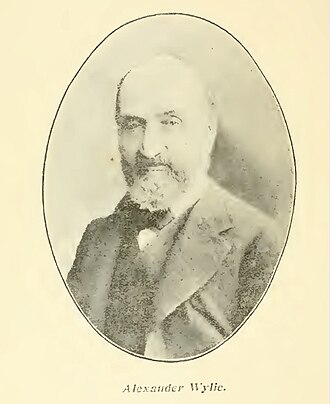
📖 Biography
Alexander Wylie (Chinese name Wei Lie Yali (伟烈亚力), 6 April 1815 – 10 February 1887) was a British sinologist and a missionary of the London Missionary Society. He came to China in 1847 (the 27th year of Daoguang). In nearly 30 years in China Wylie devoted himself to preaching, to spreading Western learning, and to introducing Chinese culture to the West, and made important contributions in all these areas. In 1877, old and frail and with failing eyesight, he returned to settle in London, where he died on 10 February 1887.
Life
Alexander Wylie was born in London on 6 April 1815. He attended schools successively in the village of Drumlithie, Kincardineshire, and in Chelsea, London.
Wylie was later apprenticed to a carpenter in London. In 1846 he went with a letter of introduction to call on James Legge in London, to ask how he might study Chinese further. Legge asked him, “How can you learn Chinese without a dictionary?” He said that he had taught himself Latin from a Chinese grammar published in Latin, Notitia Linguae Sinicae, and that he had compiled his own dictionary. His method was to find a Chinese New Testament, open it at the beginning of the first chapter of the Gospel of John, “In the beginning was the Word, and the Word was with God, and the Word was God,” and compare it with the Latin text, “In principio erat Verbum et Verbum erat apud Deum et Deus erat Verbum”: the Chinese character corresponding to “verbum” (dao, 道) had to appear three times, and the character corresponding to “deus” (shen, 神) twice. In this way he matched the Latin verbum and deus with the Chinese characters “dao” and “shen,” worked out the meanings of other characters by the same method, and then compiled a small Chinese-Latin dictionary of his own. Legge at once handed Wylie a New Testament from his desk and had him try it; he translated it quite well. Legge then arranged to give Wylie several lessons himself, and concluded on the spot that this young man would one day make his mark in sinology. Sure enough, by 1847 Wylie was in charge of the London Missionary Society's printing office in Shanghai.
Wylie also knew French, Russian, Manchu and Mongolian.
Church Work
In 1846 (the 26th year of Daoguang), because Wylie knew Chinese, Legge sent him to Shanghai to help Walter Henry Medhurst manage the London Missionary Society Press (Mohai Shuguan), the society's printing house in Shanghai. At the press Wylie translated the Gospels of Matthew and Mark. In 1857 (the 7th year of Xianfeng) he founded Liuhe Congtan, Shanghai's first Chinese monthly, and served as its editor. On 16 October of the same year Wylie, Elijah Coleman Bridgman, Joseph Edkins and other missionaries founded the Shanghai Literary and Scientific Society, with Bridgman as president and Wylie as secretary. On 20 July 1858 (the 10th day of the 6th month of the 8th year of Xianfeng) it was renamed the North China Branch of the Royal Asiatic Society. In 1858 (the 8th year of Xianfeng) Wylie accompanied Lord Elgin on an expedition up the Yangtze River and met Qing officials at Wuchang; at the end of the year, as a member of the four-man delegation sent by Lord Elgin (the others being Thomas Wade, Horatio Nelson Lay and Laurence Oliphant), he went to Nanjing to meet officials of the Taiping Heavenly Kingdom. In 1868 Wylie and Griffith John, the London Missionary Society's missionary for Central China, travelled together through Hubei, Sichuan, Shaanxi and other provinces. Wylie reported on the journey in “Itinerary of a Journey through the Provinces of Hoopih, Sze-chuen and Shen-se,” published in the Journal of the North China Branch of the Royal Asiatic Society. From 1863 (the 2nd year of Tongzhi) Wylie became an agent of the British charity the Bible Society (British and Foreign Bible Society). In November 1862 (the 10th month of the 1st year of Tongzhi) he returned to Britain, soon left the London Missionary Society and joined the British and Foreign Bible Society, and in 1863 came to China as its agent.
In 1867 (the 6th year of Tongzhi) Wylie published in Shanghai Memorials of Protestant Missionaries to the Chinese, containing brief biographies of the 338 missionaries who had come to China since the beginning of the 19th century, with the books they had published; it is an important source for the study of the history of Christian missions in China. Wylie also wrote an article on the Nestorian Stele at Xi'an: The Nestorian Tablet of Si Ngan Fu. During his 30 years in China Wylie distributed a total of one million copies of the New Testament.
Spreading Western Learning
At the London Missionary Society Press Wylie came to know Chinese scholars such as Wang Tao and Li Shanlan. In their spare time at the press they often discussed scholarly questions together. Once, when Wang Tao, Wylie and Li Shanlan were talking together, Wang Tao asked, “How many astronomers has the West had since ancient times?” Wylie took out a book and began to dictate its contents, gesturing as he went, while Wang Tao wrote it down with a brush beside him. Wylie took ten days to go through the whole book; Wang Tao arranged his notes into a book, which the press published as Xiguo Tianxue Yuanliu [Origins of Western Astronomy]. Wylie and Wang Tao also translated together Hua-Ying Tongshang Shilüe [Brief History of Anglo-Chinese Trade], on the history of the British East India Company, and Zhongxue Qianshuo [Elementary Mechanics], introducing the science of mechanics. Wylie also worked with Li Shanlan to complete the translation of Euclid's Elements, half of which had been translated by Matteo Ricci and Xu Guangqi more than two hundred years earlier; the result was Xu Jihe Yuanben [Continuation of the Elements of Geometry]. Other books that Wylie and Li Shanlan translated together include Shuxue Qimeng [Introduction to Arithmetic], Daishuxue [Algebra], and Dai Wei Ji Shiji [Analytical Geometry and Calculus], translated from the work of Elias Loomis, professor of mathematics at the University of the City of New York (now New York University). Daishuxue and Dai Wei Ji Shiji introduced analytic mathematics to China for the first time; they were very influential in China and were also translated into Japanese by Japanese mathematicians and published in Japan.
Sinological Research
Wylie not only made important contributions to bringing Western learning to the East; his work in bringing Eastern learning to the West was even more valuable, and he is recognized as a sinologist. Wylie was devoted to Chinese culture and collected a large number of classical Chinese texts, nearly twenty thousand titles. Wylie has four famous works: three on sinology (the other is Memorials of Protestant Missionaries to the Chinese).
Notes on Chinese Literature. Notes on Chinese Literature, which he published in Shanghai in 1867 (the 6th year of Tongzhi), introduced more than two thousand classical Chinese works on classical literature, mathematics, medicine, science and technology and other subjects, and has still not been equalled. Its chapters:
- Chapter 1, Classics: the Book of Changes, the Book of Songs, the Spring and Autumn Annals, the Four Books, the Book of Rites.
- Chapter 2, History: annals, dynastic histories, official documents, biography, geography, bibliography, historical criticism, etc.
- Chapter 3, Philosophy: military strategy, law, agriculture, medicine, astronomy and mathematics, divination, encyclopedias, Buddhism, Taoism, miscellaneous writers.
- Chapter 4, Literature: the Li Sao, the collected works of Li Bai, the complete works of Su Dongpo, the collected works of Ouyang Xiu, Lu Jiuyuan, Wudai Gongci [Palace Poems of the Five Dynasties], Yuemanlou Shi Bieji [Poems of the Yuemanlou], Xie Lingyun, Shi Nüshi [History of Women Poets], etc.
Jottings on the Science of the Chinese. The work of Wylie's most admired by Western scholars is the essay Jottings on the Science of the Chinese: Arithmetic, which he published in 1852 in the North China Herald (the predecessor of the North-China Daily News). Wylie was the first to introduce to Western scholarship the counting rods of ancient China, pointing out that rod numerals used a decimal place-value system several centuries earlier than in Europe and among the Arabs. In the essay Wylie discussed in detail ancient Chinese classics and mathematical works such as the Tongjian Gangmu, the Shujing (Book of Documents), the Zhoubi, the Jiuzhang Suanshu (Nine Chapters on the Mathematical Art), the Sunzi Suanjing, the Shushu Jiyi, the Xiahou Yang Suanjing, the Haidao Suanjing, the Wucao Suanjing, the Zhoubi Suanjing, the Wujing Suanshu, the Zhang Qiujian Suanjing, the Jigu Suanjing, the Shushu Jiuzhang, the Xiangjie Jiuzhang Suanfa, the Chengchu Tongbian Benmo, the Hushi Suanshu and the Ceyuan Haijing. Wylie knew the history of Western mathematics well and could compare Chinese and Western mathematics. He pointed out that the Shushu Jiuzhang, written by Qin Jiushao in 1247, already used the decimal system and zero, and that its method of “linglong kaifang” for solving equations was ahead of the method for solving higher-degree algebraic equations published by the English mathematician William George Horner in 1819. Wylie's essay was highly regarded by European scholars: a German translation appeared in 1856 and a French translation in 1862. More than one hundred and fifty years later, books on the history of Chinese mathematics still cite Wylie's Jottings, which shows that this essay was indeed a milestone in the study of the history of Chinese mathematics.
Chinese Researches. In 1897, ten years after his death, Wylie's collected essays, Chinese Researches, were published in Shanghai. The collection is in four parts:
- Part 1, religion, collects Wylie's writings on religion, including “Nestorianism in China,” “The Life of Ashoka,” “The Life of the Buddha,” “The Church in Tibet,” “The Life of Xuanzang,” “The Life of Faxian,” “The Buddha's Tooth Relic in China,” “Confucius,” “Mencius,” “Mozi,” “Taoism,” “The Bible in China,” “Secret Societies in China,” the Triad Society, the White Lotus Society, the Heaven and Earth Society in Singapore, the Triads in Hong Kong, etc.
- Part 2 collects Wylie's historical writings on China, including “The Israelites in China,” “The Jewish Synagogue at Kaifeng,” Marco Polo, “Ibn Battuta,” “The Nestorian Stele,” “Nestorian Monasteries in China,” “Arab Travellers,” the conquest of Korea, the submission of Korea, etc.
- Part 3, scientific essays, includes “The Yuan Dynasty Astronomical Instruments at Beijing,” “Astronomical Instruments Made by Missionaries,” “The Observatory of 1279,” the life of Guo Shoujing, “The Seventeen Astronomical Instruments Invented by Guo Shoujing,” “Records of Eclipses in Chinese Literature,” star charts, “The Chinese Compass,” the monk Yixing's knowledge of the compass, and “Jottings on the Science of the Chinese: Arithmetic.”
- Part 4, philological essays, includes “Manchu Grammar,” the Liao dynasty, the Jin dynasty, “Genghis Khan,” Nurhaci, “The Origin of the Manchu Script,” Liao dynasty documents, “A Comparison of the Uighur and Syriac Scripts,” a comparison of the Mongolian and Arabic scripts, Manchu cursive script, etc.
Library
During his time in China Wylie collected Chinese books from many sources; his library was on the first floor of the London Missionary Society building on Shandong Road in Shanghai. He collected some twenty thousand Chinese titles; more than one thousand of these were sold to the Royal Asiatic Society in 1869, and the rest to the Oxford University Library in 1882. The “Alexander Wylie Collection” is an important holding of the Bodleian Library at Oxford. It includes many rare editions, such as Qiantang Meng (钱塘梦), Yuanlin Wumeng (园林午梦), Weiqi Chuangju (围棋闯局), Xinqie Liyuan Zhaijin Yuefu Jinghua (新契梨园摘锦乐府菁华), Xinke Lijing Qifeng Ji (新刻荔镜奇逢集) and Lijing Ji Xiwen (荔镜记戏文).
Works
- Hua-Ying Tongshang Shilüe [Brief History of Anglo-Chinese Trade], orally translated by Wylie and written down by Wang Tao.
- Xiguo Tianxue Yuanliu [Origins of Western Astronomy], orally translated by Wylie and written down by Wang Tao
- Zhongxue Qianshuo [Elementary Mechanics], orally translated by Wylie and written down by Wang Tao
- Xu Jihe Yuanben [Continuation of the Elements of Geometry]
- Shuxue Qimeng [Introduction to Arithmetic]
- Liuhe Congtan (monthly)
- Tan Tian [On the Heavens], a translation of Outlines of Astronomy (1849) by the English astronomer John Frederick William Herschel
- Zhong-Xi Tongshu [Chinese and Western Almanac], 1860, Shanghai
- Daishuxue [Algebra], by Augustus De Morgan (England), translated by Li Shanlan and Wylie, published by the London Missionary Society Press.
- Dai Wei Ji Shiji [Analytical Geometry and Calculus], by Elias Loomis (USA), translated by Li Shanlan and Wylie, published by the London Missionary Society Press, 1859.
- Xiongnu Zhongguo Jiaoshe Shi [History of the Xiongnu in Their Relations with China]
- Man-Meng Yuwen Dian [Grammar of Manchu and Mongolian]
- Jottings on the Science of the Chinese: Arithmetic, 1852, North China Herald
- Notes on Chinese Literature, 1867 (a Shanghai edition of 1902 is also recorded)
- Itinerary of a Journey through the Provinces of Hoopih, Sze-chuen and Shen-se; Journal of the North China Branch of the Royal Asiatic Society, New Series, No. V, p. 153 ff.
- Memorials of Protestant Missionaries, 1867
- The Nestorian Tablet of Si Ngan Fu
- Chinese Researches, Shanghai: Mission Press, (1897).