💬 Famous Quotes
📋 Basic Information
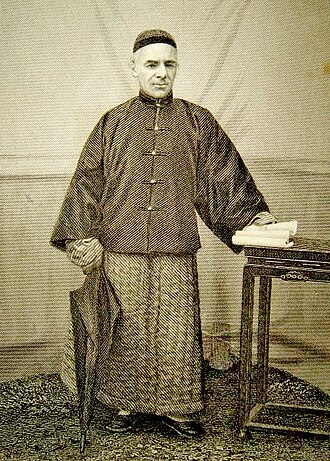
📖 Biography
William Chalmers Burns (April 1, 1815 – April 4, 1868), Chinese name Bin Huilian (宾惠廉), also known as Bin Weilin (宾为霖), was a Scottish missionary to China who joined the English Presbyterian Mission. He was once a well-known evangelist in Britain and North America, and he led spiritual revival movements in both Britain and Canada.
Life
Burns was born at Dun, Angus, Scotland, into a family of modest means, the third son of William Hamilton Burns (1779–1859), minister of the local church; his mother was Elizabeth Chalmers (d. 1879). At the age of 17 his faith was strengthened through suffering. He then received theological training, studying at Marischal College, Aberdeen (later merged into the University of Aberdeen), and at the divinity school of the University of Glasgow.
During a revival meeting he experienced the call of God. In 1839, at the age of 24, he was licensed to preach by the Presbytery of Glasgow.
In 1847 (the 27th year of Daoguang), Burns came to China, reaching Hong Kong after a long voyage during which he spent a great deal of time studying Chinese. He worked first in the Hong Kong and Guangzhou (Canton) area, and in 1851 (the 1st year of Xianfeng) he moved to Xiamen (Amoy), Fujian; thereafter he worked as a missionary in Shantou (Swatow), Xiamen and other places.
In 1854 (the 4th year of Xianfeng), Burns escorted a seriously ill co-worker back home and reported on China's needs in various parts of Britain. The following year he set out for China again, accompanied by Carstairs Douglas (杜嘉德), who later directed the church work in southern Fujian.
In 1855 (the 5th year of Xianfeng), Burns arrived in Shanghai, where he met Hudson Taylor, and the two worked together for a considerable time. Hudson Taylor, who later founded the China Inland Mission, received great spiritual help from him.
In 1863 (the 2nd year of Tongzhi), Burns arrived in Beijing, where he preached for four years. In Beijing a Russian friend took a photograph of him holding an umbrella in his right hand and a Bible in his left.
In 1867 (the 6th year of Tongzhi), he moved on to Niuzhuang (Yingkou) in Manchuria, and in the spring of 1868 (the 7th year of Tongzhi) he died of illness in Niuzhuang.
Burns had a well-known saying, "Always ready." He used it as his main message, and it was also the rule of his life and ministry. Because he was one of the earlier Western missionaries to China, the books he wrote and the messages he preached influenced many people. He encouraged Christians: "You must always be ready to say, 'God, here I am; send me.'"
📚 Major Works

🎬 Videos
Sinclair Ferguson on William Chalmers Burns
Ian Hamilton: William Chalmers Burns, "The Holiest Man Alive"
Ian Hamilton: The Life and Legacy of William Chalmers Burns
Videos are hosted on YouTube and uploaded by their original producers. YouTube loads only when you press play and may be unavailable in some regions.