💬 Famous Quotes
📋 Basic Information
📖 Biography
James Laidlaw Maxwell (Chinese name Ma Yage, 马雅各, a transliteration; 18 March 1836 – 6 March 1921) was born in Scotland, United Kingdom. He was a physician, a missionary of the English Presbyterian Mission and a minister, who preached and practised medicine in southern Taiwan in the later 19th century. He was the first missionary of the English Presbyterian Church stationed in Taiwan and is as well known as the physician George Leslie Mackay (马偕). In Tainan he founded Taiwan's first Western-style hospital, the “Kanxi Street Clinic” (看西街医馆).
Childhood and Education
On 18 March 1836 Maxwell was born into a church family near the Canongate in Edinburgh, the capital of Scotland; his father was an elder of the Free Church of Scotland. As a child, while playing, he once climbed up to the water tank on the roof, fell and was injured, and was treated in hospital under the care of the well-known doctor Syme. From middle age he suffered from a spinal disorder, which he suspected had been caused by that childhood injury. Maxwell was brought up within the Free Church of Scotland.
In 1845 Maxwell graduated from Lady Glenorchy's Free Church School. In 1850 he graduated from the Royal High School, Edinburgh. He then entered the University of Edinburgh, where he obtained a bachelor's degree (B.A.: 1853), a master's degree (M.A.: 1854) and a medical degree, receiving the M.D. in 1858 with a thesis on the spleen (with particular reference to leukaemia); during this time (or, by another account, after graduating) he also studied in Würzburg, Bavaria, and Berlin, Prussia; he also qualified as LRCP and LRCS of Edinburgh, and served for 6 months as a resident physician at the Brompton Consumption Hospital in London.
In 1860 Carstairs Douglas (杜嘉德), a missionary of the English Presbyterian Church in Xiamen (Amoy), proposed that Taiwan be made a field for medical mission and that a missionary with medical training be sent there.
In 1861 Maxwell was a resident physician at the General Hospital in Birmingham, England, where he met his future wife. At the same time he was a member of Broad Street Presbyterian Church, whose minister was Rev. Mackenzie. At a church meeting Maxwell met Rev. Carstairs Douglas, who had come home from Xiamen, China, and from him he heard the name of Taiwan (Formosa) for the first time. Maxwell was then only 25 and had just become engaged to Miss Mary Anne Goodall. He decided to leave his homeland, gave up his good salary in Birmingham and volunteered to go to Formosa (Taiwan). He cut off a lock of his hair and gave it to his beloved fiancée as a token of his longing and reluctance to part, and set out with Douglas by ship across the seas on the long journey to Taiwan.
First Period in Taiwan
In August 1863 Maxwell set out from Britain with Rev. Carstairs Douglas aboard the Polonaise, sailed around the Cape of Good Hope and across the Indian Ocean, and on 4 December finally reached the British Settlement in Shanghai. There he visited churches and hospitals and met senior missionaries.
On 2 January 1864 he arrived in Xiamen to study the language.
On 5 October 1864 Maxwell, together with Rev. Carstairs Douglas, Wu Wenshui (吴文水) and 2 believers, landed at Takao (now Kaohsiung Harbour) to explore the possibility of mission work in Taiwan. After surveying the area they concluded that the prefectural city of Tainan had a far larger population than Takao and was best suited to be the starting point and centre of the mission. On 30 October the party returned to Xiamen.
The Kanxi Street Preaching Station, Tainan (16 June 1865 – 9 July 1865)
On 28 May 1865 Maxwell, now formally in the dual role of Presbyterian missionary and physician, landed at Takao aboard the Meta. With him were Rev. Carstairs Douglas, Wu Wenshui, Chen Zilu (陈子路), Huang Jiazhi (黄嘉智), and Li Xilin (李西霖) and Wang Ayan (王阿炎), church members from Xiamen. 2–3 days later Maxwell entered the prefectural city (Tainan) and stayed as a guest at the home of Mr. Neil Mcphail of the Tianli firm (天利行) on Beishi Street (now Shennong Street, Tainan).
On 16 June 1865 William Maxwell of the Takao customs transferred to Maxwell the lease of a house he had been renting on Kanxi Street in the prefectural city of Tainan, which was chosen as a preaching station (now No. 43 Ren'ai Street, West Central District, Tainan). There he began preaching and healing, with medical work as the main approach and evangelism secondary. 16 June 1865 thus became the day the English Presbyterian Church began its mission in Taiwan, and it is commemorated throughout Taiwan. On 9 July Maxwell met hostility from local practitioners of Chinese medicine, and rumours spread that he took people's hearts and eyes to make medicine. Stirred up, a crowd surrounded the clinic, threatened to tear down the chapel and attacked church members, until a major riot broke out, known as the “Kanxi Street Incident.” The county magistrate asked Maxwell to leave within 3 days. Having been in the prefectural city only 23 days, Maxwell had to move elsewhere.
Medical Mission at the Qihou and Pitou Chapels, Kaohsiung (16 July 1865 – 26 December 1868)
Maxwell therefore moved to Qihou Street in Takao (near present-day Cijin, Kaohsiung), which was under the protection of the British consulate, and rented a shop front. On 16 July 1865 Rev. Carstairs Douglas led the opening service, and Maxwell continued healing and preaching. Soon afterwards Douglas returned to Xiamen.
At the end of November or beginning of December 1865 the British merchant William Pickering (必麒麟) led Maxwell into the Pingpu (plains indigenous) areas of Muzha (木栅, Bak-sa; in today's Neimen, Kaohsiung) and Bama (拔马) near Qishan and of Yujing (玉井), Zuozhen (左镇) and Gangzailin (岗仔林) near Tainan to preach. He was warmly received there and founded churches.
In June 1866 he bought land on the hillside at Qihou and built a chapel. This was the first formal chapel of the Presbyterian Church in Taiwan, the “Takao Chapel,” the predecessor of today's Qihou Church. On 23 July Rev. William Sutherland Swanson (宣为霖) of the English Presbyterian Church in Xiamen came to Takao and helped Dr. Maxwell for 5 weeks. On 21 August Swanson baptized Chen Qi (陈齐), Chen Qinghe (陈清和), Gao Chang (高长) and Chen Wei (陈围); this was the first baptism in Taiwan.
In late September Maxwell opened a clinic with eight beds across from the chapel, which may be regarded as Taiwan's first formal Western-medicine hospital of some size. Unfortunately the clinic has since been demolished.
In June 1866 Maxwell recommended Dr. Patrick Manson (万巴德) as Medical Officer of the Chinese customs, stationed at Takao (Qihou). Manson's main duties were treating foreigners (there were 16 of them when he arrived) and making weather reports. He also assisted Dr. Maxwell with the medical work of the Qihou clinic, and in 1869, when Maxwell went to the prefectural city of Tainan, he entrusted the Qihou clinic to Dr. Manson.
Maxwell's compassionate and skilled medicine became known far and wide. People often came from central Taiwan and even from Penghu to seek treatment, and many who were healed began to believe the gospel truth that Maxwell preached. Church membership grew rapidly, and people often came all the way from Pitou (Fengshan) to Qihou for worship. In July 1867 he bought a house outside the north gate of Pitou and set up a church with a clinic, which was the first Western-medicine clinic and chapel of Pitou; he himself went back and forth between Qihou and Pitou. Later, on 13 December 1867, Rev. Hugh Ritchie (李庥) and his wife came from Britain to Taiwan to help.
In mid-March 1868 Maxwell travelled via Xiamen and Shantou to Hong Kong, where he married Miss Mary Anne Goodall at the cathedral in Hong Kong; the ceremony was conducted by Rev. William Sutherland Swanson (宣为霖).
In 1868 (the 7th year of Tongzhi), the second year after Ritchie's arrival in Taiwan, the Camphor War broke out in Taiwan, and Taiwanese hostility toward the foreign religion and foreigners reached its peak: chapels were destroyed, converts were killed, and clashes between Chinese and foreigners followed one after another. The foreigners held that the local officials were conniving at this and not respecting the rights granted by the “treaties,” and they protested repeatedly. Not long after Maxwell had gone to Hong Kong to marry, on 11 April the preacher Gao Chang was beaten by a mob and imprisoned for 50 days, and the Pitou chapel was torn down by rioters. On 24 April the preacher Zhuang Qingfeng (庄清风) was beaten to death at Jiucheng (旧城). On 2 May Maxwell and his wife returned to Taiwan. In June Maxwell and Ritchie jointly wrote to Rutherford Alcock (阿礼国), the British Minister to China, reporting the persecution of the church in Taiwan and asking him to negotiate a proper settlement. Alcock wrote to Prince Gong (恭亲王), head of the Zongli Yamen (the office for foreign affairs); after an investigation by the consul at Takao, Taiwan Prefecture, he demanded that the Qing government punish the culprits severely and pay compensation at value for the looted and demolished chapel buildings and furnishings, a total of 762 silver dollars (300 silver dollars for the chapel's labour and materials and 462 silver dollars for the furnishings and other contents).
On 31 July 1868 the rebuilt Pitou chapel was demolished again, this time by soldiers. The newly arrived acting British consul, John Gibson (吉必勋), regarded the situation as serious and sent urgently to Hong Kong for gunboats; 3 gunboats in turn anchored at Takao and Anping, nominally to protect foreigners but in fact to apply pressure. On 3 September Maxwell was falsely accused of having killed people together with Gao Chang and buried the bones under the chapel. On receiving the report, the Zongli Yamen instructed the governor-general and governor of Fujian to send an official to investigate promptly together with the British consul, and Zeng Xiande (曾宪德), the Xing-Quan-Yong coastal defence circuit intendant of Fujian, was appointed to handle the matter. Zeng Xiande arrived in Taiwan on 8 November. On 25 November the British officer Lieut. Gurdon (茄当) opened fire at Anping and the next day made a surprise attack on the Anping garrison headquarters; the deputy general Jiang Guozhen (江国珍), after being wounded, took poison and died; the British afterwards also extorted military expenses from the merchants and residents. On 1 December Zeng Xiande and Gibson (吉必勋) reached an 8-point agreement that settled the camphor dispute.
On 21 December Maxwell accompanied Lord C. Scott, captain of HMS Rinald, Mr. Gibson, the consul at Anping, and Mr. Robert Swinhoe, the British consul at Xiamen, to Pitou to negotiate with Qing officials a settlement of the attacks on the church. In the end the Qing government paid the church 1,176 yuan to close the case and recognized the right of missionaries to preach and reside everywhere in Taiwan, along with guarantees for mission work such as “any future disputes to be tried jointly by Chinese and foreign officials,” so that the missionaries gained unprecedented room to grow. Maxwell decided to return to the prefectural city of Tainan; his residence in Takao unfortunately caught fire, and he lost all his wedding presents.
The Tingzaijiao Chapel, Tainan (26 December 1868 – November 1871)
On 25 November 1868 Maxwell travelled by sea from Takao to Anping. On 26 December 1868 Maxwell returned to Tainan with his assistants Wu Wenshui (吴文水) and Gao Chang. In mid-January 1869, at the end of Fudong Lane on Erlaokou Street in the south of the city (near the present intersection of Weimin Street and Beimen Road in Tainan, close to the Bo'ai Hall of the Tainan School for the Deaf), he rented the old Xu family house, on a site of one thousand four hundred ping, and set up a larger clinic. The house had been taken on pledge from “Kim Ke-seng” (金继成) and was a firm set up by the licentiate Xu Jianxun (许建勋), long a partner of the British trading house Yiji (怡记洋行). To distinguish it from the Sin-Lau (“New Building”) Hospital built later near the East Gate, people commonly called this Erlaokou clinic the “Old Building Hospital” (旧楼医院). On 26 June the first 7 people in Tainan were baptized at the Erlaokou chapel by Rev. Hugh Ritchie.
In July Maxwell rented a private house on bustling Tingzaijiao Street (the section of present-day Qingnian Road in Tainan running from the Prefectural City God Temple to Minquan Road, anciently called “Fukou Street,” “fu” meaning the prefectural yamen, and popularly called “Tingzaijiao Street”; tingzaijiao means an arcade, where shop-houses are set back to leave a covered walkway that shelters pedestrians from sun and rain and also allows goods to be displayed for trade), and opened the Tingzaijiao Chapel (now No. 111 Qingnian Road, Tainan). The Tingzaijiao Chapel is the predecessor of today's Taipingjing Church of the Presbyterian Church in Taiwan (No. 6 Gongyuan Road, Tainan). On 2 September 5 people were baptized at the Tingzaijiao Chapel by Rev. Hugh Ritchie.
On 1 April 1870 the Muzha chapel was established, with about 120 people attending worship. On 12 April Maxwell and his wife visited Muzha for 2 weeks. On 8 January 1871 Maxwell led the opening of the Ganzailin chapel (柑仔林), which could hold 200 people; about 100 attended worship that day. On 15 January he attended the dedication of the new chapel at Bama. On 10 February Dr. Matthew Dickson (徳马太) came to the prefectural city to help; he was the 2nd medical missionary of the English Presbyterian Church in Taiwan.
Maxwell found that the simple, unpretentious indigenous people were more receptive to the gospel than the Han Chinese. During his years in Taiwan, therefore, he travelled all over Yushan and the Central Mountain Range, crossing mountains and ridges to go deep into the various Pingpu tribes to heal and preach. In only a few years he spread the seed of the gospel of the English Presbyterian Church across central and southern Taiwan south of the Dajia River, and set up three districts: the first, the southern district among the Siraya (Muzha, Zuozhen); the second, the central district among the Hoanya (Baihe, Chiayi); the third, the northern district among the Pazeh (Puli, Fengyuan, Shengang).
During his service in Taiwan Maxwell noticed that in the small harbour towns there were more ships carrying opium than ships carrying food, and every time he saw the thin, listless faces of opium smokers he was deeply grieved. Later, after returning to Britain, he opposed the British government's sale of opium to China, even at the cost of being slandered and attacked.
In 1871 Maxwell's wife Mary became pregnant for the first time and, being unwell, had to return to Britain to give birth; Maxwell, tied up by his work, could not go with her. On 19 March the pregnant Mrs. Maxwell sailed back to Britain alone; the rough and tiring journey harmed the health of both mother and child. In April Maxwell and Thomson came to Taiwan from Xiamen. On 7 August a report by Maxwell recorded that he was working on a translation of the New Testament into Taiwanese.
In November 1871 Maxwell left Taiwan, and Dr. Matthew Dickson, who had arrived in Taiwan on 10 February 1871, took over the work of the Erlaokou clinic. On 8 January 1878 Dr. Dickson resigned and returned home, and the clinic did not reopen until Dr. Peter Anderson (安彼得) arrived in Taiwan on 14 January 1879. After becoming superintendent, Dr. Anderson, faced with growing numbers of patients, set about buying land to build a new hospital. In 1900 the new hospital at the East Gate was completed, and on 17 April the hospital moved from the old building to the new one, which was named “Sin-Lau Hospital.”
On 5 December 1871 Maxwell's eldest son, John Preston Maxwell (马士敦; in Taiwan rendered 马约翰), was born in Birmingham, before Maxwell himself had reached Britain. After his return to Britain, Maxwell's health, badly damaged by years of overwork, kept him from returning to Taiwan for many years.
Second Mission to Taiwan (23 December 1883 – 20 October 1884)
On 23 December 1883 Maxwell, suffering from pain in the joints of his lower back, came back to Taiwan with his wife; Mr. and Mrs. George Ede (余饶理) of the home church in Britain also came to Taiwan.
On 20 October 1884 Mrs. Maxwell fell ill and the Sino-French War broke out; Maxwell and his wife left on the last ship, bound for Xiamen. This time the couple stayed in Taiwan less than a year and, because of their health, had to return to Britain. In April 1885 they arrived back in Britain.
In Britain: First Return
In the course of his mission work Maxwell had found the romanized script based on Dutch spelling easy to learn and use, so he devoted himself to studying and promoting the movement for a romanized vernacular script for Southern Min (白话字), and began translating the Bible to strengthen literature evangelism. After going on leave to Britain in 1871 he lived in the Heath Street area of Hampstead, London, and continued to promote the Southern Min vernacular script movement.
On 9 June 1873 his second son, James L. Maxwell Jr., was born. On 1 October Maxwell completed the translation of the New Testament in the Amoy (Xiamen) vernacular.
Maxwell devoted himself to printing the romanized New Testament, and tuberculosis also brought on fevers that left him weak. Because he had to sit for long periods, his back was supported by a plaster frame for as long as ten years, and he lay on a water bed. During this time he wrote “The Gospel in China” for the English Presbyterian Mission, as well as books in Chinese and in romanization. He gladly received every visitor from China, such as the missionaries Gilmour of Mongolia, Grant of Chinchew (Quanzhou), Grabbe of Birmingham and Burns Thomson. Maxwell lived at No. 104 Pentherton Road, London, for five or six years.
In March 1878 the Medical Mission Association was founded in London, and Maxwell became its first secretary. Later the association bought Nos. 47-49 Highbury Park; the Maxwell family lived at No. 49, and many members visited him there and were deeply influenced by him. Through Maxwell's efforts the Islington Medical Mission was established. Under his management, medical mission work around the world was coordinated, and medical difficulties and problems concerning mission personnel were resolved. Later Maxwell bought No. 51 Highbury Park and moved there.
In 1880 he donated Taiwan's first printing press for the romanized vernacular script, together with type cases, type and other printing equipment, which led to the founding of the first printing house, the Juzhen Tang (聚珍堂) bookroom, and of Taiwan's first newspaper, the Taiwan Prefectural City Church News (台湾府城教会报), today's Church News (教会公报).
In Britain: Second Return
In 1888 a large international missionary conference was held in London, at which Hudson Taylor (戴德生), Benjamin Broomhall (海班明) and Maxwell all gave addresses. Hudson Taylor said: “I have served in China for more than 30 years, and I am convinced that the harm the opium trade does to China in one week is greater than the good all the missionaries accumulate in a year.” Maxwell said: “When thousands upon thousands of Chinese are suffering there, how can we sit idle in Britain and not rise up against so great an evil?” After Maxwell spoke, the conference passed without dissent a resolution opposing the opium trade.
In 1899 the eldest son, John Preston Maxwell (in Taiwan rendered 马约翰), married Edith Lilly Isaacson (1867-1954). On 3 February John Preston Maxwell was sent by the mission to Fujian, China, and first practised medicine at Zhangpu (1899-1904). In 1901 a terrible plague broke out in Zhangpu; between April and August alone, nearly one tenth (two thousand) of Zhangpu's population of twenty thousand died.
In 1904 John Preston Maxwell went to practise at the more remote Yongchun Holy Teaching Hospital (永春圣教医院), where he introduced the hospital's first X-ray equipment. In 1908 his wife gave birth to a daughter, Marjorie Gordon Maxwell (1908-2000).
After 20 years of medical mission at Zhangpu (1899-1904) and Yongchun (1904-1919), John Preston Maxwell moved to Peking Union Medical College to teach. His specialty was obstetrics and gynaecology, and he became head of the college's department of obstetrics and gynaecology. His research appeared in many medical journals, including a paper published in 1925 in the Journal of Obstetrics and Gynaecology of the British Empire, titled in Chinese translation “Osteomalacia in China” (中国的软骨化症), which pointed out that osteomalacia deforms the mother's pelvis, so that a caesarean section is needed for a successful delivery. At Peking Union Medical College John Preston Maxwell trained many outstanding Chinese doctors, such as Lin Qiaozhi (林巧稚).
The second son, Dr. James Laidlaw Maxwell, Jr., was born on 9 June 1873. In 1900 he was appointed missionary to Taiwan, and on 14 February of the following year he arrived in Taiwan and took up work at the Sin-Lau clinic. In 1900 the rented premises of the Erlaokou clinic, the “Old Building Hospital” in Tainan, were returned to the owner; the house was later lived in by Xu Tingguang (许廷光, born May 1861), son of Xu Xunrong (许逊荣). The clinic moved into a newly built building, named Sin-Lau Hospital. The young Maxwell Jr. practised medicine there and vigorously promoted opium cessation and the prevention and treatment of leprosy and venereal disease.
On 9 October 1901 Maxwell Jr. married Miss Millicent Bertha Saunders (1871-1961) in Hong Kong. Dr. Maxwell married in Hong Kong on 9 October and on 4 November (the 24th day of the 9th lunar month) returned to Tainan to take charge of the hospital. Between 1901 and 1923 Dr. Maxwell Jr. trained many apprentices, such as Zhou Yushan (周玉山), Gao Qingyuan (高清源), Du Yingqing (杜应清), Huang Dengke (黄登科), Lin Daru (林达儒), Wu Hefu (吴和甫), Lin Qi (林乞), Wang Qingru (王清如), Xie Dingdu (谢定笃), Cai Chao (蔡超) and Zhang Ben (张本), who became a capable middle stratum between church and society and contributed greatly to society.
In 1911, at the age of 75, Dr. Maxwell retired, resigning as secretary of the London Medical Mission Association to become its editorial secretary, and moved to Bromley, Kent, London.
On 21 November 1915, the 50th anniversary of the coming of the gospel to Taiwan, 100 churches in southern Taiwan presented gifts to Dr. and Mrs. Maxwell. Maxwell served as head of the residence for medical students, and 50 resident medical students took part in overseas mission work. Maxwell edited the association's Medical Missions at Home and Abroad and promoted medical missions at international missionary conferences.
Family and Death
Mrs. Maxwell died on 23 January 1918, aged 83.
On 6 March 1921 Maxwell died at Bromley, London, England, aged 84, and was buried with his wife in St. Mary's cemetery, Plaistow. He left two sons, both doctors: the elder, John Preston Maxwell (in Taiwan rendered 马约翰), practised medicine at Yongchun, Quanzhou, China, and the younger, James Laidlaw Maxwell Jr., at Sin-Lau Hospital in Tainan.
In 1923 Maxwell Jr. accepted an appointment from the China Medical Missionary Association (博医会) as its executive secretary and went to Shanghai.
After 1935 John Preston Maxwell returned to Britain and lived at Brinkley, Cambridgeshire.
In 1937 Maxwell Jr. became general secretary of the Red Cross Society of China, until ill health brought him back to Britain in 1940.
In 1949, as the mainland was changing hands, Maxwell Jr. went to serve at the leprosy hospital in Hangzhou, China. He died in Hangzhou on 10 August 1951, aged 78, and was buried there.
John Preston Maxwell died in Britain on 25 July 1961, aged 90.
Commemoration
In 1901 Deacon Wu Daoyuan (吴道源) of the Tingzaijiao Chapel donated a building site at Taipingjing; together with offerings from the believers and more than 2000 yuan raised by Dr. Thomas Barclay (巴克礼) from the women's mission of the home church in Britain, the church was completed on 13 September 1902. The home church in Britain presented a tablet naming it the “Maxwell Memorial Church”; this is today's Taipingjing Church in Tainan, and on its inner wall hangs a “Maxwell Memorial Tablet” presented by the home church. The church also has a small history museum holding part of the Maxwell family's relics.
On 10 March 1921 Thomas Barclay, moderator of the Presbyterian Church of England, led a farewell service for Dr. Maxwell. On 27 May Maxwell Jr. led the farewell service for his father at Taipingjing Church in Tainan.
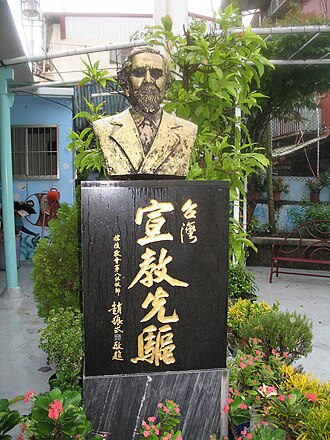
On 26 May 1985, the 120th anniversary of Maxwell's arrival in Taiwan, Kenneth M. McLennan (fourth generation), son of Millicent Hope, eldest daughter of Maxwell's second son Maxwell Jr., was invited to Taiwan and unveiled a bronze statue of Dr. Maxwell at Qihou Church.
On 24 September 1997 a party of 28, made up of directors, doctors and nurses of Sin-Lau Hospital in Tainan together with Rev. Dai Dexin (戴德馨) and members of Taipingjing Church, travelled to Britain to pay their respects at Maxwell's grave.
On 22 November 2001 the Maxwell Memorial Medical Museum opened at Sin-Lau Hospital, Tainan.
On 22 April 2002 Dr. William Maxwell Steen, a descendant of Maxwell, visited Sin-Lau Hospital in Tainan with his wife, donated precious items from Maxwell's lifetime to the Maxwell Memorial Medical Museum, and opened an exhibition of Maxwell family photographs.
On 27 October 2003, at the 138th anniversary of Sin-Lau Hospital in Tainan, items of the Maxwell family were shown in an exhibition on the century-old church. On 8 December President Chen Shui-bian (陈水扁) attended the unveiling of a statue of Maxwell. The statues were made by Mr. Lin Kun-ming (林坤明); two were completed, standing outside the outpatient halls of the Tainan and Madou branches of Sin-Lau Hospital.
On 22 March 2010 the “Maxwell Senior Park” in Anping District, Tainan, was opened. Covering 1.8 hectares, it lies on the north side of the senior apartments on Jianping Road and borders the Tainan Canal on the east; it is Tainan's first park themed for the elderly.
On 5 March 2021 Chunghwa Post issued a set of commemorative stamps, “Centenary of the Death of James Laidlaw Maxwell,” to mark the 100th anniversary of his death. On the same day Tainan held a Maxwell memorial concert.
On 6 March 2021 Tamsui Presbyterian Church and Sin-Lau Hospital in Tainan held simultaneous centenary commemorations in the north and the south of Taiwan, and on that day Tainan's Park No. 9 was renamed “Maxwell Youth Park.”
🎬 Videos
Mission Pulse: James Laidlaw Maxwell, Pioneer of Medical Missions in Taiwan
Videos are hosted on YouTube and uploaded by their original producers. YouTube loads only when you press play and may be unavailable in some regions.